
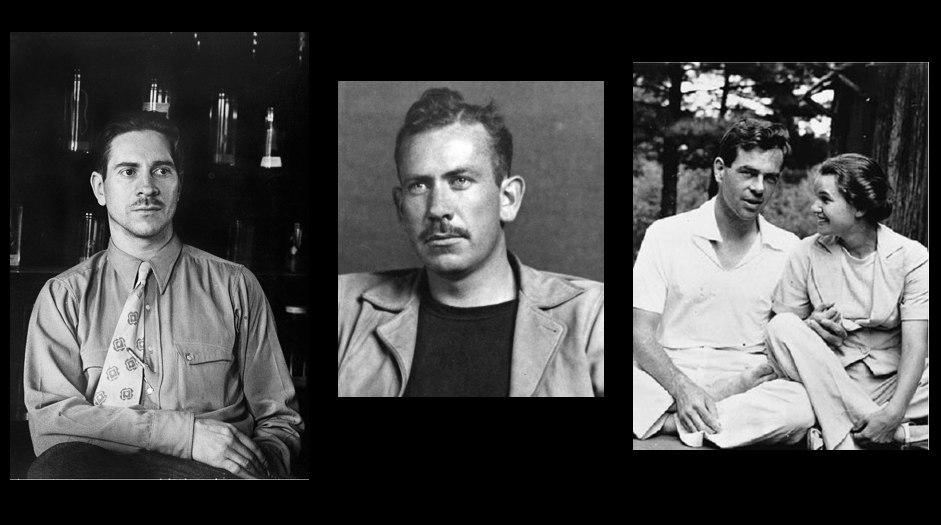
If I had a time machine, I’d take it to Cannery Row, Monterey, about 1935.
Ed Ricketts, “Doc,” of Pacific Biological already has steaks and oysters and a loaf of sourdough, the last neatly bisected and all of them bathed in garlic and butter, ready to grill.
He crosses the street to Wing Chong’s for a gallon of red wine. He crosses back to start preparing dinner.

The guests, who drove in together from Pacific Grove, knock perfunctorily and walk in unencumbered—one of them, with luck, might’ve remembered to bring loaves of hard salami and Jack cheese. Regardless, Ricketts offers them their wine, poured generously into laboratory beakers. Then they barbecue, and one guest, the writer, offers unsolicited opinions—the very worst kind—on the proper way to grill Spencer steaks. They sip.
The steak expert is the the the novelist John Steinbeck. His friend and co-pilot on the perilous journey tomorrow morning back to Pacific Grove is the mythologist Joseph Campbell, who bears a remarkable resemblance to my Grandfather Kelly.
When their time comes, the steak and oysters and sourdough are dispatched promptly, along with a perfunctory iceberg salad with Thousand Islands dressing.
Two-thirds of the wine is left.
I don’t want the wine or the salad or the steak or the oysters–or even the sourdough, dipped in steak juices. I want to be, for just a short time, a fly on the wall, a grass snake under a warm lamp in one of Pacific Biological’s glass terrariums or even a skate breathing noiselessly at the bottom of a tank, just to listen, in my animal disguise, when the talk that won’t end until sunrise begins.
And could they talk. There would have been a lot of laughter, but there would’ve been confrontational moments, too. Ricketts, especially, with the scalpel that is a scientist’s mind, would have sliced his friends’ theories— about sexuality, life after death, about God the Father-Creator vs. God the Prime Mover, about the Great Depression and Italian Fascism— into slices as transparent as sashimi.
I can almost see Steinbeck, from my skate’s tank, slumped disconsolate into his chair once he’s been bested by his friend. In the silence, the only sound might’ve been the waves crashing into the pilings beneath the floor. But writers never shut up. Steinbeck would’ve found his voice again.
When sunrise came, I am sure that they departed wobbly friends.
Ten years away from 1935, the Allies will liberate Dachau and Auschwitz-Birkenau and they will vaporize Hamburg and Hiroshima. Three years later, Doc Ricketts, will be gone, killed on the train tracks above the Row—a little later, The Log from the Sea of Cortez will be his eulogy [Sweet Thursday would have embarrassed Ricketts]— so talks quite like this won’t happen anymore.
That’s a sadness because they told each other such grand stories, made even grander because they were told inside such a homely building.
What they told each other, thought through and distilled and re-worded, was what they’d learned from each other.
They were a biologist whose mind was so profound but whose stock-in-trade was Pacific Coast specimens for high school biology classrooms in Minnesota; a frustrated novelist, who’d written a dismal treatment of the pirate Captain Morgan and an immature and condescending novel about a paisano named Danny from Tortilla Flat and a mythologist who occupied an academic stratosphere to which no living wage could ascend.
What they discovered in each other was an electric attraction—or what Whitman called a “necessary film”— that ties all of us together. Granted, the red wine helped. They talked about our antecedence as clarified by Charles Darwin and William Jennings Bryan, they talked about Celtic and Hindi myth, about human nature’s potential, found in The Buddha, and its tawdriness, found in Huckleberry Finn. They argued about every conceivable topic, from Jungian theory to St. Francis’s wolf.
If they agreed on anything by the time the sun came up over the Gavilan Mountains, it was that this place—this planet—was a living organism, that we were its subordinates and, at the same time, its most murderous and indispensable components. They agreed that we belonged to it, and so to each other.
All of this disparate business, of course, had been hashed out a century before and a continent away from Pacific Biological by the Transcendentalists at Brook Farm. And before that, an ocean away, the same kind of talk happened, but it was in German: the Romantics there called the “necessary film” that ties all of us together weltgeist: World-Spirit.
But they didn’t have barbecue.
The talk on Cannery Row would have disappeared with the Del Monte Express that killed Ed Ricketts, except for Bill Moyers’s marvelous PBS series, The Hero’s Journey: Joseph Campbell and the Power of Myth. This was when we learned, thanks to Campbell, just how miraculous Luke Skywalker’s arrival truly was. Luke became even more miraculous when the mythologist helped us to understand, to our delight, that there was nothing new about Star Wars at all.
And then Campbell, thanks in great part to what he’d learned at Pacific Biological, told Moyers and all of us miraculous stories of his own that, of course, didn’t belong to him at all. He had learned them, too.

But that series was a long time ago. But now, against the hard edges of current events, it’s in our soft remembrance of myth where we find the deepest truths, and there we have the chance to find our way back from the desolate place where we find ourselves now.
In the myth that is American film, I look to Frank Capra and Howard Hawks, and, when I can stand him, to John Ford. In writing, I look to Steinbeck and Willa Cather and to Hemingway’s short fiction; from my generation, I look to New Journalists like Tom Wolfe and Gay Talese. I look to the historians Bruce Catton and Barbara Tuchman and Doris Kearns Goodwin, to young historians like Laura Hillenbrand and Lynne Olson and Isabel Wilkerson, to baseball writers Roger Angell and Roger Kahn. I look to documentarian Ken Burns. I rely on the stories they tell me because they are true.
There are some—a harpy in Congress— who hold that our destiny lies in hating each other. That is a monstrous lie.
One way we can counteract this lie is to tell each other the truth: We belong to each other.
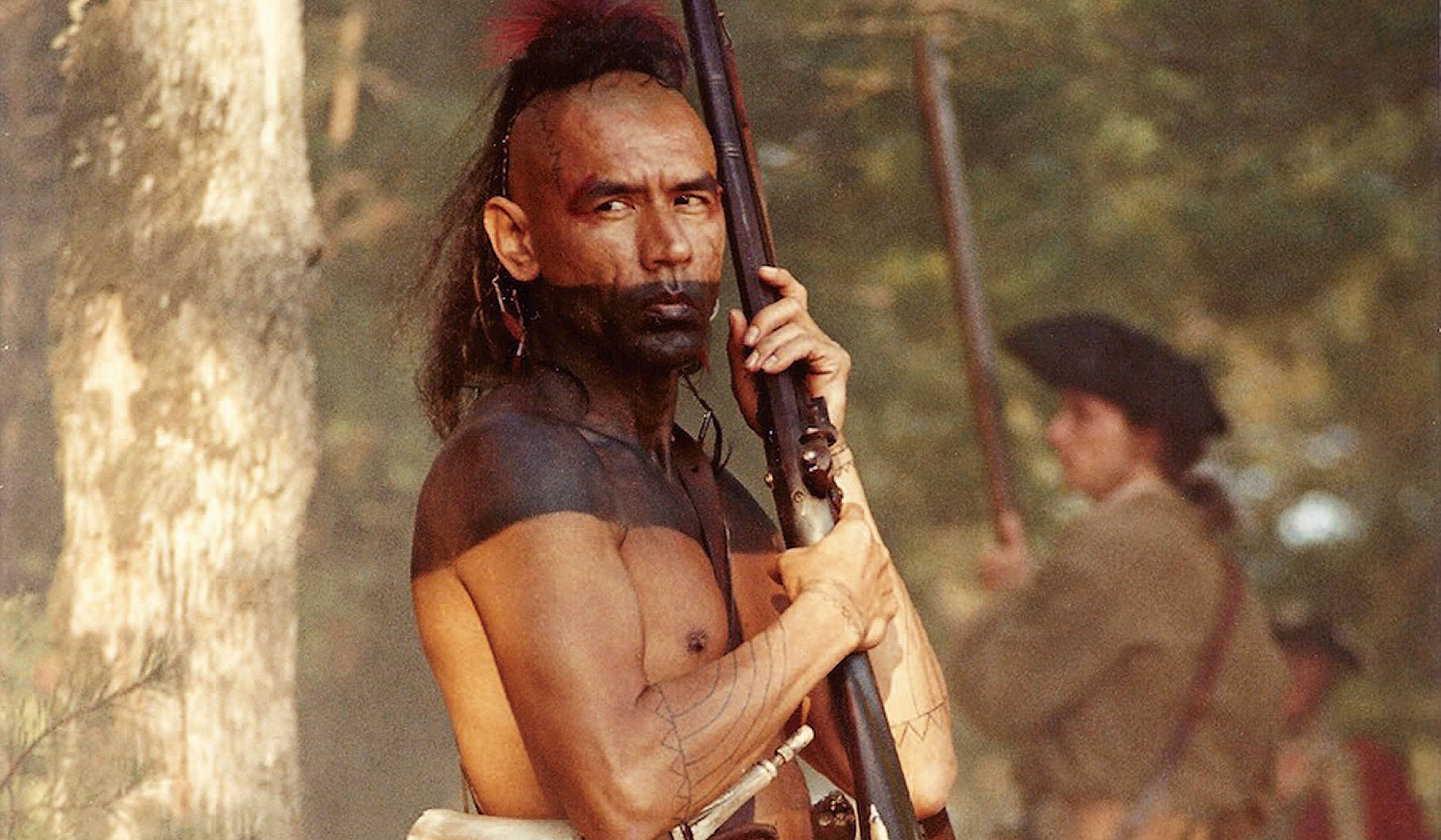
Here is just one example of what connects us: Campbell told Moyers that his research had taught him that there is a version of “Cinderella,” in one form or another, that’s found in nearly every culture in the world. I once watched Wes Studi—so terrifying as Magua in the film Last of the Mohicans—read a Native American version of the story to little children on Reading Rainbow, and he was so open-hearted and read the story so beautifully that the children at his feet, wide-eyed, knew immediately that it was a true story.
So here’s a story that I invented. The fact that it never happened doesn’t make it any less true.
It’s day’s end in Monterey in the summer of 1935. I am shivering a little in the fog despite layers of sweater and jacket. I am sitting on the bottom step of Pacific Biological. It’s cold, but I can smell the promise of warmth: red oak burning on a grill nearby. Then, in my story, I see Ed Ricketts, dressed in indifferent shades of khaki complemented by a surplus olive Army tie. He is closing a worn leather jacket across his chest and against the chill as he crosses the street with a gallon of red wine, which he carries with care, because the bottle’s green glass is thin. Its bottom is lined with sediment.
When he sees me waiting for him, an immense smile transforms his face, always serious, except for now.

 A Work in Progress