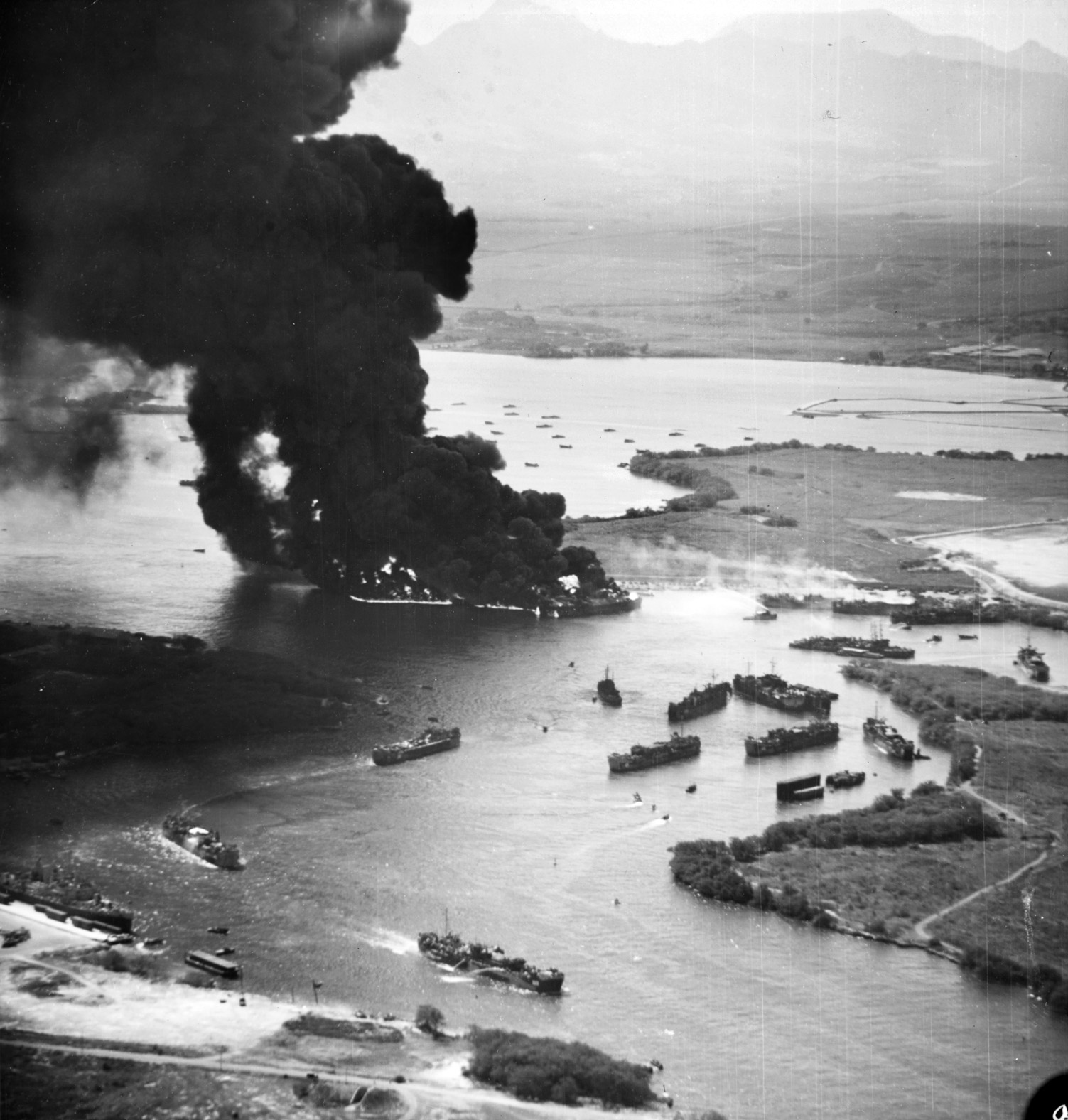
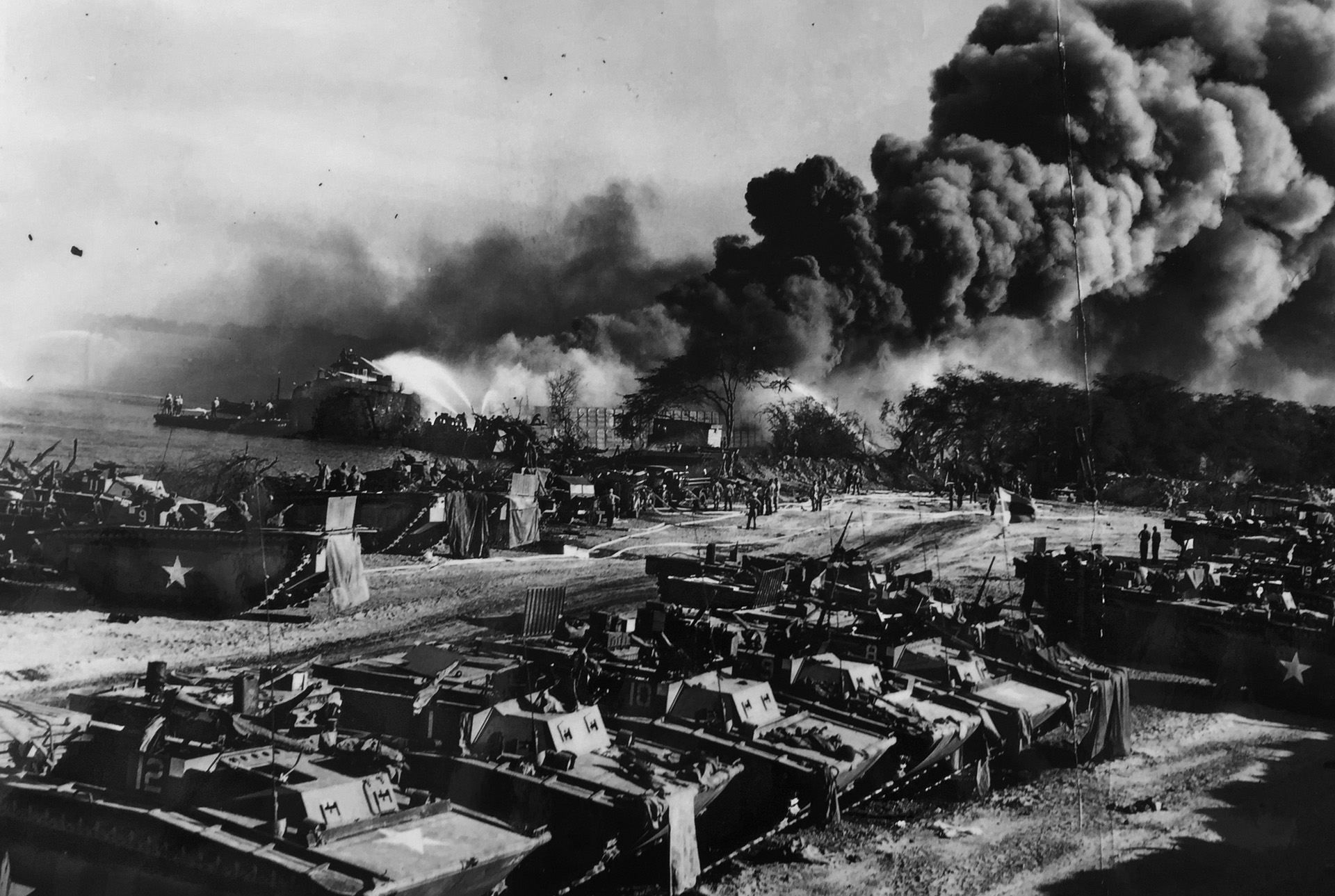
Aerial photograph of Pearl Harbor’s West Loch, showing the burning LSTs at berths T-8 and T-9. Some LSTs are manuevering in the foreground, leaving the vicinity of the explosions and fire, while other ships have yet to get underway. Official U.S. Navy Photograph, now in the collections of the National Archives.
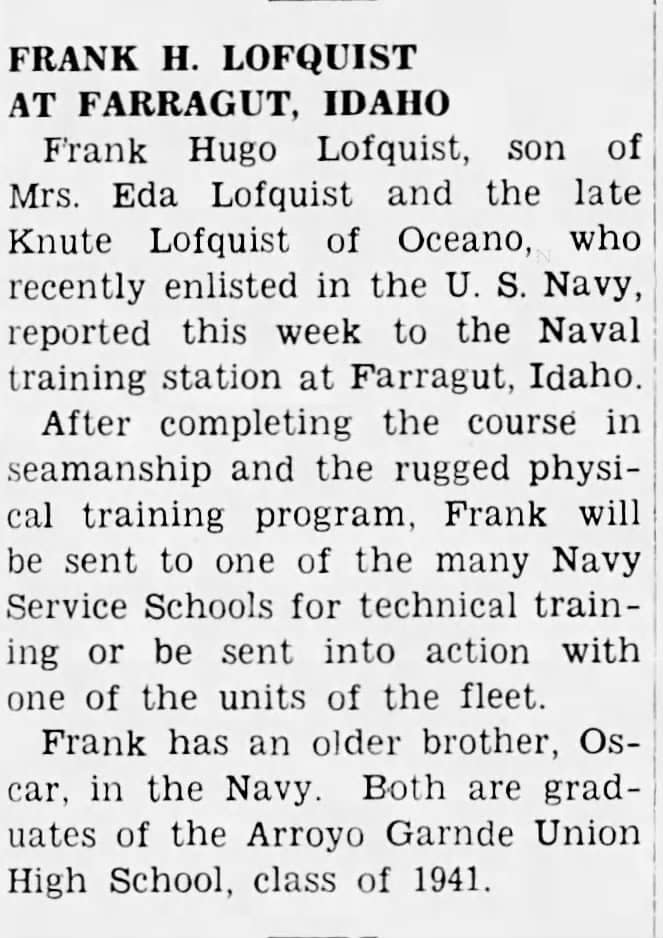
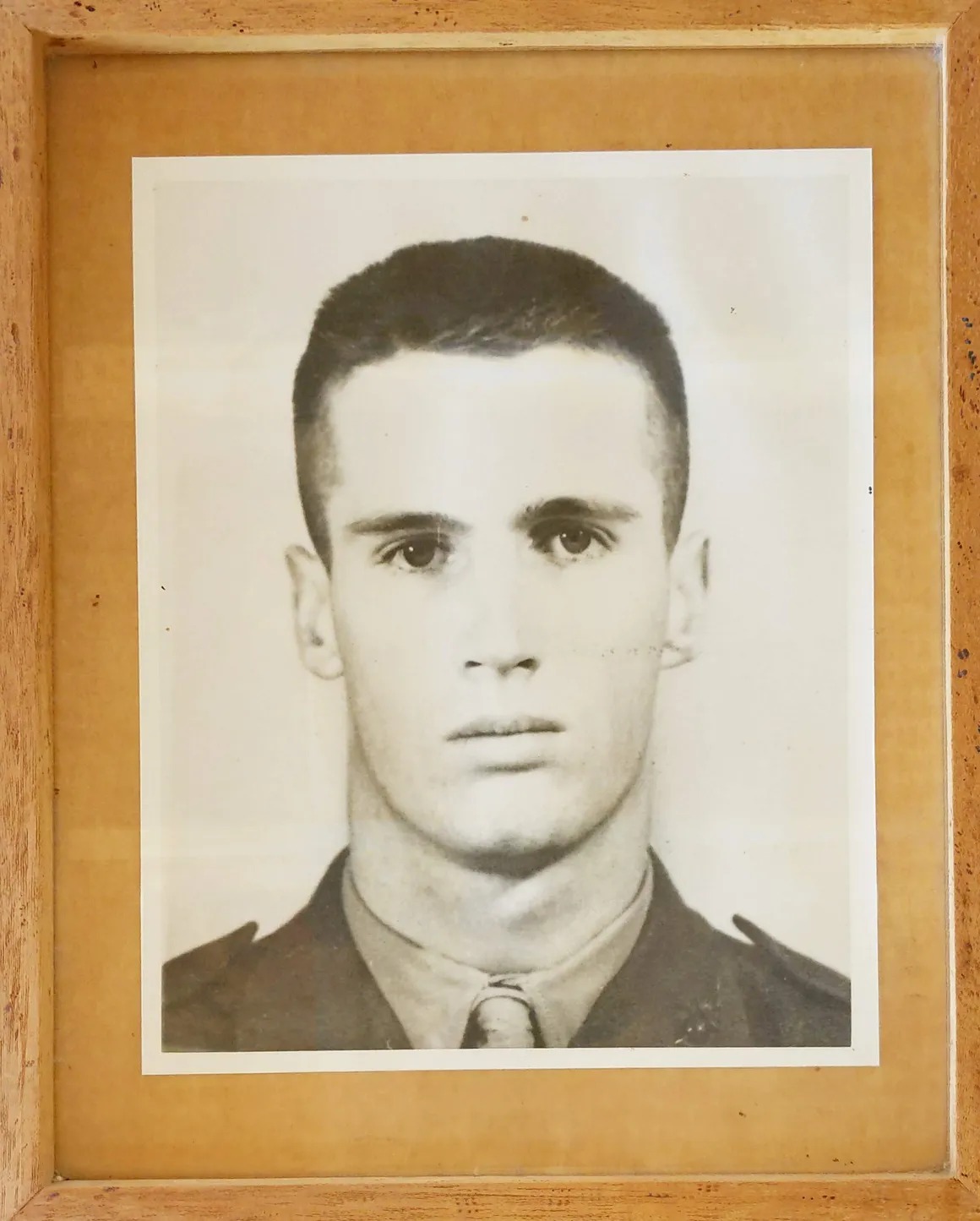
My Facebook friend Shannon Ratliff-Evans keeps a faithful record of Arroyo Grande High School Eagles who have passed on. I noted today this article she posted from the local weekly, probably from 1943, citing this sailor from the high school class of 1941, the last peacetime class for four years:
I had to find out more. I’m nosy that way.
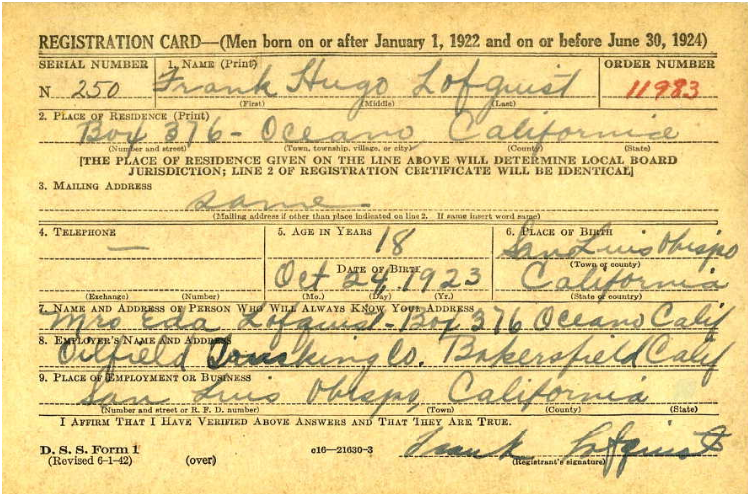
Here’s Frank’s draft card (his father, as the article notes, had died by then: Knute was a Swedish immigrant, but Frank’s mother was a Californian)
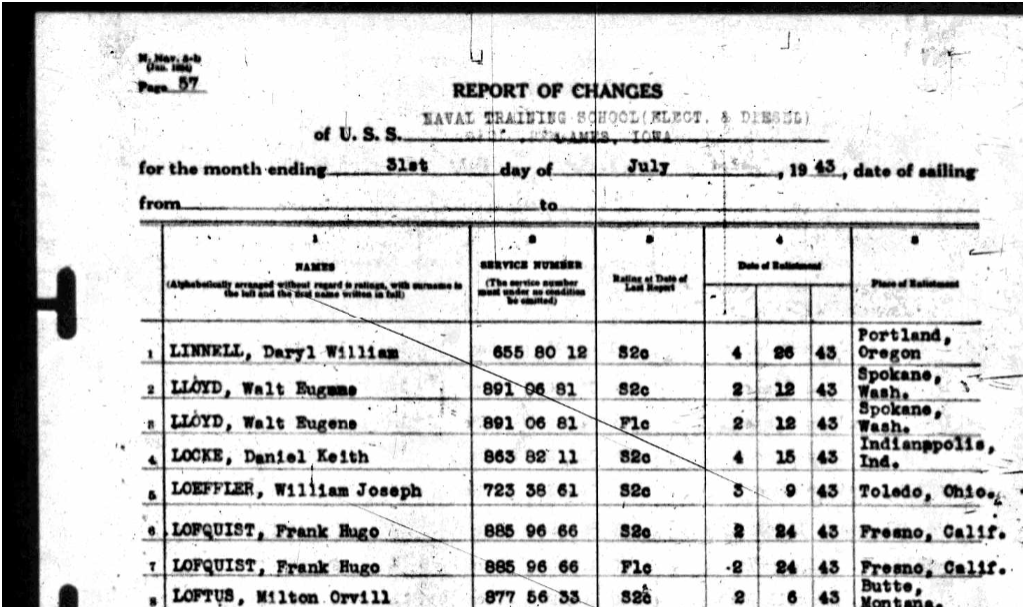
After his time at Farragut–named for a Civil War admiral–Frank would be sent to another landlocked place, Ames, Iowa, home of Iowa State University, for specialized training as a mechanic.
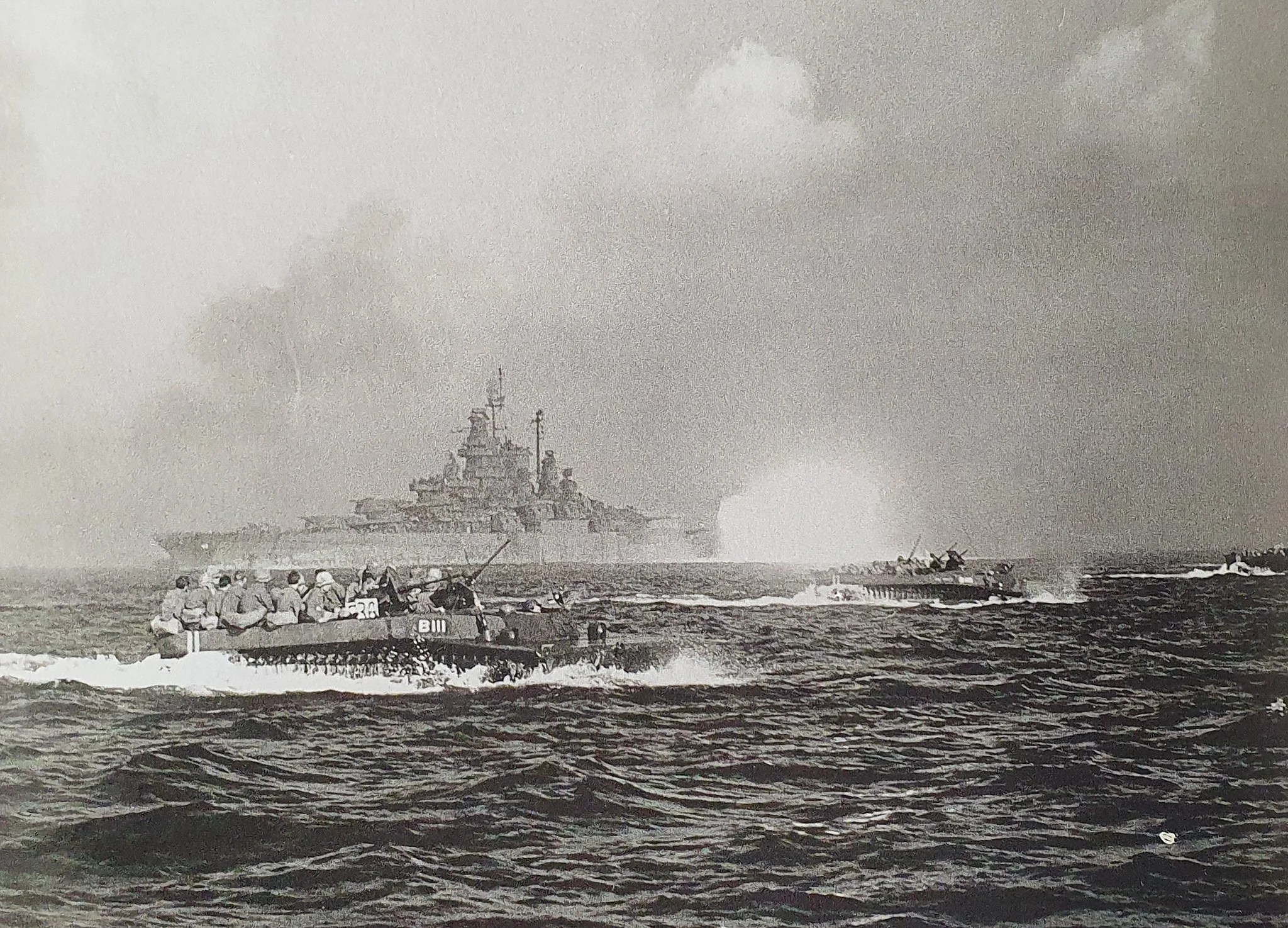
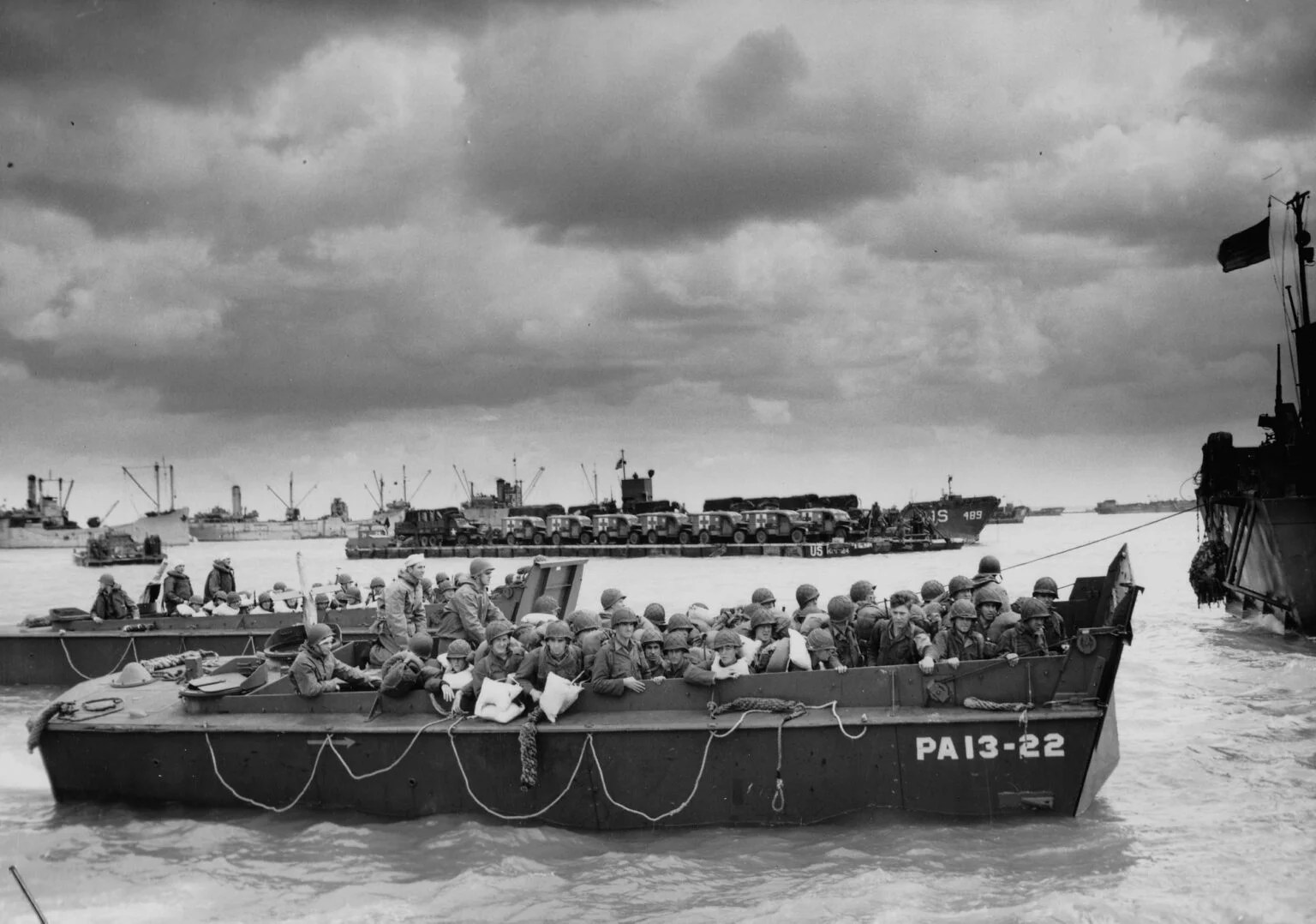
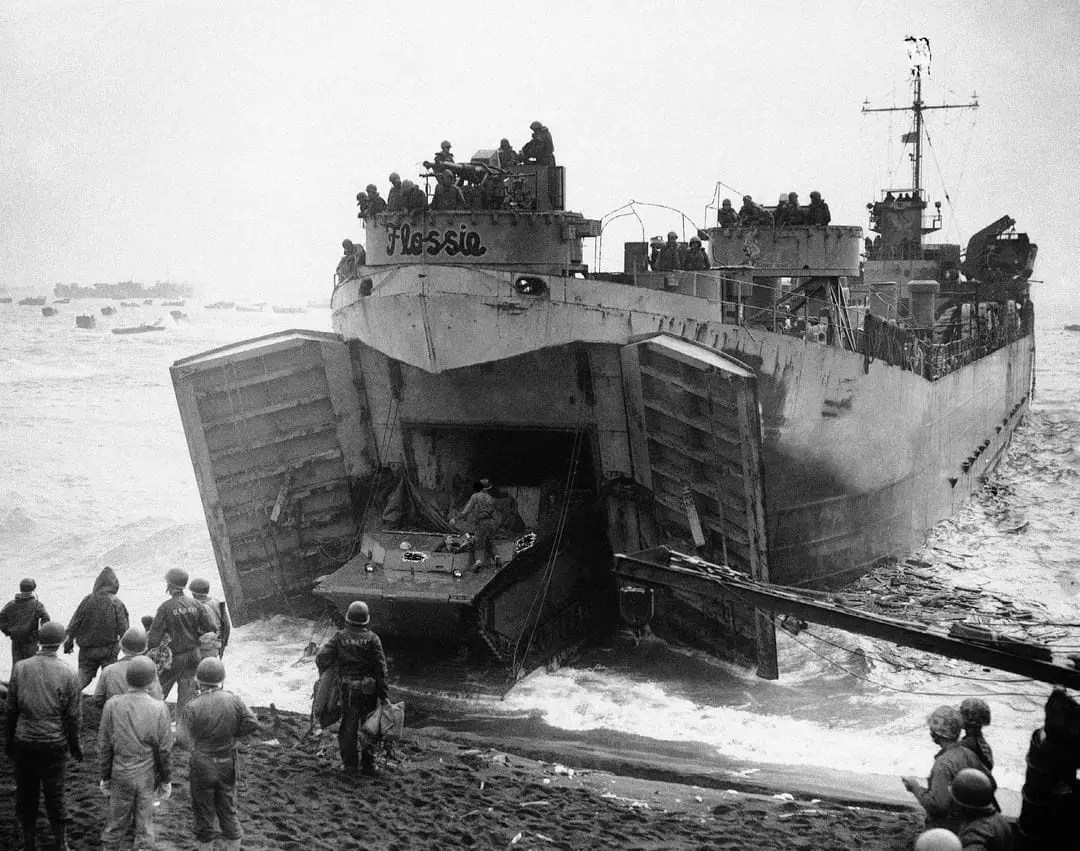
After this, Frank would go to war. I was hoping he would see service on a carrier or a cruiser or a destroyer. No. His skills sent him to the Landing Craft Unit 34 at the Waipo Amphibious Operating Base, on a peninsula bounded by Pearl Harbor’s West Loch. So, if Frank wasn’t steaming into action against the Imperial Navy, he was doing something just as important: helping to train servicemen and maintain landing craft in preparation for the costly landings across the Central Pacific in 1944-45.
Among the craft at Waipo:
LVI’s: Amphibious Tractors, carrying 1st Division Marines to OkinawaLCVP’s, better known as Higgins Boats, featured in Saving Private RyanLSTs, Landing Ships, Tanks–big fellows
Amphibious tractors in the foreground as fires rage along the West Loch, May 1944.
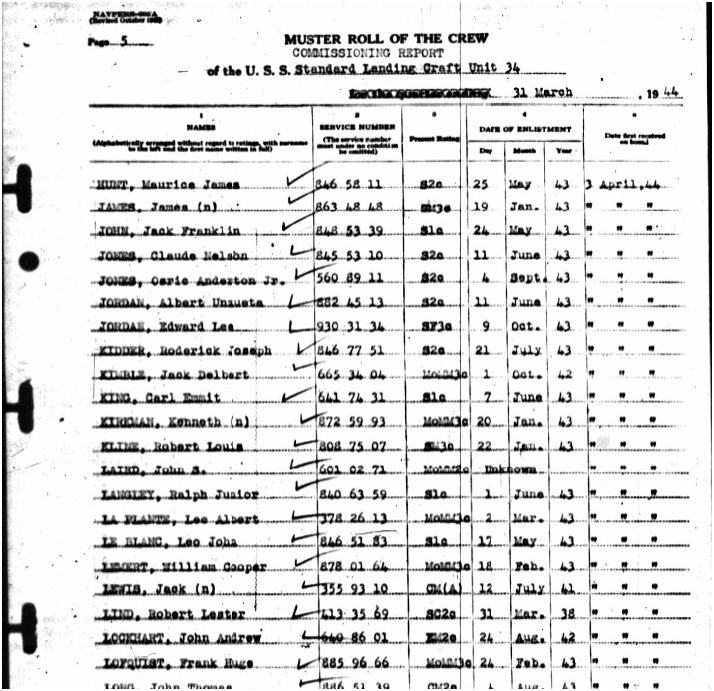
According to U.S. Navy Muster Rolls, Frank (at the bottom, below) reported to Waipo in April 1944. He would be stationed there until the end of the war. But it only took a month for the war to come to him.
In May 1944, Unit 34 would have been preparing sailors, Coast Guardsmen and Marines for the invasion of the Marianas Islands, which included the horrific Battle of Saipan. The invading Marines included Archie Harloe, the son of the Arroyo Grande schoolteacher, and some of them witnessed civilians, convinced that the Americans would torture them, leaping to their deaths from sea cliffs.
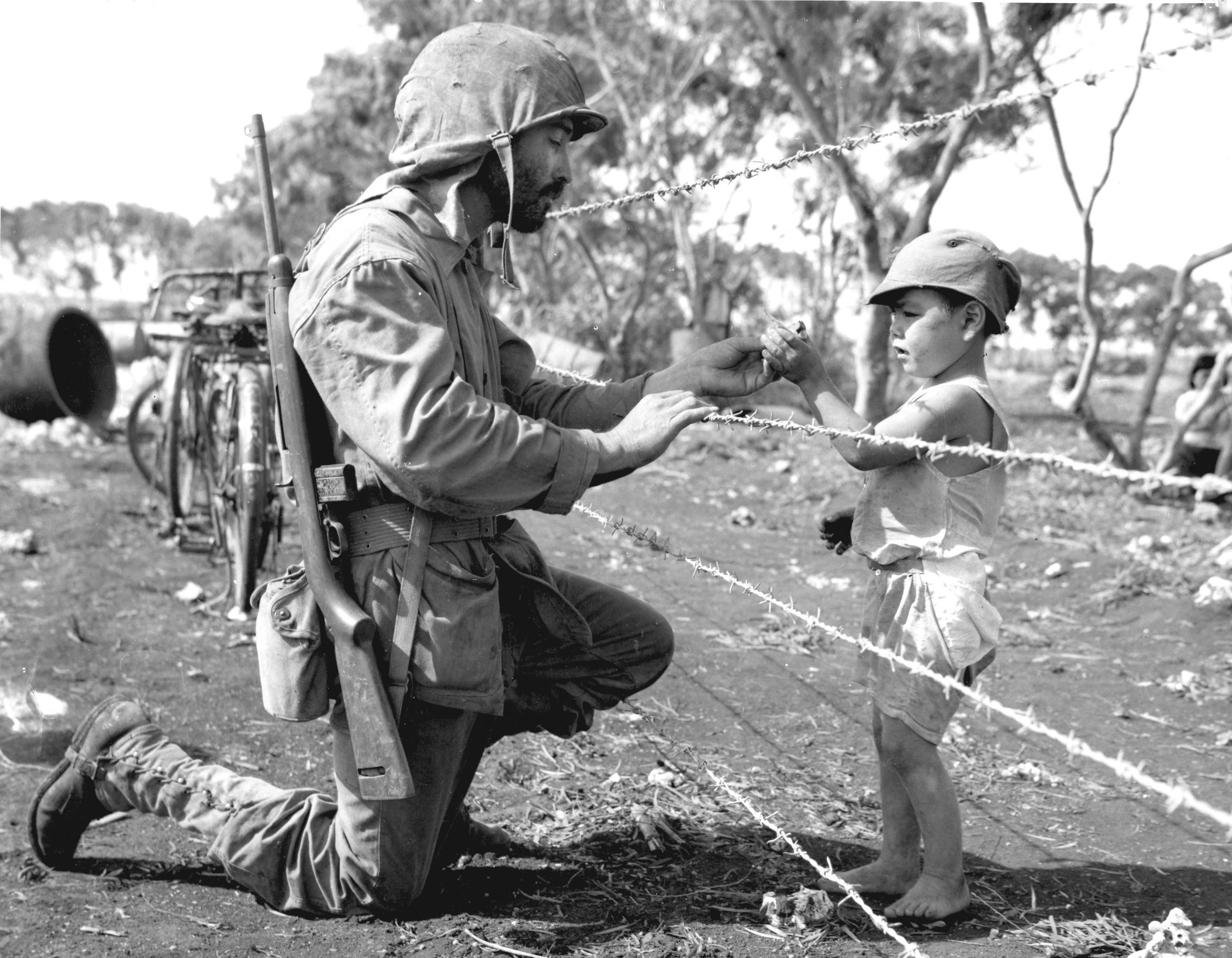
Had the people who committed suicide waited, they would’ve met Americans like this one: A Marine shares food with a Saipanese child.
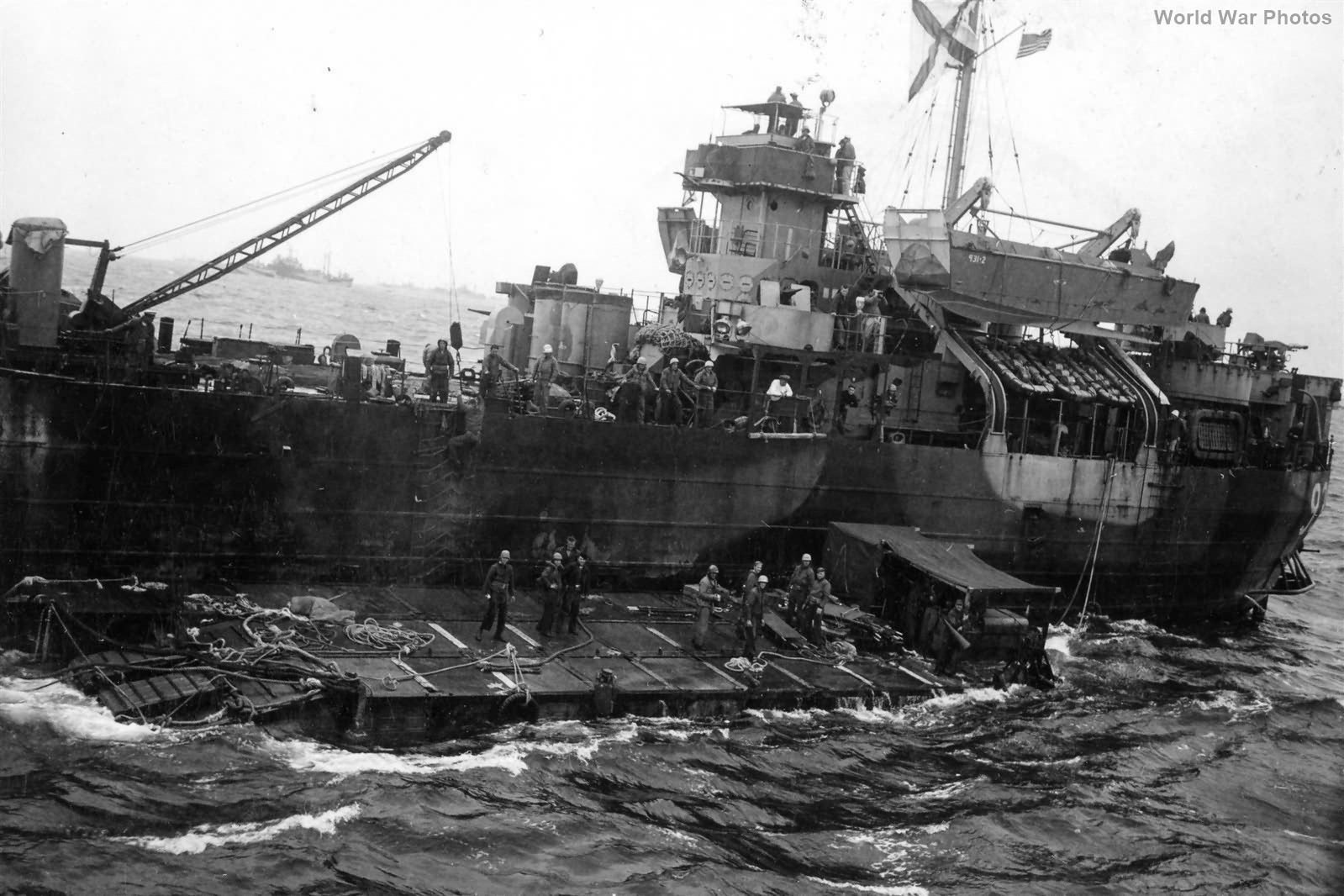
That was in June. Another tragedy–this one at Waipo–preceded Saipan’s. On May 21, 1944, the West Loch, in preparation for the Marianas, was packed with the big ships, the LST’s. Mortar ammunition was being transferred to one of them when a mortar round either fell or was detonated by gasoline vapors, The resultant explosion was massive, but not as massive as the second explosion, which showered the LST’s with burning debris, which in turn set off aviation fuel and ammunition.
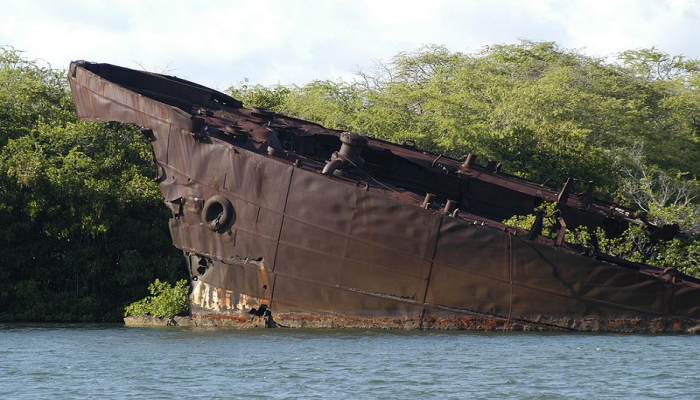
The fires burned for twenty-four hours. Six LST’s were destroyed. One of them, LST-480, remains alongside the West Loch today:
The official Navy casualty list cites 163 killed. That is almost certainly an underestimate. It may not reflect the deaths of Marines from the 2nd and 4th Divisions and soldiers from Schofield Barracks acting as stevedores at Waipo. Some estimates put the deaths at 1,000 young Americans.
Frank Lofquist was there, and, as fate would have it, he would live a long life–he died, at eighty, in 2003. I’ll post below a video of some South County sailors and their ships, but it occurred to me that Lofquist’s service at Pearl Harbor was just as important, and, since I just learned about the West Loch disaster, almost as dangerous.
Using the World War II Army ratio, for every American combat soldier, there were 4.3 support troops (like my father, a quartermaster officer who sent gasoline supply companies to Omaha Beach, and like Lofquist). World War II was their war, too.
Thank you for your service, Frank Hugo Lofquist.
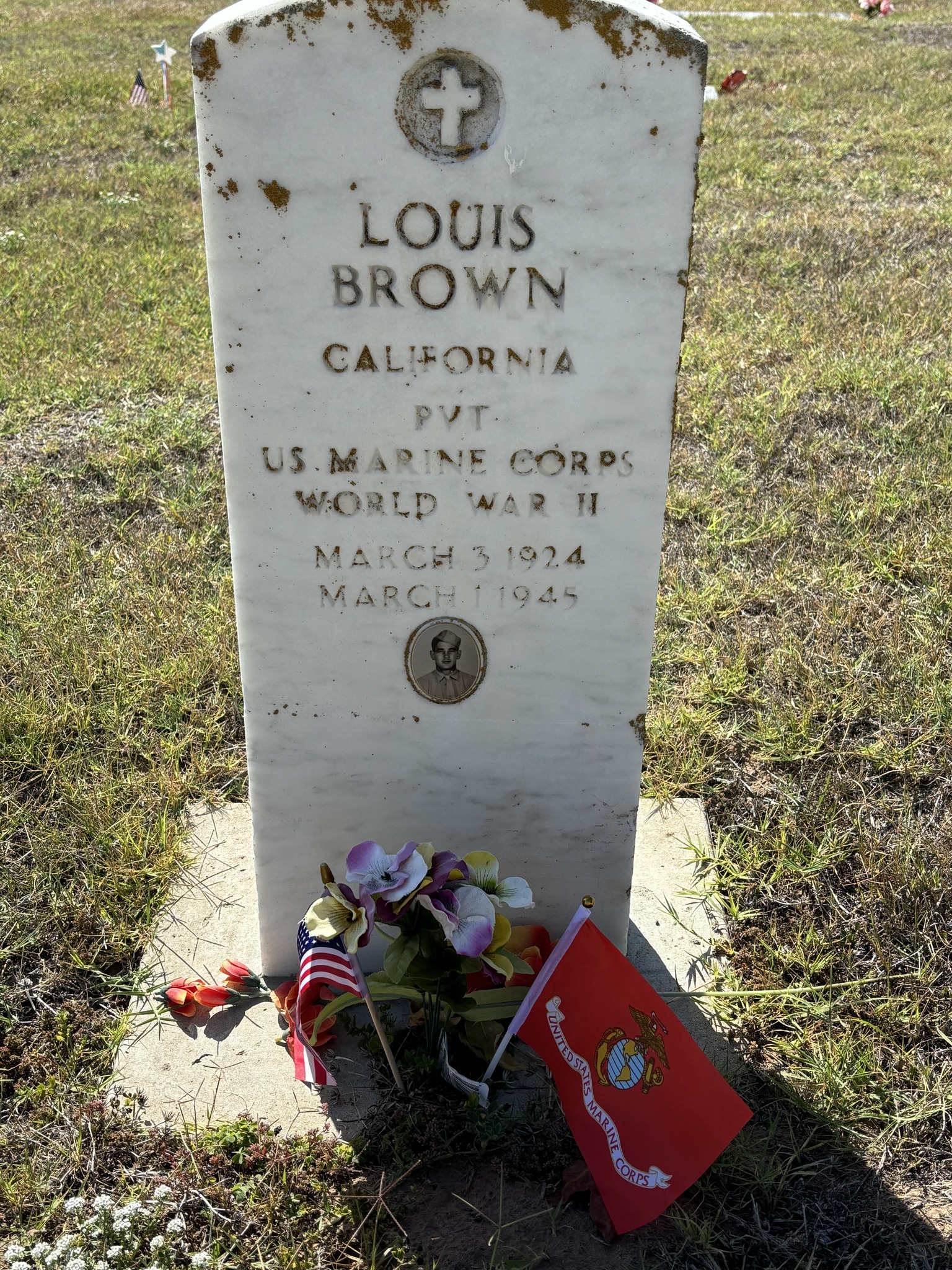
An LST takes on wounded Marines at Iwo Jima, March 1945, where Arroyo Grande Marine Louis Brown was killed three days short of his 21st birthday.
It was Lofquist’s war, and, of course, it was the war of the Black sailors at Port Chicago, near San Francisco. An explosion there three months later killed at least 320 of them, detailed as stevedores, when an ammunition ship blew up. What happened after is another story that needs to be retold every few years.
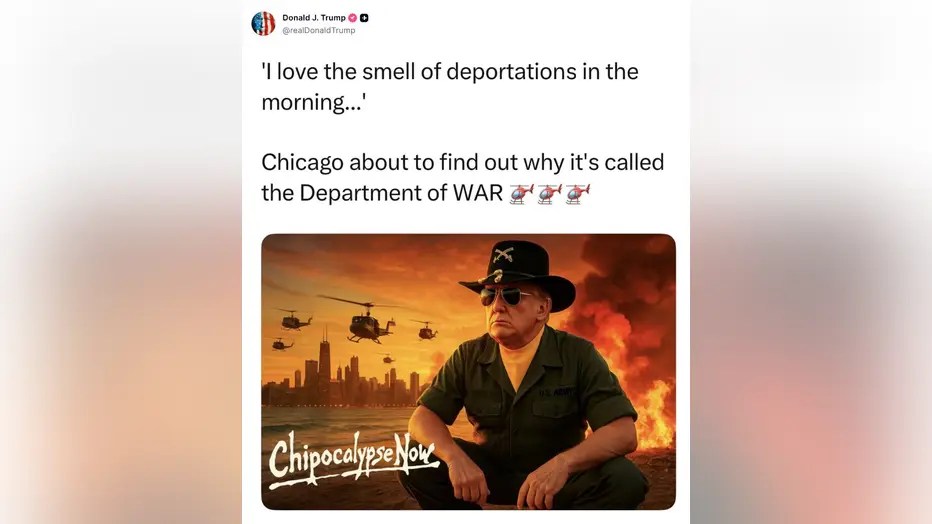
This was Saturday. He’s half-heartedly apologized today: “We’re not going to war with Chicago.” I’m sure, with the bellicose re-naming of the Department of Defense, that Chicago is overwhelmed with gratitude.
War would overwhelm this president* because, like all bullies, he is a coward. It takes so much air to fill him, but he has a kind of army—his sycophants—who stand ready to provide it.
The president* visits London
This is a re-creation of the 1918 Battle of Belleau Wood (the re-enactors are real Marines), but the men who actually fought that battle were called by the first-term Trump, the milder version, “losers” and “suckers.” He was to honor them on the 100th anniversary of the assault, but it was raining in France.
And this is what war was like for local men who endured it.
The 607th Tank Destroyer Battalion, 1944.
The Americans’ breakout from Normandy, after claustrophobic weeks in the death traps of the hedgerows, must have been a jubilant one, but the 607th would encounter another death trap whose brutality sobered them. The Americans, under Omar Bradley, and the British and Canadians, under Bernard Law Montgomery, had the chance to encircle the entire German Army in Normandy. They would fail, and thousands of Germans would escape, battle-weary, some of them now barefoot, running for their lives along narrow roads and cattle trails through what became known as the Falaise Gap.
But American artillery units still found many of them there–artillery spotters were nearly incoherent because there were so many targets to call in on their field radios–and the slaughter they inflicted was horrific.19 Seventy years later, one of the 607th’s soldiers, Frank Kunz, remembered the results in an interview with his hometown newspaper: “ Christ help me. There were 6 to 8 inches of bodies and horses ground up on the road. There was nothing you could do. You had to drive through it.” People, Kunz added, don’t understand what war is.20
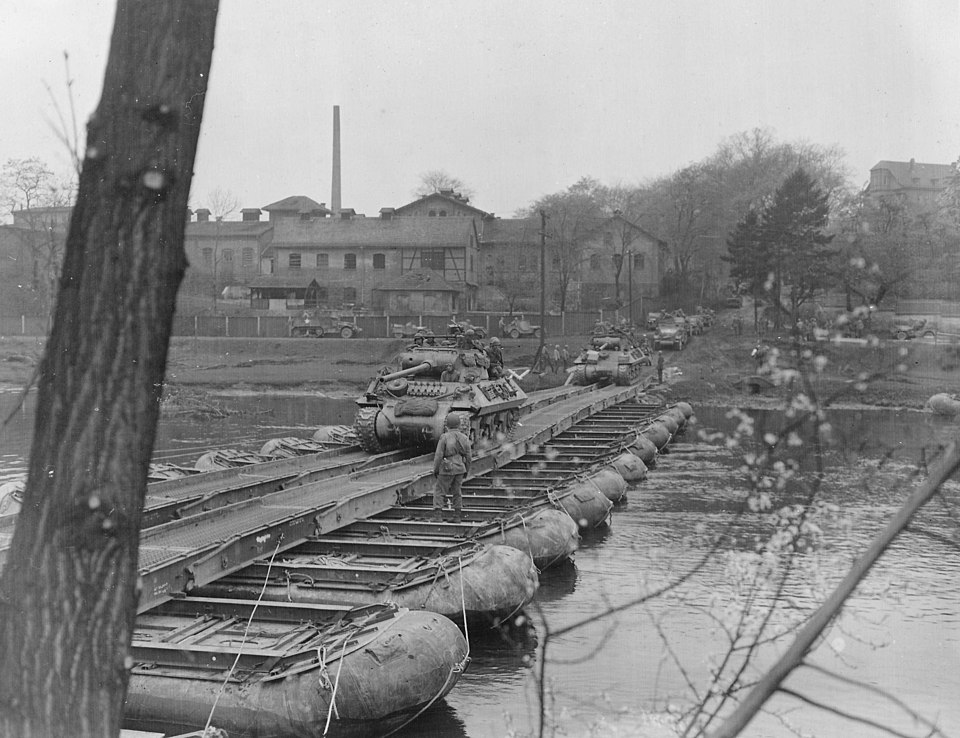
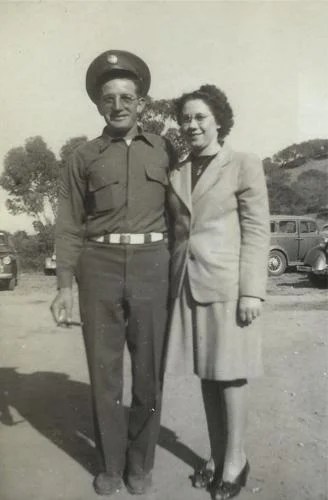
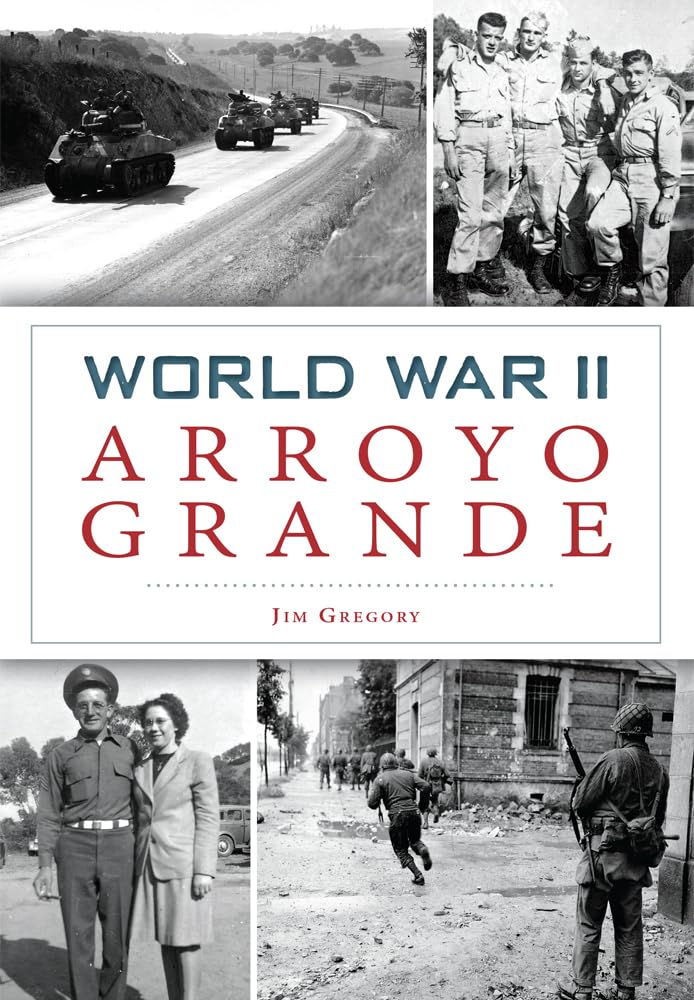
In the photos: Frank and Sally Gularte at a family barbecue in Arroyo Grande before he shipped out as a member of the 607th Tank Destroyer Battalion, seen crossing a river into Germany. A German sniper claimed Frank’s life in November 1944. Sally gave birth to Frank Jr. five days later.From the book World War II Arroyo Grande.
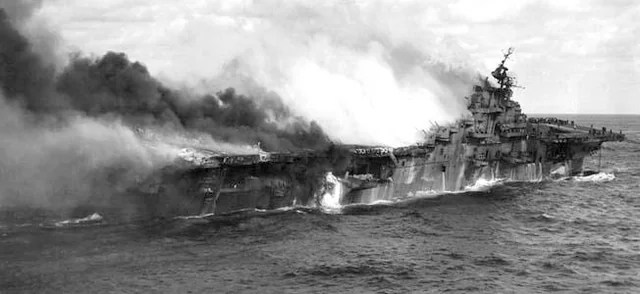
The aircraft carrier Ben Franklin, 1945
The bomb’s detonation [one of two that his the aircraft carrier Franklin off Japan in 1945] flipped a 32-ton deck elevator like a flapjack, leaving it canted at a 45-degree angle in its well. The shaft below it and the decks adjacent were an inferno: crewmen were incinerated instantly; aircraft on the hangar deck melted and plummeted to decks farther below. Twelve of the 13 pilots in the famed Marine Corps “Black Sheep” Squadron, based, since the beginning of the year, at a naval air station near Goleta, died in their ready room.19
Ships below the horizon felt the explosions. Camilo Alarcio clambered up to the flight deck only to realize that he was freezing: he made his way back to his quarters to fetch a jacket, flak jacket and flashlight and bolted topside again with his shipmates. Those emerging from below would have seen sailors running for their lives as the fires spread. In the black, heavy smoke, some ran into the turning propellers of aircraft, their engines still running for their next combat mission.
Alarcio’s deliverance, and that of many others, began when he saw the cruiser Santa Re move alongside. That ship’s crew began to throw lines across to Franklin as the flames threatened to engulf the entire flight deck. He grabbed one of the lines and made his way across–other sailors fell and drowned, some so badly burned that they couldn’t save themselves, while others were pulled under by the turning of Franklin’s screws. Alarcio survived.2020
Franklin’s survival was in doubt. The initial explosion was just the beginning. As fires reached twenty more aircraft, fueled and ready for flight on the hangar deck, and ignited a chain reaction that, throughout the day, set off stores of bombs, rockets, anti-aircraft ammunition and aviation gasoline. At one point, the violence inside Franklin made the 32,000–ton ship shudder and spun her, like the needle on a compass, hard to starboard, where she lay dead in the water.
Photos: South County sailor Camilo Alarcio; his ship, the carrier Ben Franklin, afire. Somehow Franklin, with Alarcio aboard, made it back to her birthplace, the Brooklyn Navy Yard.
The 91st Bomb Group, 1945
Henry Hall now lives in Cayucos; he was a Kansan transplanted to Bakersfield before the war and then to San Luis Obispo County afterward to become a gunner in the Ninety-First Bomb Group, the “Ragged Irregulars.”
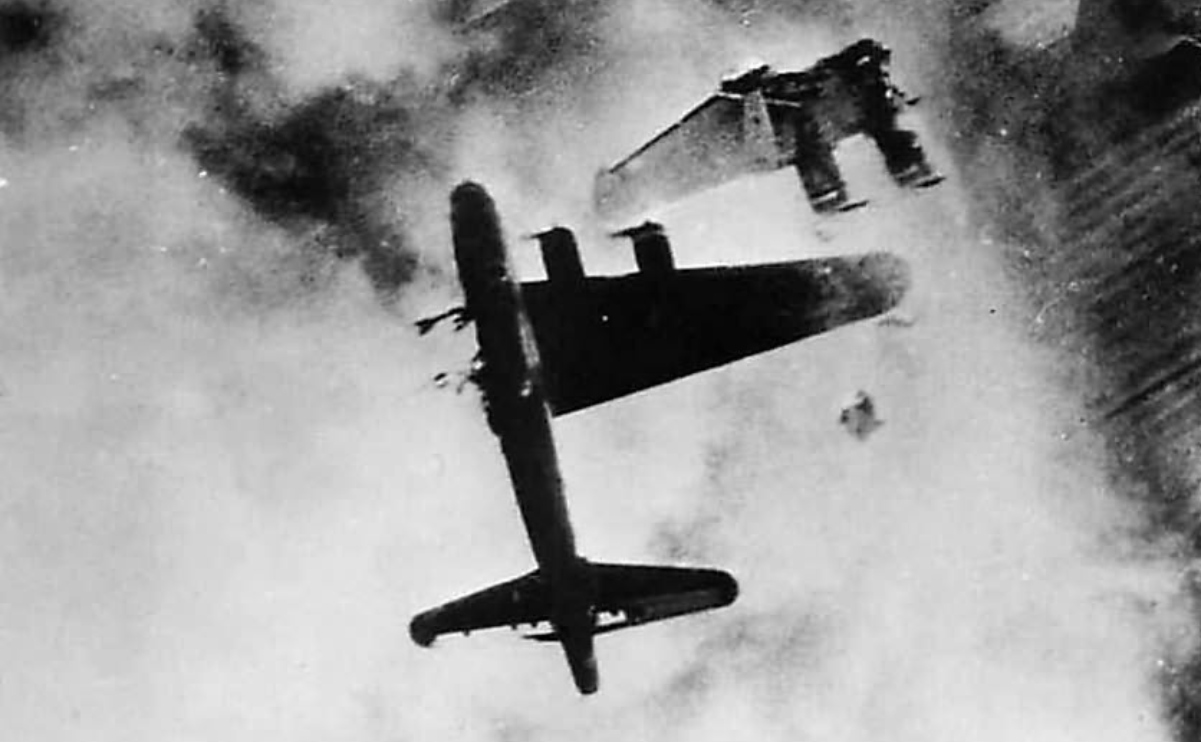
Hall witnessed a horrific chain reaction over Holland: a swarm of German fighters singled out a B-17 ahead, and the multiple hits on the bomber registered for him when he saw the right- side landing gear listlessly drop and an engine on the right wing catch fire. When the out-of-control bomber began its final plunge, it clipped two more B-17s in the formation—both of them went down as well.
It was the hardest of days for Hall’s bomb group: they lost six B-17s on a mission that gained nothing: their primary target, a ball-bearing factory near Berlin, was obscured by clouds, so the Ninety-First dropped their payloads on “targets of opportunity”—on this day, Hall remembered, on a little crossroads town that probably contributed little to the Nazi war effort.55
That was Hall’s first mission. He was twenty years old when he saw the three Ragged Irregular bombers plummet to earth together. Many members of his bomb group were even younger. Some of them, thanks to crafty misdirection aimed at recruiting sergeants pressured to meet their quotas, were as young as sixteen.
Far below them, in German cities like Hamburg and Dresden—or in relatively obscure Japanese cities like Toyama, the size of Chattanooga, or Kagoshima (the seat of the prefecture from which most San Luis Obispo County Japanese had emigrated), the size of Richmond, Virginia—the ashen bodies of schoolchildren stained sidewalks and streets.
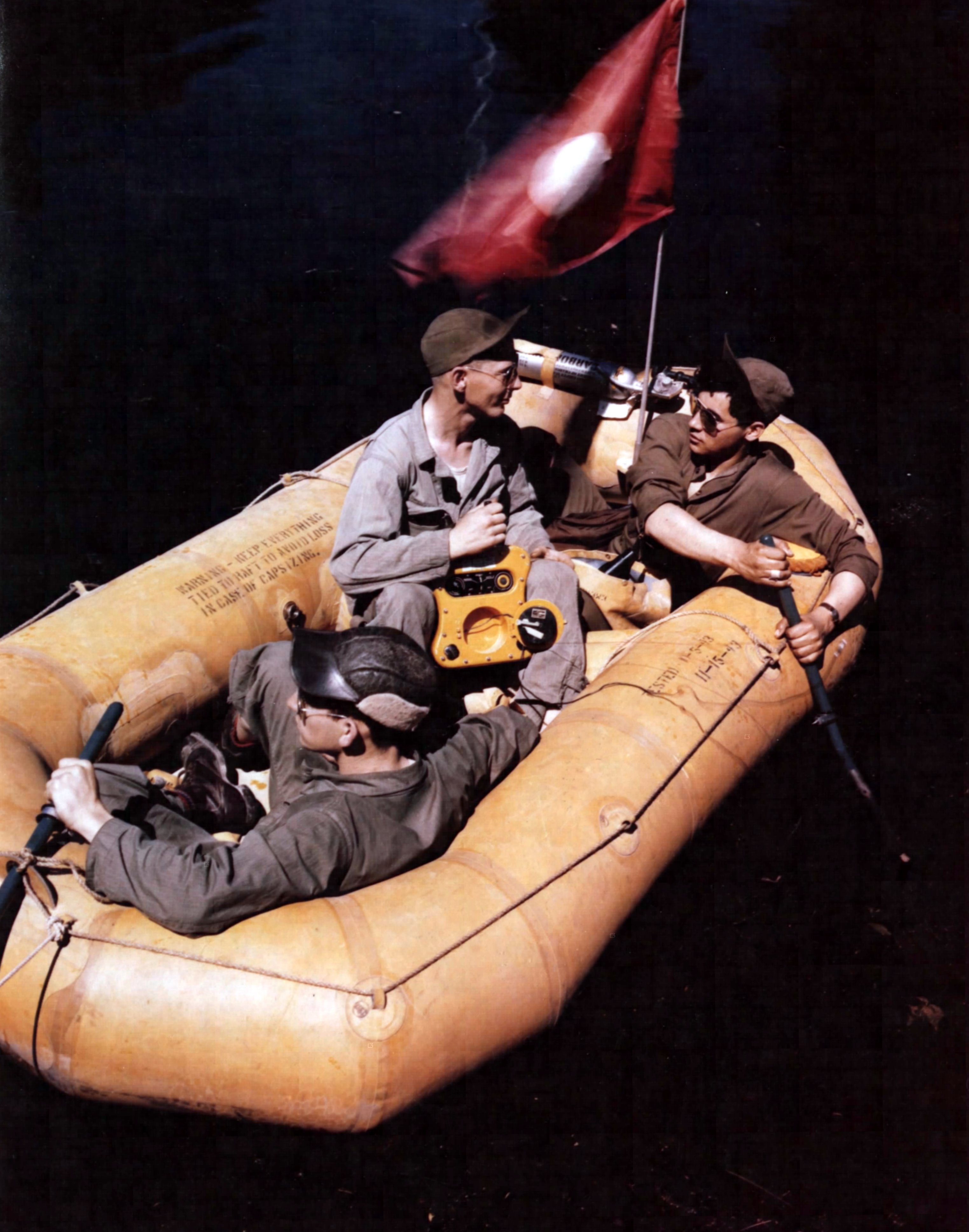
Photos: Henry Hall, with his back turned, practicing water survival with his comrades. The B-17 “Wee Willie,” from Hall’s 91st Bomb Group, on its way down. There was one survivor.From the book Central Coast Aviators in World War II.
The 60th Ohio Volunteer Infantry, 1864
So under [Union Gen. Ambrose] Burnside, the 60th Ohio, on the afternoon of May 5, crossed the Rapidan River at the Germanna Ford. From a rise, they could see dust clouds raised by Lee’s army on the move and began to march into The Wilderness, a vast tangle of forest and scrub so dense that it shut out the sun. Adam Bair was a corporal and therefore, like Richard Merrill had been at Antietam, a file closer. Bair must have been tired after the river crossing. His role was like that of a border collie, striving constantly to keep his company together and moving forward, cajoling potential stragglers, barking, like a collie, at men who’d packed too heavily when they had been warned to travel light.
The wake of the 60th would have been a Civil War treasure-collector’s dream, strewn as it would have been with all manner of equipment: rubber blankets, coffeepots, needless overcoats and extra clothing, books that would never be read. Eventually, as the sounds of battle began to become more distinct, the 60th would leave behind what many Civil War soldiers left: playing cards, dice, flasks of brandy or whiskey, packets of what were euphemistically called “French postcards” with their leering plump models. These are not the items a man would want on his person if he “fell,” to use another euphemism common to describing the indescribable violence of a Civil War soldier’s death in combat.
Union soldiers would begin to see, as they crunched through the carpet of leaves in the closeness of the woods, dead soldiers grinning at them in their passage. These were the skulls of the men who’d fought the year before at Hooker’s debacle, Chancellorsville, either disinterred from their shallow graves by hungry animals, perhaps by a hardscrabble Virginia farmer’s hogs, or simply lost and left where they’d fallen in the days when Lee and Jackson had played hammer and anvil with the Army of the Potomac.
The woods themselves would become the enemy in this new battle, in 1864, because the dark wasteland made a mockery of combat drill; its density cut up infantry formations into little knots of soldiers who became separated from one another as they struggled forward, whipped by branches, tripping over roots, cursing in the close humidity and heat already descending on northern Virginia. For many Union soldiers, the dark was suddenly illuminated by the muzzle flashes of Confederate infantry with their bullets amputating tree branches, vaporizing leaves, buzzing like hornets past men’s ears. Some of them, with a dull thud, a sound familiar to Civil War soldiers but now as lost as the sound of the rebel yell, found their targets in the bodies of young men. The flash of powder did something else: firefights sparked fires that would rage in the tangle of trees and scrub and the fires burned wounded men alive as they shrieked for help. No battle in the Civil War was more grotesque than the one fought in this forbidding place.
Photos: 60th Ohio soldier Adam Bair became a Huasna Valley farmer after the war. Combat artist Alfred Waud depicts the fires that swept The Wilderness in May 1864. From the book Patriot Graves: Discovering a California Town’s Civil War Heritage.
It’s not even the Dollar Tree anymore. It’s the $1.25 tree. At least it doesn’t smell like mothballs, like the old, old Rasco store did, and it’s like Lee Chong’s grocery in Cannery Row. It’s a miracle of supply. You can find almost anything that fits your mood: animal crackers, birthday balloons, eyeglass repair kits, navy beans in a can.
I went there for some miniature American flags and plastic flowers.
The line at the checkstand was long. It always is. The couple ahead of me, a husband with tattoos up to his chin, the young wife with yoga pants—I averted my gaze—and the little girl wearing a ZOMBIE CROSSING medallion. The husband smiled at me. Then he called over my shoulder to a woman two customers back. The man between the woman and me —tiny, deeply tanned, with a wiry salt-and-pepper beard, was as stooped as a comma and he shook uncontrollably. Parkinson’s.
“How are you?” he called to the woman behind the tiny man. She smiled. Her upper teeth were irregular, kind of crenelated. “I’m doin'” she called back. “Job?” he asked.
“Still looking.” her smile dissipated.
“Why don’t you come over tonight?” the man said. His pretty wife agreed. “Yeah! We’re doing Mexican!” It was a going-away party for someone they knew. They asked the checker for a helium balloon, so he went to fetch it. When he came back to the checkstand, they invited him over, too. I think he’s going after his shift ends.
They paid for their cart—canned and boxed food—and the husband asked if he get could $50 over on his EBT Card, from the federal food assistance program. They needed to get the fresh stuff–carne asada, shredded cabbage and lettuce, cheese, onions and peppers–because they were doing Mexican.
The cash register took a long, long time to do the cash-back transaction. It was thinking. The old, old man behind me was shaking. I was liking the little family as they left the checkout. My turn.
These people, including the gracious young man with the tattoos up to his chin, are about to suffer. The woman he called to is jobless and looking, but I suspect that he, in using the EBT card, is among what are euphemistically called “the working poor.” He may work in the fields. Maybe not. If his little girl (who wants to be a zombie) gets sick, this family might be without the Medicaid they’d need for her.
The old man behind me will die. Very soon.
So they all might suffer. But they deserve it, don’t they? Their place in the the economy’s lower tiers (economics was once called “the dismal science”) is their own fault, isn’t it? My sons, who rely on Medical, might suffer as well. And Thomas uses his EBT card to supplement our food supply when the month, as it invariably does, outlasts the money. (My sons have jobs and work hard—John repairs water wells and Thomas drives a forklift.)
If the Present Administration goes after Medicare, and the rumblings suggest that they will, then I will suffer. I must deserve it.
Then I realize I’m being stupid. The United Kingdom, Australia, Canada, Sweden, Norway, Denmark, Brazil, France and Germany all subsidize health care. South Korea’s public health system is probably the best in the world.
Then there’s Social Security. The president said today that he will “love and cherish” Social Security. He says the same about women. Eighteen have accused him of sexual assault. And, by the way, “social security” is not some bleeding-heart liberal New Deal cushion for the retired (and therefore, according to Elon Musk, the unproductive. SEE: The film Soylent Green).
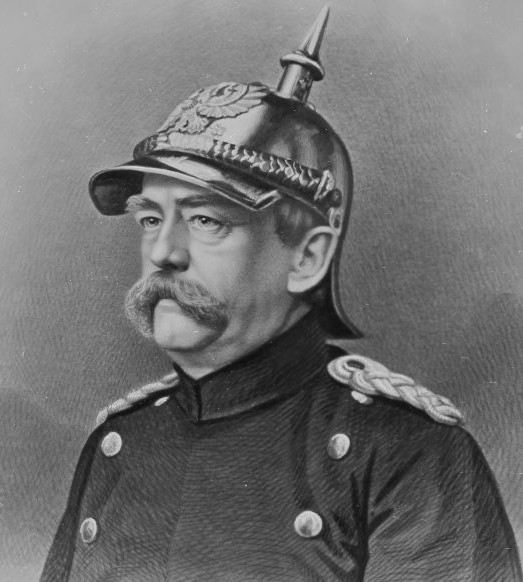
Here’s the man who invented Social Security, right after waging successful wars against Denmark, the Austrian Empire and France. He provoked all three wars and, in the process, had unified Germany by 1871. Otto von Bismarck, “The Iron Chancellor” brought an old-age pension program to Germany in 1889. The milk of human kindness, as you can see, flowed through his Prussian veins.
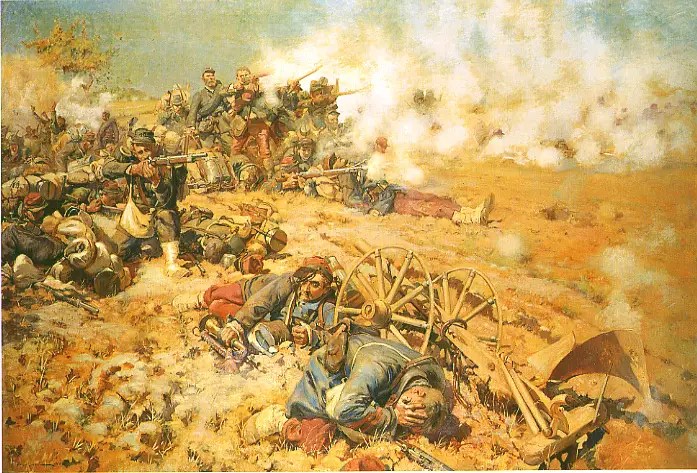
Above: A French defeat in the Franco-Prussian War, 1870-71; The “Iron Chancellor” who provoked it.
We need to go in a different direction than Bismarck’s. Our national resources need to be diverted to people like these. They deserve The Big Beautiful Bill.
I was thinking this and getting depressed, and angry, so to cheer myself up, I went to the cemetery.
I wanted to be with people who, like the man in line, were more far more generous than the billionaires.
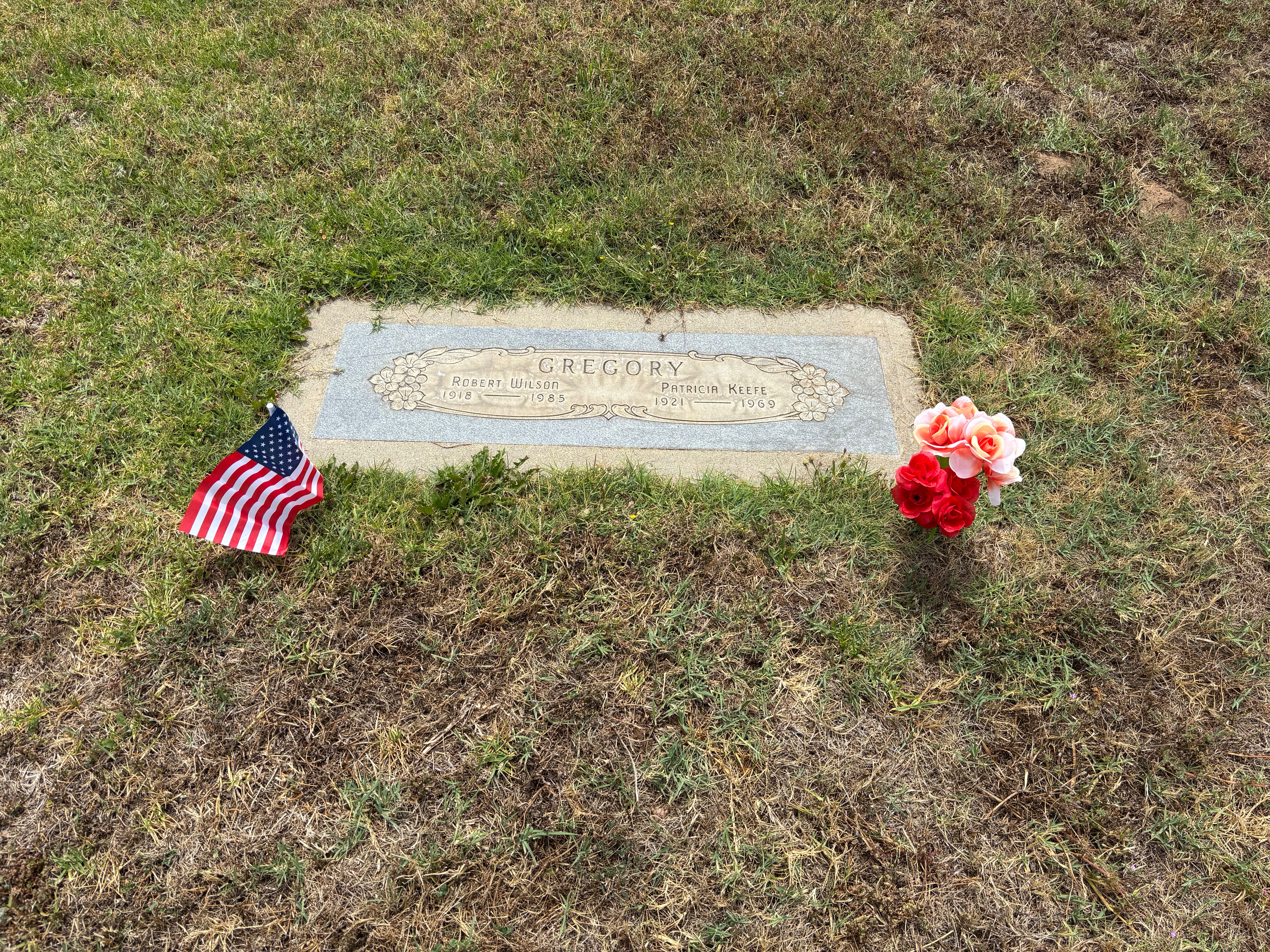
Of course, I found them. My Dad, Robert Wilson Gregory, taught me how to tell stories. Patricia Margaret Keefe was my Mom, named for two Irish Famine ancestors, Patrick Keefe and Margaret Fox. She had a fierce sense of social justice and a hunger to learn. These are the things she taught me.
I had to be a teacher.
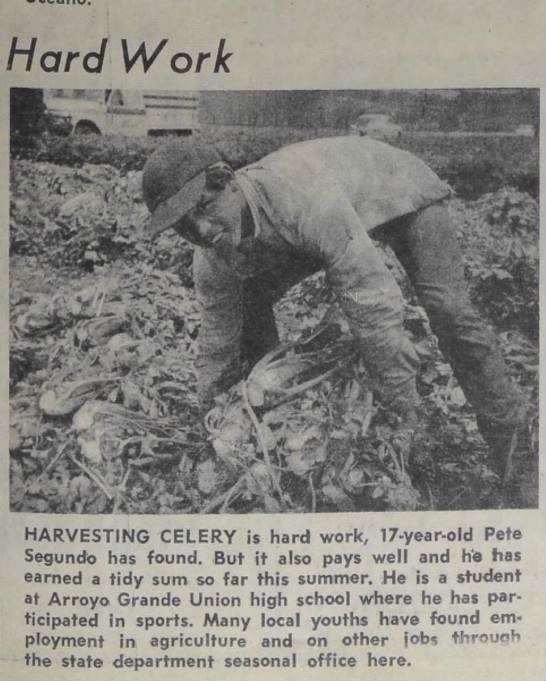
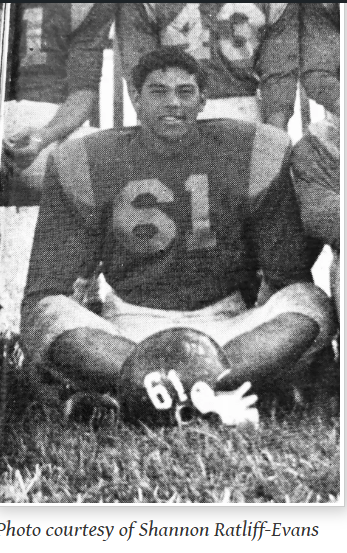
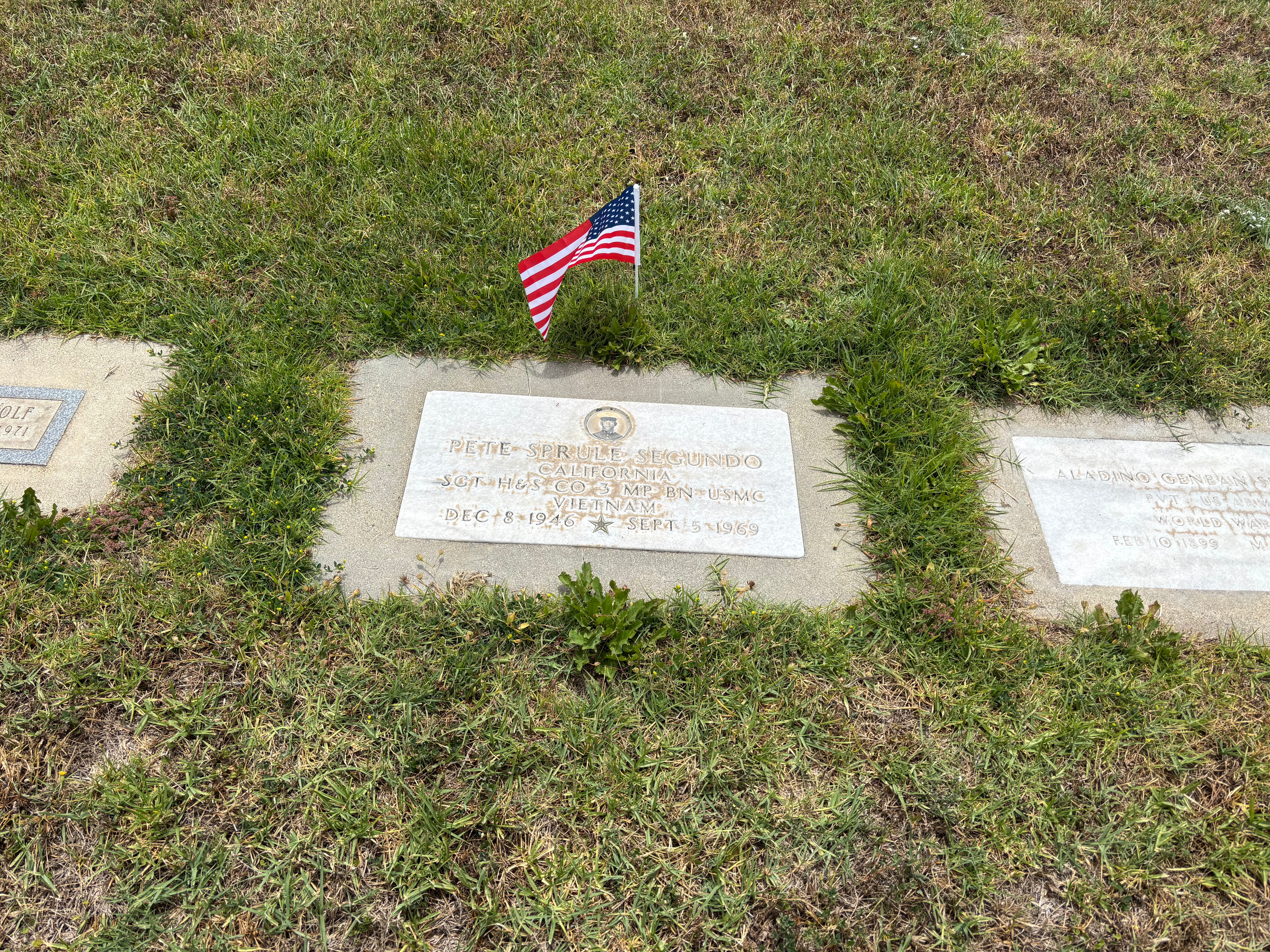
And then I looked for another young man, Pete, who was as generous to his friends as my parents were to me. “To know Pete was to love him.” I have heard that many, many times. Pete Segundo, AGUHS ’66, my big brother’s class, was an incredible athlete. He wrestled and played football. He was the Letterman’s Club president (in one yearbook photo, his arm’s broken and in a sling. He is grinning broadly). He showed a steer for FFA. While other kids went to the Choo-Choo Drive-In on East Grand after school, Pete went into the fields to chop celery.
In 1969, the Marine Pete Segundo died in Vietnam, killed by “friendly fire,” which might be the worst euphemism of all for the greatest act of generosity that any American can give.
His grave was uncharacteristically bare. Usually it’s bright with flags, flowers, red-white-and-blue pinwheels spinning in the wind. Maybe they cleaned everything up after Memorial Day. Luckily, I had another American flag. I remembered, as I pushed into the turf, what my big brother said about Pete. Bruce went out for wrestling and Pete was already establishing himself as the next big thing for Coach Ruegg. Bruce was not going to be the next big thing. “Pete was nice to me,” he said once, “and he didn’t have to be.”
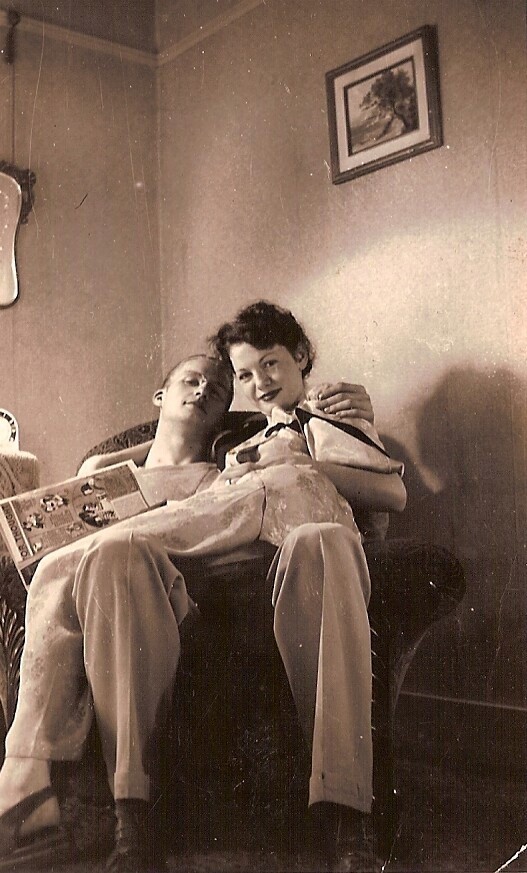
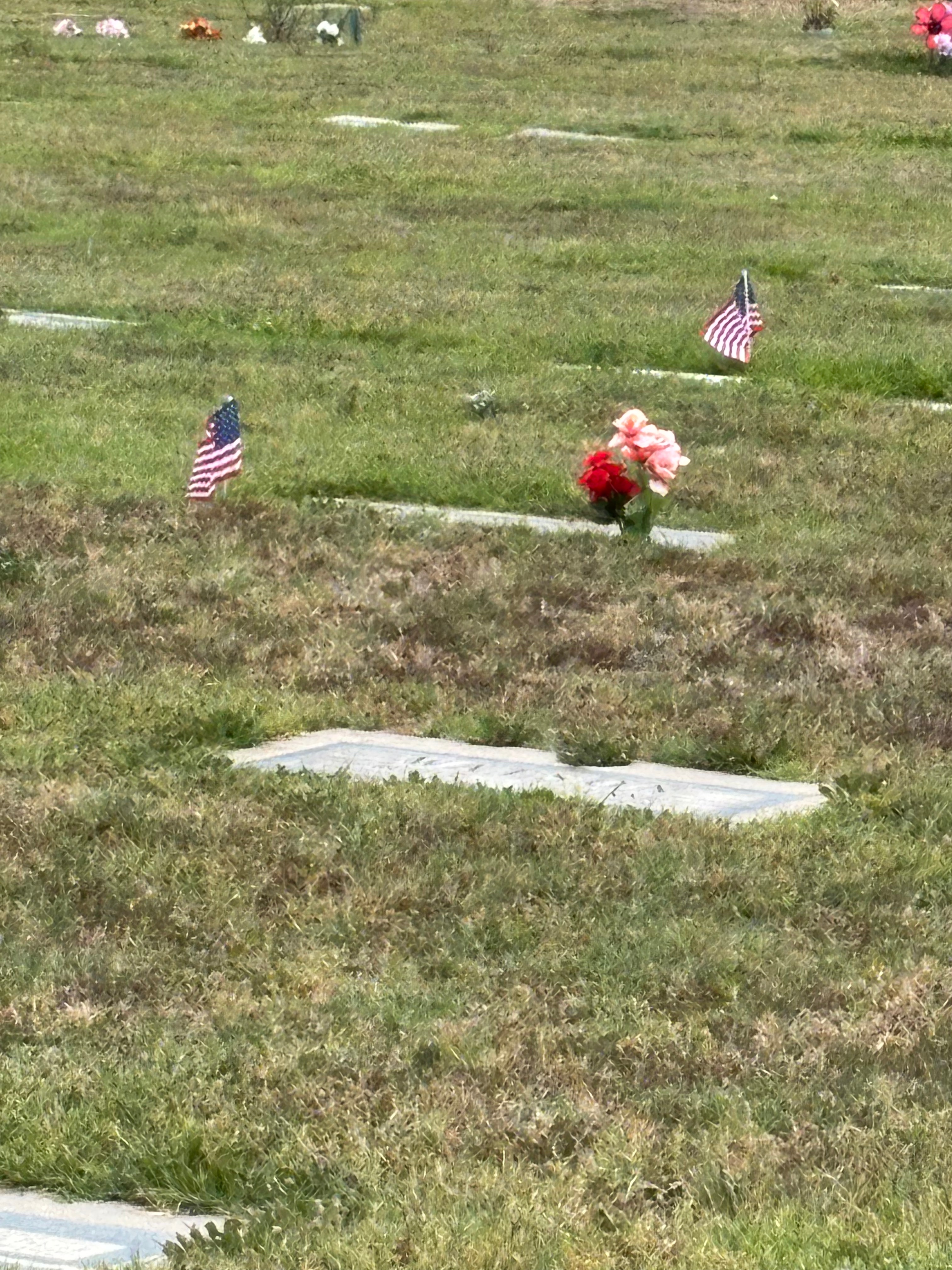
Above: My folks, with the Sunday funnies, about 1940; Pete’s grave is a row above theirs.
I was once a newspaper reporter and therefore, all my life, a news junkie. Part of my recovery from alcoholism means watching the news far less than I used to. We live in an age of meanness. I was raised to value kindness. Today I felt a little overwhelmed, so I made my deliveries, flowers and flags, and I spent more time than I ever have at the cemetery, talking to my parents, telling my Dad how proud I was of him, telling my Mom how much I loved her.
I was worried about the people in line at the Dollar Tree and thinking, painfully, about the way Pete had died.
I think my parents were whispering back to me. Suddenly, I felt at peace.
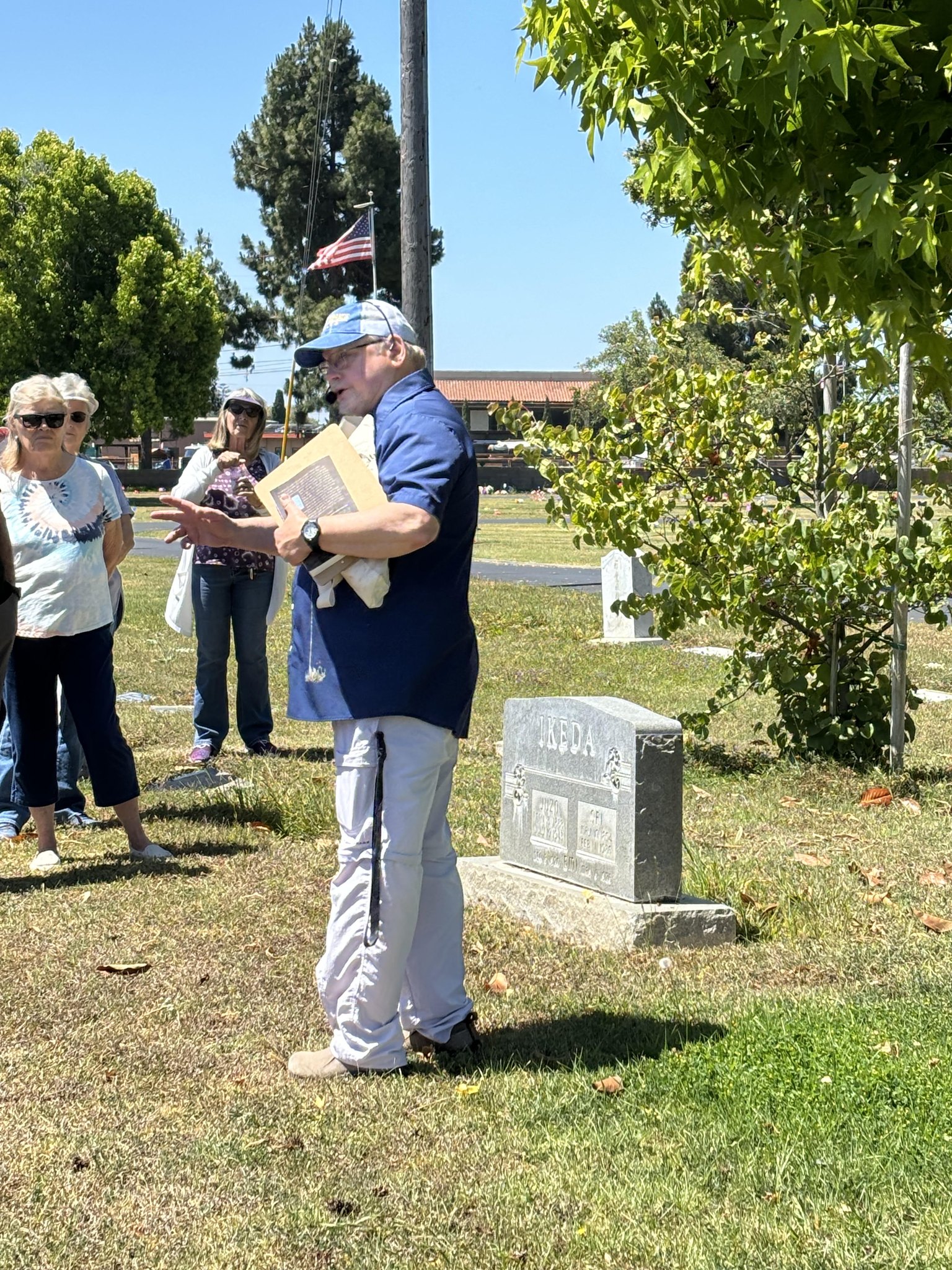
Me leading a cemetery tour for the South County Historical Society. The family I’m discussing embodied the generosity I admire so much.
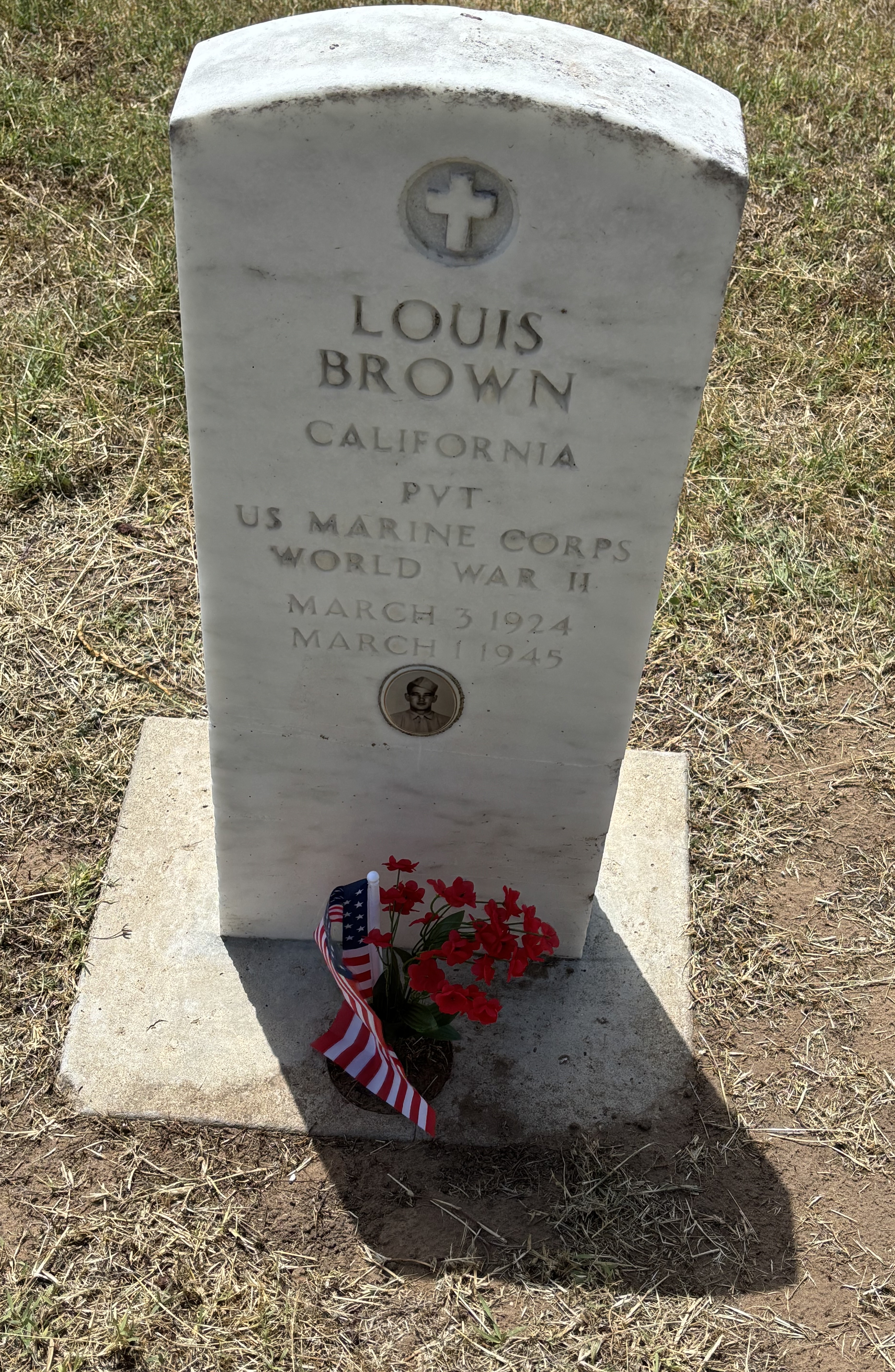
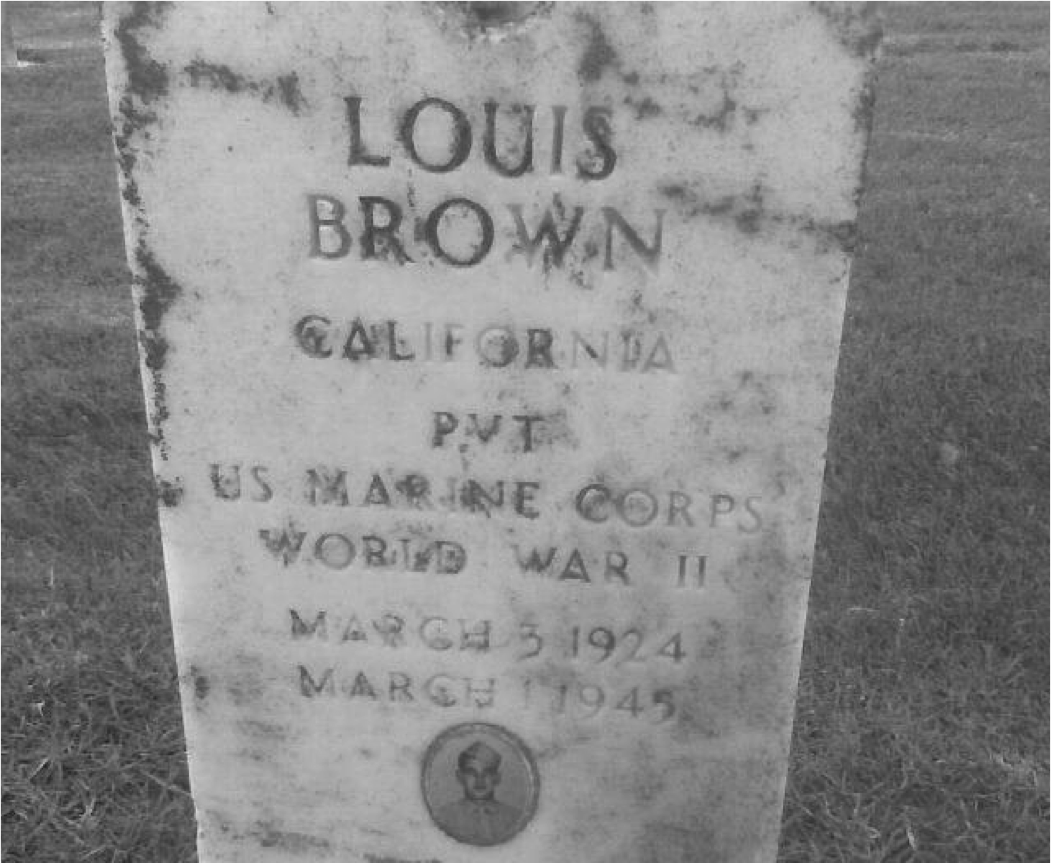
Postscript. I had one more American flag and a sprig of little red plastic flowers. My last stop was for this Marine, a Corbett Canyon farmer’s son, who died on Iwo Jima. Finding Louis Brown’s grave led to my first book. He was generous to me, to all of us, beyond imagining.
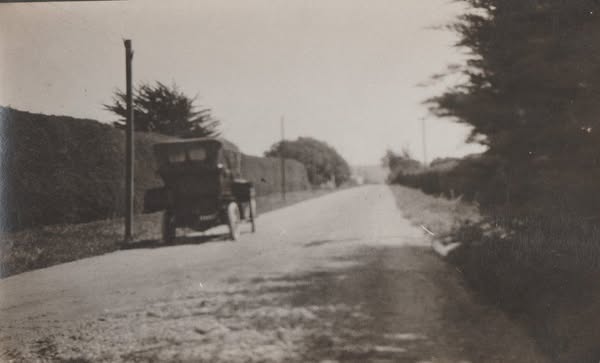
My Facebook friend Jason Blanco posted this photo and leave it to my historian friends Shirley Gibson and Michael Shannon, all of us are now pretty sure that this is Halcyon Road, somewhere between the mobile home park and the Halcyon store today.
Jason’s photo is from about 1908.
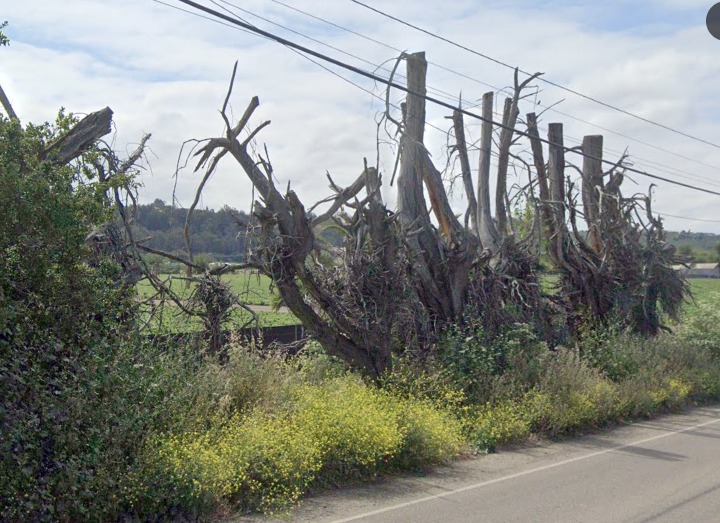
Those cypress trees are nearly all dead now, and ghastly-looking, but more than 100 years ago, they were dense. Halcyon Road was like a funnel, bounded by thick and dense green cypress, until you hit the County Highway, today’s Highway 1, to Oceano.
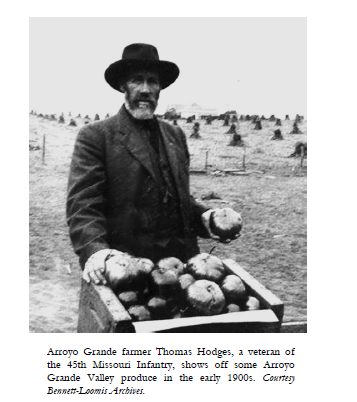
Shirley and Michael pinpointed the man who planted the cypress. He was Thomas Hodges, a Civil War veteran (45th Missouri Volunteer Infantry), who planted them as a windbreak to protect his fruit trees. He made a guest appearance in my Civil War book.
Arroyo Grande has always been famous for its row crops. You can read about them in old newspapers as far away as Kansas and South Carolina. Our pumpkins were astonishing.
But tree crops were important too—some of you may remember dense walnut groves that surrounded AGHS, until they were decimated by the husk fly larvae.
Arroyo Grande High School at the bottom of the photo with the vast walnut orchards beyond.
But even on the “farmette” (3 acres) where I grew up, on Huasna Road, there were fruit trees that preceded our house, built in 1956. So I grew up with:
–Plums
–Apricots
–Peaches
–Apples
–Oranges
–Lemons
–Avocados.
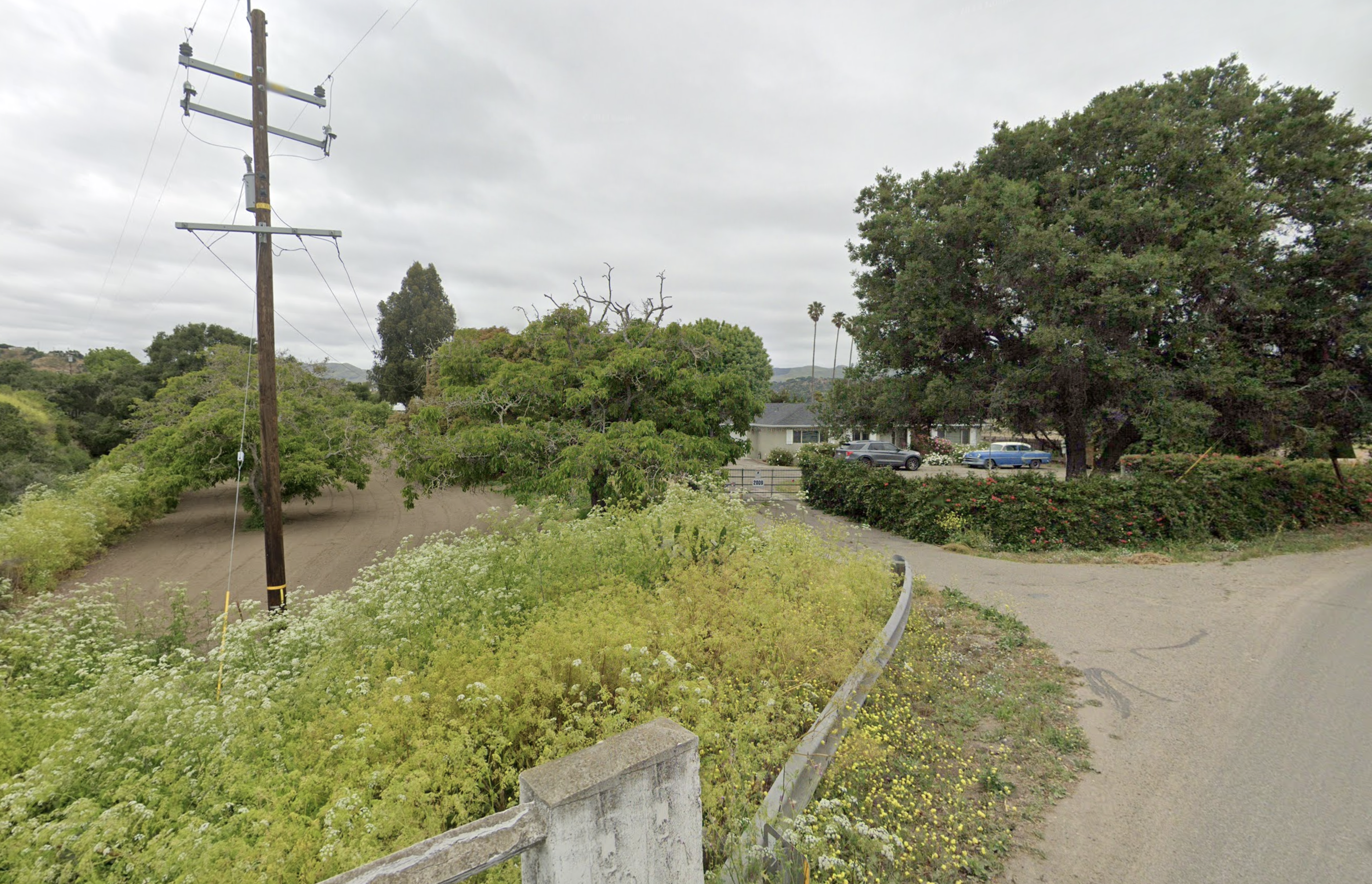
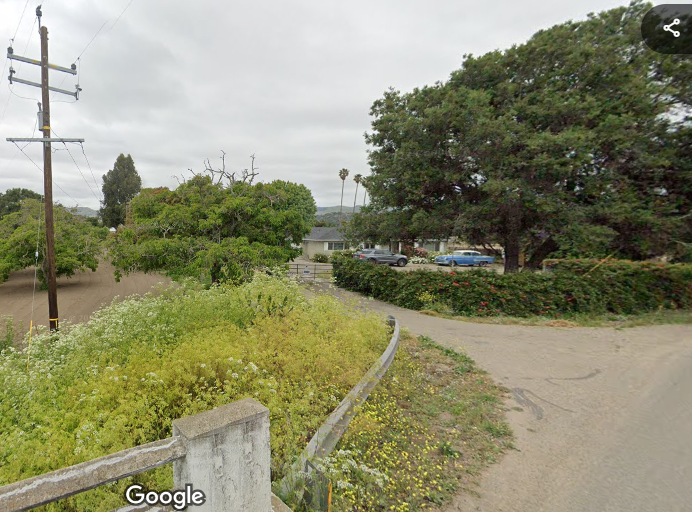
The house where I grew up, Lopez Drive and Huasna Road. Two walnut trees remain at left, in the lower pasture. The big fella out front is a loquat tree. The Queen Anne’s Lace in the foreground was always there. Arroyo Grande Creek is just beyond the left edge of this photo.
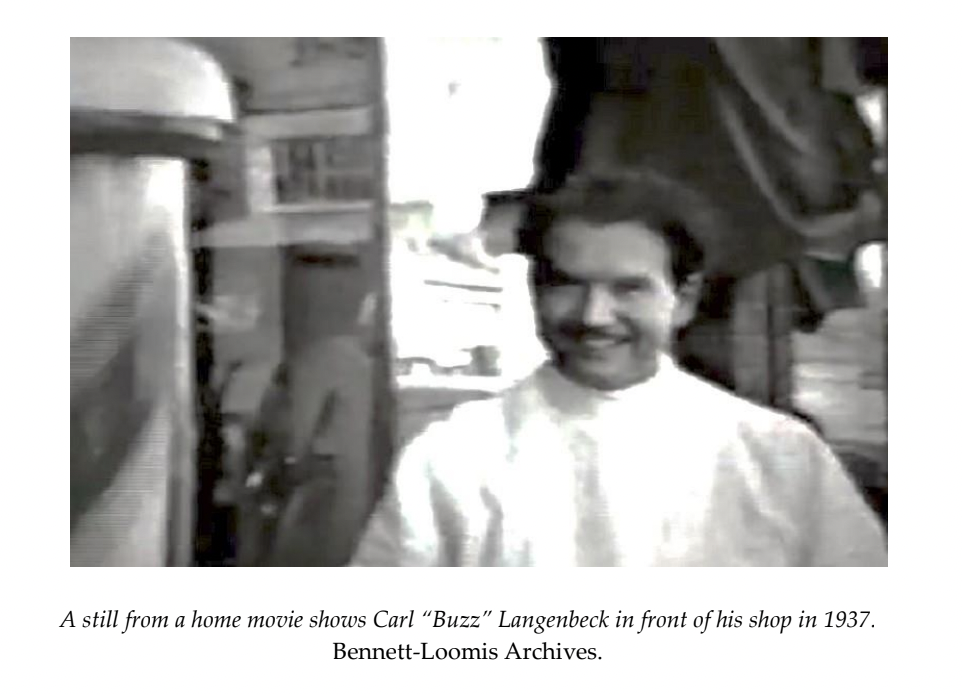
We had nine avocado trees. They were nowhere near the best. The best avocados were grown by barber “Buzz” Langenbeck, whose barbershop is today’s Heritage Salon on Branch Street. Sadly, I did not appreciate avocados until the day I discovered guacamole, probably when I was in my twenties.
And you can find, if you look for them, at least two more generations of Hodges at AGUHS, playing sports, starring in school plays, elected to class office, graduating–the venues varied–at the movie theater in Pismo or the one in Arroyo Grande, today’s Posies in the Village.
Like any other living thing, cypress trees get old, turn brittle, and die. I don’t think that my hometown’s ties to history, even to the Civil War, ever die.
Adapted from The Heritage Press, South County Historical Society
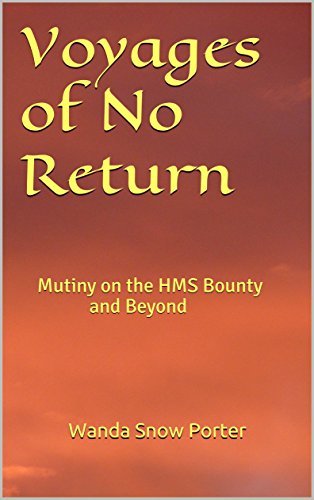
Wanda Snow Porter’s wonderful book about her husband’s ancestor. Charles Porter was a descendant of Isaac Sparks.
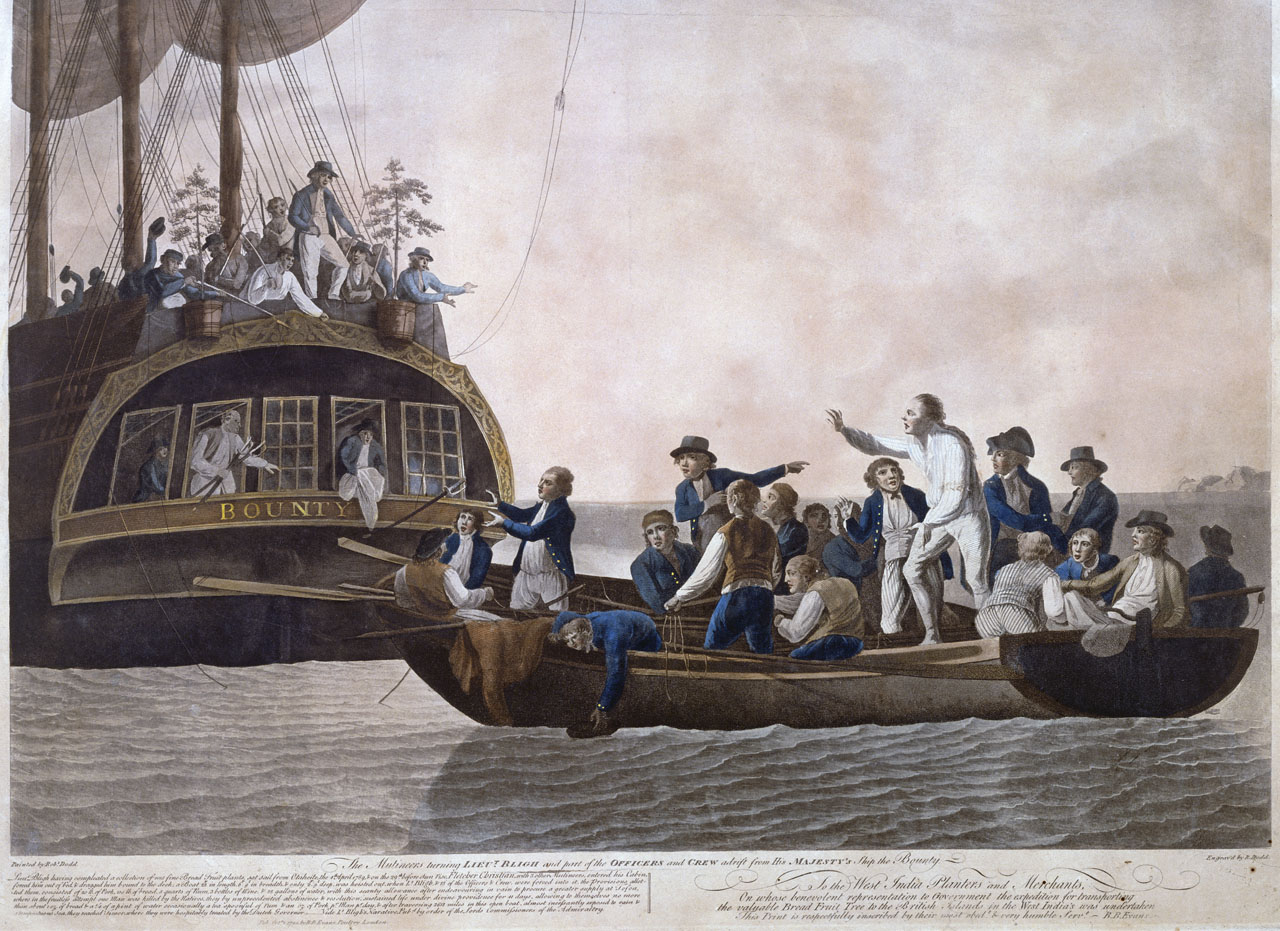
On April 28, 1789, mutineers led by Fletcher Christian put Capt. William Bligh and his loyalists into a longboat and sailed away with HMS Bounty. Bligh navigated his way to safety.
The mutineers sailed for Pitcairn Island and settled there, but violence was frequent. Some of their descendants still live on Pitcairn.
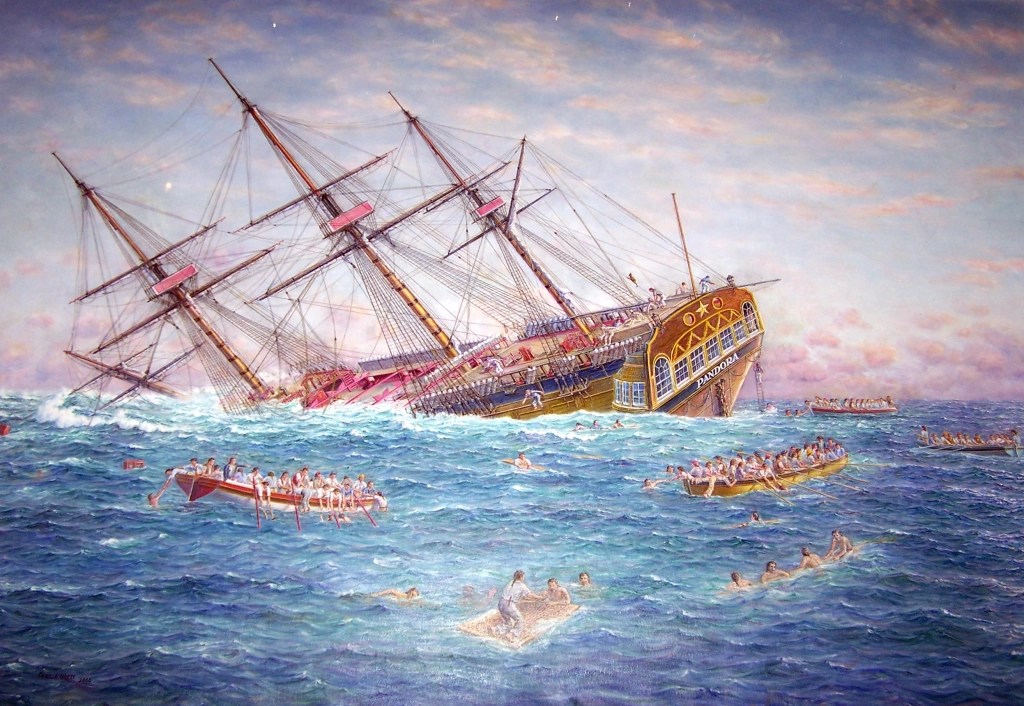
In 1791, the frigate HMS Pandora captured some of the mutineers and sailed for England for their trials. But Pandora wrecked on a reef near Australia and several mutineers died.
Among them was midshipman George Stewart, 21, killed by a falling gangway as Pandora broke up.
Stewart left behind his Polynesian wife, Pegue (“Peggy”) and their little girl, Maria Stewart (1790-1871).
Maria married George Washington Eayrs (1775-1855), an American ship captain, in Tahiti in 1809.
Their little girl, Maria de Los Remedios Josefa Antonio Eayrs, was born aboard Eayrs’s ship, Mercury, in Bodega Bay in 1813. (She died in 1871).
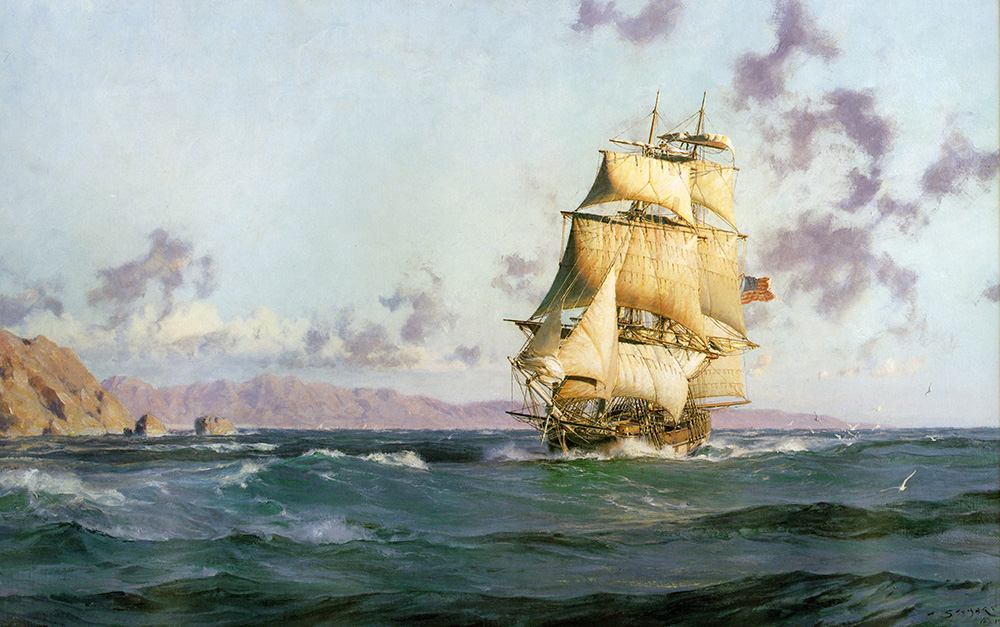
The brig Pilgrim, depicted leaving Santa Barbara for Monterey, was part of the active California trade with the East Coast, as was George Washington Eayrs.
She married Isaac James Sparks (1800-1865), the master of the Huasna Rancho, in Santa Barbara in 1836.
Their daughter, Maria Rosa, married Arza Porter in Santa Barbara in 187-.
The Porters still own the Huasna ranch today, and it’s still an active cattle ranch. This incredible pioneer family is our connection to the mutiny on HMS Bounty.
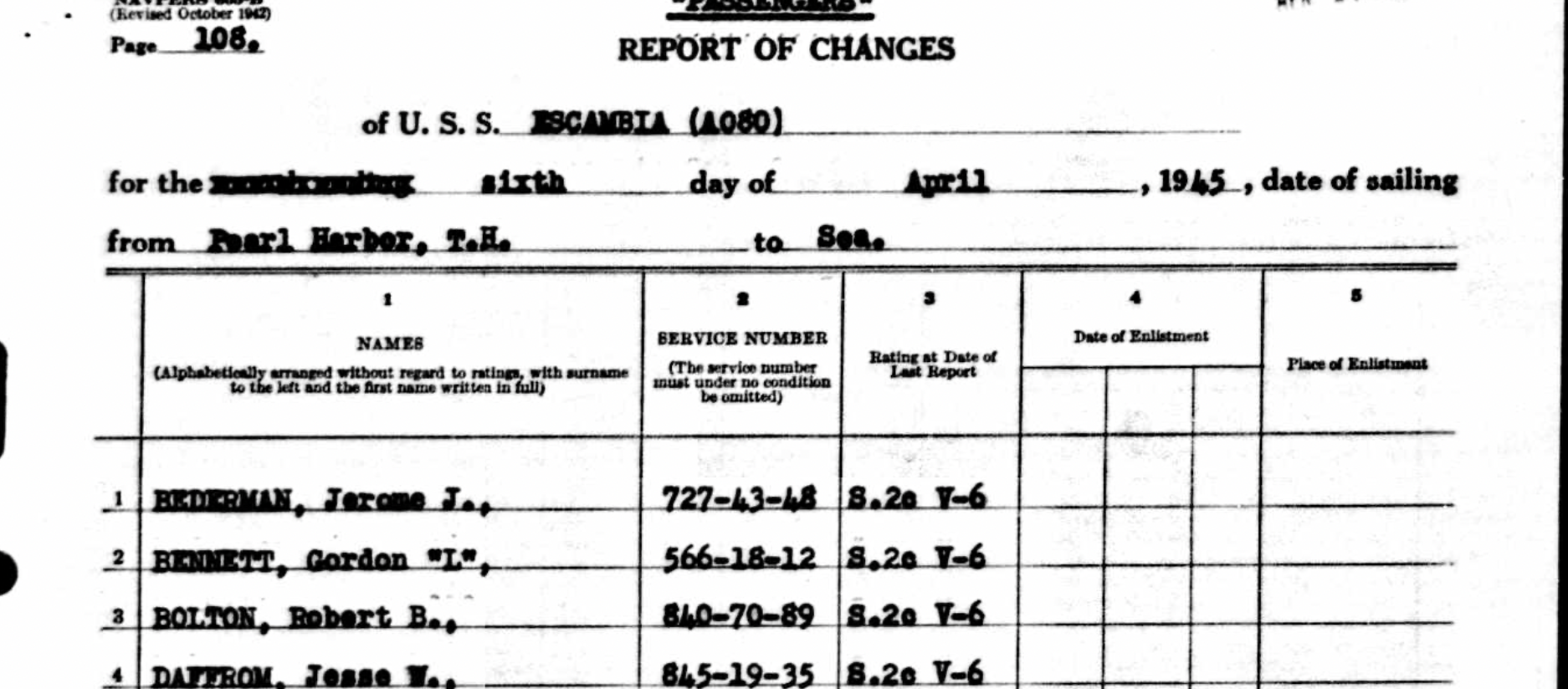
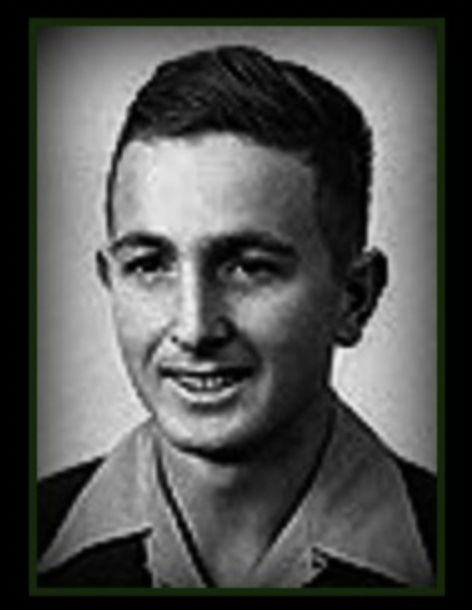
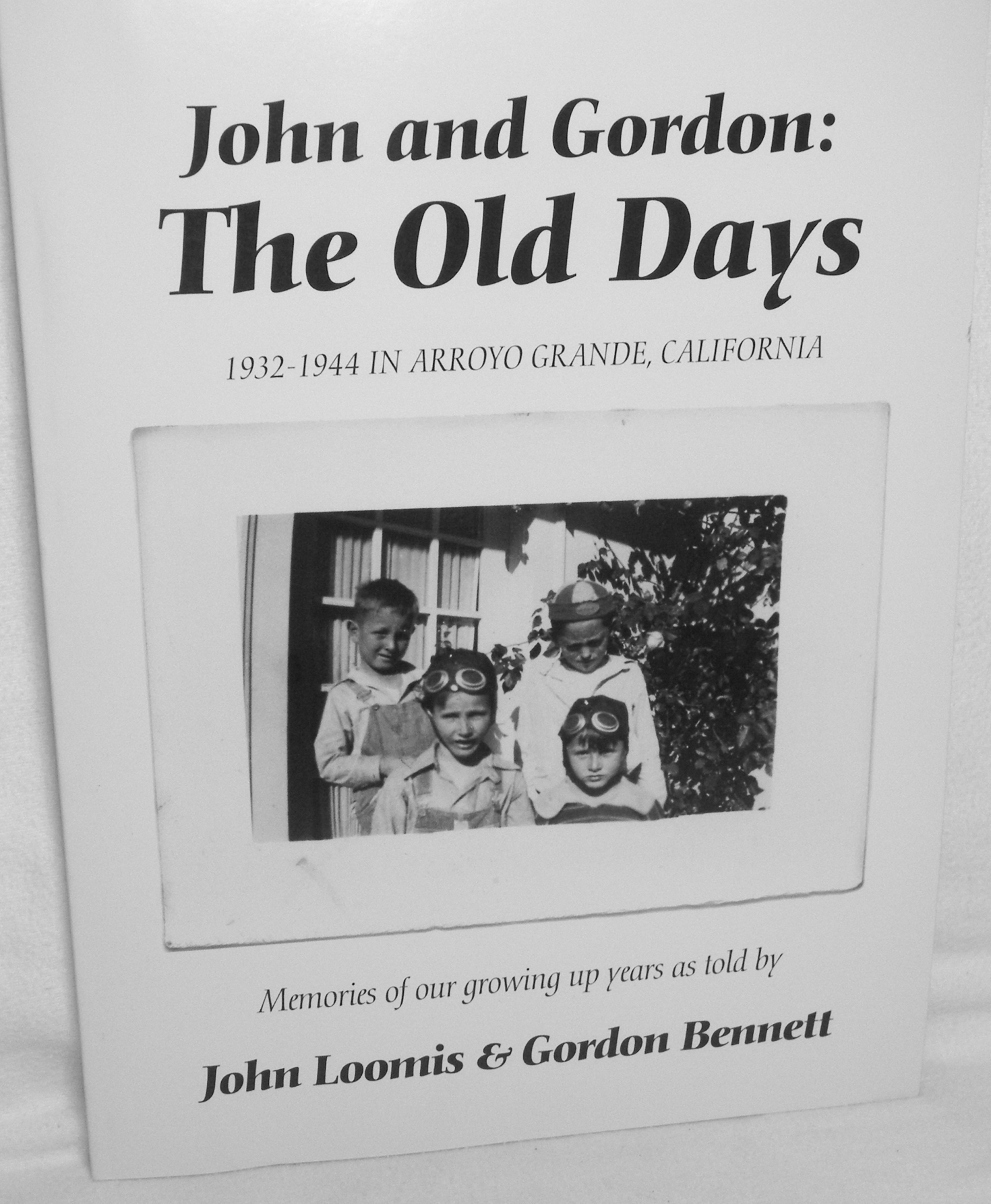
Gordon Bennett, Arroyo Grande Union High School ’44, was one of my students’ favorite guest speakers when I taught U.S. History at AGHS. He was a gifted storyteller with a sense of humor as dry as vermouth. My students and I loved hearing his stories about growing up in Arroyo Grande during the Depression and World War II.
World War II was waiting for them when both Gordon and his cousin, John Loomis, joined the service. The two found themselves not that far apart during the Battle of Okinawa, which had begun April 1, 1945. John was onshore with the 1st Marine Division, Gordon offshore serving as a sailor on the fleet oiler Escambia (named after a river in Florida).
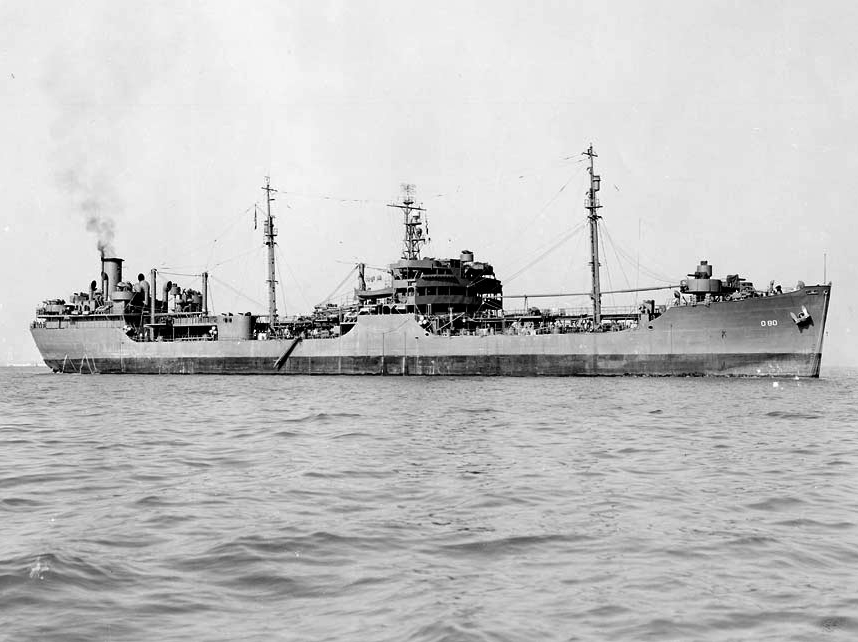
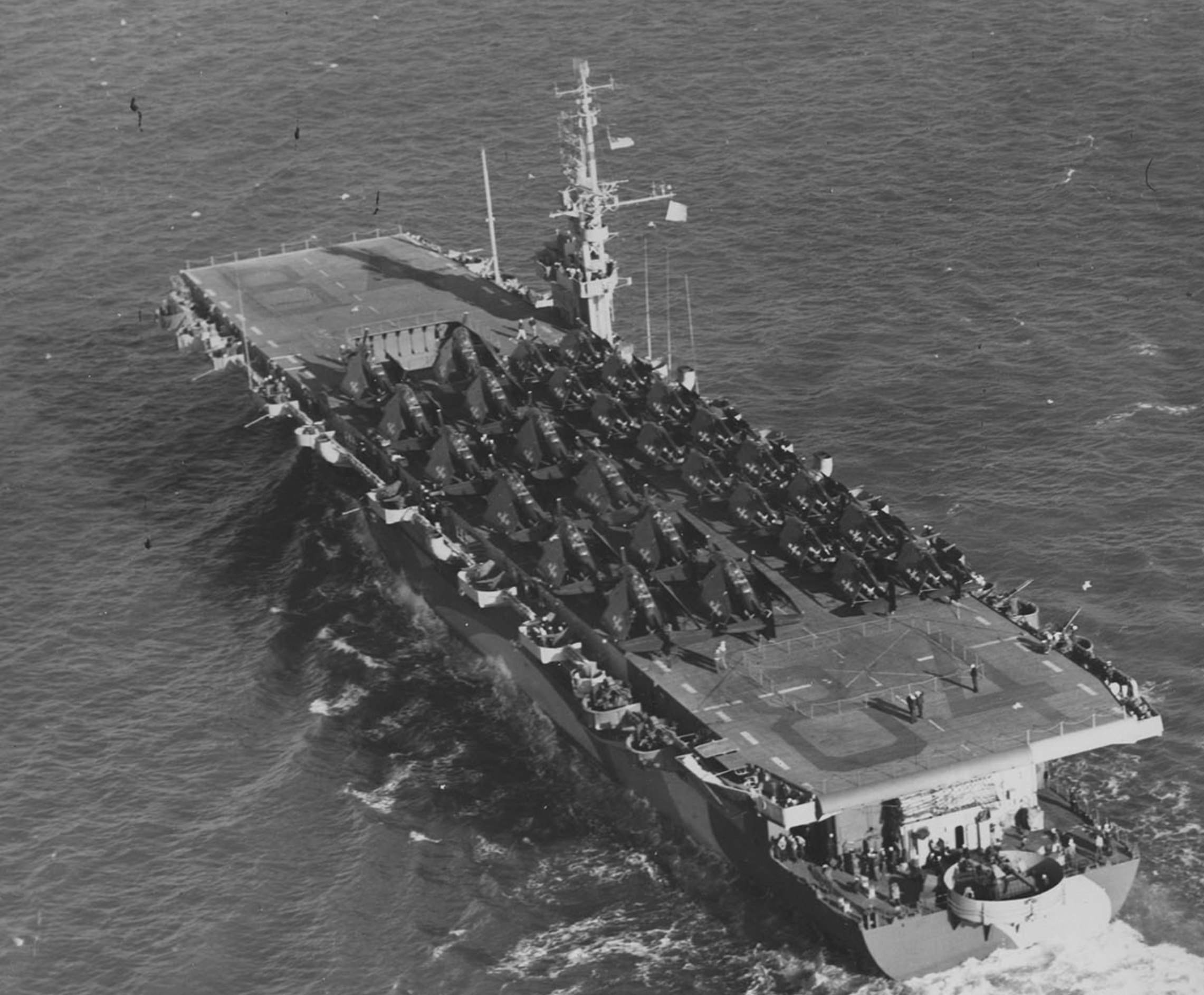
Gordon and his shipmates serviced escort carriers (small carriers that carried around thirty planes, like Emerald Bay (above), during the height of the kamikaze attacks off Okinawa. Thirty-four Navy vessels were sunk and over 280 damaged during the last, desperate battle of the war. The little carriers that were Escambia’s responsibility escaped and launched a series of airstrikes on the island. Both Escambia and Emerald Bay were based at Ulithi, where Gordon, according to legend, experimented in the distillation of medicinal beverages.
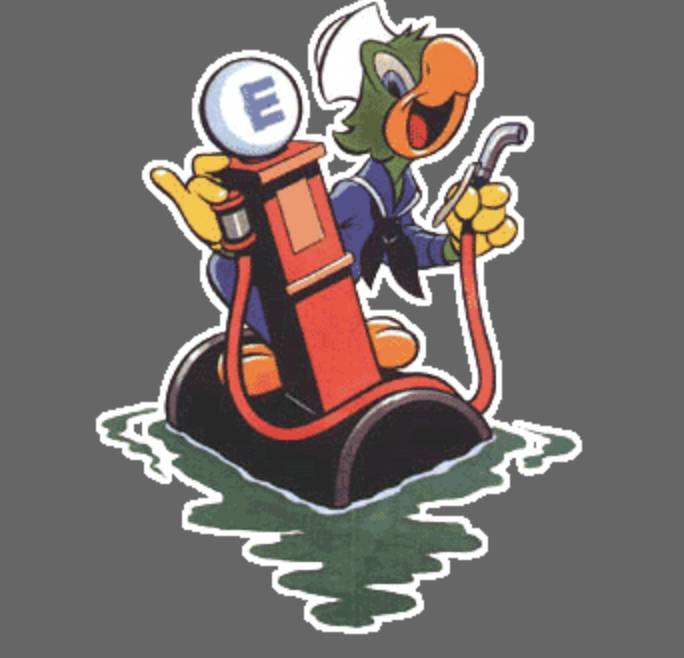
Above: The Ulithi anchorage; Gordon in high school; USS Escambia’s logo, designed by a Disney artist.
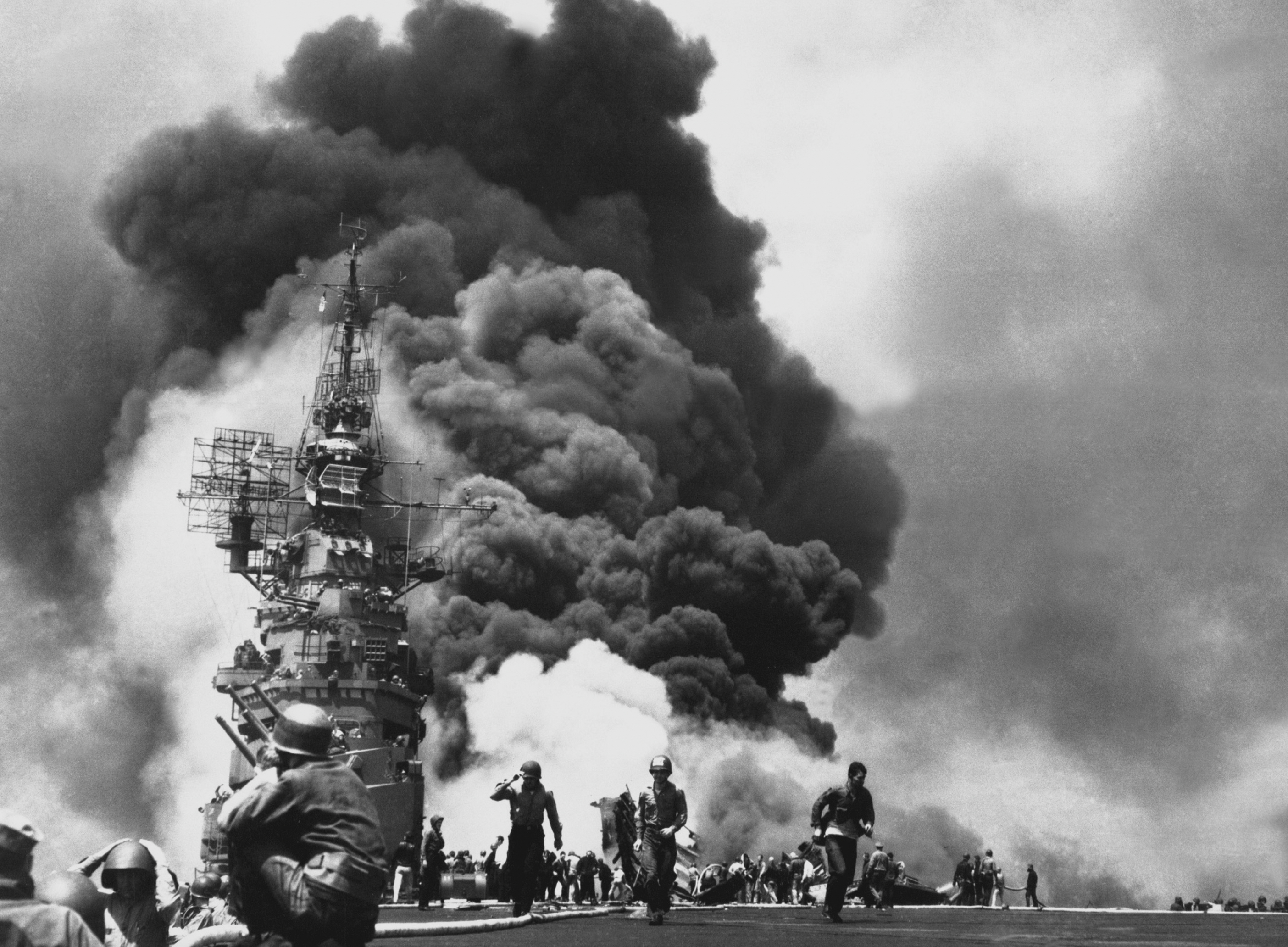
Which, given the ferocity of the kamikaze attacks, I might’ve sipped. The carrier Bunker Hill after once such attack, below.
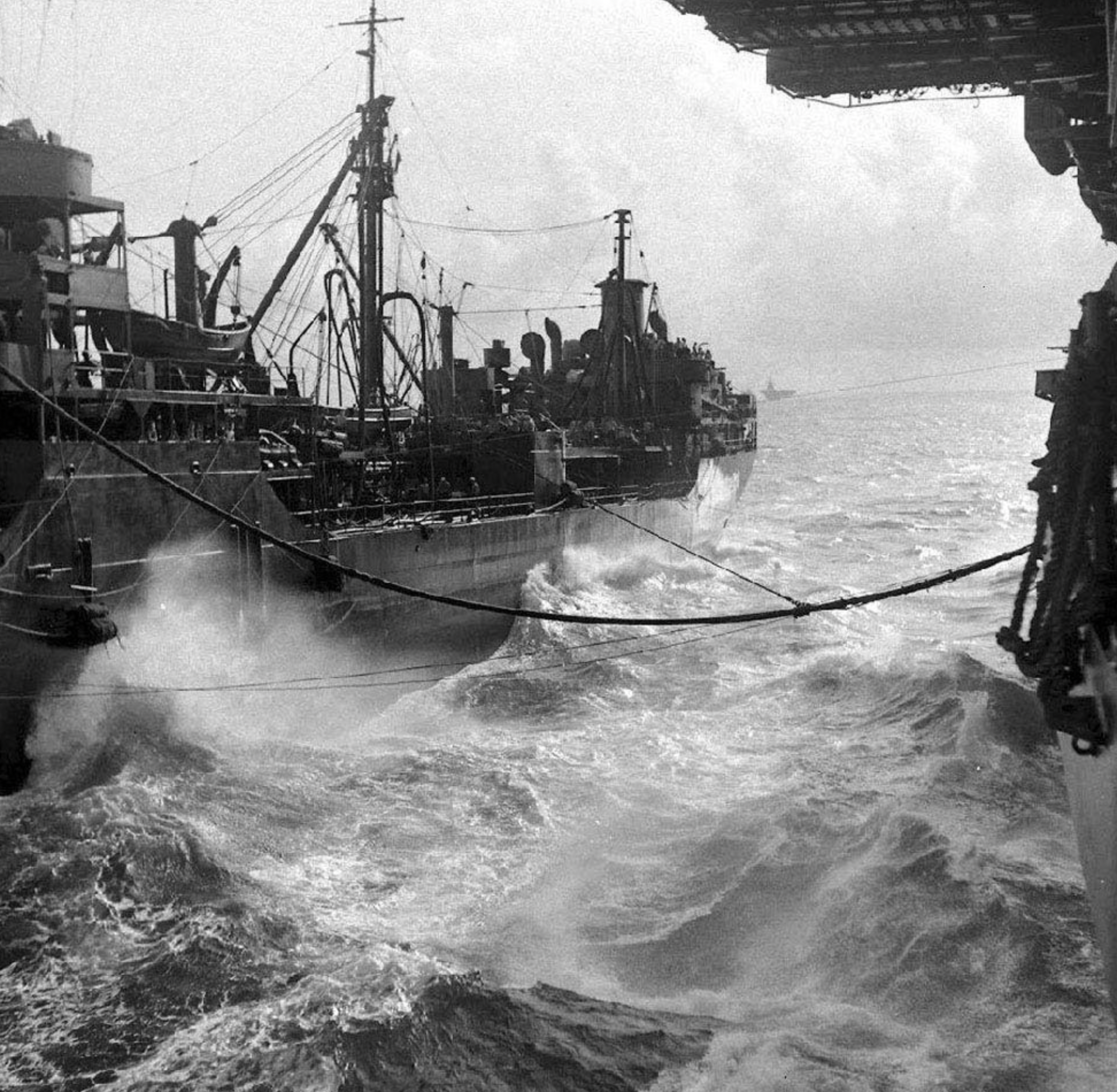
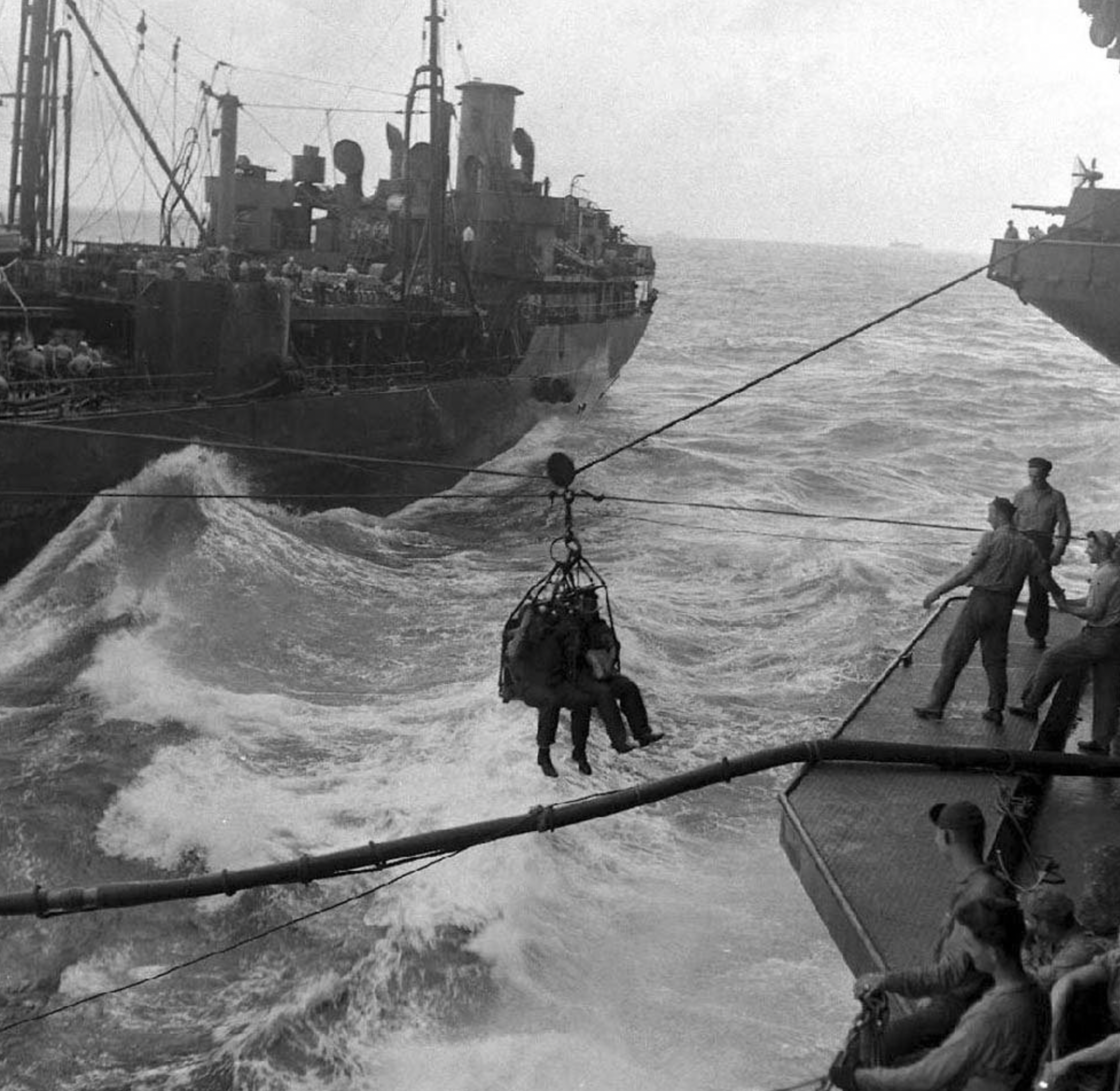
The sailors on the fleet oilers were tough men. Fueling at sea was smelly, dirty, and very dangerous. The two photos show a fueling operation between Escambia and the fleet carrier Ticonderoga in July 1945. The way Escambia sailors return to their ship, in that breeches buoy, does not seem safe to me, but my guess is that Gordon would have had his turn in the same kind of conditions.
Sadly, Escambia (below, about 1950) would be used by, of all institutions, the United States Army during the Vietnam War as an auxiliary power plant. Transferred to the Vietnamese government in 1971, Gordon’t ship was scrapped.
Happily, Gordon came home safe. So did his cousin, John. They had many years of storytelling ahead of them. Gordon, in my classroom, fueled the imaginations of the young people who were high-school juniors in 2003, just as Gordon had been in 1943.
I can get through one episode at a time of the Spielberg/Tom Hanks series Band of Brothers, which speaks more to me because my Dad was an Army officer in Europe. Sometimes I can’t get that far in The Pacific. It’s so harrowing that I don’t know how any Marine came home undamaged. I don’t imagine that any did.
I read, many years ago, With the Old Breed, by Eugene “Sledgehammer” Sledge, a character in the miniseries, and the historian/biographer William Manchester’s account of his war service, Goodbye Darkness, and both left me deeply troubled. That’s exactly the impact they should’ve had.
Somehow, thanks to the work of computer artists and the incredible composition, “Honor,” by Hans Zimmer, the opening credits to the miniseries are strangely and surpassingly beautiful.
But it remains a disconnect in my spirit, to imagine what young men from my hometown went through. There were other Marines, but here are five who resonate for me.
Louis Brown, killed on the beach at Saipan in 1942, finally came home to his mother in 2017.
Archie Harloe, son of the schoolteacher, was part of the invasion Saipan. He survived, but Marines watched, horrified, as islanders leaped to their deaths from ocean cliffs. They’d been told the Americans would torture them.
Louis Brown, the son of a Corbett Canyon farmer, an Azorean immigrant, stepped on a Japanese on Iwo Jima. Cause of death: “Burns, entire body.” This is the young man who, on finding his grave, started me writing books. What I owe him is beyond measure.
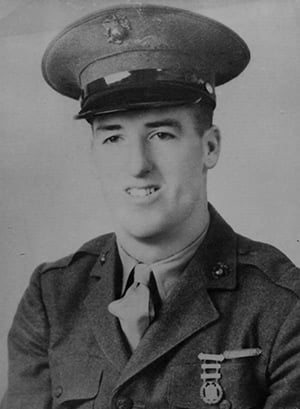
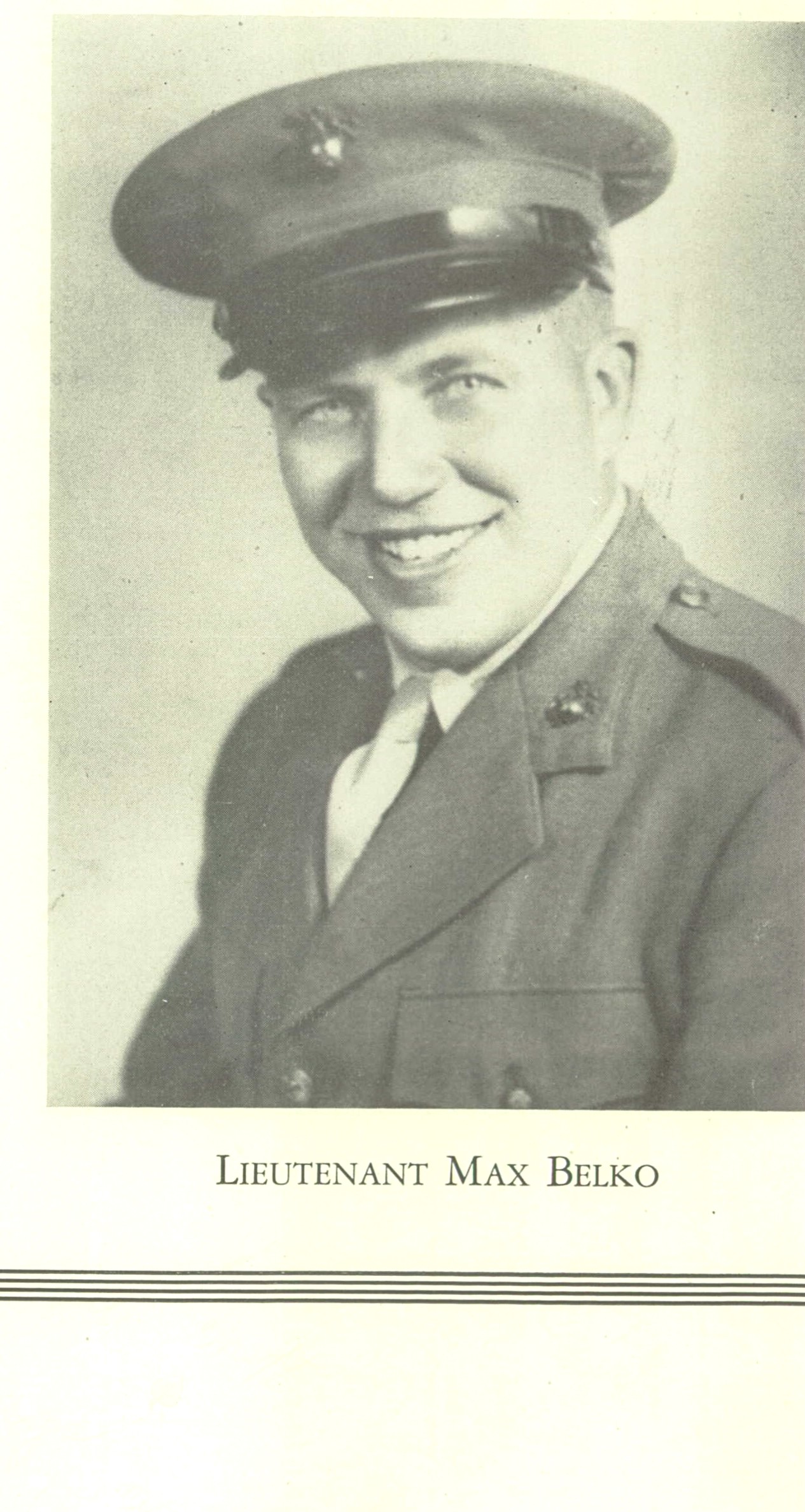
Lt. Max Belko, a USC All-American football player, became a P.E. teacher and football/basketball coach at Arroyo Grande Union High School–his kids would’ve played in today’s Paulding Gym. He was killed on the beach in the invasion of Guam.
John Loomis, AGUHS ’44, joined the Marines so he could get into the war before it ended. He did, at Okinawa, one of the costliest battles in the Pacific. He survived to raise the daughters and the son who would be among my closest friends growing up.
I ran away from home when I was about thirteen. It didn’t last long. We lived by the Harris Bridge–that’s our house, the way it looks today.
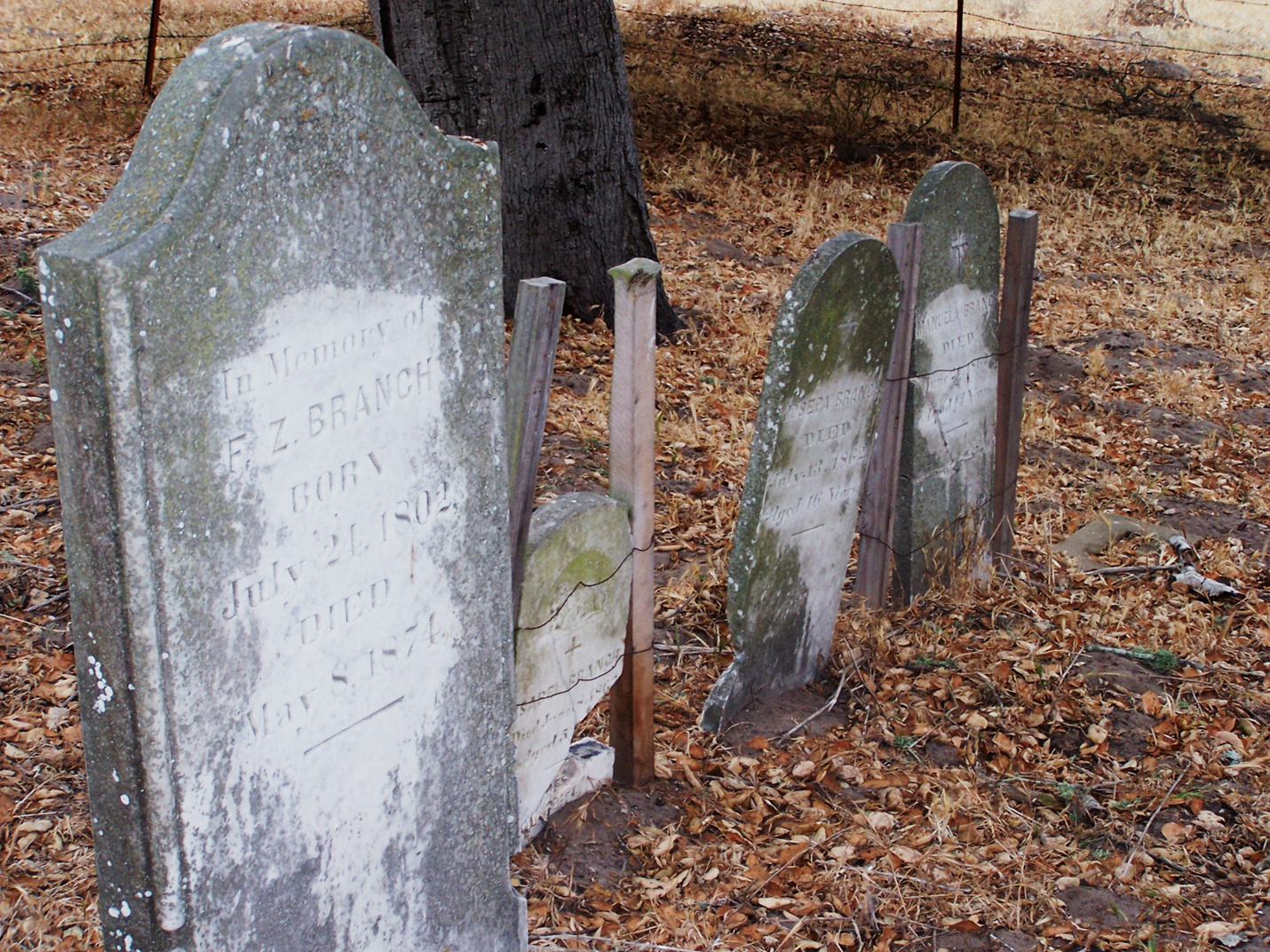
So I went up into the hills, where I found cowpies, some fresh–damn!–and cow bones and skulls, which later made their way into a book I wrote, about the drought of 1862-64 that decimated Francis Branch’s cattle. In modern dollars, it cost the founder of Arroyo Grande $8 million, and the drought arrived the same year he lost three little girls, now buried next to him, to smallpox.
My situation wasn’t quite that dire. I was angry with my Mom and, given to grand gestures, running away from home seemed appropriate.
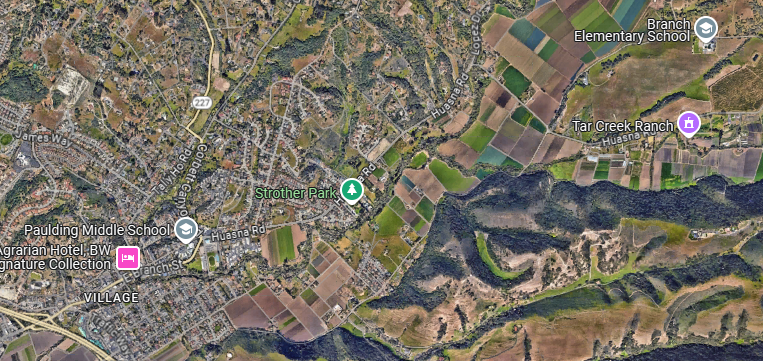
My runaway covered most of this map.
That lasted about twenty minutes. The idea wore itself out. My stubbornness didn’t. For those of you keeping score at home, I did a big loop. I turned left behind the IDES Hall, went behind Old Arroyo (We did NOT call it “The Village,” a term I consider insulting, unless you’re a Smurf), went up Cherry and then onto Branch Mill Road, grudgingly headed toward home.
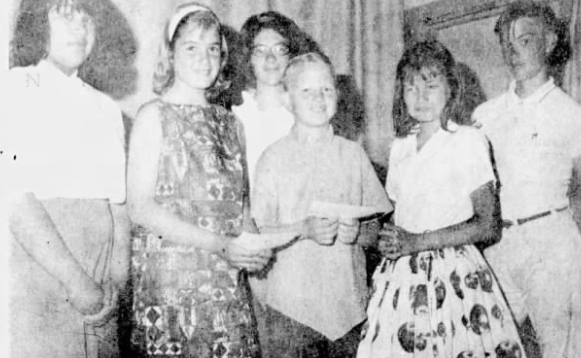
It was a long hike, especially for someone, like me, who was vertically challenged. I was always the shortest in the photo, and here’s proof, the year before I ran away from home, when I’d won a writing award for the American Legion’s Women’s Auxiliary. I believe the topic was “Lordy, How I Hate Communism.” I could be wrong, but not by much.
Me, front center, with my hair neatly slicked down by Avon Hair Trainer, courtesy of our Avon Lady, Mary Lou Fink, whom we loved. To my immediate right is Josephine Thwaites, AGHS ’71. Her Mom, many years later, took our wedding photos.
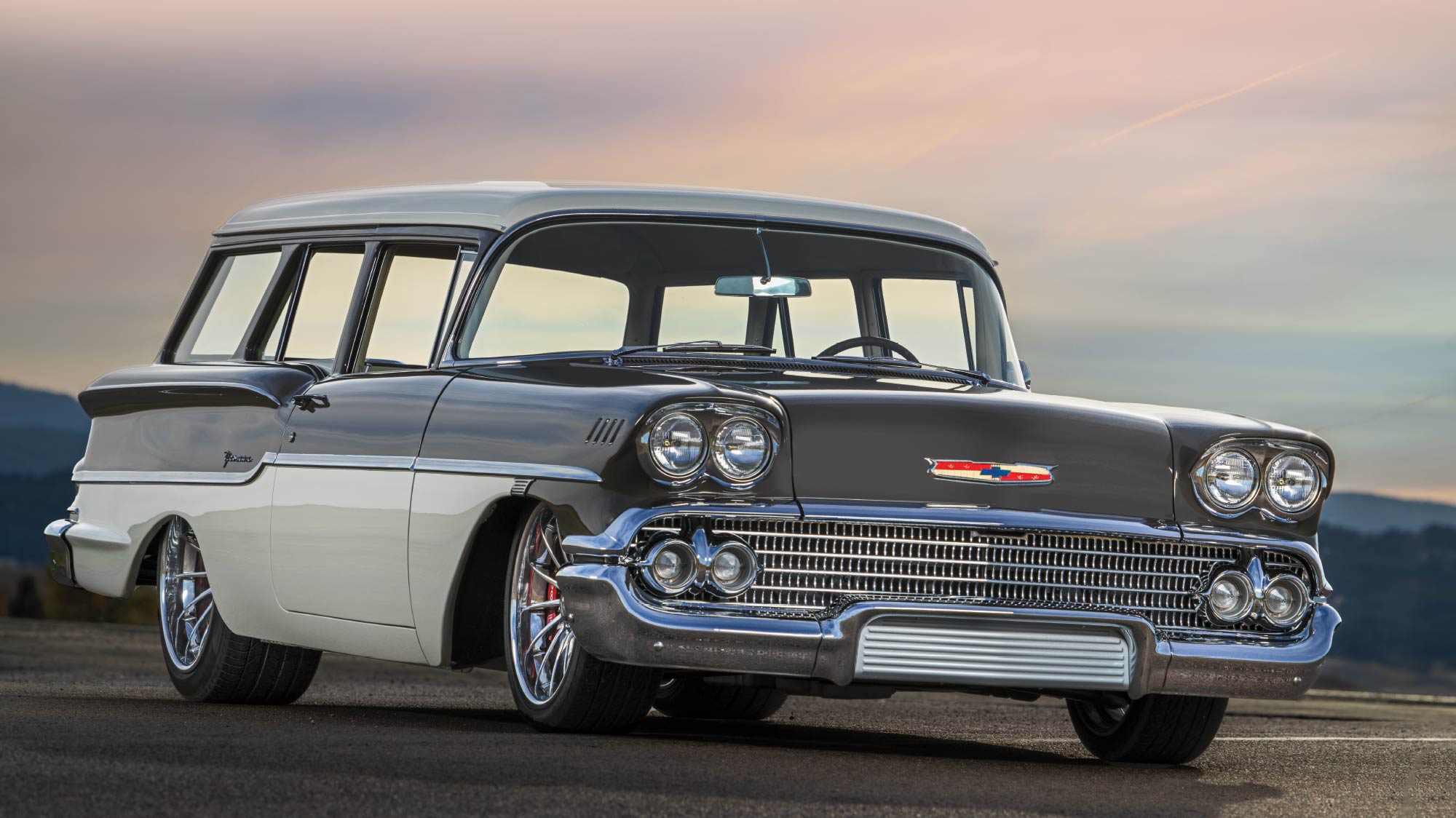
I walked up Branch Mill and was getting close to Tar Springs Creek when a 1958 Chevy station wagon stopped.
Behind the wheel was Diana Berguia. Her passengers were, I think, her sisters—Angie, Connie (my contemporary and my friend back to first grade at Branch School, and later my teaching colleague at AGHS) and Emily.
“Do you need a lift?”
My feet hurt.
I bashfully accepted. Diana was immensely older and more classy than I—she must have just gotten her driver’s license, which only validated this estimated. And she was beautiful, with long straight black hair, and I think I remember a soft and almost musical voice. Her family farmed far up Huasna Road, past the haunted house where little Alice had been murdered, up toward the Coehlos but not quite as far as the big tree where the fog stopped and not quite as far as the Tar Springs Ranch or the Porter Ranch beyond where, in my imagination, bounded as it was by the Upper Arroyo Grande Valley, you reached the ends of the Earth and fell off. I later learned about Pozo.
Geography aside, my feet hurt, and I was being picked up by a station wagon full of girls. Accepting Diana’s offer was the first good decision I’d made all day.
I have a damnable habit of getting rescued by friends—Joe Loomis is another example of this, if you’ve heard that story (if you haven’t, look up “Redheads” on this blog)—and I think Diana sensed that I was upset. And she was worried. I was short enough to be run over by a celery truck, with me unseen, so the Berguias got me home safely.
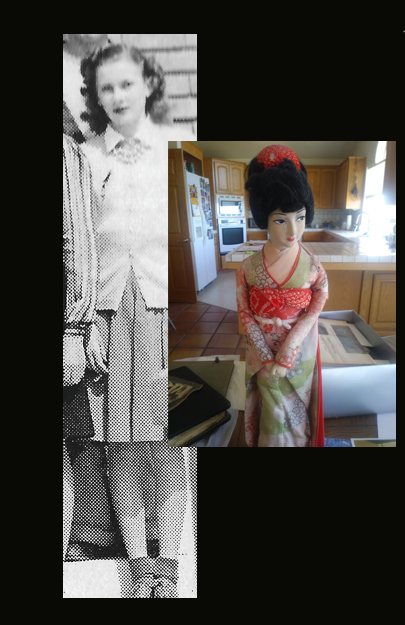
Years and years and years later, I was interviewing Jeanne Wilkinson Frederick, whose father owned the Arroyo Grande Meat Market. I’ve written about her, too, because her dad was so kind to his Japanese customers—his friends—that they sent Jeanne this beautiful doll from the Rivers Internment Camp in the Arizona desert. Jeanne, at 93, still had it.
Jeanne Wilkinson as an AGUHS student, about 1944, and the doll .
She also still had her father’s ledgers. It was customary for grocers and butchers to allow the farm customers to run a tab, to be paid off when the harvest came in. When I opened the ledger, the entries were for Diana’s father, Victorino, born in 1909 in the Philippines.
The memory of the day I ran away from home came back to me just then, along with the realization of the luck I’d had in growing up with Victorino’s children. An AI description of his birthplace:
Barotac Nueva, Iloilo, is known for its friendly people and is a great destination for travelers who want to experience the local culture. Some say that the people of Barotac Nuevo are among the most hospitable in [the Philippines].
Of course that must be true. It is now sixty years since Diana pulled over to ask if I needed a ride. It remains one of the most vivid, and one of the warmest, memories of my life.
The Berguias were, are, and always will be one of our finest families.
Special thanks to Shannon Ratliff Evans, whose faithful Facebook record, “Arroyo Grande High School’s Fallen Angels,” is a constant reminded to me of how lucky I’ve been to have grown up in Arroyo Grande.
This is a first draft–most of it borrowed from other writing of mine–of remarks I’m to give for the History Center of San Luis Obispo on October 19 at the beautiful octagonal barn just south of town.
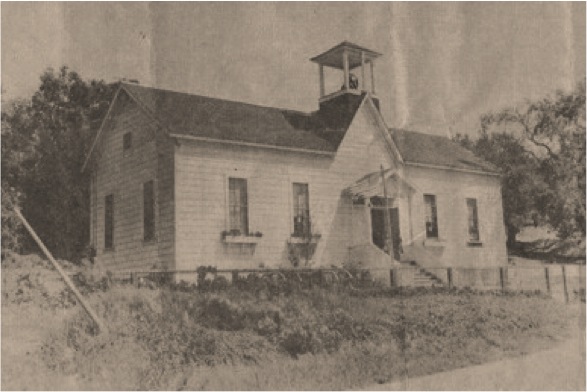
I began my formal education in a two-room schoolhouse in the Upper Arroyo Grande Valley that had been built in 1888. Some of our desks still had inkwells. A two-cubicle outhouse was our restroom. One day a mountain lion came down from the hill above the schoolhouse and sniffed around our baseball field.
Just over the hill was a little family cemetery that contained the graves of the Branch family, rancheros and founders of Arroyo Grande. Mr. Branch, who died in 1874, is buried beside three daughters, all taken by smallpox in the summer of 1862. And nearby are the graves of a father and son, suspected killers, lynched from a railroad trestle over the creek in 1886.
I had no choice but to become a history teacher. Later, I had the chance to write books about the history—local history—that I love so much.
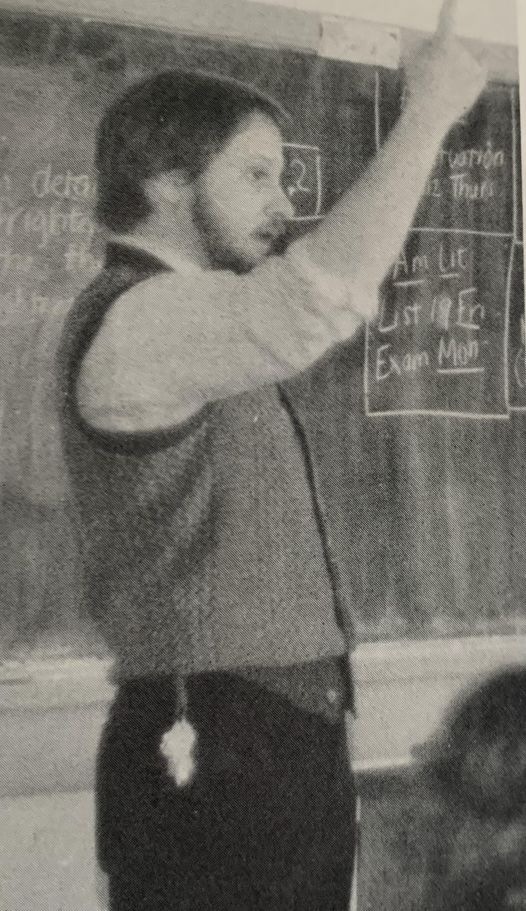
Me, teaching, I guess, at Mission Prep. It’s probably Civil War-era, either Whitman’s poem “Crossing Brooklyn Ferry” or Little Round Top on July 2 at Gettysburg.
The lynch mob’s victims, a father and his fifteen-year-old son, led to a book about San Luis Obispo County outlaws.
Finding a Marine’s tombstone—he grew up in Corbett Canyon and died on Iwo Jima three days short of his twenty-first birthday—led to a book about World War II.
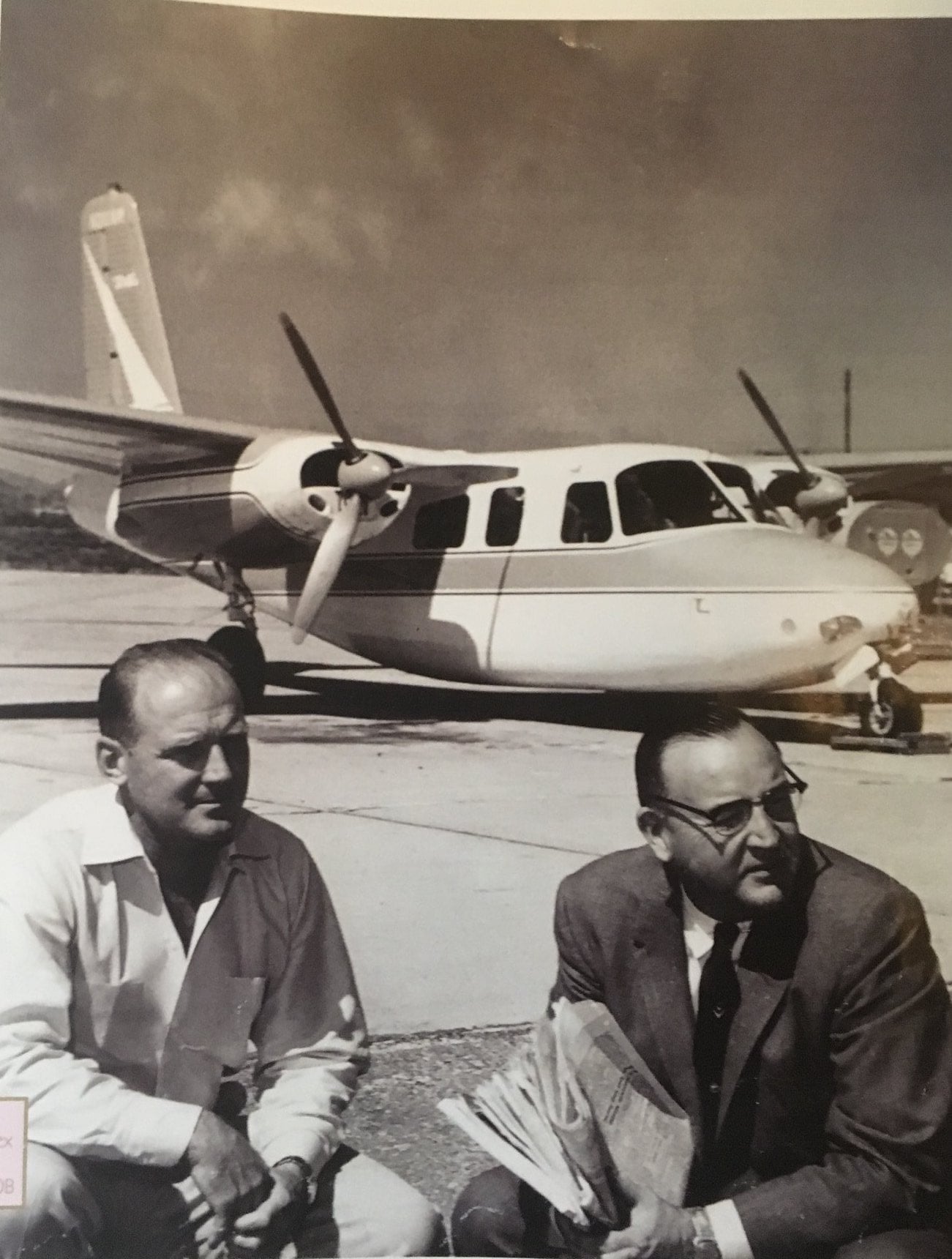
My father was Madonna Construction’s comptroller. He took my brother Bruce and me on an airplane with him once—I was six—while he bid a job in Marysville. The plane was Madonna’s twin-engined Aerocommander; the pilot was Earl Thomson, co- founder of the county airport. I was enthralled by that trip. Sixty years later, it led to a book about Central Coast aviators in World War II.
Alex Madonna, Gov. “Pat” Brown, and the Aerocommander.
My father liked to tell family stories. Dad and Dan Krieger were the best storytellers I have ever known, and that is how I taught history for thirty years.
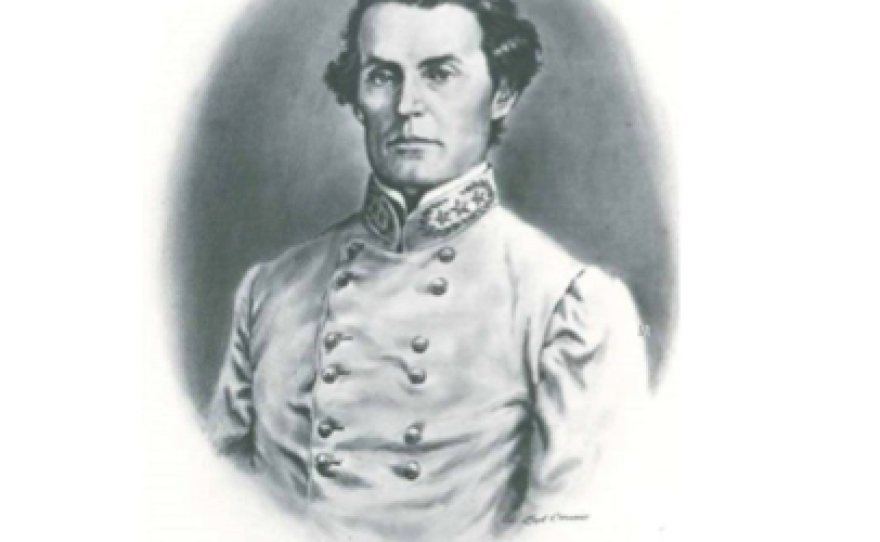
My name, James Douglass, is from Dad’s family. James comes from my great-great grandfather, an undistinguished Confederate brigadier general. Douglass comes from his son, a young staff officer who had an unfortunate encounter with a Union artillery shell in Arkansas in 1862. Dad’s stories about his family, influding these two, would lead to my writing a book about the Civil War and the sixty veterans buried in Arroyo Grande’s cemetery. To my distinct pleasure, they are all Yankees.
I do not want to cause a political ruckus here, but I am a Lincoln man.
Gen. James H. McBride, for whom I am named.
History can touch us in what seem to be the most casual of ways.
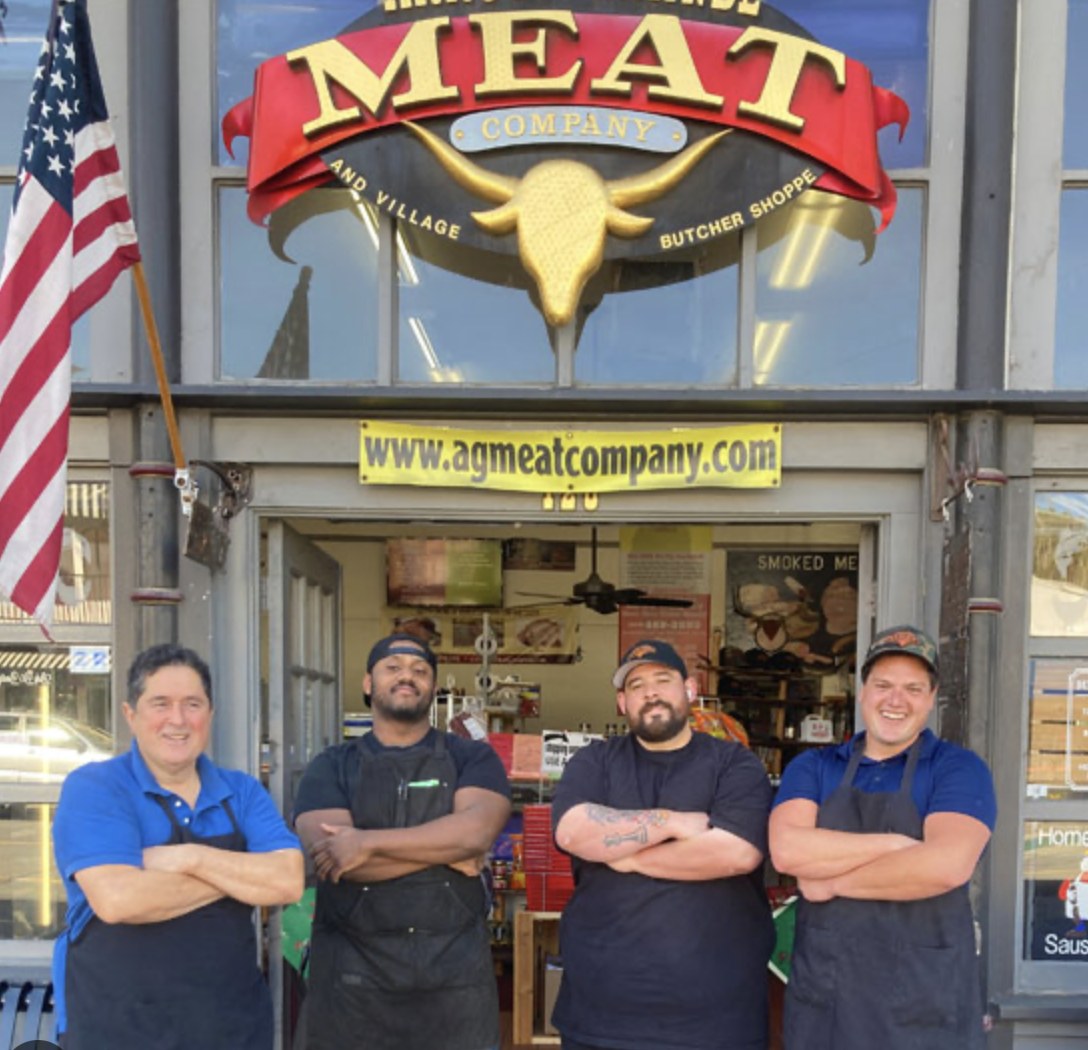
Last week I spent a large sum of cash at the Arroyo Grande Meat Co. on Branch Street, and it was money well spent: Five grass-fed Spencer steaks for my son John’s birthday.
While I waited for the steaks to be wrapped, I remembered that
–This has been a meat market since 1897.
–It, and the storefronts alongside it, were built with brick quarried from Tally Ho Creek clay.
–The brick was fired in a lot owned by Pete Olohan, Saloonist Extraordinaire, and the building named for him includes today’s Klondike Pizza.
–Two of the early meat market partners were E.C. Loomis, he of the feed store, now empty, at the base of Crown Hill, and Mathias Swall, who also built the bank that is now Lightning Joe’s.
–Mr. and Mrs. Swall lived in the home that is now the Murphy Law Firm on Branch Street. They both loved music and played instruments and resolved to teach their children to play instruments, as well. There were twelve little Swalls. Noisiest house in town.
–E.C. Loomis’s sons, including Vard, a onetime Stanford pitcher who coached a local Nisei team, safeguarded the farms and farm equipment of their Japanese American customers during internment, among many local families who did so out of simple admiration for their neighbors, their values and for their devotion to the little town they shared.
–That is how Vard Ikeda got his name, and those families’ friendship is in part why two generations of Ikedas have been so incredibly important to local youth sports.
–Shortly before they were “evacuated” to internment camps in 1942, Japanese farmers came into the meat market to settle their bills. Paul Wilkinson, then the owner, refused to take their money. These were his friends.
“You keep it,” he told them. “You’re going to need it.”
After the war, they paid Mr. Wilkinson back. In full.
I grew up with schoolmates whose grandparents came from Kyushu, the southernmost Japanese home island. Some of my friends’ families came from the Azores and some from Luzon, in the Philippines.
When I was a little boy, the whistling of braceros—baroque and beautiful—woke me up summer mornings as they went down to the fields next to us for work.
I learned my first Spanish from them. Years later, one of my university Spanish professors took me aside to offer me one of the greatest compliments of my life::
“Mr. Gregory, you have a distinct Mexican accent.”
My first sushi was on a special Japanese holiday—I think it was Labor Day—at Ben Dohi’s house. Ben was married to a Yamaguchi sister, and Dr. Jim Yamaguchi came down with his wife and baby girl from the Bay area to visit. I got to hold Jim Yamaguchi’s daughter. Her name was Kristi. She would grow up to be an Olympic gold medalist. I did not drop her.
Kristi Yamaguchi, 1992 Winter Olympics
Mary Gularte took pity on me one cold morning when the schoolbus was late. She took me inside her kitchen and kept an eye out for the bus while setting a dish of sopa—Portuguese stew—on the kitchen table in front of me. I inhaled it. I did not have to eat the rest of the day.
My friends included families with surnames like Pasion and Domingo and sometimes they’d bring back sugarcane from the Philippines and gift me with a stalk to gnaw on. It was wonderful, but I later discovered lumpias, the divine Filipino egg roll, at the Arroyo Grande Harvest Festival. It gave me the greatest pleasure to watch Filipino mothers, most of them, once upon a time, war brides, watch me as I took my first bite of lumpia. My reaction must have been transparent. They beamed.
These were the helping hands that built our county. They helped me in my growing up. These people filled me with their history, by which I mean our history, and they remind me that history is always around us, sometimes just beyond the reach of our understanding. I write about history because I owe the past so much. My writing is the least, and it’s the very least, that I can do for my friends, including those I never had the chance to meet.
My grandfather, Ozark Plateau farmer John Smith Gregory (1862-1933) died eighteen years before I was born. He was the sweetest waltzer in Texas County, Missouri; I wish he’d lived long enough to teach me how to dance.