• About
  • The Germans

A Work in Progress

A Work in Progress

Category Archives: World War II

I honestly don’t know how all of this stuff fits in my brain

26 Thursday Mar 2026

Posted by ag1970 in World War II

≈ Leave a comment

Tags

Arroyo Grande, History, world-war-ii-aviation, world-war-ii-in-california

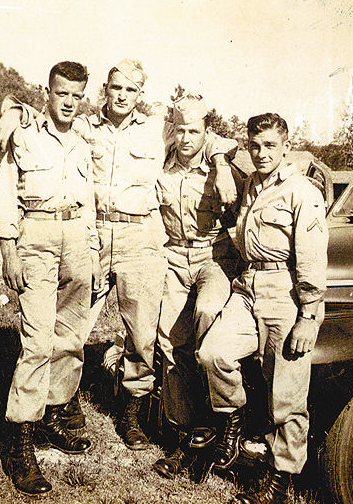
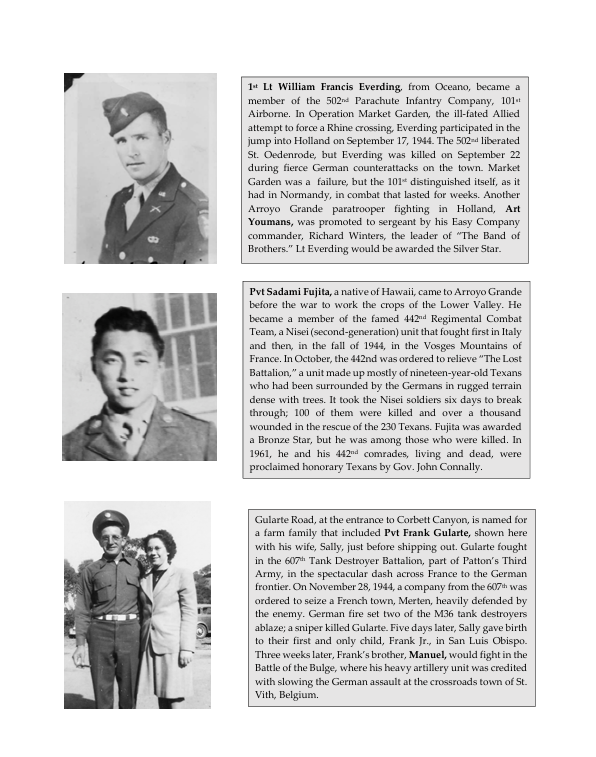
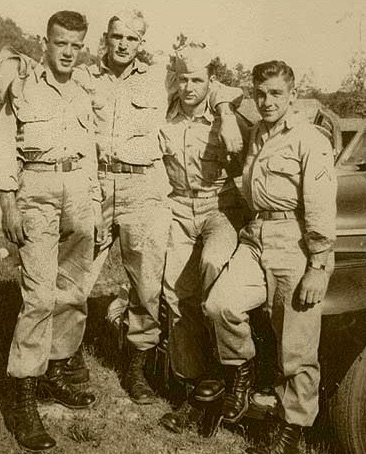
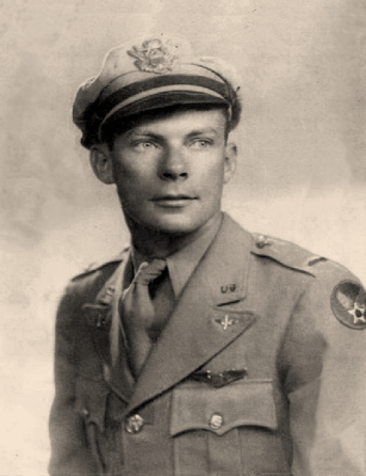
Arthur Youman, second from left, in training with the 101st Airborne’s Easy Company.


I’ve been blessed. Both an editor/author with the National Japanese Historical Society and, through my friend Erik, a young Poly history student want to learn as much as they can about SLO County (and particularly the South County) in World War II.

So I put together a blog post to try to summarize some of what I’ve learned in writing about World War II in the last eleven years, since I retired from AGHS.

I think I scared myself a little.

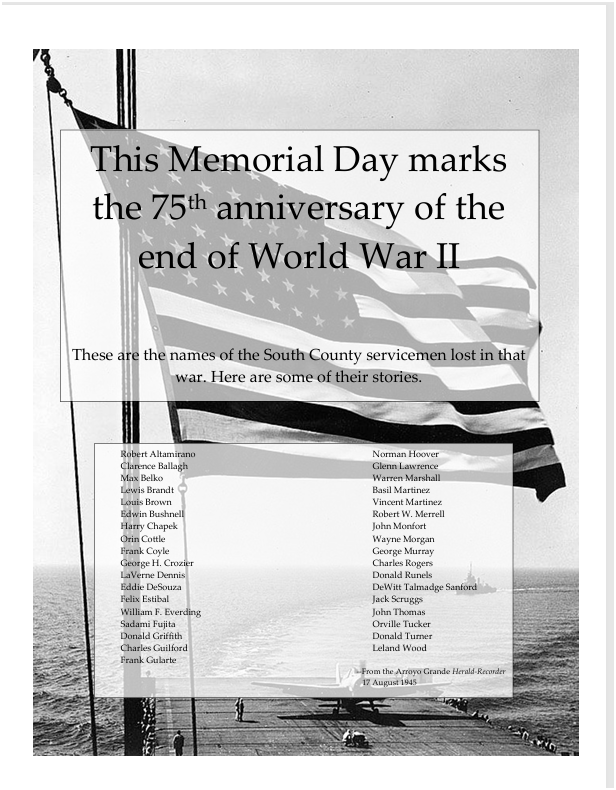
Among the South County’s (and Northern Santa Barbara County’s) contributions to World War II:

1. Arroyo Grande was home to two Nisei soldiers in the famed 442nd, one KIA in the relief of the “Lost Battalion.”


2. Another, an intelligence officer, who served as a liaison with Mao’s guerillas. Madame Mao danced with him.


3. A third, a young Guadalupe man, a medic KIA on the German frontier, 1944.


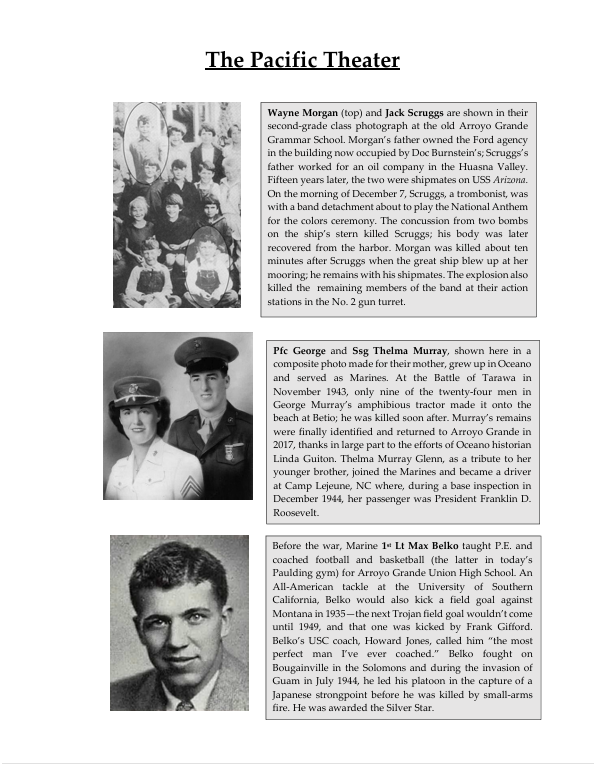
4. Two Arroyo Grande sailors, third-grade classmates, killed on “Arizona.”


5. A Pismo Beach dishwasher, a machine gunner on “Nevada,” credited with shooting down the first Japanese plane that morning.


6. Former County Superintendent of Schools Earl Cornwell, a sailor on Ford Island on December 7.


7. Nipomo sailor Donald Runels, killed on the heavy cruiser “Northampton,” who had a destroyer escort named for him.


8. The best letter home I’ve ever read was from an Arroyo Grande Filipino American. He was killed when his destroyer, “Walke,” was sunk by a Long Lance torpedo. Both “Northampton” and “Walke” went down in Ironbottom Sound, off Guadalcanal.


9. Seven of the Doolittle raiders did their primary flight training at Hancock Field in Santa Maria, including pilot Ted Lawson, who wrote Thirty Seconds Over Tokyo.

10. An Arroyo Grande B-17 copilot was awarded the Silver Star for bringing his ship home safely after it had been set afire over Berlin.


11. An Arroyo Grande High School shop teacher, as a World War II flight engineer, brought his ship home after a midair collision and a flak hit that took out both the No. 1 and No. 2 engines.

12. The P-38 figured prominently in local history, with three fatal crashes from the Santa Maria Army Airfield in January 1945 alone. A P-38 pilot from Shandon, memorialized at the American Cemetery at Normandy, was shot down over Cherbourg in a mission that was stupidly planned. Another, who retired to Orcutt, saw his B-17s “bounced” by Me109’s over the Alps. He went after them, only to find out that the lubricant to his machine guns had frozen. He decided that the Germans didn’t know that, so he made repeated passes at them. They broke contact and disappeared.


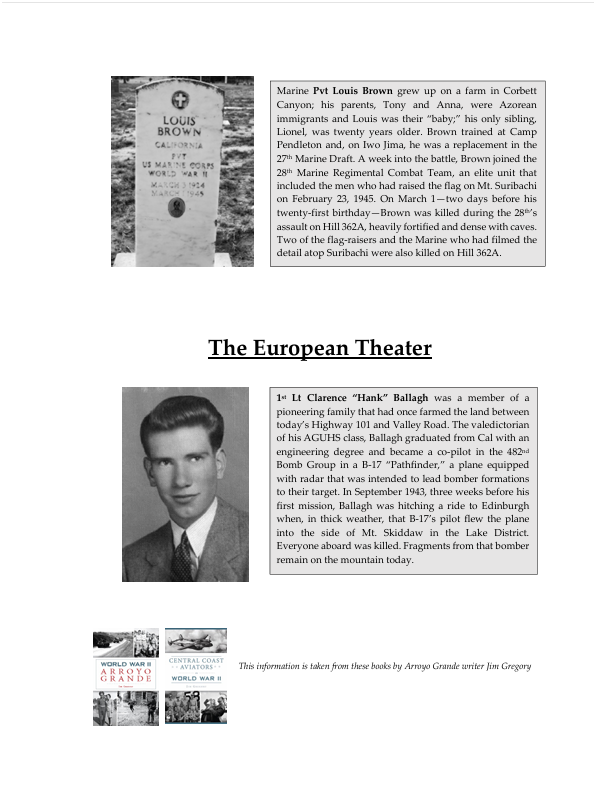
13. A Marine from Corbett Canyon was killed on Iwo Jima three days before he turned twenty-one. He was a replacement in the elite 28th Marines, which included the squad that raised the flag on Suribachi. Our Marine was killed on 362A, along with three of the flag raisers and Marine film photographer Bill Genaust, who warned AP still photographer Joe Rosenthal to turn around and get that shot that made him famous. Our Marine, a replacement and therefore resented, was in combat for total of 48 hours before he stepped on a mine. I got a copy of his Marine Corps personnel file and it read, bluntly: “Cause of Death: Burns, entire body.”


14. A Marine from Oceano was killed the instant he stepped off his landing craft at Tarawa. He was buried there, but somehow the Marine graveyard disappeared. His remains finally came home in 2017, and he’s buried next to his mother.


15. His sister joined the Marines, too. She was a driver at Camp Lejeune, and in December 1944, was FDR’s driver on a tour of the camp.

16. World War II made the Filipino American friends I grew up with possible. Filipinas were not allowed to immigrate before the war. But after Pearl Harbor and the invasion of the Islands, local Filipinos joined the Army in droves, quickly filling the ranks of two infantry regiments. They were superb soldiers and, at war’s end, there was a flurry of proposals and of weddings in the Islands. (One war bride was a little dismayed at arriving in Arroyo Grande: “It’s so muddy,” she said. “And farmy.”)

17. A Nipomo retiree landed on Dog Green Beach with the second wave of the 29th Infantry Division. The killing there resembled the opening sequence of Saving Private Ryan. He never forgot the wounded friend he could not reach without himself getting killed. Meanwhile, a future Lucia Mar Assistant Superintendent, Frank Schimandle, was piloting his B-17 above the beaches that day.

18. After their time with “Pappy” Boyington, the Black Sheep Squadron trained at the Goleta Marine Air Station, on the site of today’s UCSB. Sometimes, the AGUHS softball team played the women Marines at Goleta, and there are photos of Corsairs making low passes over Morro Bay during Army practice landings. When two 800-lb bombs struck the carrier Franklin off Kyushu, the resultant fires wiped out the Black Sheep in their ready room. 800 crewmen died that day.An Arroyo Grande sailor, maybe the most beloved Grandpa I’ve ever known, Filipino American, somehow survived to help bring the carrier home to her birthplace, the Brooklyn Navy Yard.

19. I took my AGHS students to the cemetery in Normandy, at Colleville-sur-Mer, and we found the grave of Pvt. Domingo Martinez, a local farmworker killed in July during the Normandy Campaign.

20. Another Arroyo Grande soldier—before the war, a firefighter at Camp San Luis Obispo—jumped into Normandy with the “Band of Brothers.” Dick Winters promoted him sergeant for his conduct and leadership during Market Garden.

From six years ago, another way of capturing the sacrifice our part of the county endured.


And then there are the videos:


And if these videos aren’t necessarily about World War II servicemen from my part of California, they’re indicative of my feelings for my parents’ generation, which is why I study this war so intently.


And most of the blog posts about this war:

World War II | A Work in Progress: I honestly don’t know how all of this stuff fits in my brain


Three San Luis Obispo County soldiers in the Battle of the Bulge, December 1944

20 Saturday Dec 2025

Posted by ag1970 in Uncategorized, World War II

≈ Leave a comment

Tags

ardennes-offensive, battle-of-the-bulge, belgium, d-day, france, History, san-luis-obispo-county, wwii

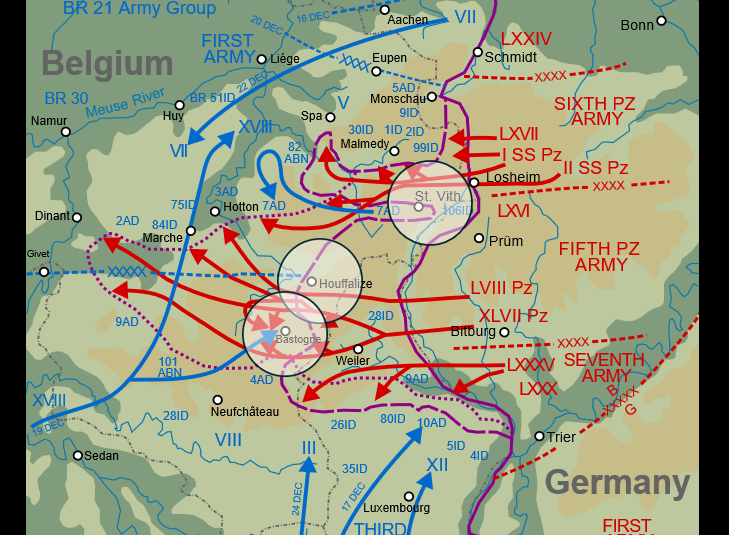
The “Bulge,” in the dotted line, indicates the depth of the German assault, intended to drive a wedge between the American and British armies and drive to the Channel.

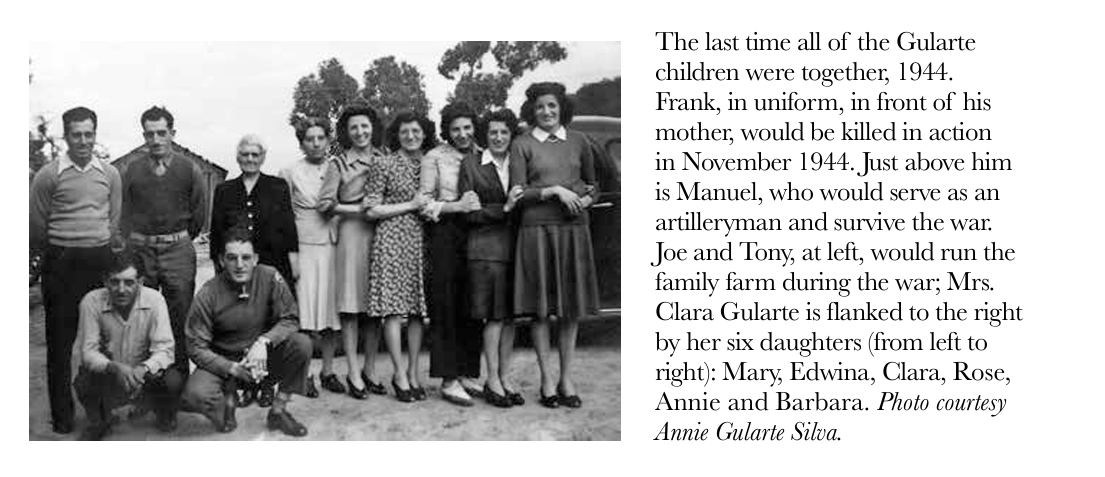
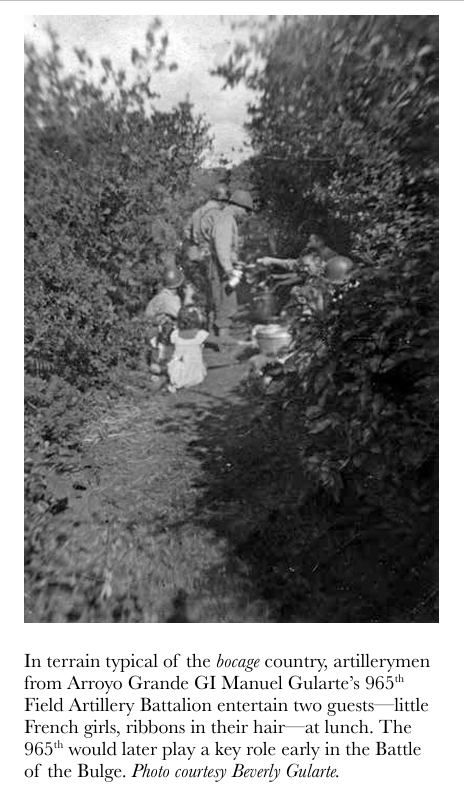
Manuel Gularte, Arroyo Grande, 965th Artillery Battalion

The 965th provided fire support at the town of St. Vith for the 7th Armored Division and the 106th Infantry Division. Their fire and the resistance of the two divisions stalled the German attack at its onset, which later took its toll as German tanks and trucks began to run out of fuel—by now, Berlin taxis were running on firewood. Oil had never been a German resource, which led to HItler’s Russian debacle. This was his Western Front disaster.

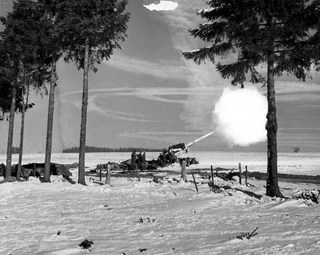
A 155mm “Long Tom” fires a round in the Battle of the Bulge.
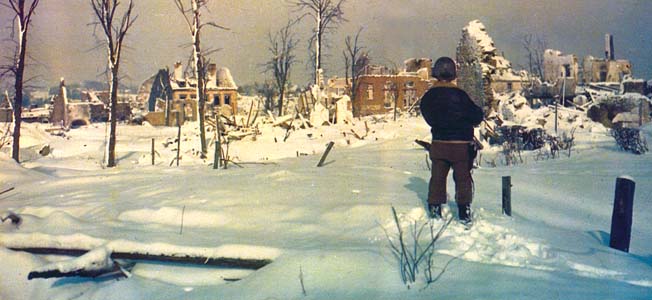
A G.I. in St. Vith.

Art Youman, Arroyo Grande, 101st Airborne

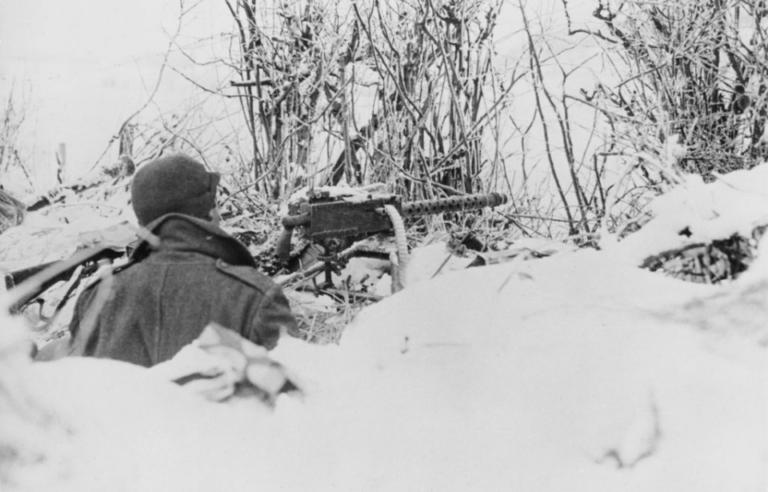
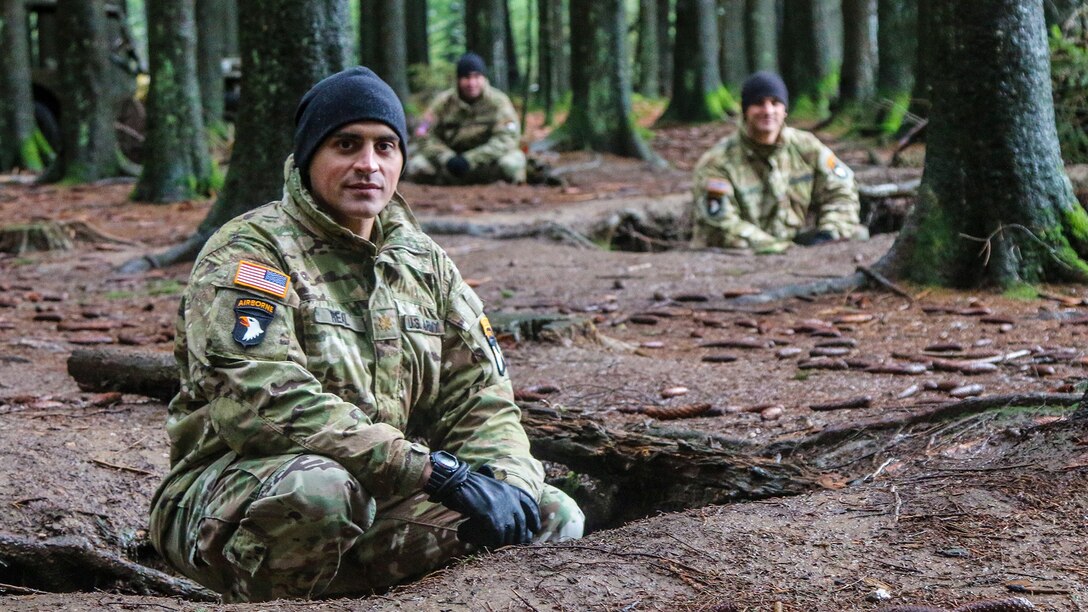
The “brothers” were Easy Company, 506th Parachute Infantry, 101st Airborne, and Youman, before the war a firefighter at Camp San Luis Obispo, was among them. He’d been promoted to Sergeant by Easy Company commander Dick Winters in Holland in September, and now the 101st was being asked to hold Bastogne, a Belgian town awash in the German advance. Their stand, during the coldest winter in Europe in thirty years, was, like St. Vith, a critical fight, diverting German forces determined to wipe the Americans out. They failed.

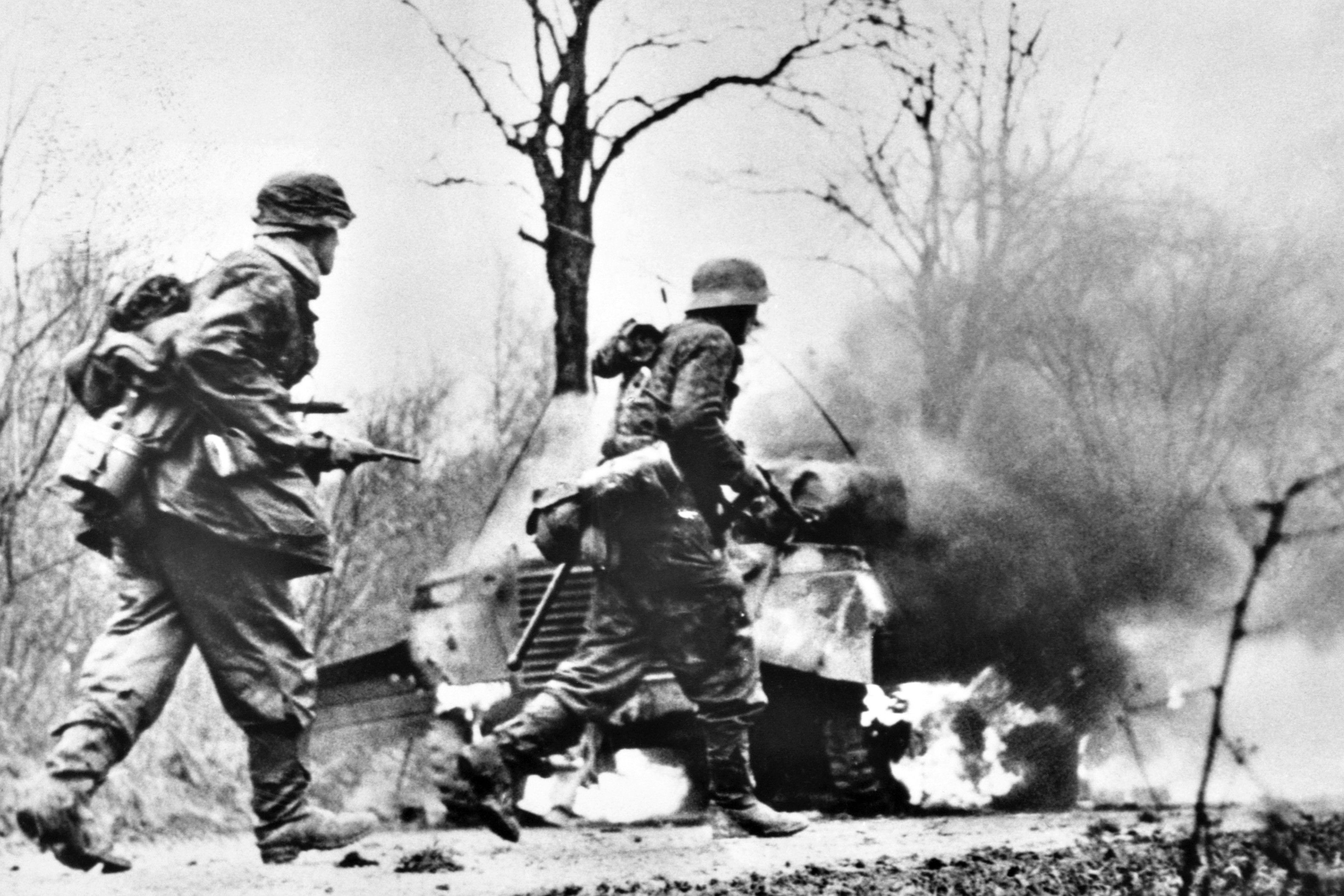
German infantry during their offensive.
Youman, second from left, during Easy Company training.

(Above): A 101st machine gunner in his foxhole; 101st soldiers in the 1944 foxholes their comrades had dug. This photo was taken 75 years after the Bulge.

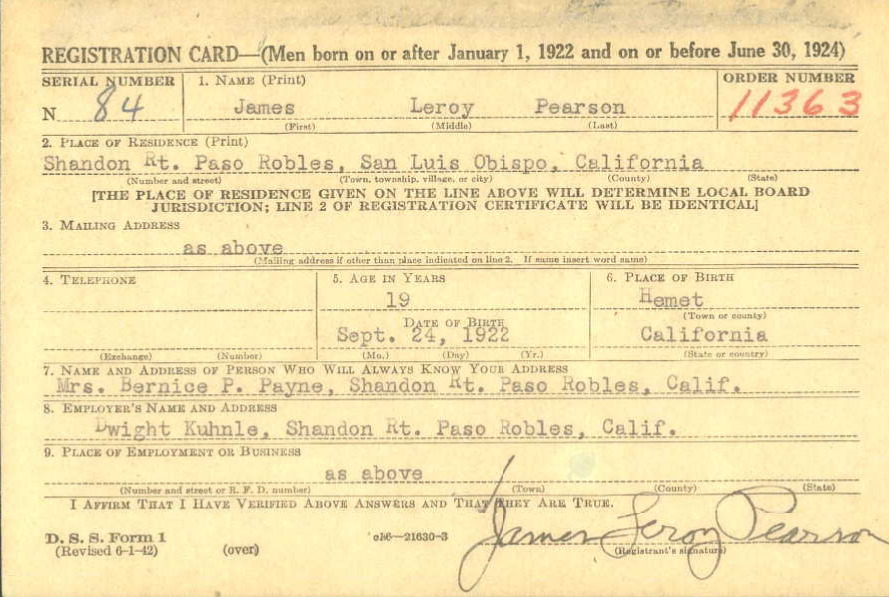
James Pearson, Paso Robles, 455th Bomb Squadron, 323rd Bomb Group

(Above: Houffalize, Belgium; a German Panther tank in the town center suggest this town’s importance in the Battle of the Bulge.

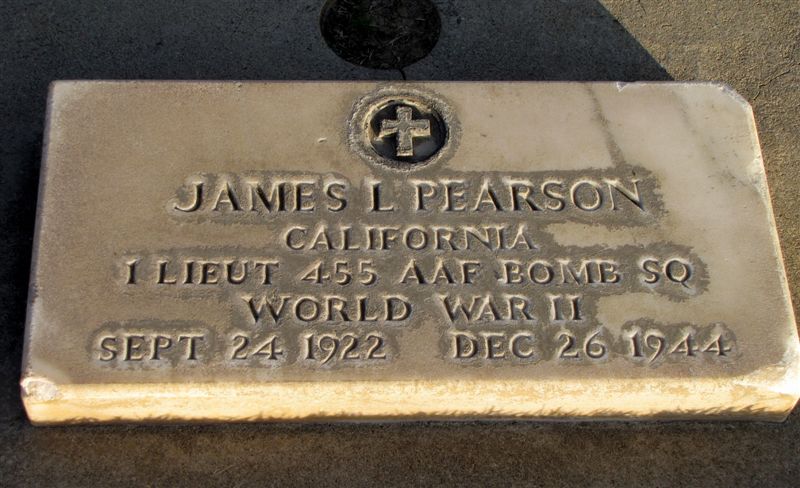
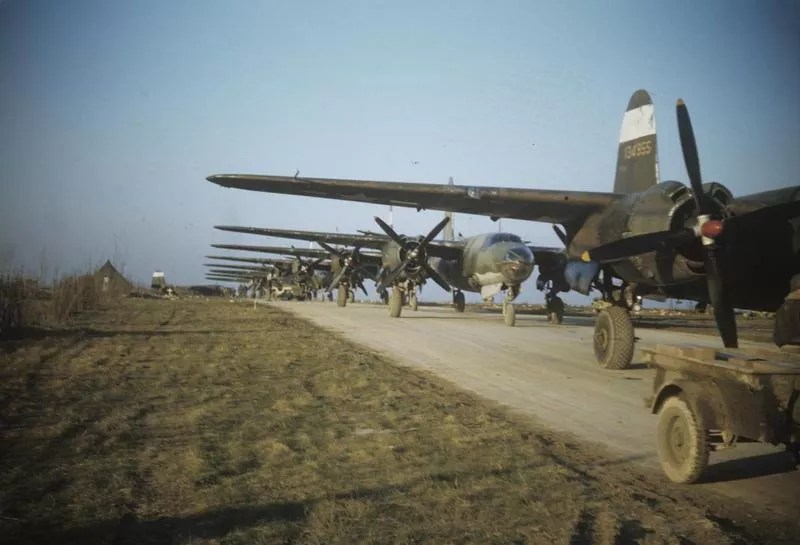
Another key turning point in the Battle of the Bulge was the lifting of a stubborn overcast, which allowed American airpower to assert itself. One medium bomber that participated in this effort, a Martin B-26 Marauder, had a crew that included 1st Lt. James Pearson, the navigator. On December 26, 1944, that aircraft, “Mission Belle,” was shot down over this beautiful town. There were no survivors.

Pearson’s draft card
He is buried in Hanford


“Mission Belle,” with an earlier aircrew, February 1944. The aircraft flew 149 combat missions.
“Belle” at the right edge of this photo, taking off from Laon, France, in December 1944, the month Pearson was killed.


(Below): B-26 Marauders from Pearson’s bomb group–the “White Tails”–over Germany. The video’s music is touching, as is the sight, far below the Marauders, of P-38 fighters, which have connections to the Central Coast. You hope they are safely headed home.

December 2, 1941: “Climb Mt. Niitaka”

02 Tuesday Dec 2025

Posted by ag1970 in World War II

≈ Leave a comment

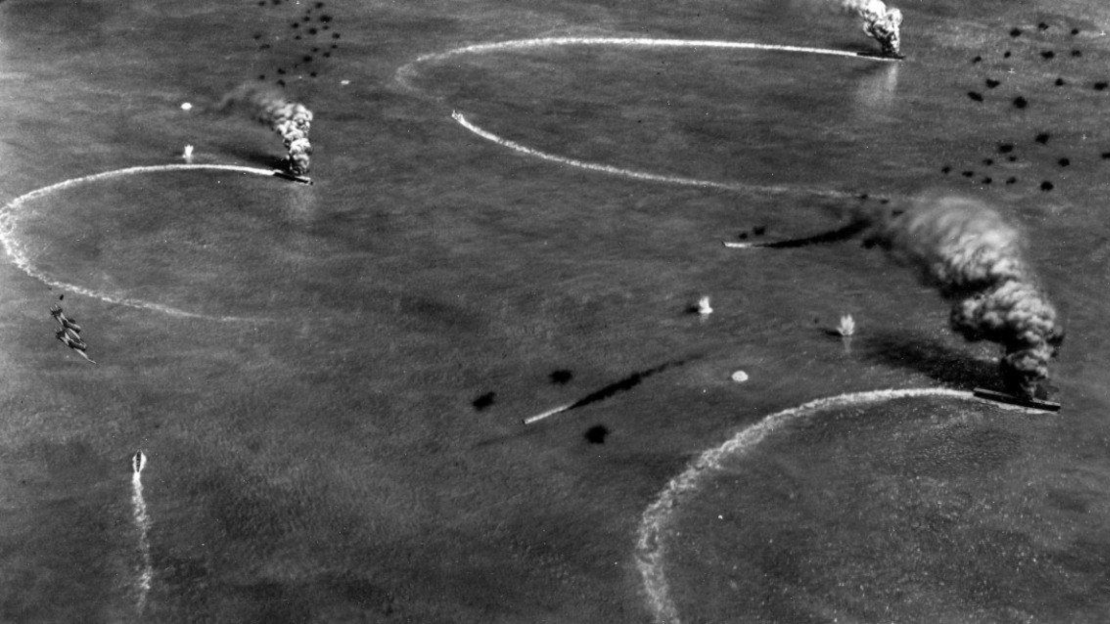
Two carriers from Kido Butai, the Imperial Navy striking force, en route to Pearl Harbor

I have an infallible wish to change the course of history. I want to tell Custer, not that he’d listen, “Don’t go down there.” I want to tell Captain Smith of Titanic: “Slow down, sir. Pack ice, bergs and growlers ahead.” I want to tell President Lincoln not to go to the theater. I want to tell Amelia Earhart to double-check her radio equipment.

All of it, for sure, for naught.

The biggest challenge would be to give Pearl Harbor some kind of advance notice of what was coming to them five days after today’s date. The Imperial task force–six fleet carriers and a cluster of support ships—had just received the message “Climb Mt. Niitaka,” the code ordering Adm. Nagumo’s fleet to complete its mission. Radio silence followed.

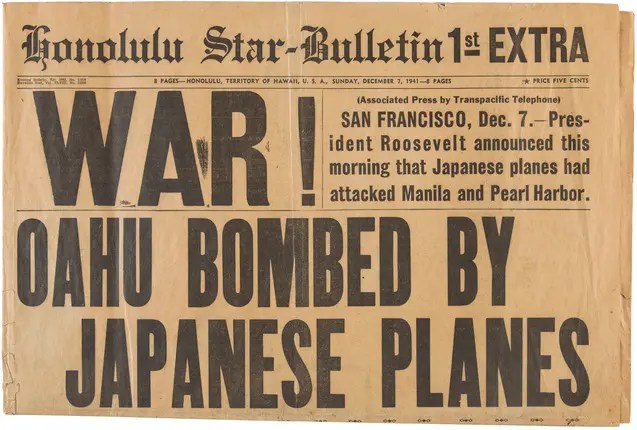
My warning, obviously, never worked but neither did warnings from Naval Intelligence that the Japanese fleet had suddenly disappeared. That morning, the destroyer Ward’s sinking of a midget sub at the Pearl Harbor entrance didn’t cause enough nerves to jangle. The radar report from Point Opana, about heavy incoming air traffic, was dismissed because a flight of B-17 bombers from the States was due in that morning. The telegram from Washington warning that war was imminent arrived long after the attack had.

And, having no means to travel back in time, I wasn’t there, hopping up and down on Waikiki to warn servicemen and tourists alike about what was coming. They would’ve put me in the looney bin, anyway.

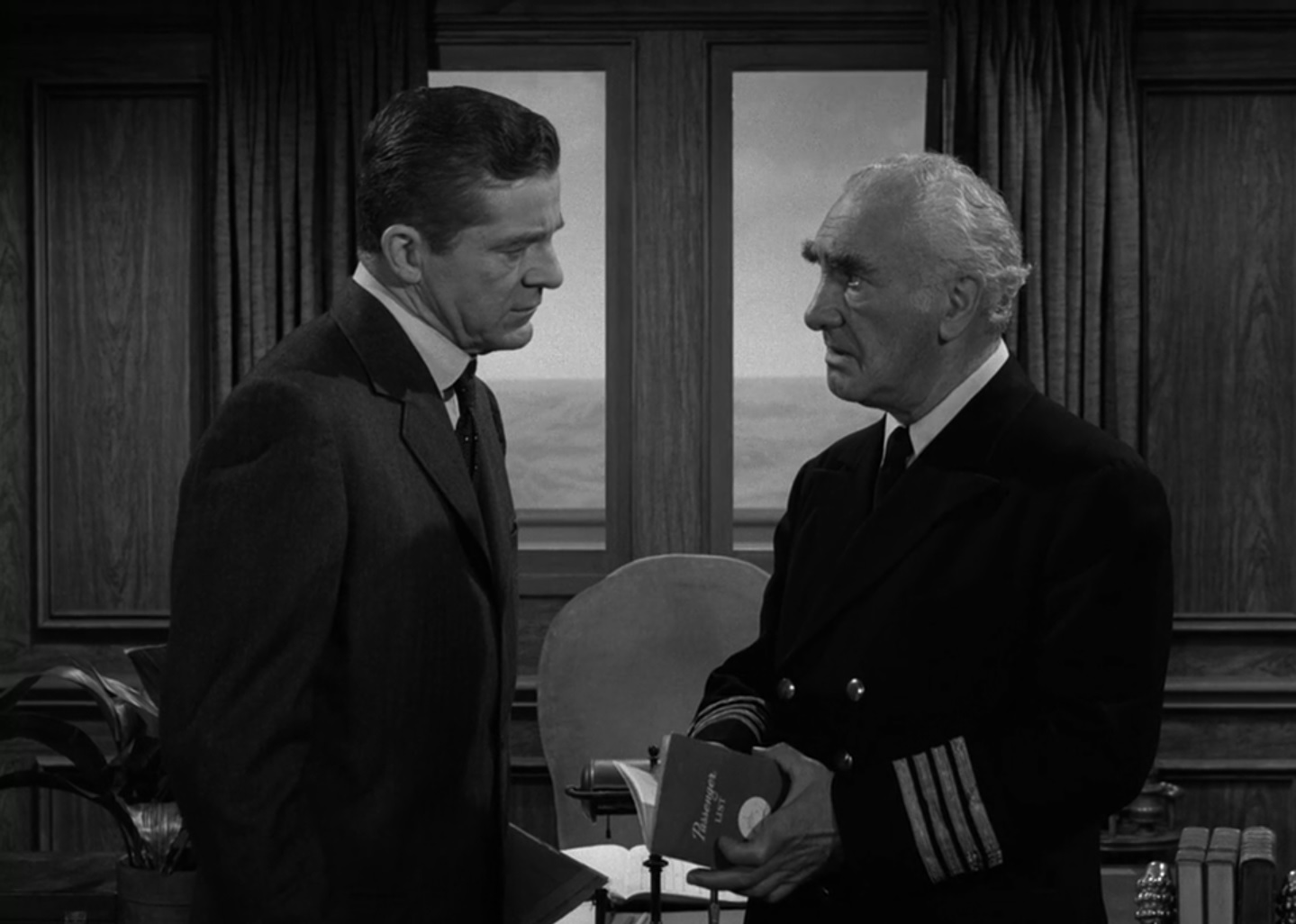
Rod Serling’s Twilight Zones loved to play with the time-travel warning from the future idea. In another vintage TV broadcast, the wonderful actor Dana Andrews (Best Years of Our Lives) tries the same trick, in an episode written by Serling. This Wikipedia summation is excellent:

Paul (Andrews) first travels to Hiroshima on August 6, 1945, and attempts to warn a Hiroshima police captain about the atomic bomb, but the captain dismisses him as insane. Paul then travels to a Berlin hotel room to assassinate Adolf Hitler in August 1939 (immediately before the outbreak of World War II the following month), but is interrupted when a housekeeper knocks on his door and later calls two SS guards to his room. On his third stop, Paul tries to change the course of the Lusitania on May 6, 1915, to avoid being torpedoed by a German U-boat, but the ship’s captain questions his credibility.

Paul accepts the hypothesis that the past cannot be changed. He then uses the time machine to go to the town of Homeville, Indiana in 1881, resolving not to make any changes, but just to live out his life free of the problems of the modern age. Upon his arrival, he realizes that President James A. Garfield will be shot the next day, but resists the temptation to intervene.

Dana Andrews, as Paul, fails to convince Lusitania’s captain that destruction lies ahead.

Even Kirk Douglas, for crying out loud, failed to change history, and his chance, sure enough, came at Pearl Harbor. In the slightly cheesy but somehow engrossing film The Final Countdown, his aircraft carrier—the VERY appropriately-named Nimitz, after the American commander in the Pacific in World War II-—is transported back in time, to Kido Butai’s time. All hell ensues.


From the lofty heights of 1980, it was comforting to imagine we had the airpower sufficient to prevent the tragedy at Pearl Harbor. We didn’t, of course, lacking the time-travel storm, and we didn’t have the right, either.

That’s a shame, for the impact of Pearl Harbor was devastating on my hometown, Arroyo Grande, California. Two sailors who grew up here were killed on battleship Arizona, as was a second cousin of mine. One of the Arizona sailors, Jack Scruggs, was about to play his trombone as the ship’s band assembled for the morning Colors Ceremony when concussions from falling bombs killed him, blowing his body into the harbor. His second-grade Arroyo Grande Grammar School classmate, Wayne Morgan, died moments later when the great ship blew up. I used many sources to put together the ship’s story.

Since retribution seems to be a big theme in today’s America, Americans got theirs six months after Pearl Harbor. Four of Kido Butai’s carriers, Shokaku, Zuikaku, Shoyu and Hiryu, were sunk at Midway. 2200 sailors died with the four ships.

Japanese carriers under attack at the Battle of Midway, June 1942.


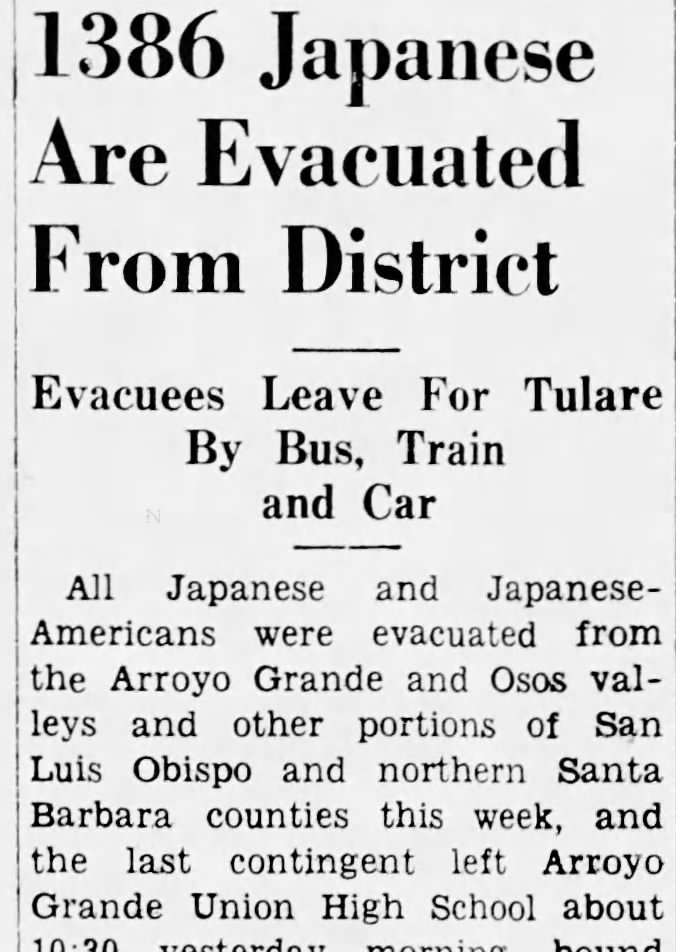
By then, my hometown’s Japanese American residents—-farmers, merchants, athletes, honor roll students— were at the assembly enter at the Tulare County Fairgrounds. In August, they would be moved to the Rivers Camp in Arizona, where the temperature hovered at 108 degrees for most of that month.

At war’s end, only about half came home. By then, two of them, soldiers, had died in combat. One was a 442nd Regimental Combat Team rifleman who died in the relief of the “Lost Battalion.” These were 240 terrified 19-year-old Texans surrounded by the Germans in France in October 1944. The 240 Texans were rescued, at the cost of at least 800 killed or wounded Nisei soldiers, including ours, who was trying to bring up more ammunition under withering German fire. The other G.I., an 83rd Infantry Division medic, was felled by a German sniper’s shot as he knelt over a wounded brother-soldier.

That’s too much history to change, and, in truth, given those two local sailors and those two local soldiers, we are honored—and, hopefully, humbled— by the gifts that were their lives.

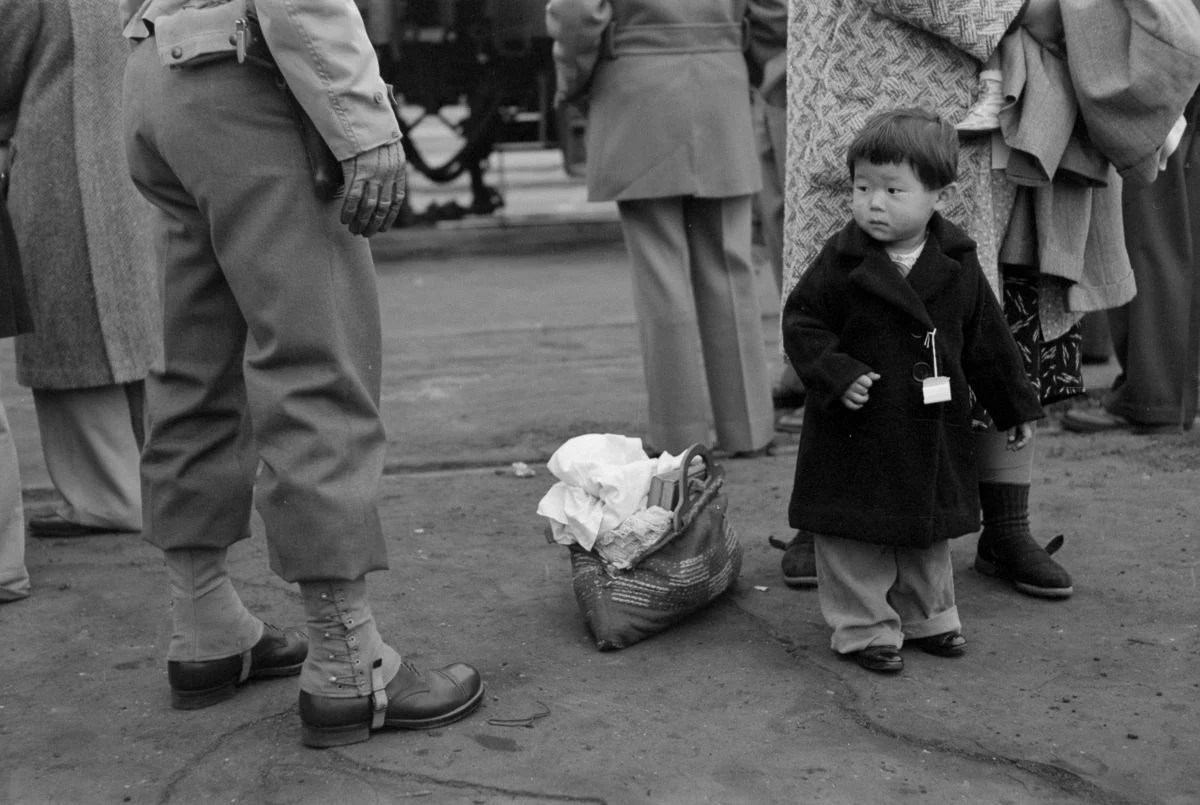
A Dorothea Lange photograph, censored during the war, taken in 1942 California.

An American Thanksgiving in England, 1944

22 Saturday Nov 2025

Posted by ag1970 in World War II

≈ Leave a comment

Tags

eighth-air-force, History, thanksgiving, world-war-ii-england

More and more, as I age (Oops! One arm just fell off!) the more I appreciate Thanksgiving.

We forget sometimes that it’s a uniquely American holiday, first declared by my foremost hero, Abraham Lincoln.

When I wrote a book about local World War II aviators, I found dozens of heroes. Most of them were Eighth Air Force fliers, stationed in England.

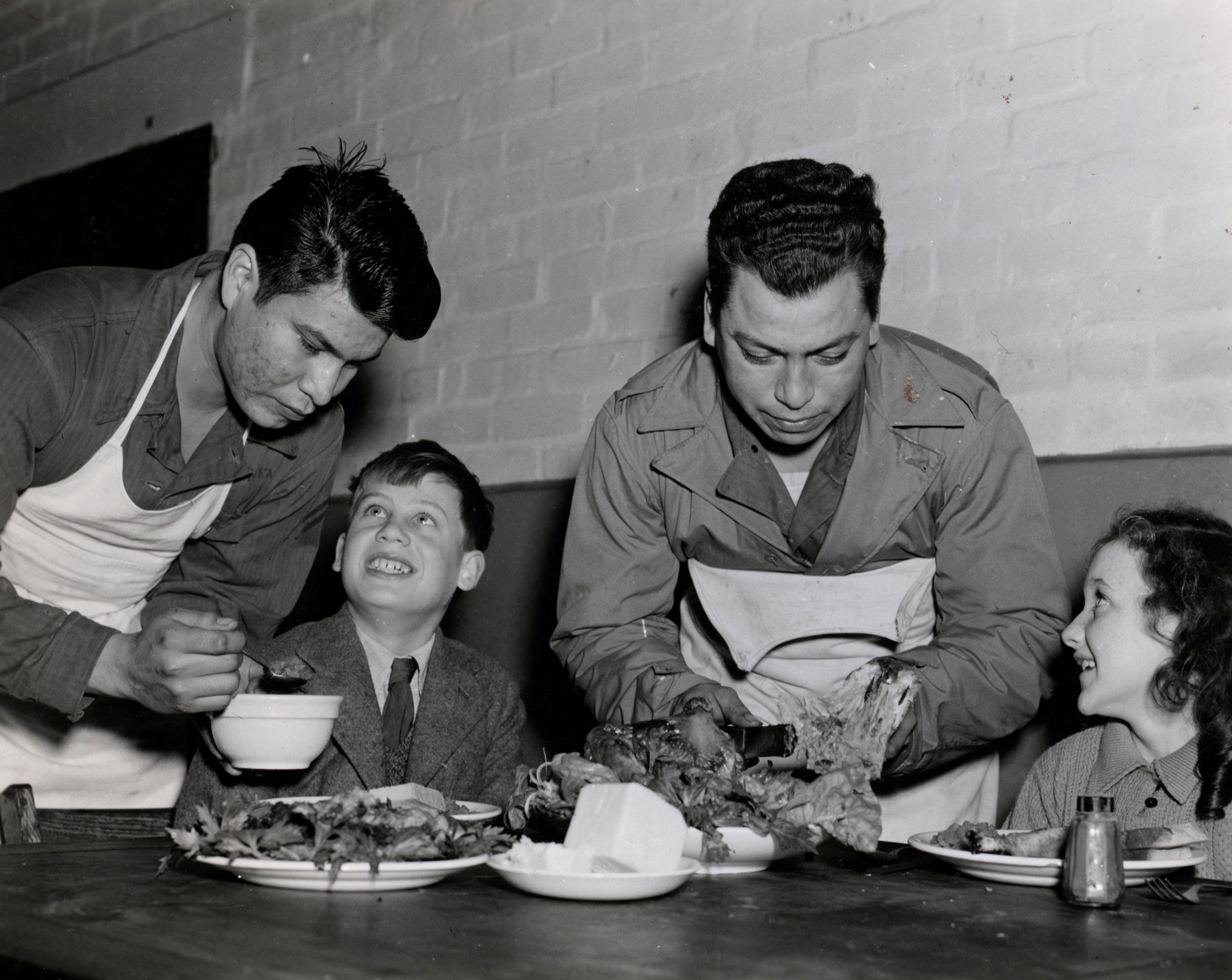
These photos show some of those Yanks. One teaches British war orphans about baseball.

Joseph Sleeping Bear, on the left, helps to serve a Thanksgiving meal to British kids.

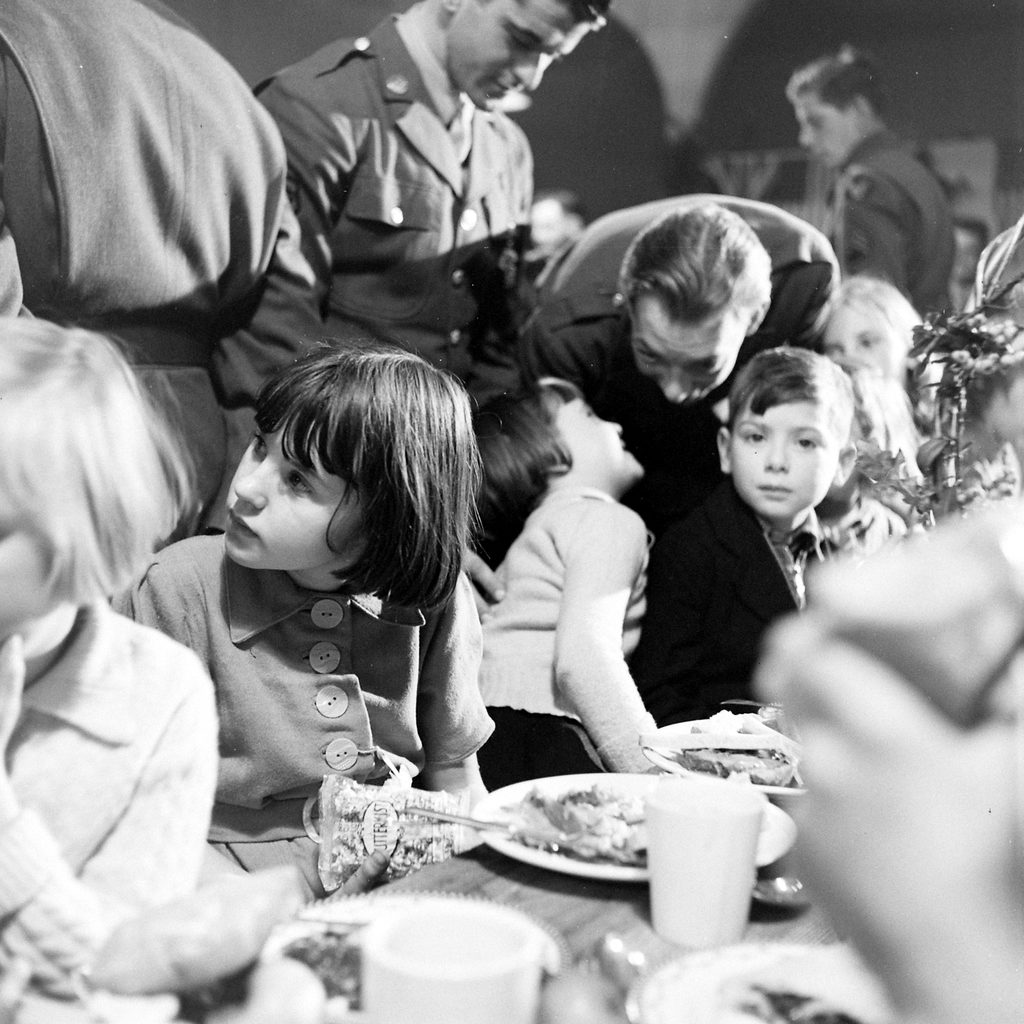
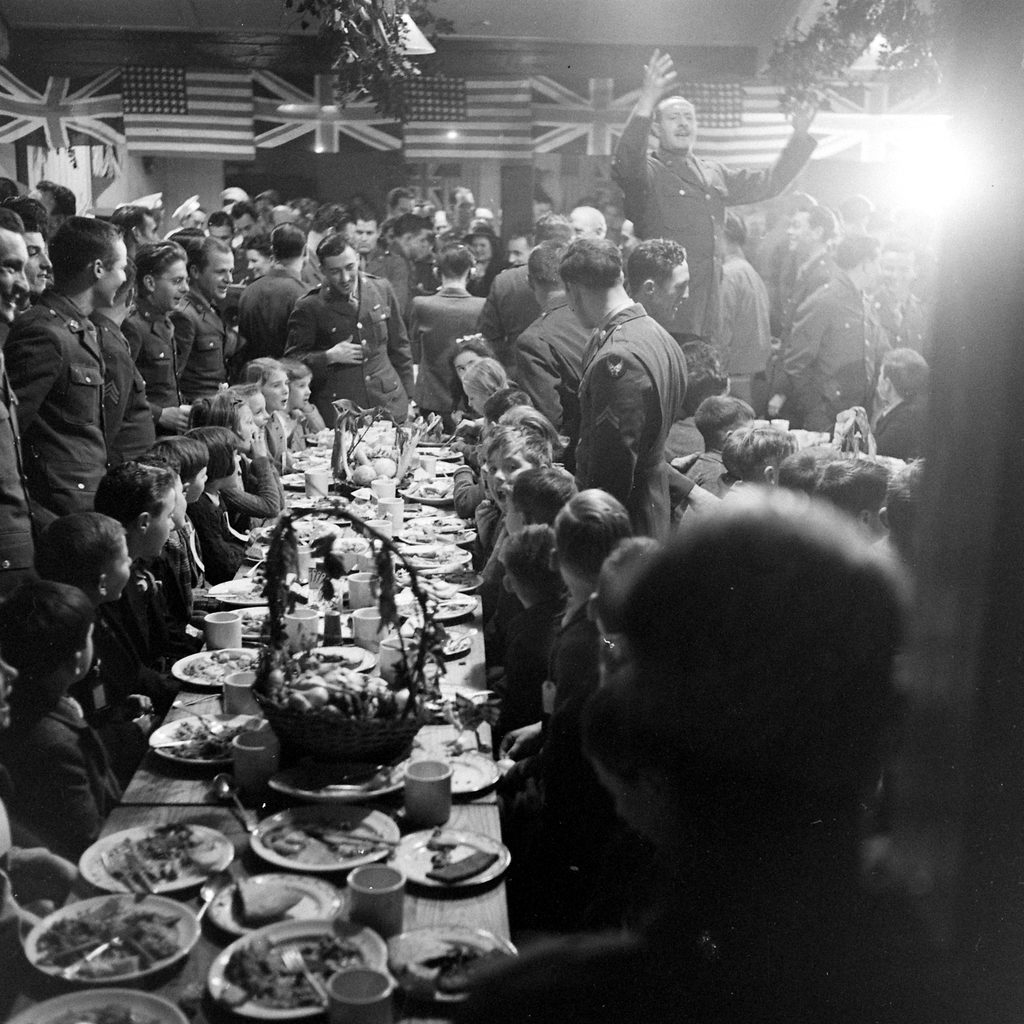
Two photos show a grander Thanksgiving celebration, with Army Air Forces officers in conversation with their little guests.

Sand
S

For British children, Thanksgiving was an impossible holiday. Thanks to the U-boat campaign, the British had been going hungry for years.
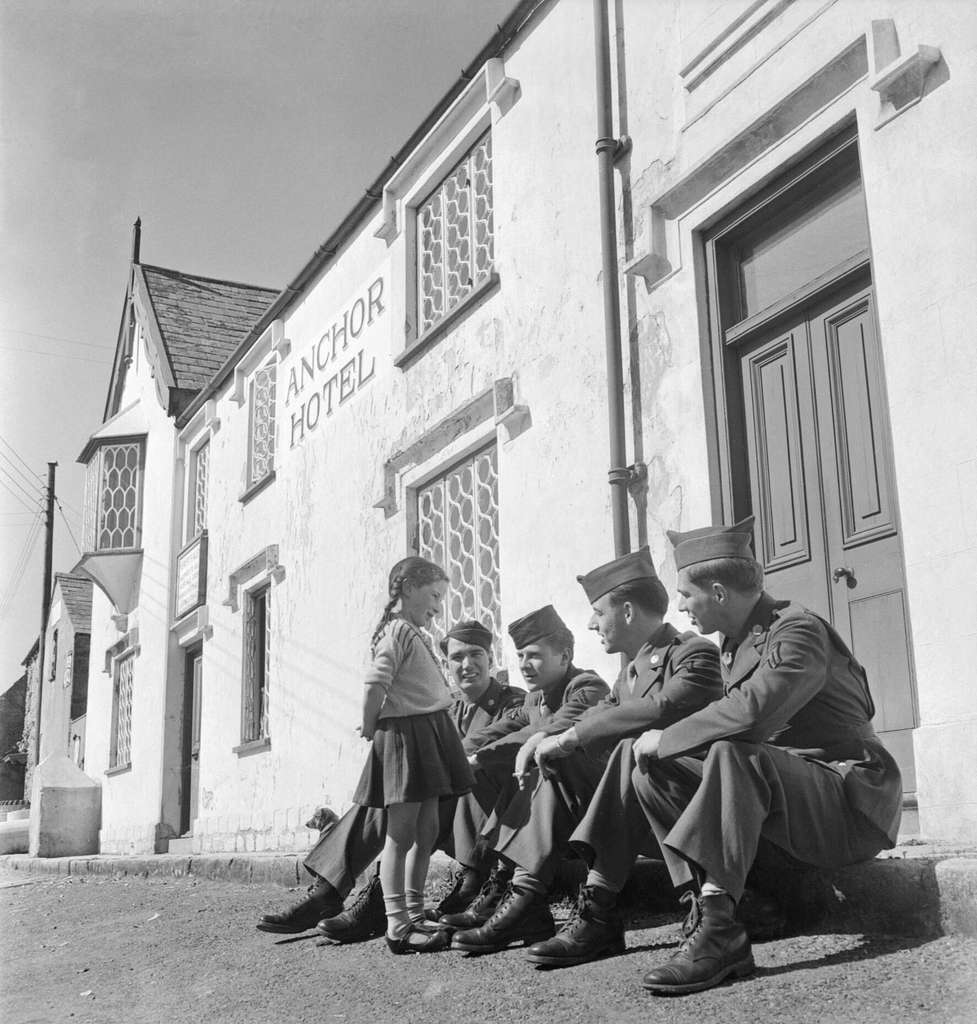
I’ve told the story before because I’m so touched by it. My father, an Army officer, was kind of “adopted” by a family in London–a common occurrence–and when he brought them a bag of California oranges in the summer of 1944, the family’s mother burst into tears. Her family hadn’s seen fresh oranges since 1939.

What the Yanks brought was their brashness, their loudness, and their determination to romance English girls–the elder sisters of children like these. So they left behind Anglo-American babies.

But they left behind their good will, offered in seemingly endless Hersey bars and spearmint gum. Their rough kindness remains vivid in the memories of children, now in old age, who will never forget the Americans.

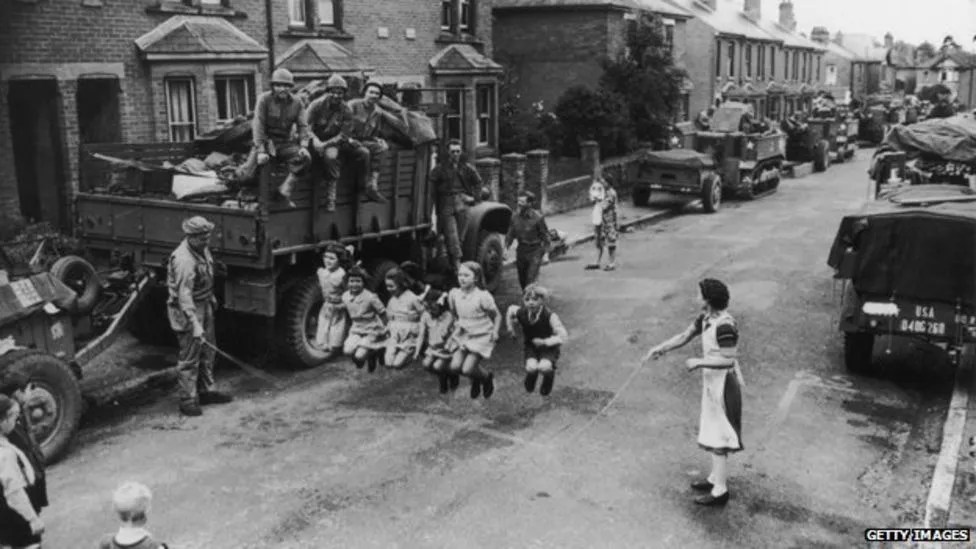
An American soldier, among those marshaling for D-Day in southern England, finds time for a little jump rope.
Yanks and “Freckles,” the little Dorset girl who befriended them.

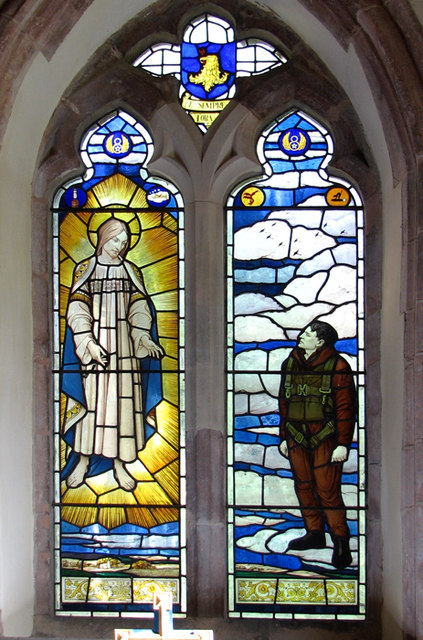
There’s proof of that remembering. The stained-glass window is from a church near a wartime airfield, RAF Alconbury, from which at least three Arroyo Grande airmen, B-17 crewmen, flew.

The left panel depicts the Risen Christ. In the right panel, looking up at Jesus, is a Yank airman.

I keep writing about this generation, stupidly condemned by prewar sociologists as self-centered and pleasure-seeking, because I loved my parents so much, and because the war brought out in these Americans the generosity that I think is a fundamental American trait.

It’s a trait that has been nearly destroyed in the last year.

Picture this about the impact we had in England: On nearly every heavy bomber mission taking off from nearly every American airfield in England, little schoolchildren would gather to line the airfield’s perimeter fence.

They were there to wave goodbye to their Yanks.


Addenda: This kind comment appeared in he original Facebook post of this essay.


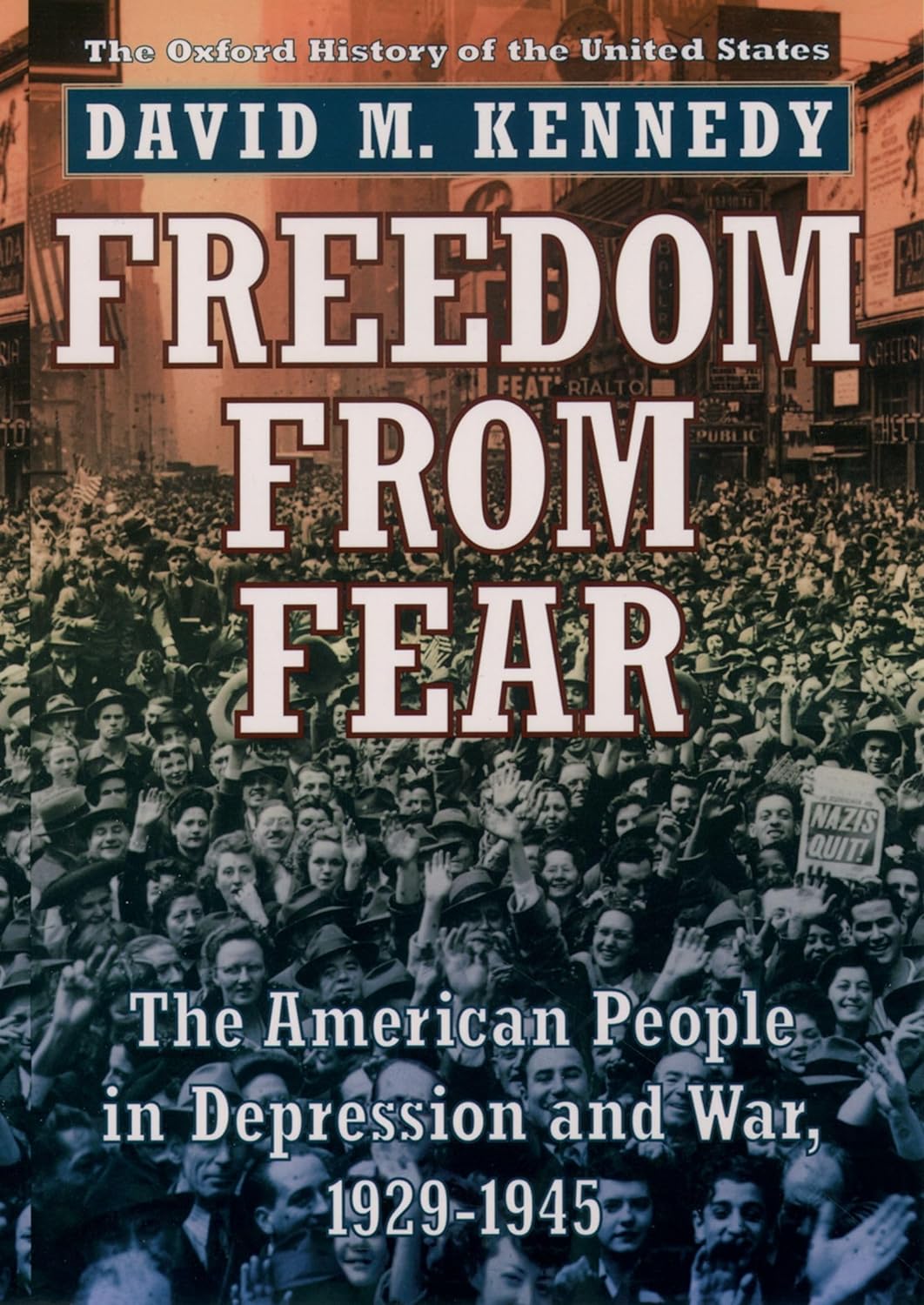
Stanford history professor David M. Kennedy published the book Freedom from Fear, about America in depression and war. It won the Pulitzer Prize.


I took a weeklong class from Kennedy, along with thirty history teachers from all over America, at Stanford in 2004. It was one of the great experiences of my life: Kennedy was warm and engaging, answered questions with both brilliance and respect, and his admiration for the Americans he’d written about was obvious. My admiration for Kennedy will remain with me always.

War and Innocents

18 Tuesday Nov 2025

Posted by ag1970 in World War II

≈ Leave a comment

Tags

History, japan, mrs-hall-all-creatures, pearl-harbor, politics, prince-of-wales, repulse, wwii

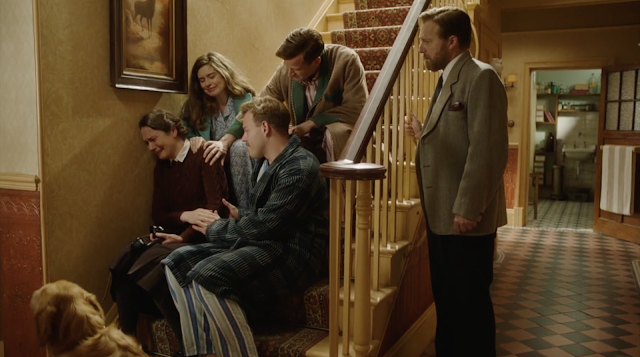
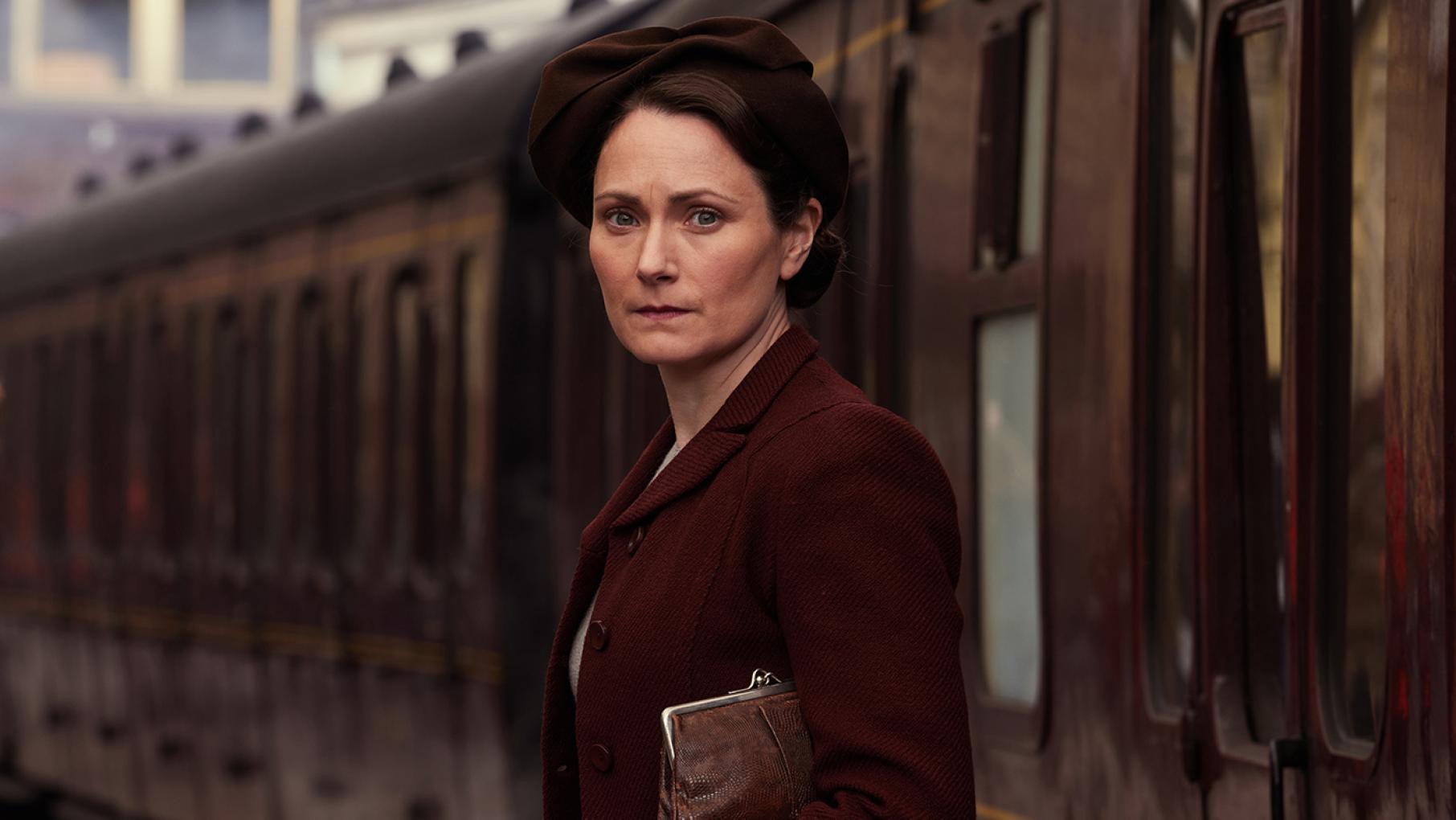
Last night, PBS reprised the 2024 All Creatures Great and Small Christmas episode. It tugged, as usual, at the heartstrngs, but this was set at Christmas 1941, when the world had gone quite mad.

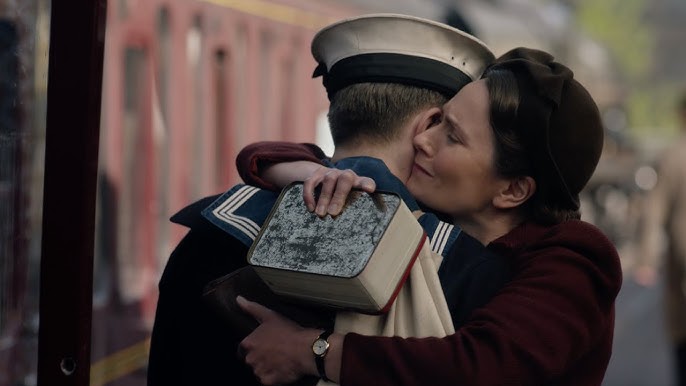
Earlier in the season, the housekeeper, Mrs. Hall, had reunited with her estranged son, only to see his train take him away to a war in progress in Britain since 1939, and to his duty in the Royal Navy.

Word comes over what was called the wireless that her son’s ship, the battle cruiser HMS Repulse, has been sunk, along with the battleship Prince of Wales. The Farnons and the Herriots were about to attend to Christmas dinner when Siegfried, the head of the veterinary practice, had to break the news to the woman who is the emotional glue of the home. When she collapses, the ripple that spreads through Skeldale House is seismic.

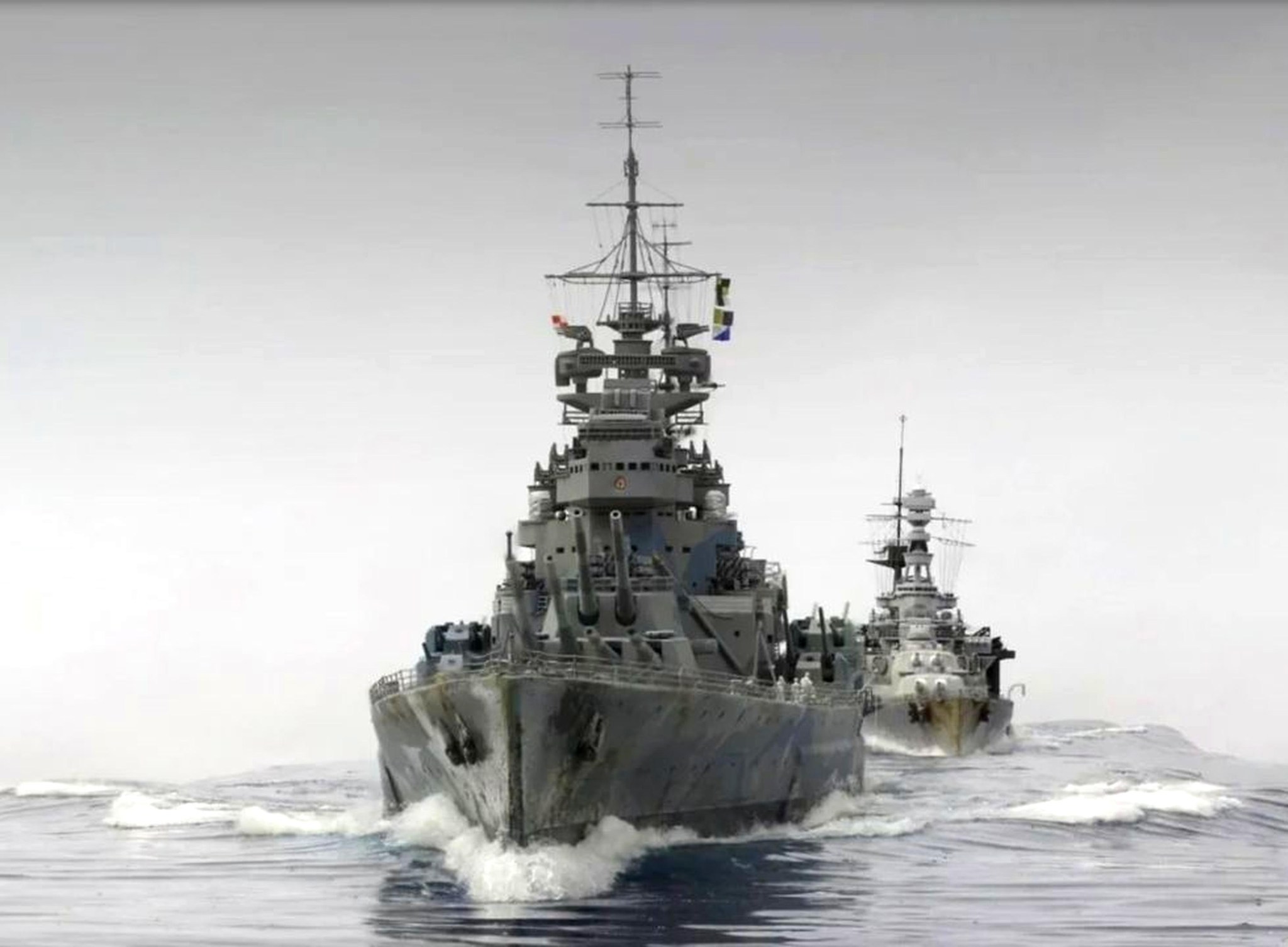
The news shouldn’t have been brought because the tragedy shouldn’t have happened. Only three days after Pearl Harbor, the two great ships sailed north heedlessly, without air protecton, and, just as Pearl Harbor had proven, battleships were vulnerable to air attack. 840 British sailors died, the victims of that terrible and seemingly congenital White Man’s disease, arrogance. Swarms of Japanese planes descended on the pride of the Royal Navy in the Far East. Twenty-eight Japanese aviators gave their lives for their country in a running battle that lasted a little over an hour.

The illustration depicts Prince of Wales with Repulse in her wake.

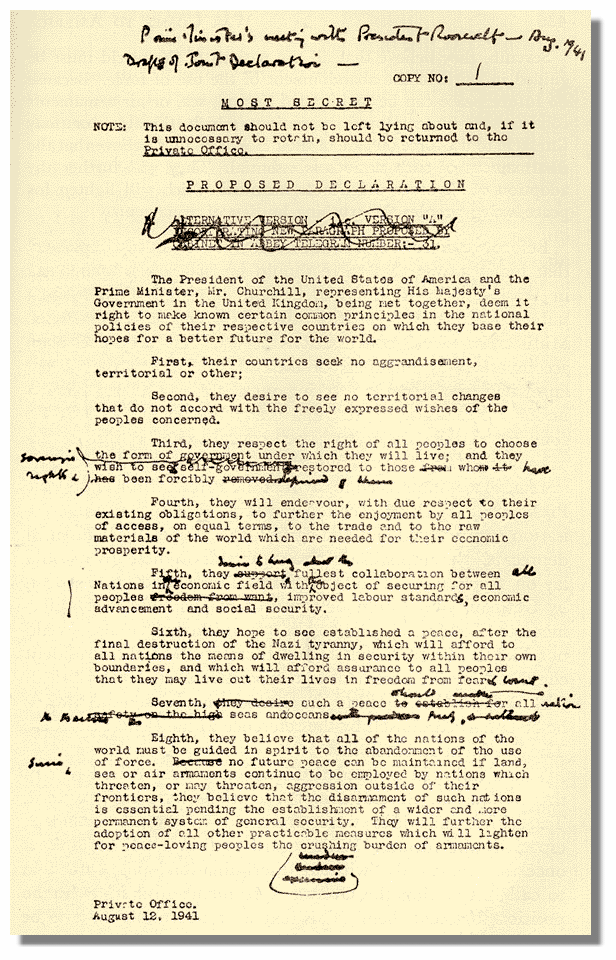
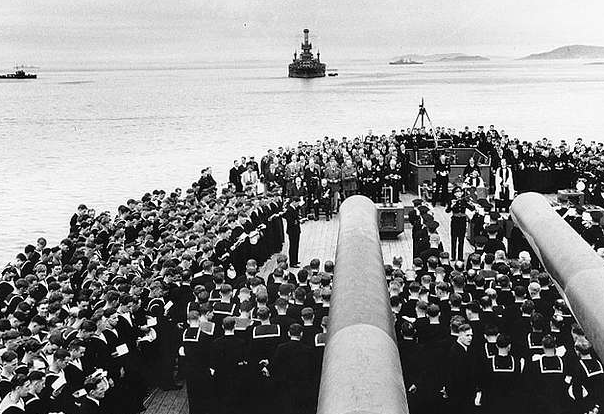
The loss of Prince of Wales would have resonance in America, waiting to learn about the destruction wreaked on the American base at Pearl Harbor. The British battleship represented the birth of the Anglo-American alliance that seems to be in grave danger today. It was on Prince of Wales, off the coast of Newfoundland, where Winston Churchill and Franklin Roosevelt met—in person, for the first time— for a conference that concluded with the issuing of The Atlantic Charter, a set of principles that seem to be in grave danger, as well. This is Churchill’s annotated copy:


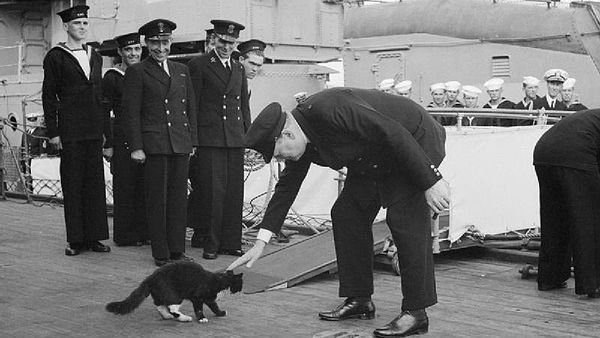
(Above) Churchill, always fond of cats, greets Prince of Wales mascot Blackie on arriving for the conference. Blackie survived the battleship’s sinking; many of the sailors, attending divine services with the two leaders, would not.

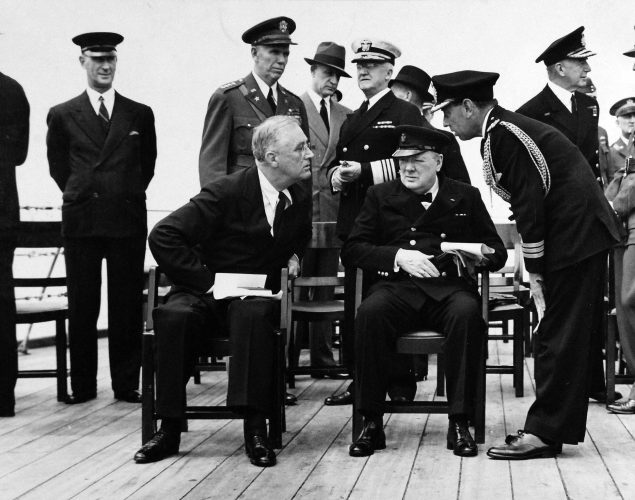
The great ship was ideal for the meeting between the president and the prime minister. One of the similarities that cemented their friendship was their love for the navy. Churchill had served as First Lord of the Admiralty (he used the term “Naval Person” to refer to himself in his correspondence with Roosevelt) FDR, like his wife’s uncle Theodore, had served as Assistant Secretary of the Navy.

FDR and Chuchrill aboard Prince of Wales. Gen. George Marshall is just behind the president.

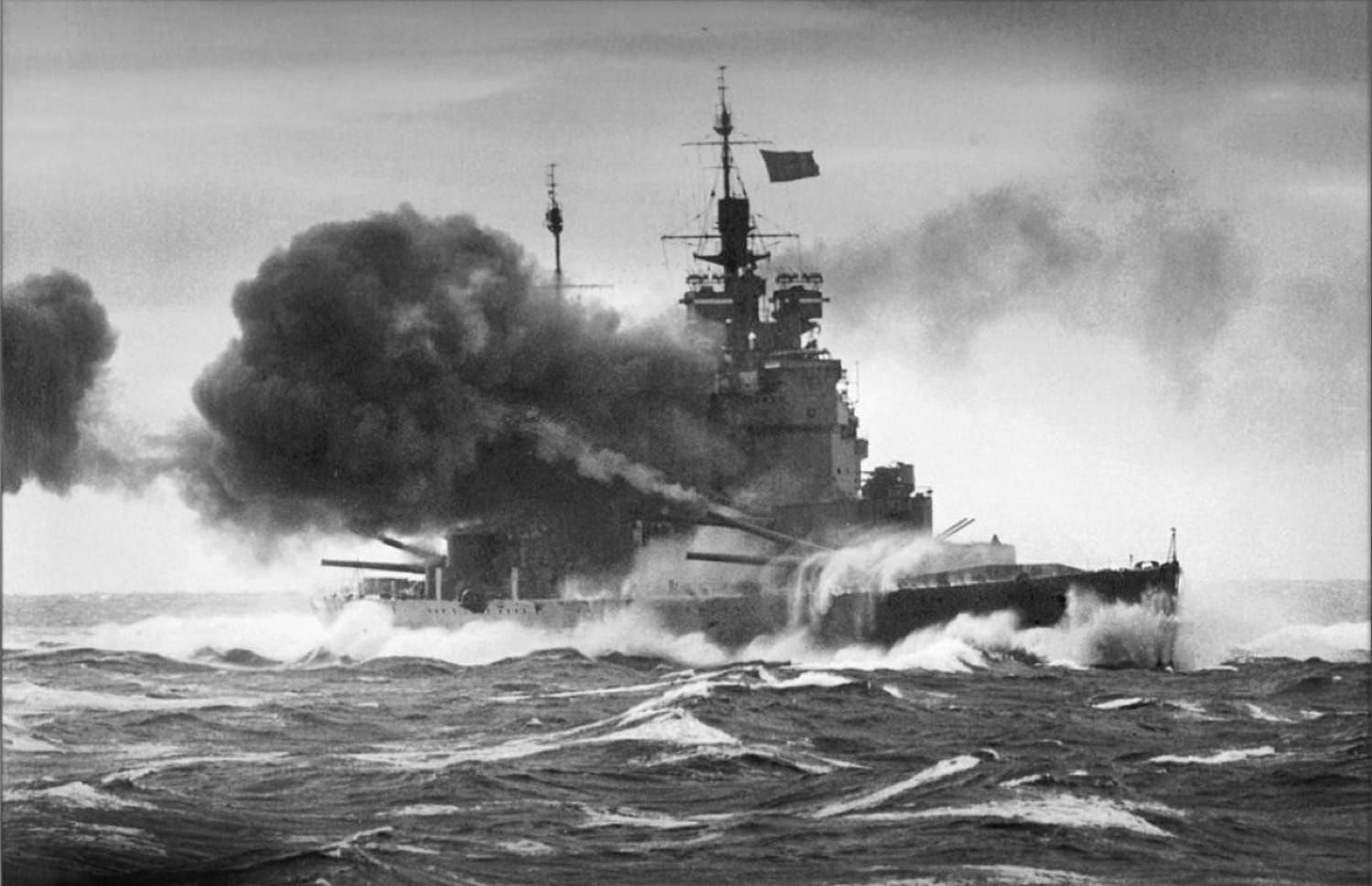
Three months later, it was appropriate that another battleship, HMS Duke of York ( engaging a German battleship, Scharnhorst, in the 1943 photo below) brought Churchill to America.

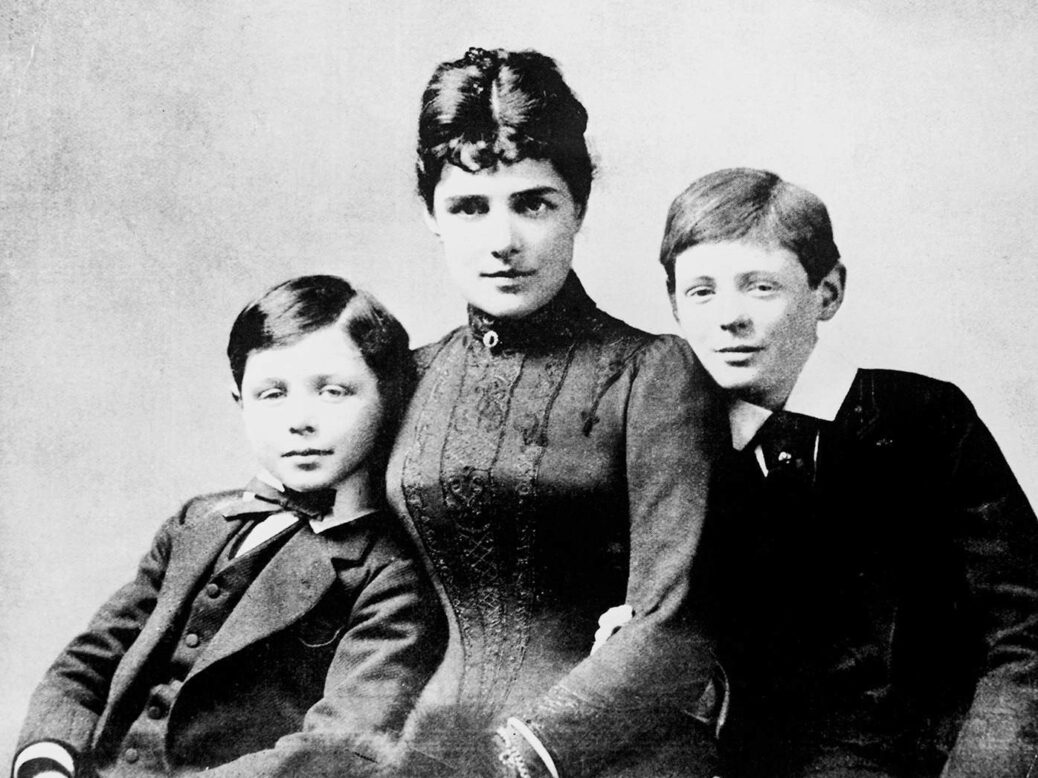
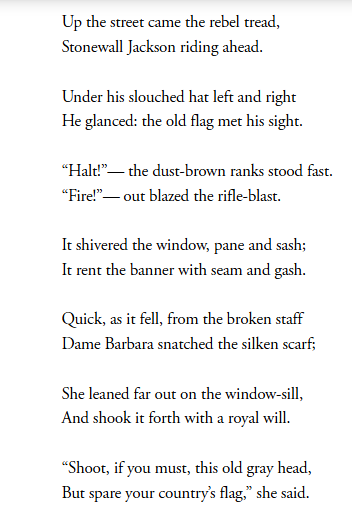
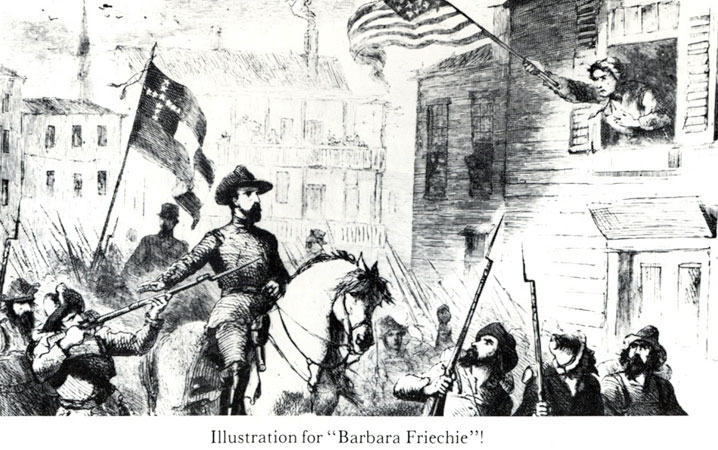
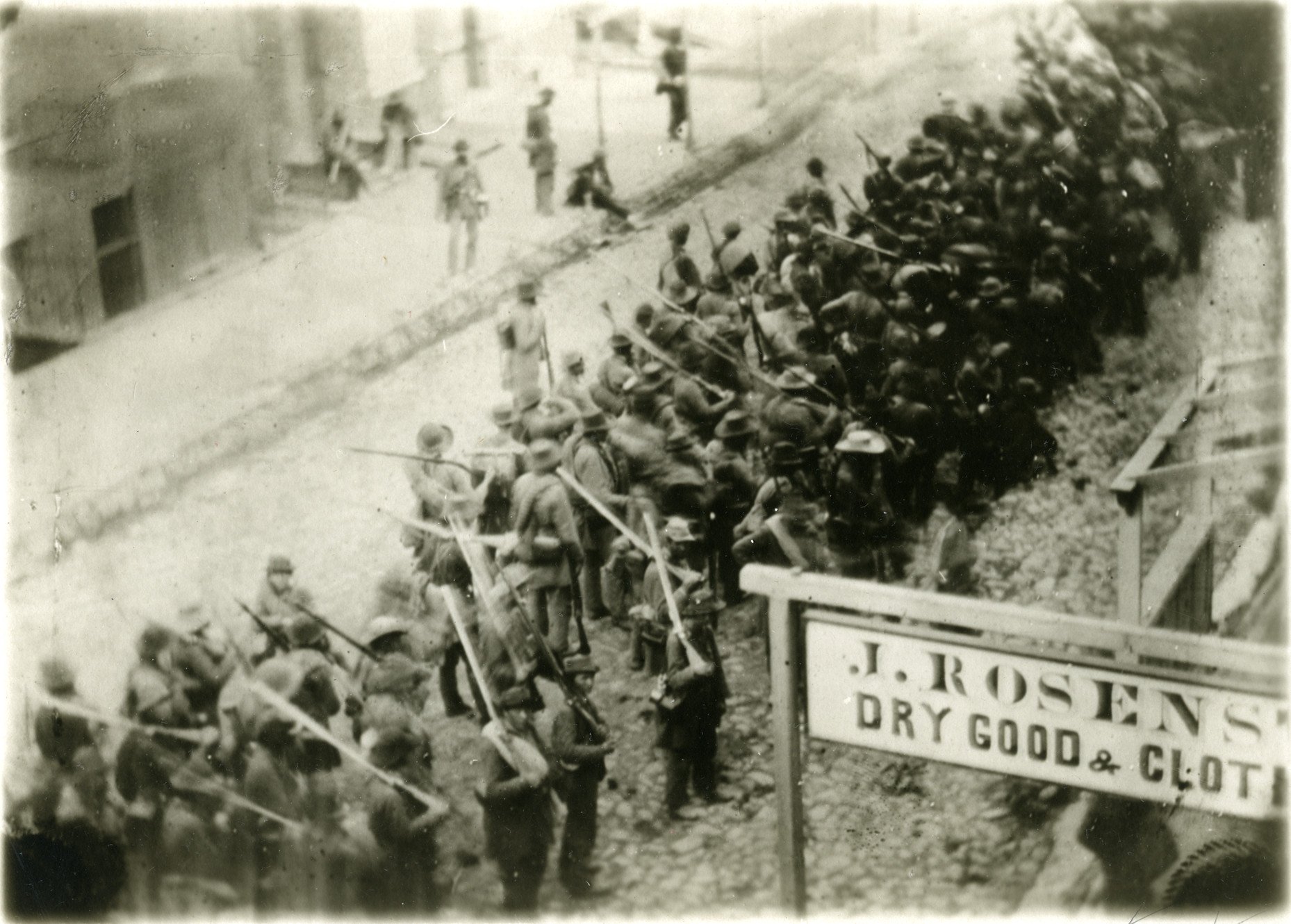
On the way to the White House, motoring through Maryland, the Prime Minister regaled the President by reciting, from memory, the Whittier poem “Barbara Fritchie,” about an elderly Frederick, Maryland, woman who defied the invading Confederates by waving the American flag out her window. The poem is very long and not very good, but Churchill relished it—reminding his hosts that he, thanks to his mother, Jennie, was half-American.

Jennie Jerome Churchill and her sons, Jack and Winston

Lee’s troops in Frederick, September 1862. They’re on their way to Antietam, the costliest battle in American history.

Churchill arrived at the White House on December 13 and didn’t return home until January 17, 1942. Along the way he horrified White House staff with his breakfast orders, which included copious amounts of whiskey and soda, remained naked—not counting the cigar— and pink as a cherub when the president visited him immediately after a bath. Churchill, a late-late riser, worried Eleanor because he kept her husband up until the wee hours; the P.M. also made discreet use of the White House’s potted plants because the president adored cocktail hour and invented concoctions for his guests that were said to be truly dreadful.

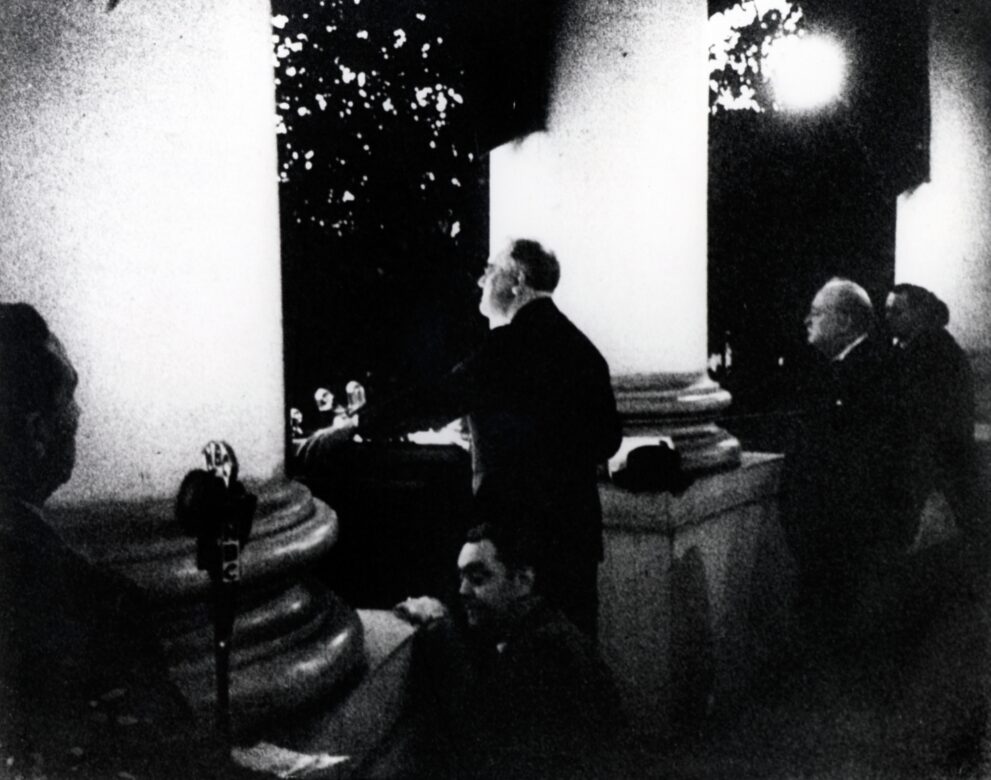
Churchill, to FDR’s right, witnesses the lighting of the National Christmas tree, December 24, 1941.

The meetings were productive but fraught: The two leaders (Churchill may have had a mild heart attack) were enduring the aftershocks of Pearl Harbor and the capital ships’ sinkings: Japanese troops were advancing rapidly in the Philippines, the fall of Hong Kong on Christmas Day crushed the prime minister.

Historians theorize that these runaway Japanese successes, and FDR’s fondness for his new friend, played a key role in the president’s decision to issue Executive Order 9066, which was enforced here, in Arroyo Grande, 2400 miles from Pearl Harbor, 2800 miles from Washington DC and 5400 miles from London.

The aftershocks of December 1941 finally crested here on April 30, 1942. This war spared no one.

The Man Who Fell 22,000 Feet

03 Sunday Aug 2025

Posted by ag1970 in World War II

≈ Leave a comment

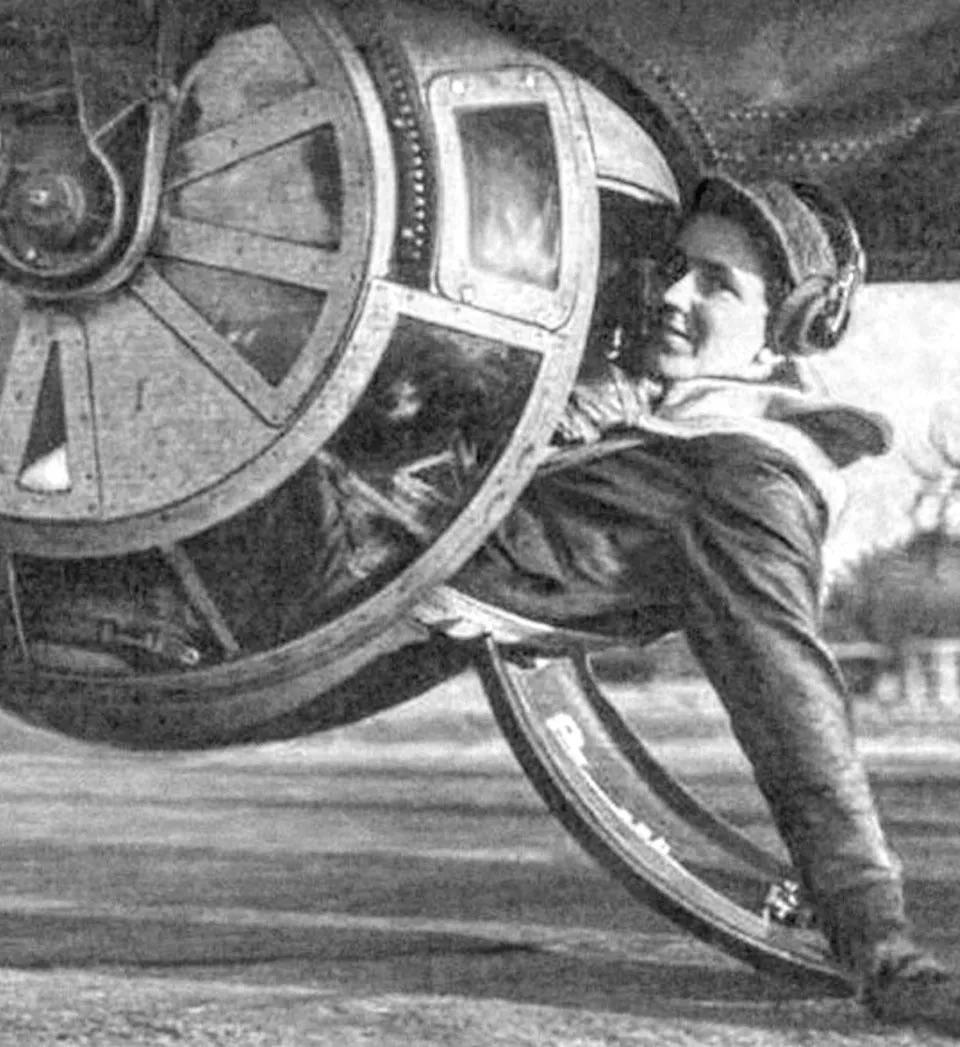
Alan Magee was a ball-turret gunner on a B-17 based at RAF Molesworth in March 1943. A key responsibility of his bomb group, the 360th, and his squadron, the 303rd, was to assault the German U-boat bases along France’s western coast. The U-boats themselves, as long as they were in their pens, were safe; the concrete and steel protection, built by slave labor, was so indestructible that the French Navy used the sub pens for their submarines throughout the Cold War.

In 1943, the U-boats were attacks were devastating, the tonnage sunk so vast that England was in danger of starving. (My father gifted a British family, in 1944, with a bag of California oranges. The mother of the family burst into tears. They hadn’t seen fresh oranges since 1939. That was the work of the U-boats.)

Later, the Halcyon brothers, the Varians, would help to develop the klystron tube, an improvement on radar that, in air attacks, devastated the U-boats once they’d slipped into the slipped from their protection at St. Nazaire or Lorient. I once read a gripping autobiography written by a U-boat captain, appropriately entitled Iron Coffins; by 1944, that’s what they’d become.

So it wasn’t the sub pens themselves that were the targets of Magee’s squadron: it was the yards where torpedoes were gathered after their shipment from German factories to the French coast.

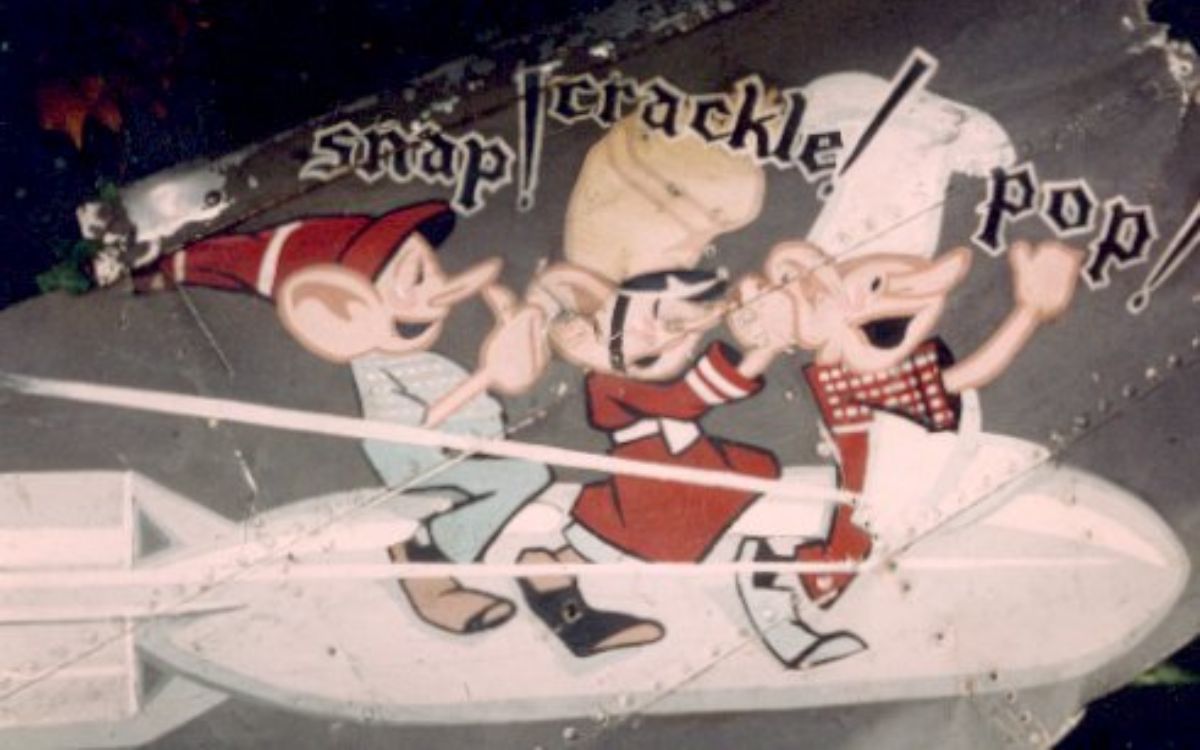
His B-17 was named “Snap! Crackle! Pop!” after the Rice Krispies characters, which made for far less racy nose painting than the generously-bosomed Vargas girl imitations that adorned so many B-17s. (Pilots averaged around twenty-two; some gunners, liars, were fifteen.)


Since Magee was a ball-turret gunner, that meant he was the tiniest of the nine men he flew with. Only a small man could fit in the bubble beneath the B-17. An electrical motor rotated the turret; the exit hatch, however could only be opened from inside the B-17’s fuselage, .

Magee was lucky. When “Snap! Crackle! Pop!” was riddled by German fighters on the St. Nazaire mission, on January 3, 1943, He found his way onto the flight deck, inside the seeming safety of the fuselage.

That’s when the B-17 blew up.

Magee was thrown out by the blast, semiconscious, and began to fall.

He had no parachute.

He had 22,000 feet to fall.

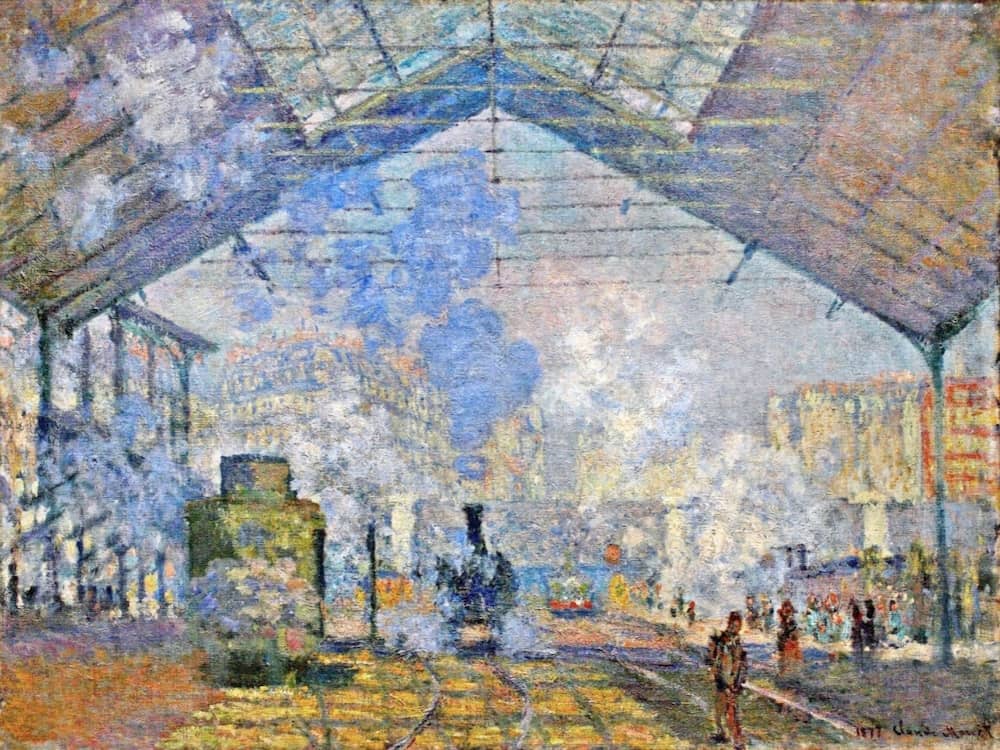
What broke his fall was the steel-and-glass roof of the St. Nazaire train station, made famous in studies by the Impressionist Claude Monet, obsessive, in 1877, about capturing light properly at different times of the day, experiments he could continue with the Rouen Cathedral and along the banks of the Seine.


The train roof broke Magee’s fall, and it broke Magee. One arm was nearly severed. one leg was broken, he suffered massive internal injuries and the surface of his body was peppered by bits of shrapnel. In a story not uncommon for the war in Europe, a German military doctor saved his life. The antiaircraft crew that had shot down another Morro Bay copilot offered him a hot bowl of potato soup once they’d recovered him, about to be shot by an irate German farmer. When he was on his way to a POW camp, he boarded a train with his Luftwaffe guard, who slipped the latches of the briefcase he was carrying, removed its contents, and wordlessly offered Lt. Robert Abbey Dickson a thick slice of sausage atop black bread.

Robert Abbey Dickson survived the war and over two years in a POW camp. He became the father of three little girls who adored their dad.


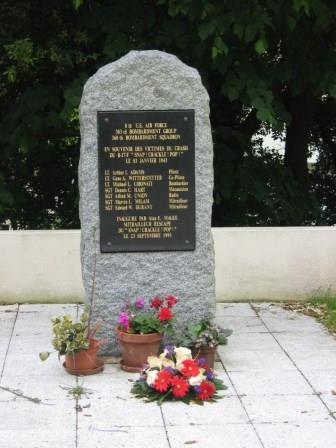
In the 1990s, Alan Magee returned to France for the unveiling of this memorial to the crew of “Snap! Crackle! Pop!”


That might be the end of the story, but of course it isn’t. Weeks later, another member of the 303rd Bomb Squadron was killed returning from a raid on the submarine facilities at Lorient. Clair Abbot Tyler was from Morro Bay. I once lived on Piney Way, the street where he grew up. The best man at his wedding, to a schoolteacher and descendant of the Dana family, was Alex Madonna, for whom my father worked.

Like so many fliers I wrote about in Central Coast Aviators in World War II, Tyler left a little girl behind.


Here is his story.


And one final point, but this one about U-boats. There have been so many fine World War II films, and one of the finest is German, written and directed by Wolfgang Petersen. Das Boot (1981) humbled me in that it separated Germans from Nazis. In this scene, the crew sings a popular British tune from the First World War, mostly to infuriate the boat’s political officer. He got off easily. In The Hunt for Red October, Sean Connery strangled his political officer.


i

“This is the Army” (1943)

29 Tuesday Jul 2025

Posted by ag1970 in Film and Popular Culture, World War II

≈ Leave a comment

Elizabeth and I were watching this film, featuring this Irving Berlin song, and modestly enjoying it.

And, of course, being raised proper by our World War II-generation parents, we began to wonder where the Black GI’s were. Not one in sight.

They were in London, where their dash endeared them to most Londoners. There was an outburst of “race riots,” from San Luis Obispo to Greenland, the same year as this film.

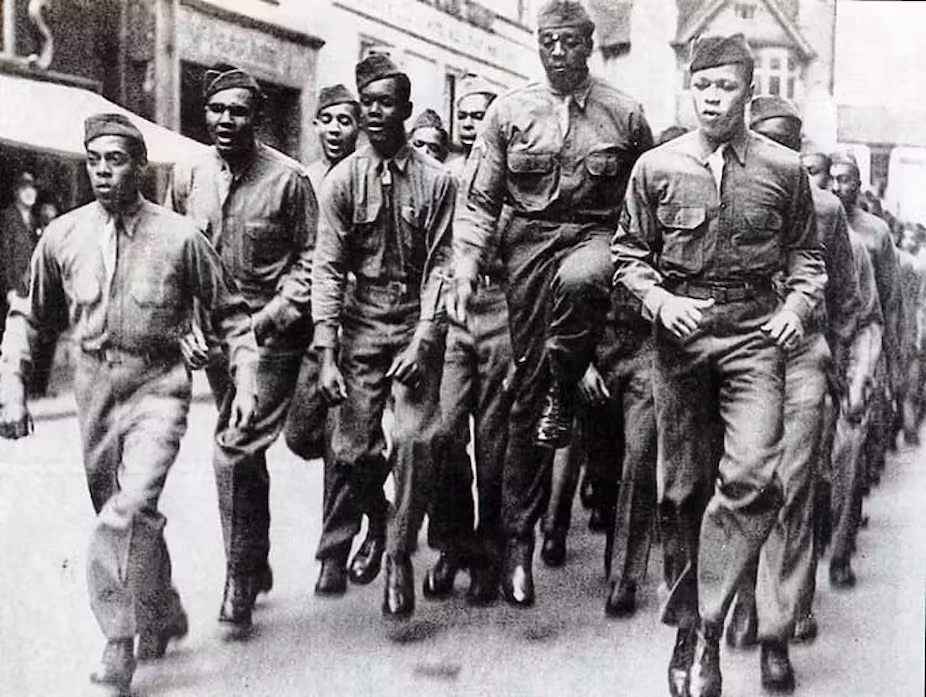
No one—no one—marched and sang cadence like Black American soldiers, including these young men on a British street.

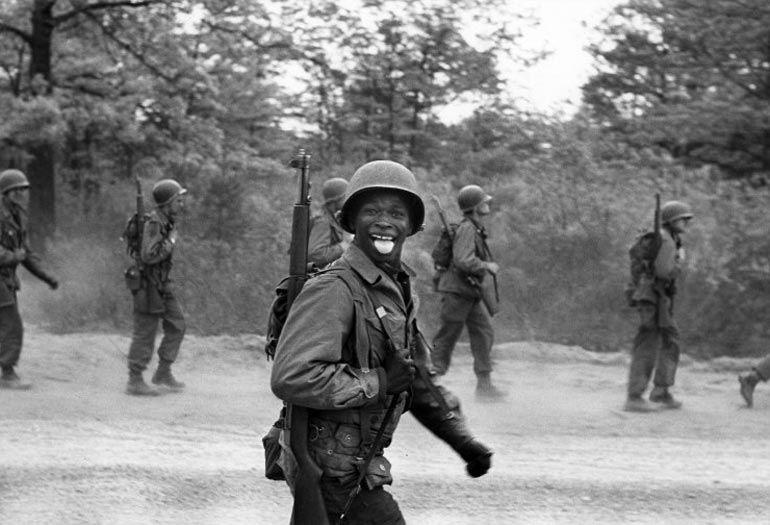
And their dash was often equaled by their sass. This soldier, with his M1 Garand, seems to be outpacing the White column beyond him.
But you didn’t see Black GIs in This Is the Army. Then this scene appeared, in all its glory, in blackface, even with blackface transvestites.

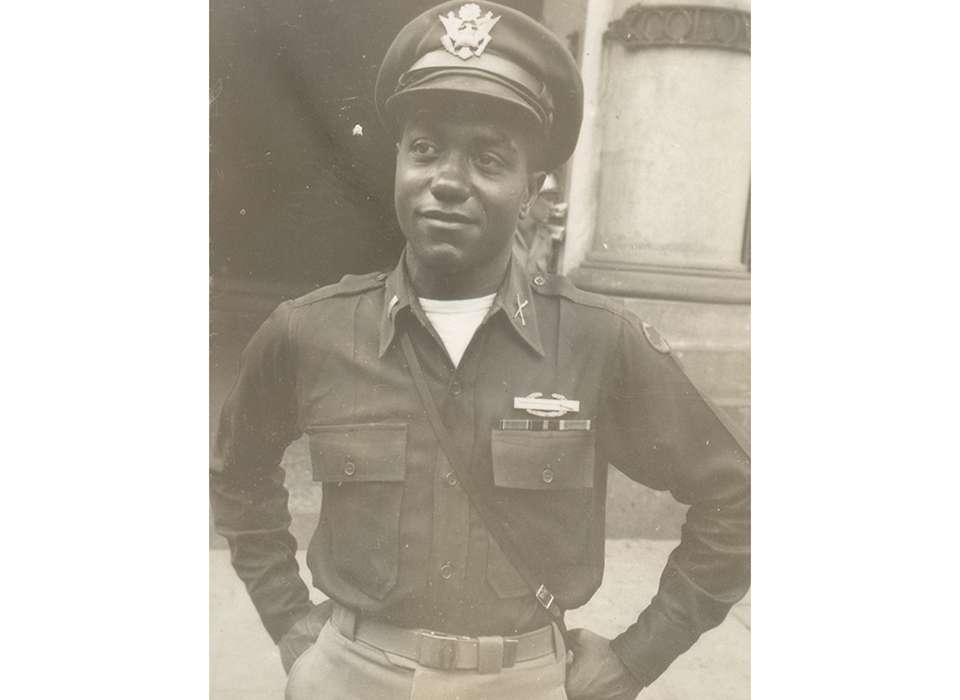
Only 432 World War II American servicemen were recipients of that rarest of honors, the Medal of Honor. Not one of them was a Black man.

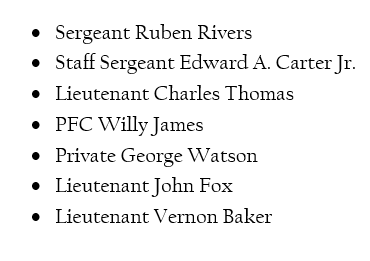
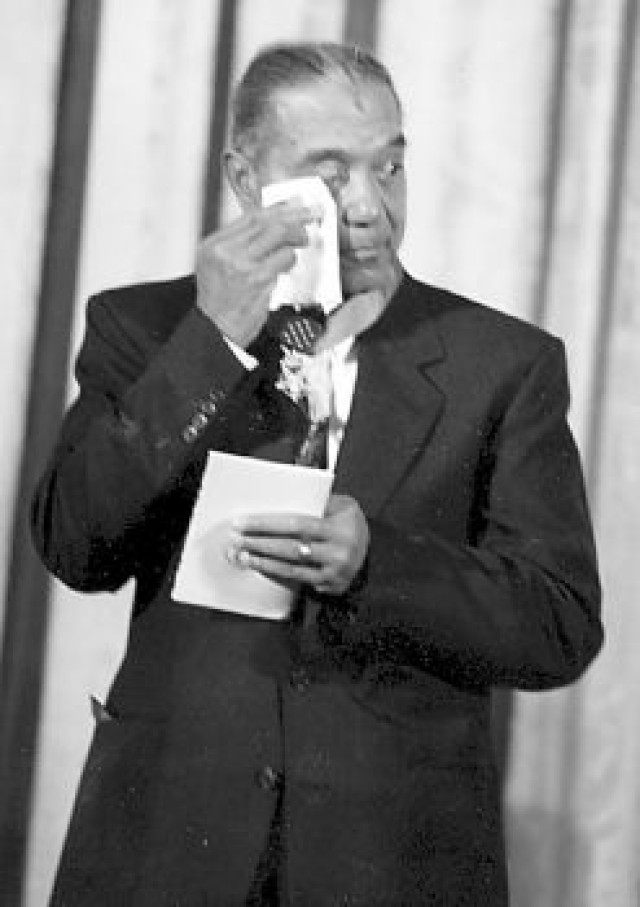
It took the Army until 1997 to bestow the Medal of Honor on these soldiers:


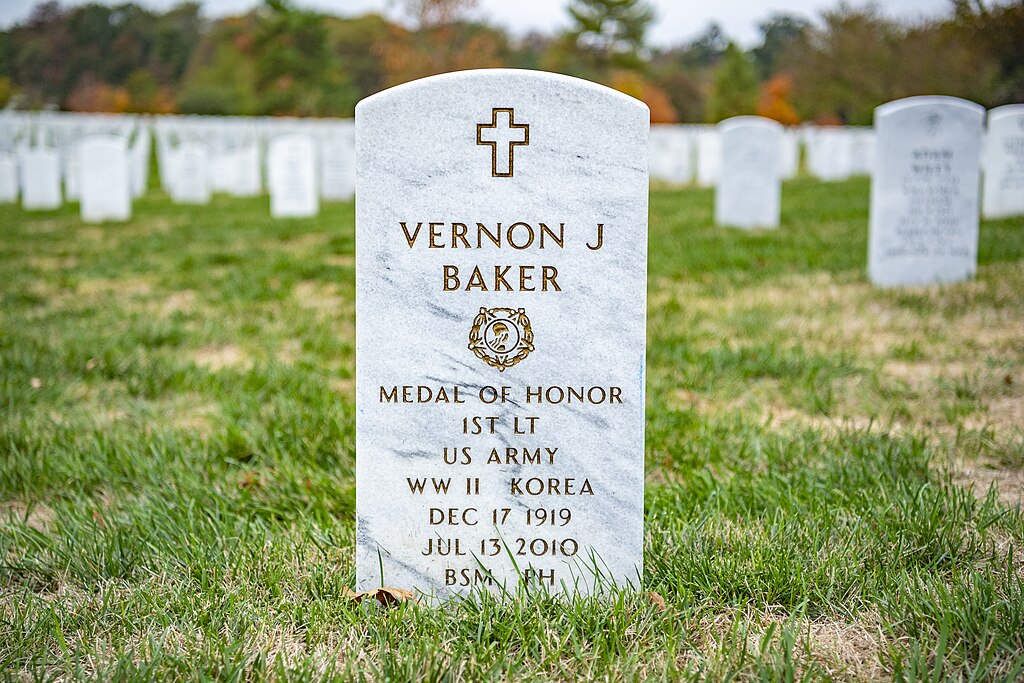
By 1997, Baker was the only one of this group still alive. Here is his Medal of Honor citation:

For conspicuous gallantry and intrepidity at the risk of his life above and beyond the call of duty: First Lieutenant Vernon J. Baker distinguished himself by extraordinary heroism in action on 5 and 6 April 1945. At 0500 hours on 5 April 1945, Lieutenant Baker advanced at the head of his weapons platoon, along with Company C’s three rifle platoons, towards their objective, Castle Aghinolfi – a German mountain strong point on the high ground just east of the coastal highway and about two miles from the 370th Infantry Regiment’s line of departure. Moving more rapidly than the rest of the company, Lieutenant Baker and about 25 men reached the south side of a draw some 250 yards from the castle within two hours. In reconnoitering for a suitable position to set up a machine gun, Lieutenant Baker observed two cylindrical objects pointing out a slit in a mount at the edge of a hill. Crawling up and under the opening, he stuck his M-1 into the slit and emptied the clip, killing the observation post’s two occupants. Moving to another position in the same area, Lieutenant Baker stumbled upon a well-camouflaged machine gun nest, the crew of which was eating breakfast. He shot and killed both enemy soldiers. After Captain John F. Runyon, Company C’s Commander joined the group, a German soldier appeared from the draw and hurled a grenade which failed to explode. Lieutenant Baker shot the enemy soldier twice as he tried to flee. Lieutenant Baker then went down into the draw alone. There he blasted open the concealed entrance of another dugout with a hand grenade, shot one German soldier who emerged after the explosion, tossed another grenade into the dugout and entered firing his sub-machine gun killing two more Germans. As Lieutenant Baker climbed back out of the draw, enemy machine gun and mortar fire began to inflict heavy casualties among the group of 25 soldiers, killing or wounding about two-thirds of them. When expected reinforcements did not arrive, Captain Runyon ordered a withdrawal in two groups. Lieutenant Baker volunteered to cover the withdrawal of the first group, which consisted mostly of walking wounded, and to remain to assist in the evacuation of the more seriously wounded. During the second group’s withdrawal, Lieutenant Baker, supported by covering fire from one of the platoon members, destroyed two machine gun positions (previously bypassed during the assault) with hand grenades. In all, Lieutenant Baker accounted for nine enemy dead soldiers, elimination of three machine gun positions, an observation post, and a dugout. On the following night, Lieutenant Baker voluntarily led a battalion advance through enemy mine fields and heavy fire toward the division objective. Lieutenant Baker’s fighting spirit and daring leadership were an inspiration to his men and exemplify the highest traditions of the military service.

Baker’s grave at Arlington

April 1945: Thank you for your service, Gordon Bennett

02 Wednesday Apr 2025

Posted by ag1970 in Arroyo Grande, California history, World War II

≈ Leave a comment

Tags

aviation, History, world-war-2, wwii

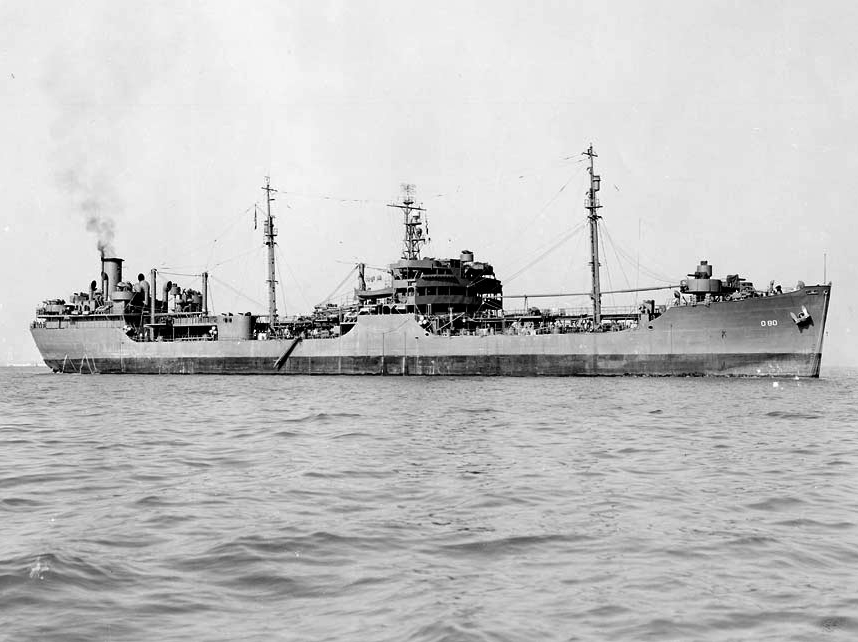
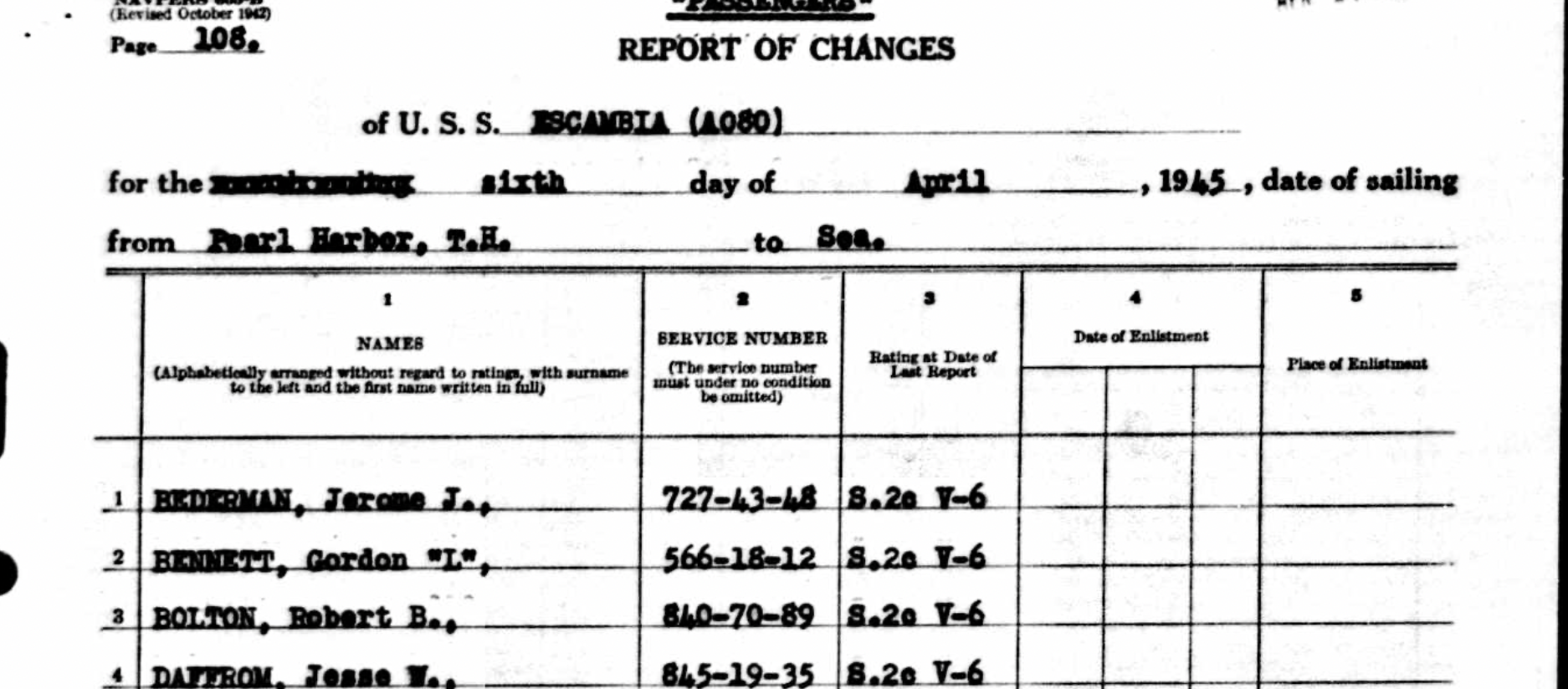
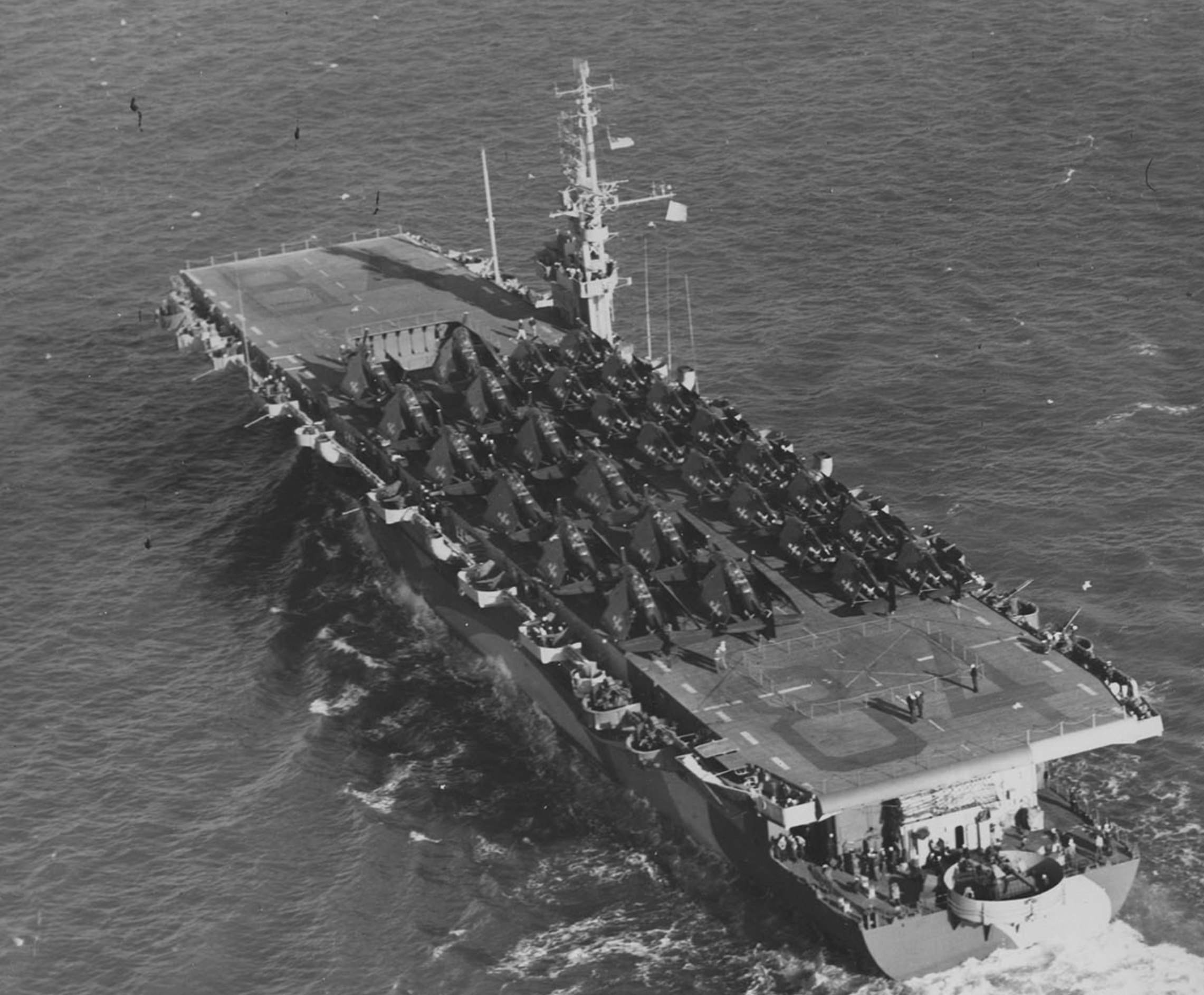
Gordon’s fleet oiler, USS Escambia

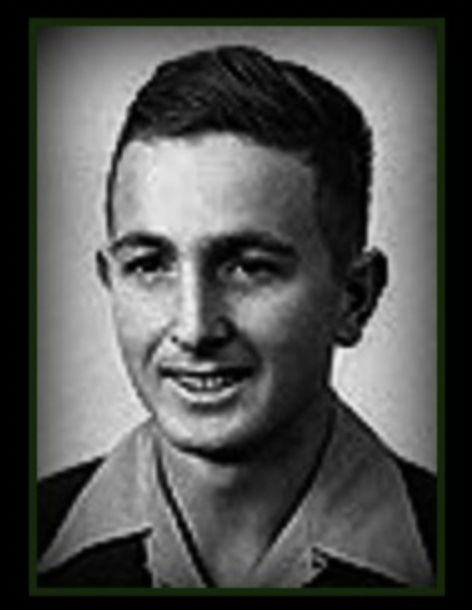
Gordon Bennett, Arroyo Grande Union High School ’44, was one of my students’ favorite guest speakers when I taught U.S. History at AGHS. He was a gifted storyteller with a sense of humor as dry as vermouth. My students and I loved hearing his stories about growing up in Arroyo Grande during the Depression and World War II.

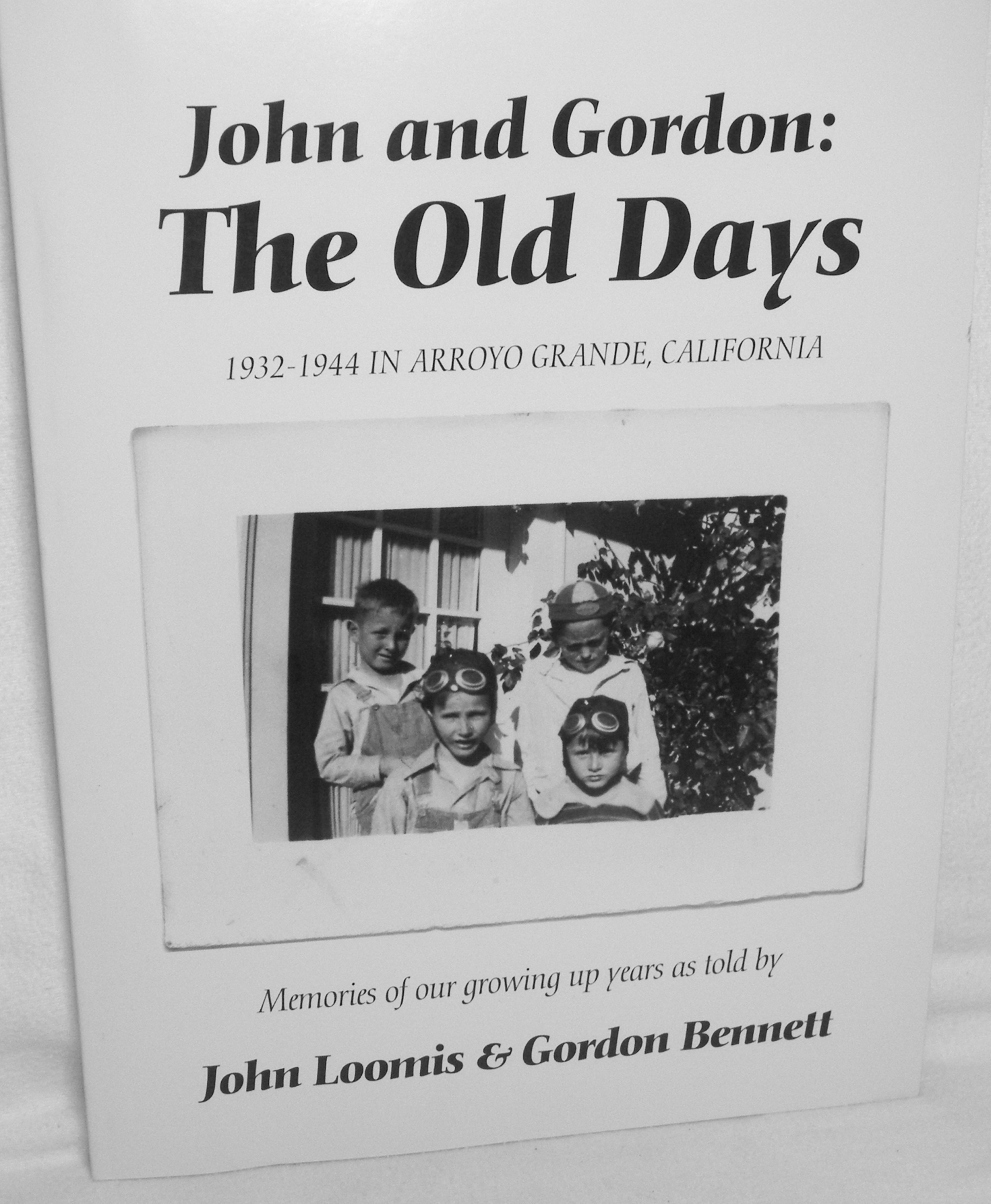
World War II was waiting for them when both Gordon and his cousin, John Loomis, joined the service. The two found themselves not that far apart during the Battle of Okinawa, which had begun April 1, 1945. John was onshore with the 1st Marine Division, Gordon offshore serving as a sailor on the fleet oiler Escambia (named after a river in Florida).

Gordon and his shipmates serviced escort carriers (small carriers that carried around thirty planes, like Emerald Bay (above), during the height of the kamikaze attacks off Okinawa. Thirty-four Navy vessels were sunk and over 280 damaged during the last, desperate battle of the war. The little carriers that were Escambia’s responsibility escaped and launched a series of airstrikes on the island. Both Escambia and Emerald Bay were based at Ulithi, where Gordon, according to legend, experimented in the distillation of medicinal beverages.

Above: The Ulithi anchorage; Gordon in high school; USS Escambia’s logo, designed by a Disney artist.

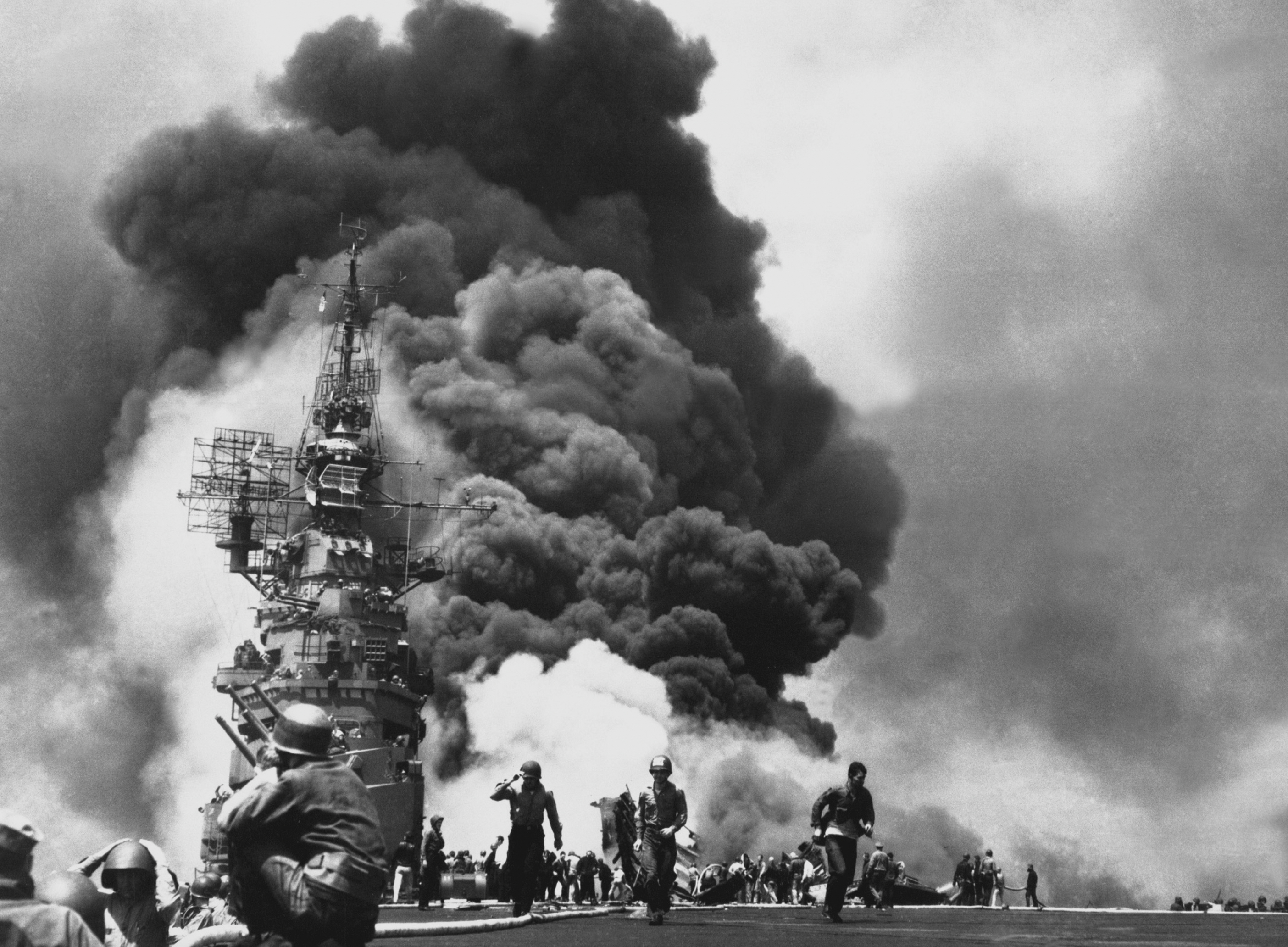
Which, given the ferocity of the kamikaze attacks, I might’ve sipped. The carrier Bunker Hill after once such attack, below.


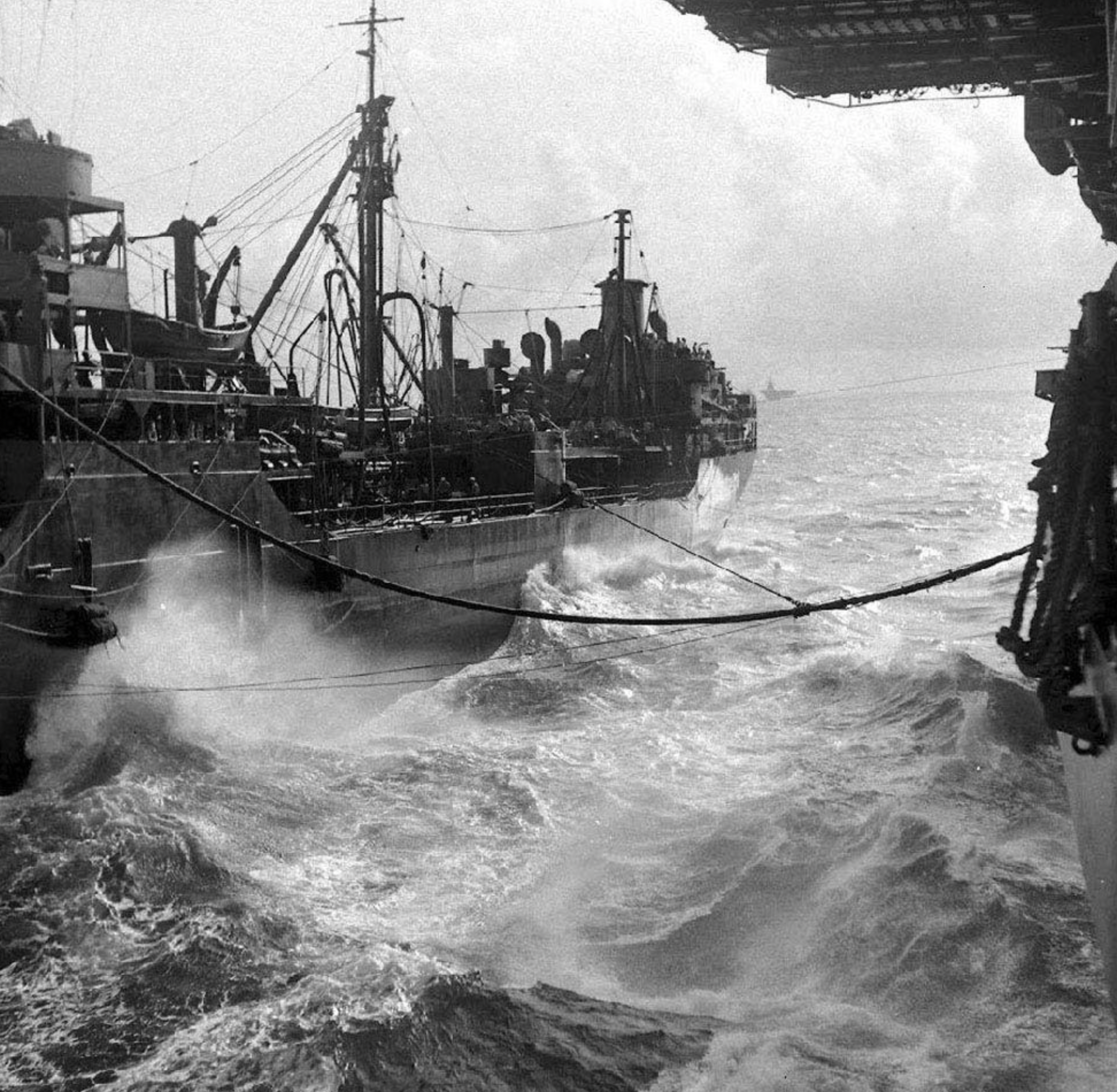
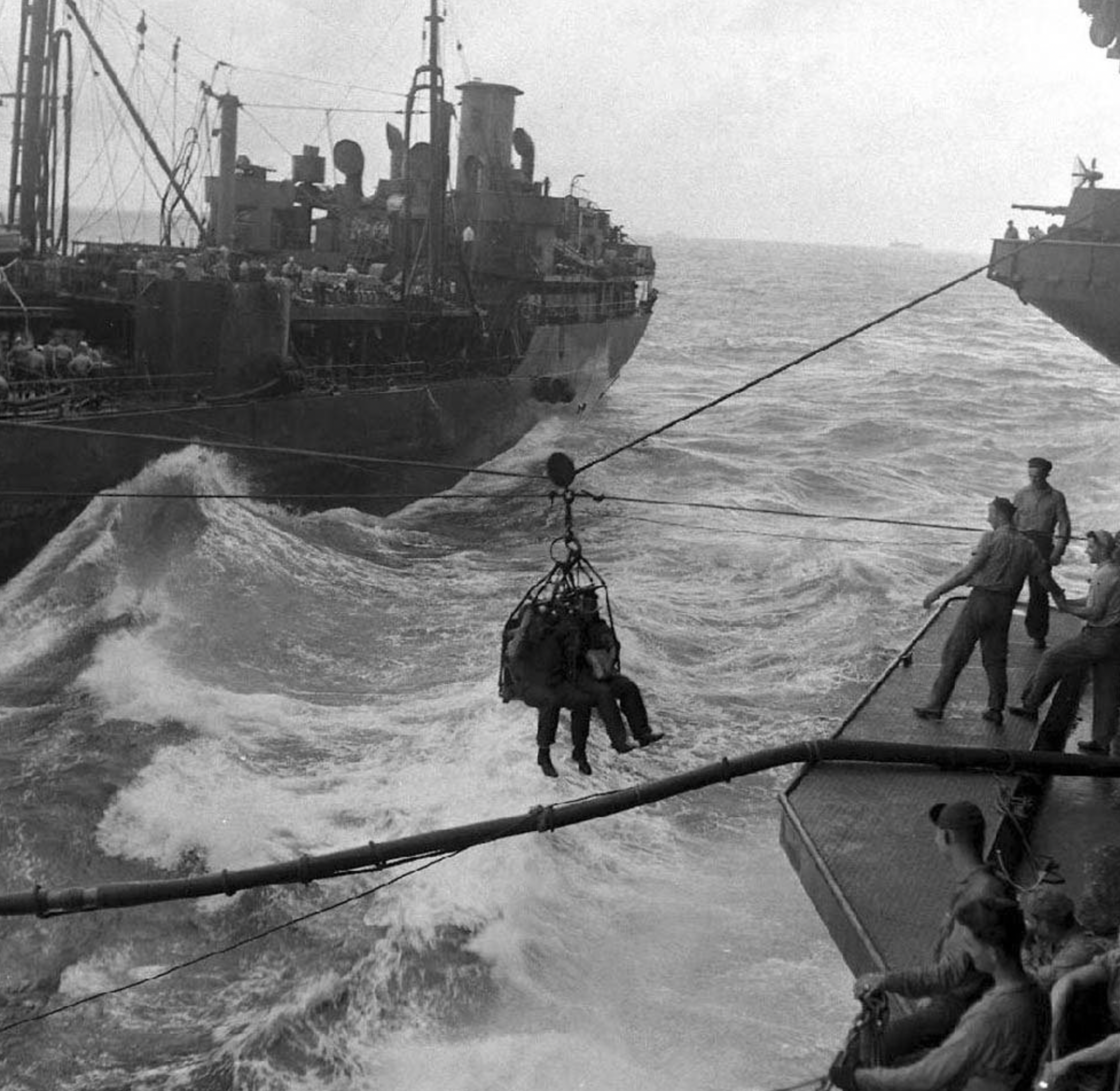
The sailors on the fleet oilers were tough men. Fueling at sea was smelly, dirty, and very dangerous. The two photos show a fueling operation between Escambia and the fleet carrier Ticonderoga in July 1945. The way Escambia sailors return to their ship, in that breeches buoy, does not seem safe to me, but my guess is that Gordon would have had his turn in the same kind of conditions.

Sadly, Escambia (below, about 1950) would be used by, of all institutions, the United States Army during the Vietnam War as an auxiliary power plant. Transferred to the Vietnamese government in 1971, Gordon’t ship was scrapped.

Happily, Gordon came home safe. So did his cousin, John. They had many years of storytelling ahead of them. Gordon, in my classroom, fueled the imaginations of the young people who were high-school juniors in 2003, just as Gordon had been in 1943.

(Below): Gordon’s obituary, which is enchanting.

https://www.legacy.com/us/obituaries/sanluisobispo/name/gordon-bennett-obituary?id=11810332

Some of our connections to the Battle of Okinawa, April 1, 1945

29 Saturday Mar 2025

Posted by ag1970 in Arroyo Grande, World War II

≈ Leave a comment

Rehearsal Monana de OroDownload

The HBO series that’s too close to home

14 Friday Mar 2025

Posted by ag1970 in Arroyo Grande, Film and Popular Culture, History, Uncategorized, World War II

≈ Leave a comment


I can get through one episode at a time of the Spielberg/Tom Hanks series Band of Brothers, which speaks more to me because my Dad was an Army officer in Europe. Sometimes I can’t get that far in The Pacific. It’s so harrowing that I don’t know how any Marine came home undamaged. I don’t imagine that any did.

I read, many years ago, With the Old Breed, by Eugene “Sledgehammer” Sledge, a character in the miniseries, and the historian/biographer William Manchester’s account of his war service, Goodbye Darkness, and both left me deeply troubled. That’s exactly the impact they should’ve had.

Somehow, thanks to the work of computer artists and the incredible composition, “Honor,” by Hans Zimmer, the opening credits to the miniseries are strangely and surpassingly beautiful.


But it remains a disconnect in my spirit, to imagine what young men from my hometown went through. There were other Marines, but here are five who resonate for me.

Louis Brown, killed on the beach at Saipan in 1942, finally came home to his mother in 2017.
Archie Harloe, son of the schoolteacher, was part of the invasion Saipan. He survived, but Marines watched, horrified, as islanders leaped to their deaths from ocean cliffs. They’d been told the Americans would torture them.
Louis Brown, the son of a Corbett Canyon farmer, an Azorean immigrant, stepped on a Japanese on Iwo Jima. Cause of death: “Burns, entire body.” This is the young man who, on finding his grave, started me writing books. What I owe him is beyond measure.
Lt. Max Belko, a USC All-American football player, became a P.E. teacher and football/basketball coach at Arroyo Grande Union High School–his kids would’ve played in today’s Paulding Gym. He was killed on the beach in the invasion of Guam.

John Loomis, AGUHS ’44, joined the Marines so he could get into the war before it ended. He did, at Okinawa, one of the costliest battles in the Pacific. He survived to raise the daughters and the son who would be among my closest friends growing up.
← Older posts

Subscribe

  • Entries (RSS)
  • Comments (RSS)

Archives

  • April 2026
  • March 2026
  • February 2026
  • January 2026
  • December 2025
  • November 2025
  • October 2025
  • September 2025
  • August 2025
  • July 2025
  • June 2025
  • May 2025
  • April 2025
  • March 2025
  • February 2025
  • January 2025
  • December 2024
  • November 2024
  • October 2024
  • September 2024
  • August 2024
  • July 2024
  • June 2024
  • May 2024
  • April 2024
  • March 2024
  • February 2024
  • January 2024
  • December 2023
  • November 2023
  • October 2023
  • September 2023
  • August 2023
  • July 2023
  • June 2023
  • May 2023
  • April 2023
  • March 2023
  • February 2023
  • January 2023
  • December 2022
  • November 2022
  • October 2022
  • September 2022
  • August 2022
  • May 2022
  • April 2022
  • March 2022
  • February 2022
  • January 2022
  • December 2021
  • November 2021
  • October 2021
  • September 2021
  • August 2021
  • July 2021
  • June 2021
  • April 2021
  • March 2021
  • February 2021
  • January 2021
  • December 2020
  • November 2020
  • August 2020
  • July 2020
  • June 2020
  • May 2020
  • April 2020
  • January 2020
  • December 2019
  • November 2019
  • October 2019
  • September 2019
  • August 2019
  • May 2019
  • April 2019
  • March 2019
  • February 2019
  • January 2019
  • December 2018
  • November 2018
  • October 2018
  • September 2018
  • July 2018
  • June 2018
  • May 2018
  • April 2018
  • March 2018
  • February 2018
  • January 2018
  • December 2017
  • November 2017
  • October 2017
  • April 2017
  • March 2017
  • December 2016
  • November 2016
  • October 2016
  • September 2016
  • August 2016
  • July 2016
  • June 2016
  • April 2016
  • March 2016
  • February 2016
  • January 2016
  • December 2015
  • November 2015
  • October 2015
  • September 2015
  • August 2015
  • July 2015
  • June 2015
  • May 2015
  • April 2015
  • March 2015
  • February 2015
  • January 2015
  • December 2014
  • November 2014
  • September 2014
  • August 2014
  • July 2014

Categories

  • American History
  • Arroyo Grande
  • California history
  • Family history
  • Film and Popular Culture
  • History
  • News
  • Personal memoirs
  • Teaching
  • The Great Depression
  • trump
  • Uncategorized
  • World War II
  • Writing

Meta

  • Create account
  • Log in

Blog at WordPress.com.

  • Subscribe Subscribed
    • A Work in Progress
    • Join 69 other subscribers
    • Already have a WordPress.com account? Log in now.
    • A Work in Progress
    • Subscribe Subscribed
    • Sign up
    • Log in
    • Report this content
    • View site in Reader
    • Manage subscriptions
    • Collapse this bar

Loading Comments...