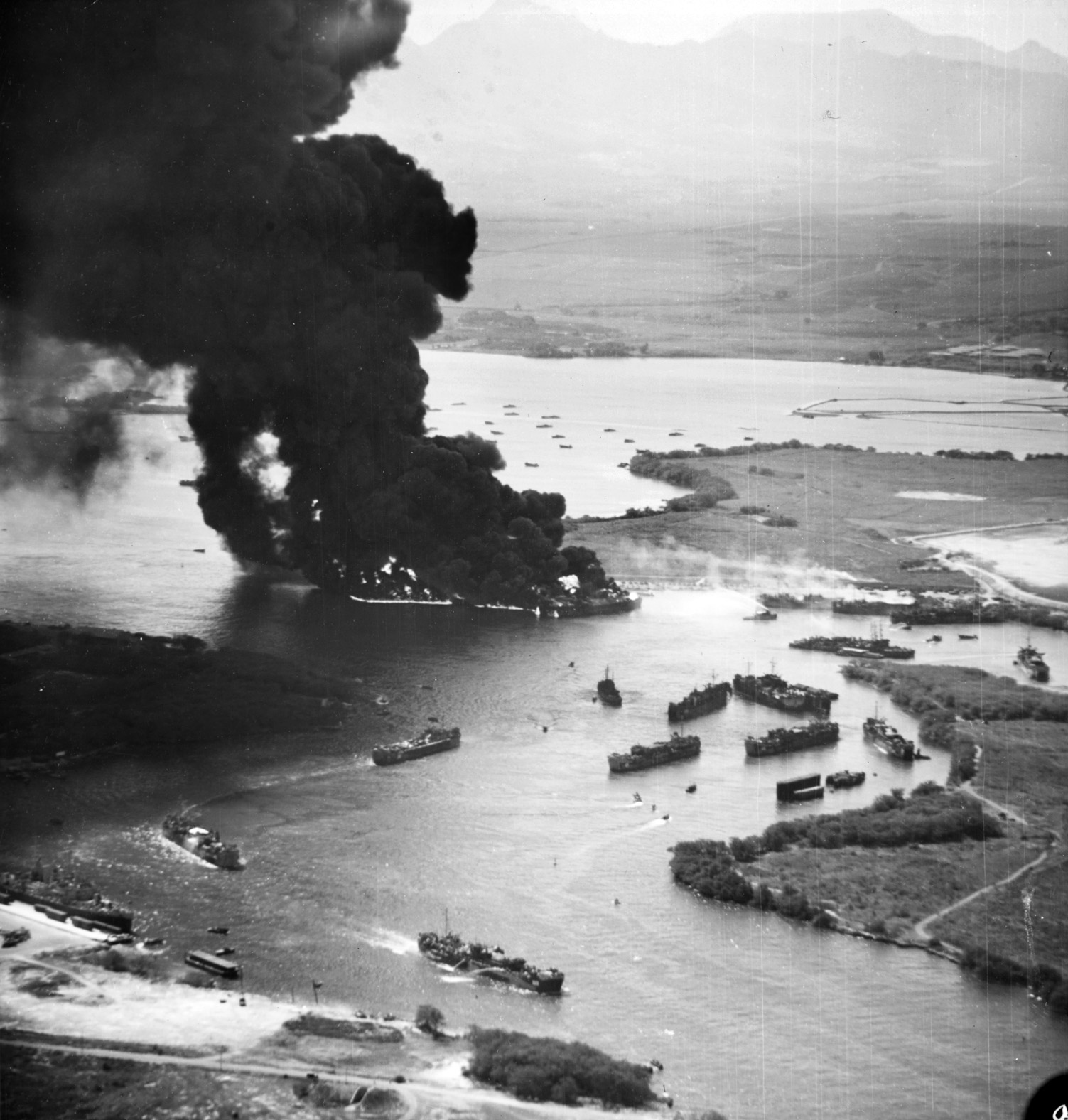
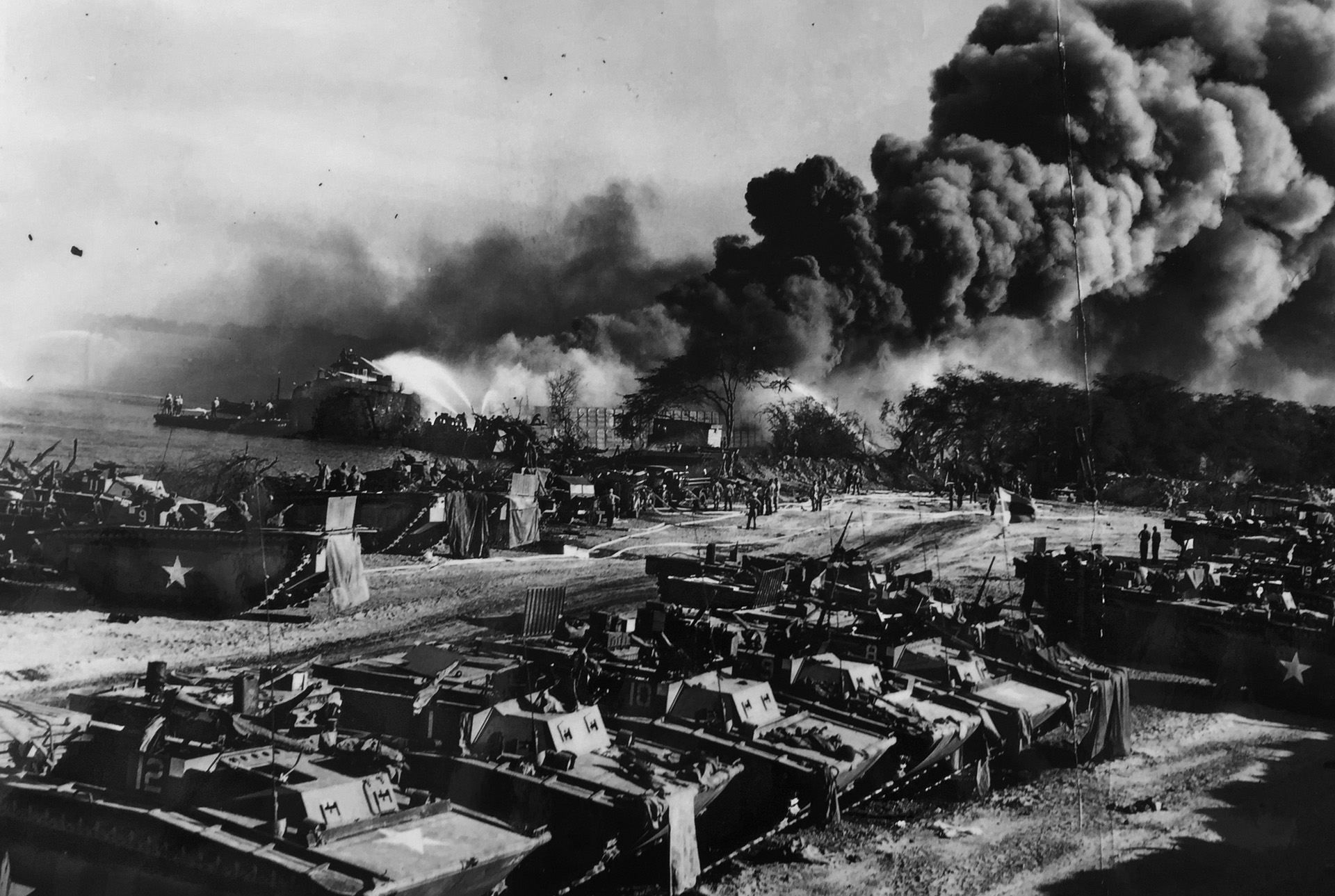
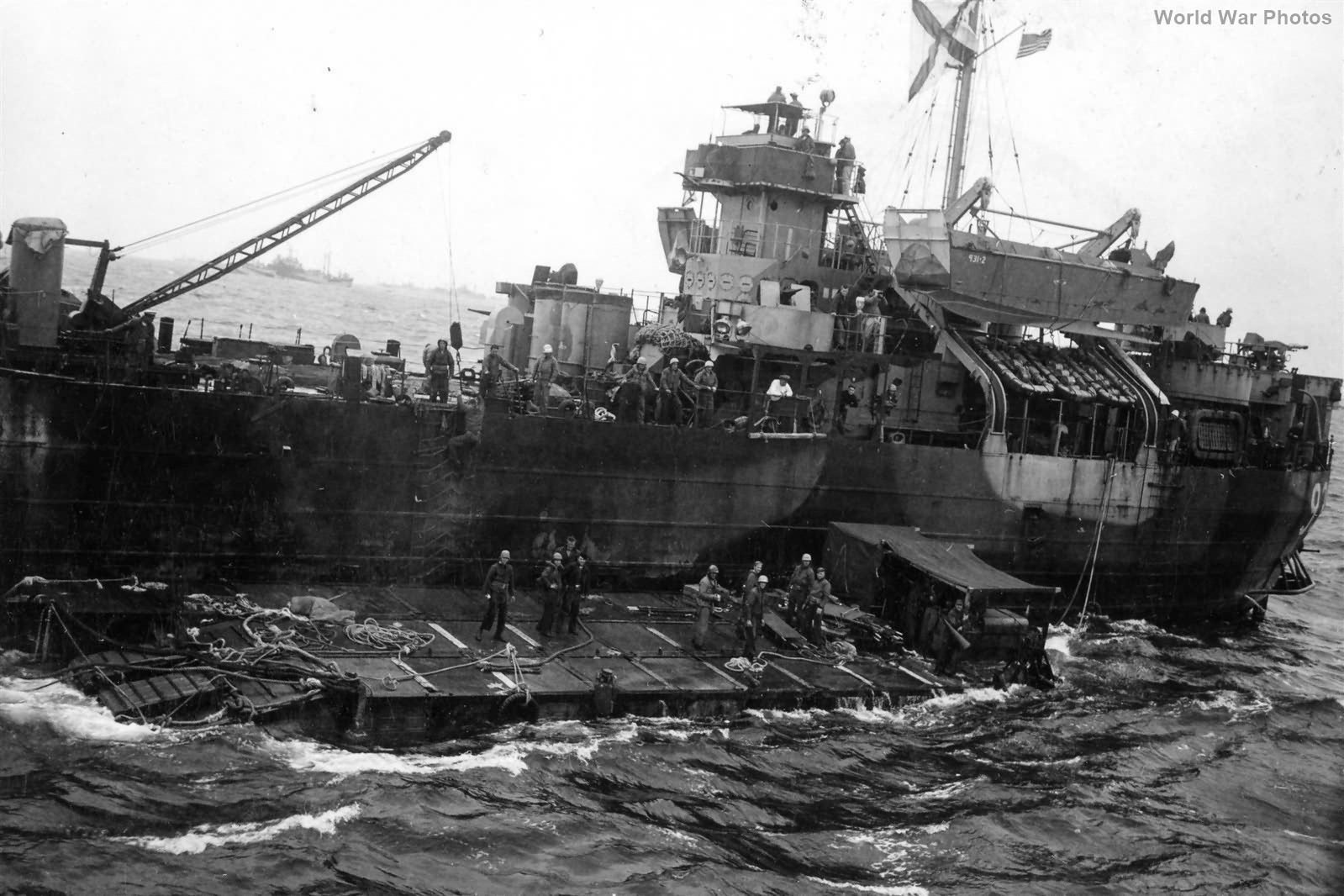
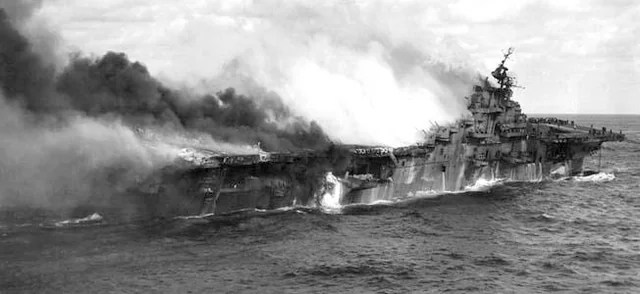
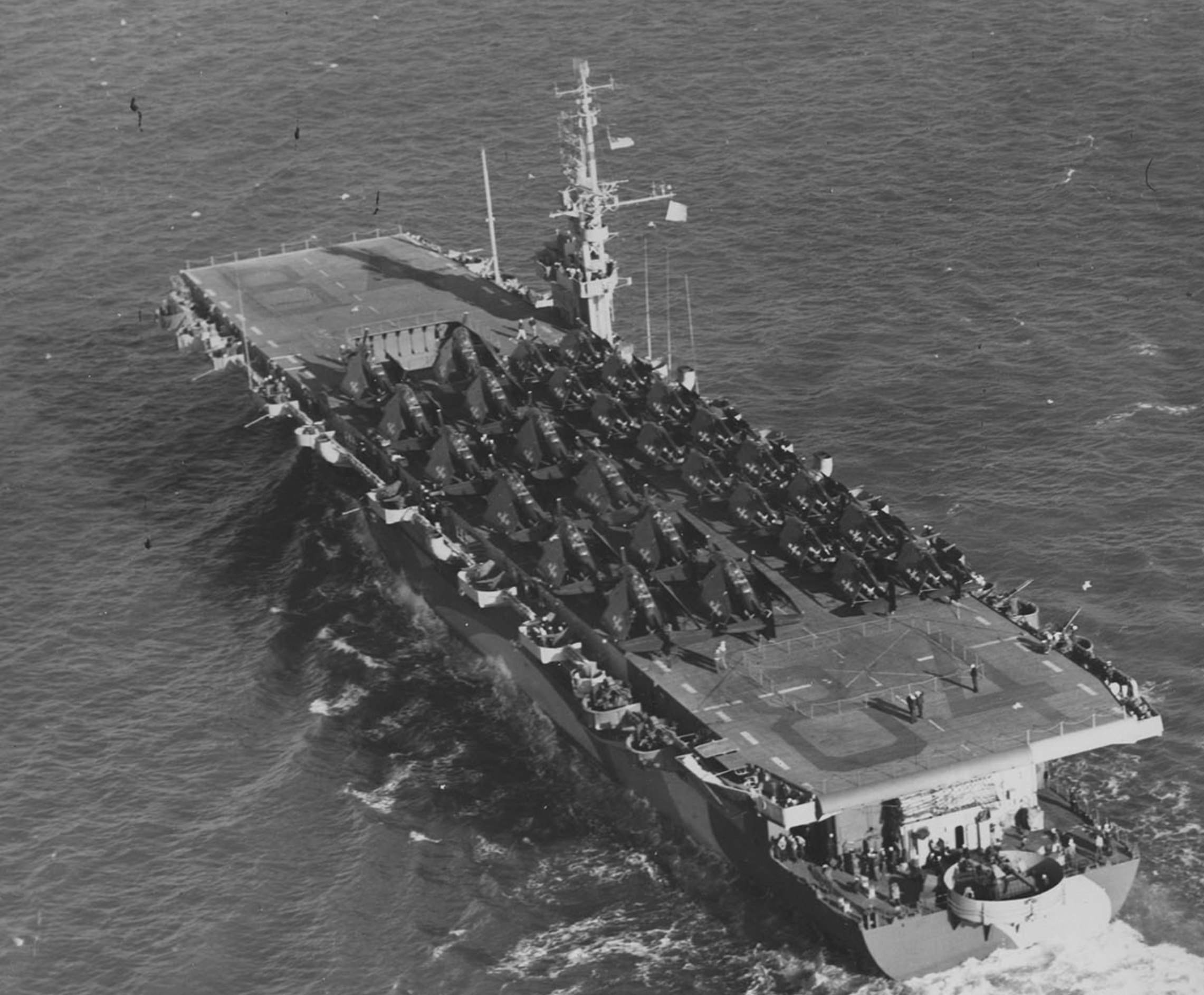
Aerial photograph of Pearl Harbor’s West Loch, showing the burning LSTs at berths T-8 and T-9. Some LSTs are manuevering in the foreground, leaving the vicinity of the explosions and fire, while other ships have yet to get underway. Official U.S. Navy Photograph, now in the collections of the National Archives.
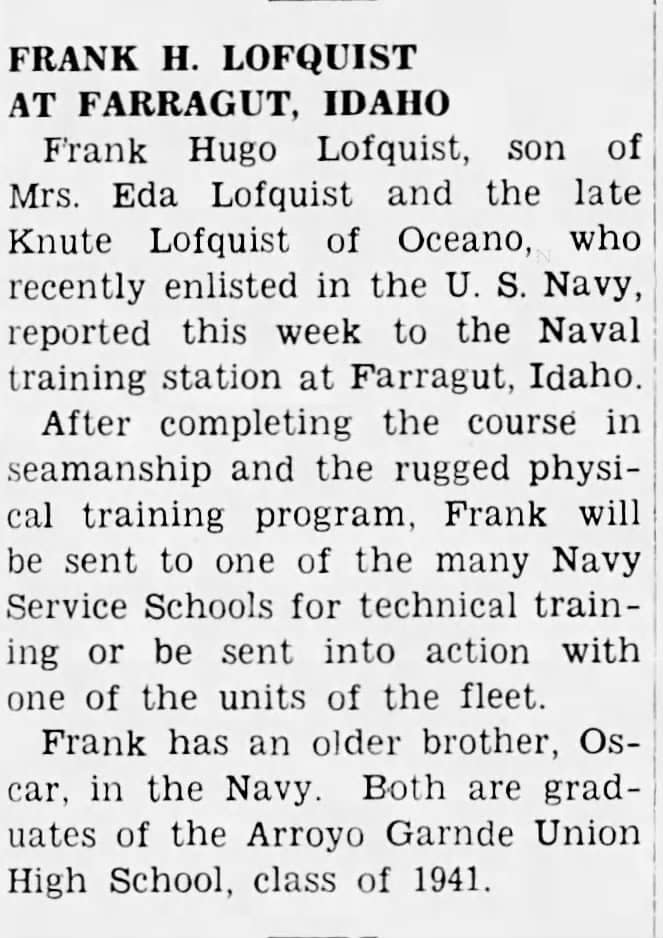
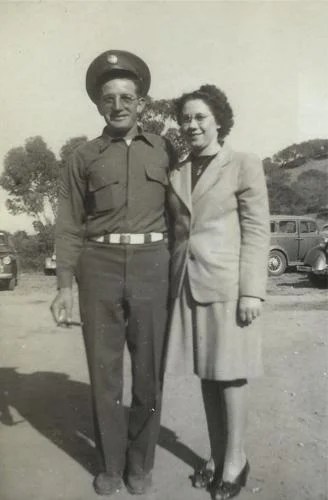
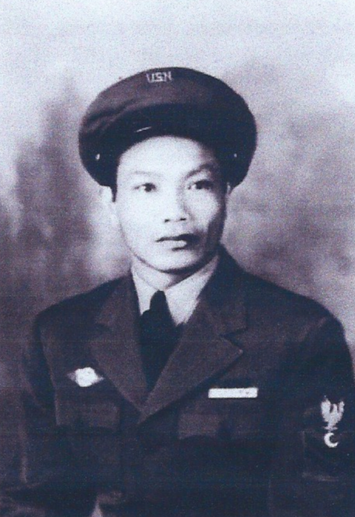
My Facebook friend Shannon Ratliff-Evans keeps a faithful record of Arroyo Grande High School Eagles who have passed on. I noted today this article she posted from the local weekly, probably from 1943, citing this sailor from the high school class of 1941, the last peacetime class for four years:
I had to find out more. I’m nosy that way.
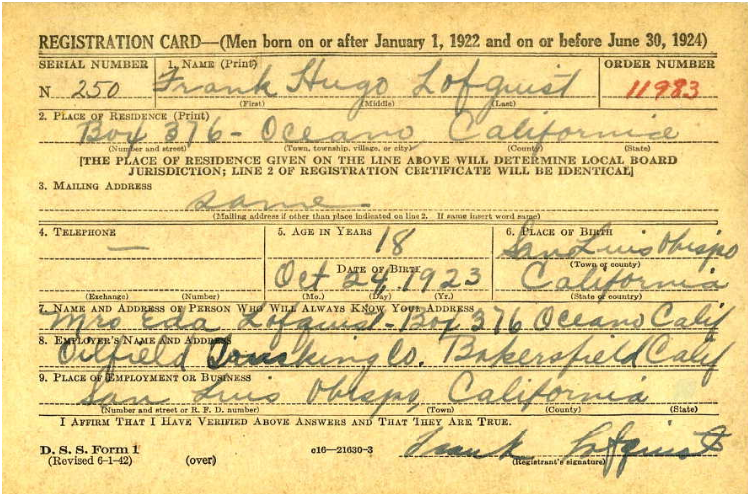
Here’s Frank’s draft card (his father, as the article notes, had died by then: Knute was a Swedish immigrant, but Frank’s mother was a Californian)
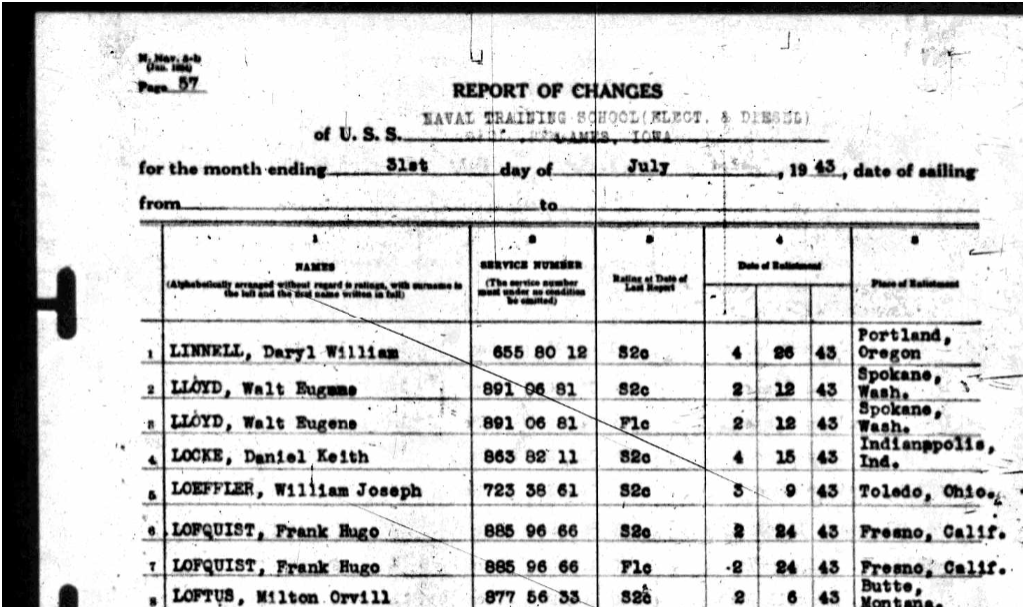
After his time at Farragut–named for a Civil War admiral–Frank would be sent to another landlocked place, Ames, Iowa, home of Iowa State University, for specialized training as a mechanic.
After this, Frank would go to war. I was hoping he would see service on a carrier or a cruiser or a destroyer. No. His skills sent him to the Landing Craft Unit 34 at the Waipo Amphibious Operating Base, on a peninsula bounded by Pearl Harbor’s West Loch. So, if Frank wasn’t steaming into action against the Imperial Navy, he was doing something just as important: helping to train servicemen and maintain landing craft in preparation for the costly landings across the Central Pacific in 1944-45.
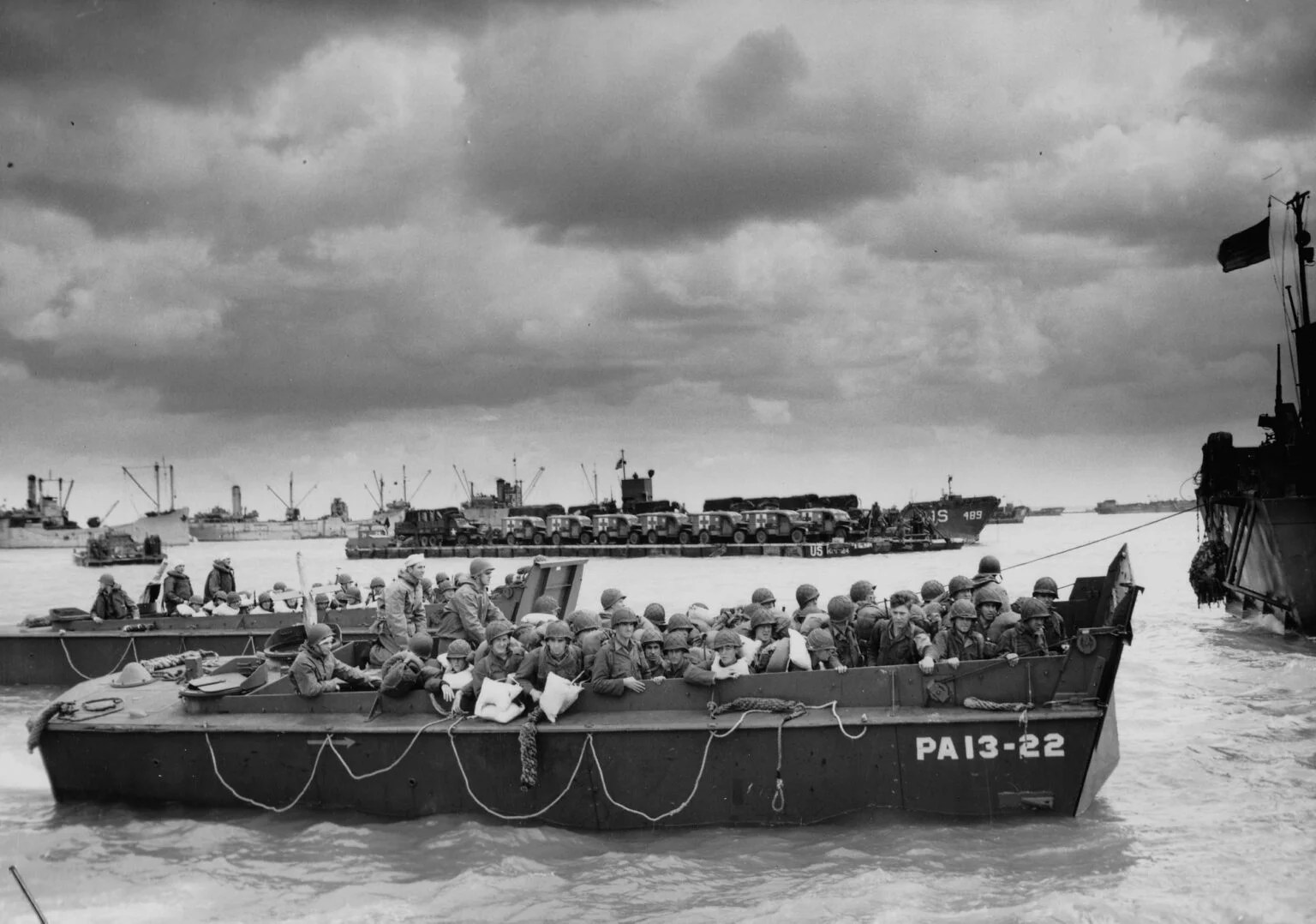
Among the craft at Waipo:
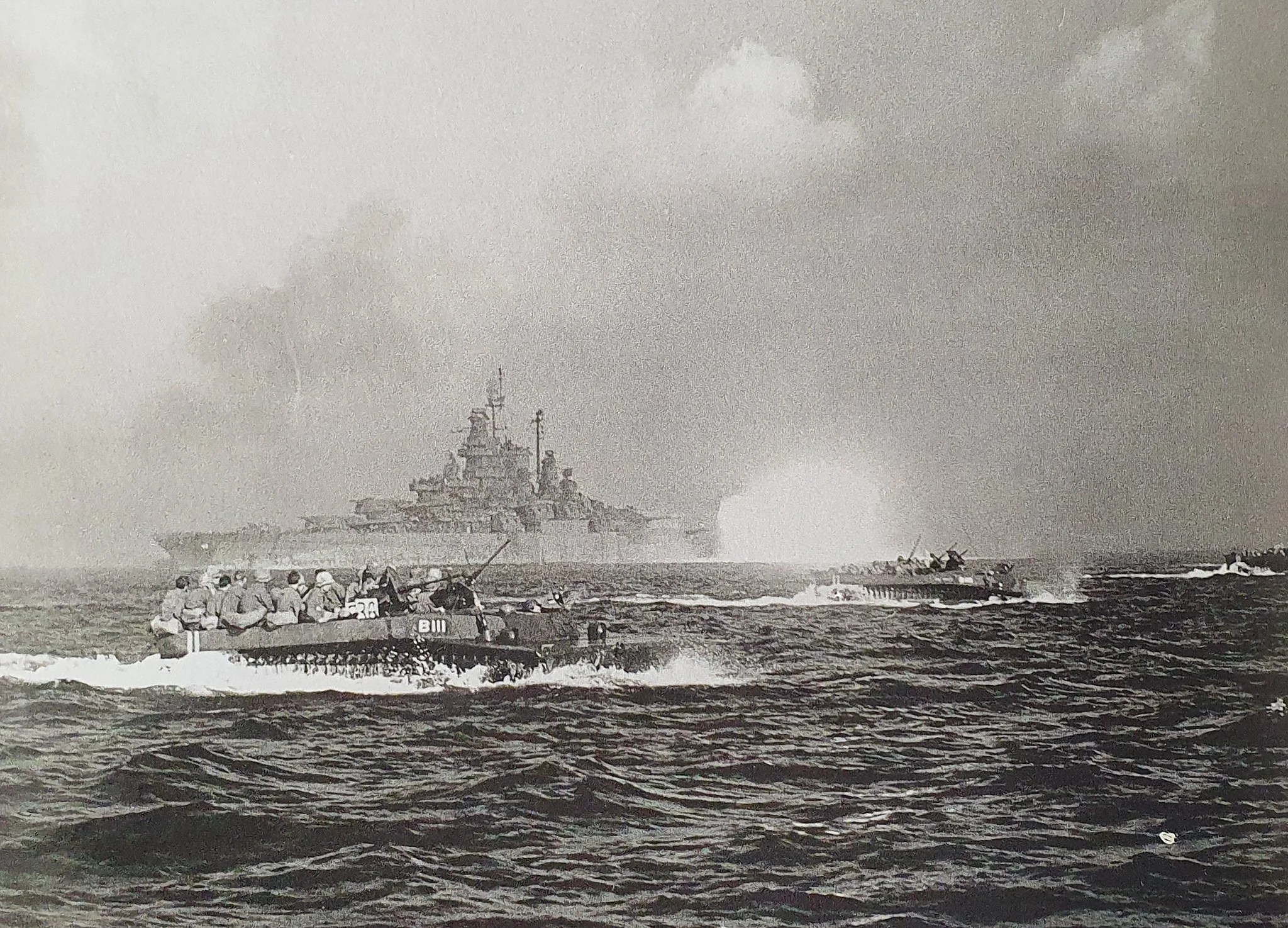
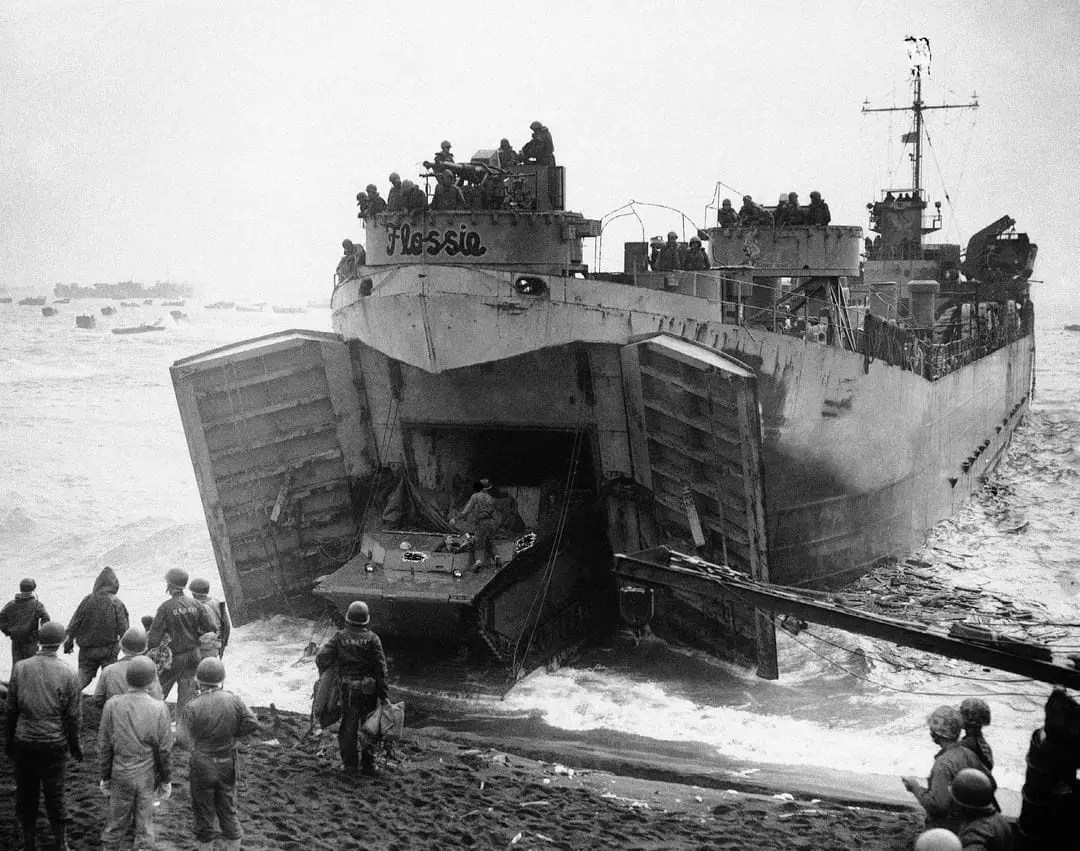
LVI’s: Amphibious Tractors, carrying 1st Division Marines to OkinawaLCVP’s, better known as Higgins Boats, featured in Saving Private RyanLSTs, Landing Ships, Tanks–big fellows
Amphibious tractors in the foreground as fires rage along the West Loch, May 1944.
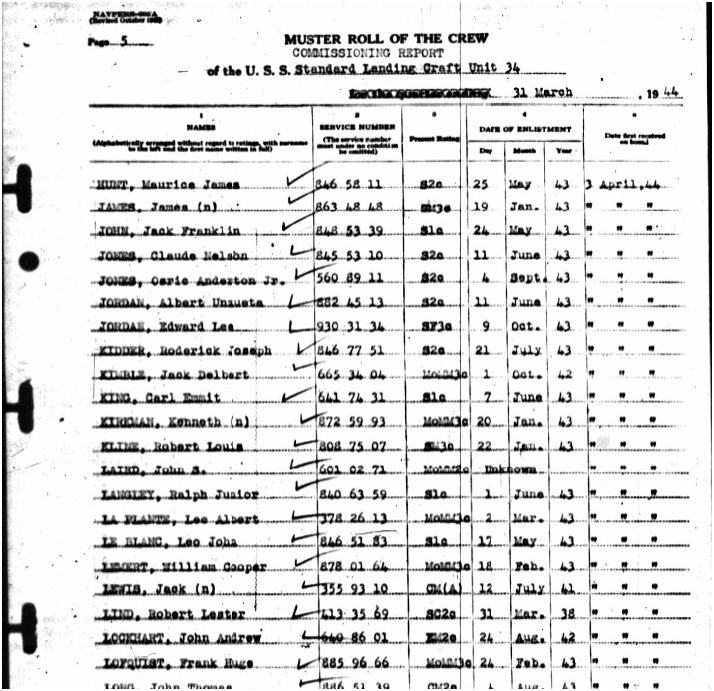
According to U.S. Navy Muster Rolls, Frank (at the bottom, below) reported to Waipo in April 1944. He would be stationed there until the end of the war. But it only took a month for the war to come to him.
In May 1944, Unit 34 would have been preparing sailors, Coast Guardsmen and Marines for the invasion of the Marianas Islands, which included the horrific Battle of Saipan. The invading Marines included Archie Harloe, the son of the Arroyo Grande schoolteacher, and some of them witnessed civilians, convinced that the Americans would torture them, leaping to their deaths from sea cliffs.
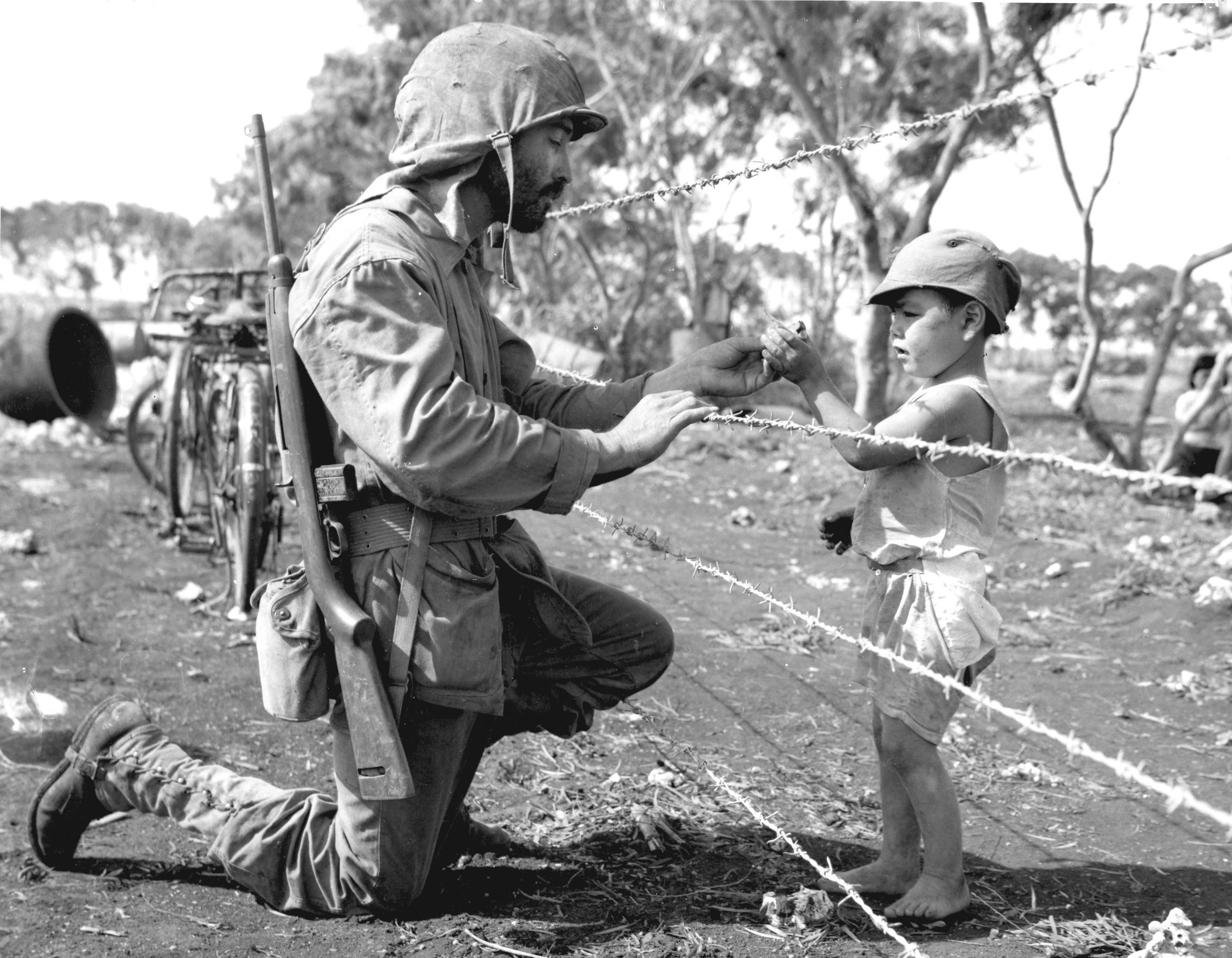
Had the people who committed suicide waited, they would’ve met Americans like this one: A Marine shares food with a Saipanese child.
That was in June. Another tragedy–this one at Waipo–preceded Saipan’s. On May 21, 1944, the West Loch, in preparation for the Marianas, was packed with the big ships, the LST’s. Mortar ammunition was being transferred to one of them when a mortar round either fell or was detonated by gasoline vapors, The resultant explosion was massive, but not as massive as the second explosion, which showered the LST’s with burning debris, which in turn set off aviation fuel and ammunition.
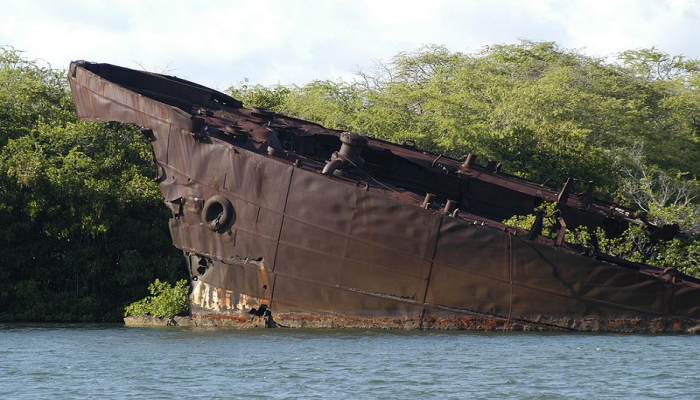
The fires burned for twenty-four hours. Six LST’s were destroyed. One of them, LST-480, remains alongside the West Loch today:
The official Navy casualty list cites 163 killed. That is almost certainly an underestimate. It may not reflect the deaths of Marines from the 2nd and 4th Divisions and soldiers from Schofield Barracks acting as stevedores at Waipo. Some estimates put the deaths at 1,000 young Americans.
Frank Lofquist was there, and, as fate would have it, he would live a long life–he died, at eighty, in 2003. I’ll post below a video of some South County sailors and their ships, but it occurred to me that Lofquist’s service at Pearl Harbor was just as important, and, since I just learned about the West Loch disaster, almost as dangerous.
Using the World War II Army ratio, for every American combat soldier, there were 4.3 support troops (like my father, a quartermaster officer who sent gasoline supply companies to Omaha Beach, and like Lofquist). World War II was their war, too.
Thank you for your service, Frank Hugo Lofquist.
An LST takes on wounded Marines at Iwo Jima, March 1945, where Arroyo Grande Marine Louis Brown was killed three days short of his 21st birthday.
It was Lofquist’s war, and, of course, it was the war of the Black sailors at Port Chicago, near San Francisco. An explosion there three months later killed at least 320 of them, detailed as stevedores, when an ammunition ship blew up. What happened after is another story that needs to be retold every few years.
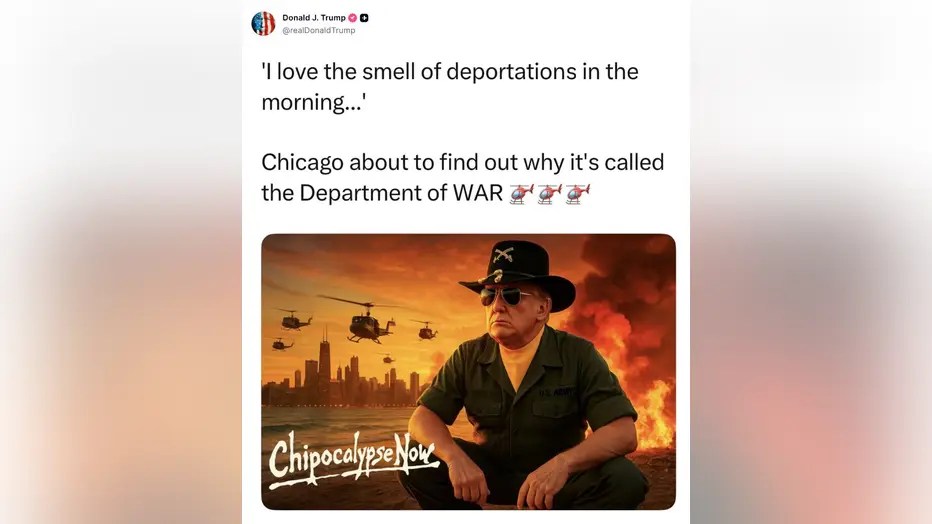
This was Saturday. He’s half-heartedly apologized today: “We’re not going to war with Chicago.” I’m sure, with the bellicose re-naming of the Department of Defense, that Chicago is overwhelmed with gratitude.
War would overwhelm this president* because, like all bullies, he is a coward. It takes so much air to fill him, but he has a kind of army—his sycophants—who stand ready to provide it.
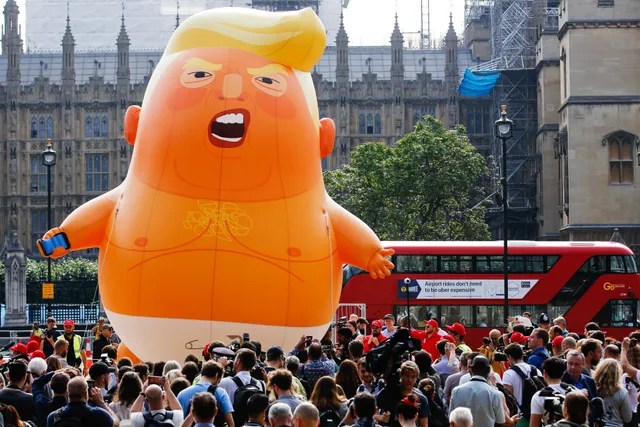
The president* visits London
This is a re-creation of the 1918 Battle of Belleau Wood (the re-enactors are real Marines), but the men who actually fought that battle were called by the first-term Trump, the milder version, “losers” and “suckers.” He was to honor them on the 100th anniversary of the assault, but it was raining in France.
And this is what war was like for local men who endured it.
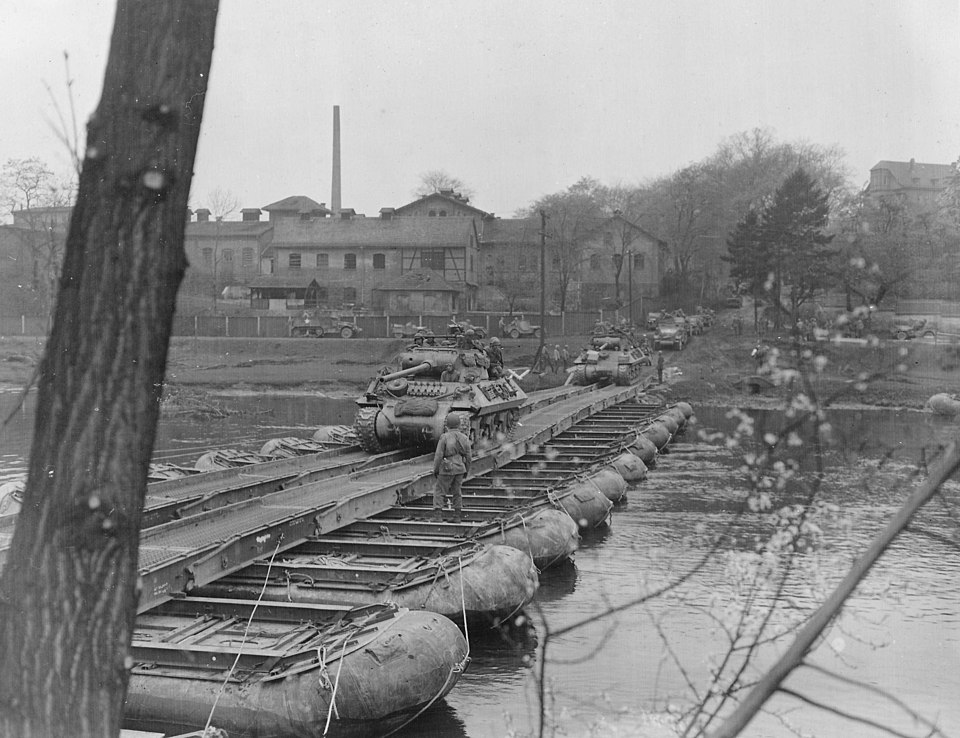
The 607th Tank Destroyer Battalion, 1944.
The Americans’ breakout from Normandy, after claustrophobic weeks in the death traps of the hedgerows, must have been a jubilant one, but the 607th would encounter another death trap whose brutality sobered them. The Americans, under Omar Bradley, and the British and Canadians, under Bernard Law Montgomery, had the chance to encircle the entire German Army in Normandy. They would fail, and thousands of Germans would escape, battle-weary, some of them now barefoot, running for their lives along narrow roads and cattle trails through what became known as the Falaise Gap.
But American artillery units still found many of them there–artillery spotters were nearly incoherent because there were so many targets to call in on their field radios–and the slaughter they inflicted was horrific.19 Seventy years later, one of the 607th’s soldiers, Frank Kunz, remembered the results in an interview with his hometown newspaper: “ Christ help me. There were 6 to 8 inches of bodies and horses ground up on the road. There was nothing you could do. You had to drive through it.” People, Kunz added, don’t understand what war is.20
In the photos: Frank and Sally Gularte at a family barbecue in Arroyo Grande before he shipped out as a member of the 607th Tank Destroyer Battalion, seen crossing a river into Germany. A German sniper claimed Frank’s life in November 1944. Sally gave birth to Frank Jr. five days later.From the book World War II Arroyo Grande.
The aircraft carrier Ben Franklin, 1945
The bomb’s detonation [one of two that his the aircraft carrier Franklin off Japan in 1945] flipped a 32-ton deck elevator like a flapjack, leaving it canted at a 45-degree angle in its well. The shaft below it and the decks adjacent were an inferno: crewmen were incinerated instantly; aircraft on the hangar deck melted and plummeted to decks farther below. Twelve of the 13 pilots in the famed Marine Corps “Black Sheep” Squadron, based, since the beginning of the year, at a naval air station near Goleta, died in their ready room.19
Ships below the horizon felt the explosions. Camilo Alarcio clambered up to the flight deck only to realize that he was freezing: he made his way back to his quarters to fetch a jacket, flak jacket and flashlight and bolted topside again with his shipmates. Those emerging from below would have seen sailors running for their lives as the fires spread. In the black, heavy smoke, some ran into the turning propellers of aircraft, their engines still running for their next combat mission.
Alarcio’s deliverance, and that of many others, began when he saw the cruiser Santa Re move alongside. That ship’s crew began to throw lines across to Franklin as the flames threatened to engulf the entire flight deck. He grabbed one of the lines and made his way across–other sailors fell and drowned, some so badly burned that they couldn’t save themselves, while others were pulled under by the turning of Franklin’s screws. Alarcio survived.2020
Franklin’s survival was in doubt. The initial explosion was just the beginning. As fires reached twenty more aircraft, fueled and ready for flight on the hangar deck, and ignited a chain reaction that, throughout the day, set off stores of bombs, rockets, anti-aircraft ammunition and aviation gasoline. At one point, the violence inside Franklin made the 32,000–ton ship shudder and spun her, like the needle on a compass, hard to starboard, where she lay dead in the water.
Photos: South County sailor Camilo Alarcio; his ship, the carrier Ben Franklin, afire. Somehow Franklin, with Alarcio aboard, made it back to her birthplace, the Brooklyn Navy Yard.
The 91st Bomb Group, 1945
Henry Hall now lives in Cayucos; he was a Kansan transplanted to Bakersfield before the war and then to San Luis Obispo County afterward to become a gunner in the Ninety-First Bomb Group, the “Ragged Irregulars.”
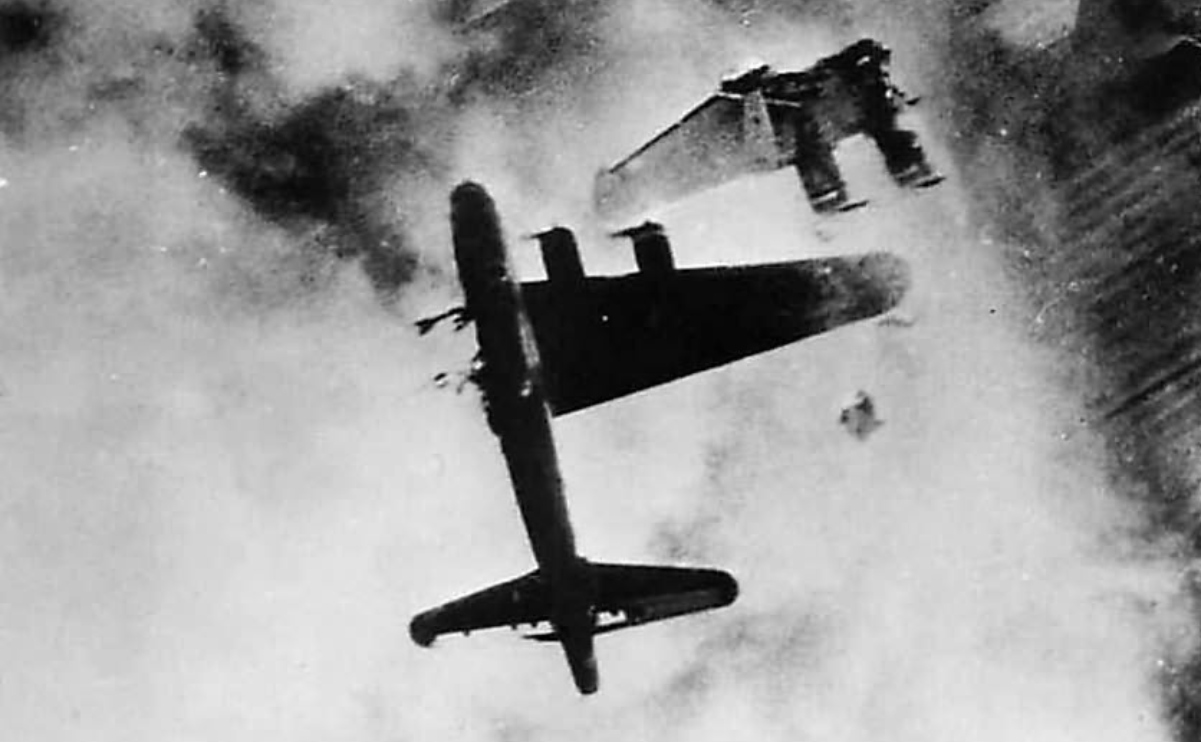
Hall witnessed a horrific chain reaction over Holland: a swarm of German fighters singled out a B-17 ahead, and the multiple hits on the bomber registered for him when he saw the right- side landing gear listlessly drop and an engine on the right wing catch fire. When the out-of-control bomber began its final plunge, it clipped two more B-17s in the formation—both of them went down as well.
It was the hardest of days for Hall’s bomb group: they lost six B-17s on a mission that gained nothing: their primary target, a ball-bearing factory near Berlin, was obscured by clouds, so the Ninety-First dropped their payloads on “targets of opportunity”—on this day, Hall remembered, on a little crossroads town that probably contributed little to the Nazi war effort.55
That was Hall’s first mission. He was twenty years old when he saw the three Ragged Irregular bombers plummet to earth together. Many members of his bomb group were even younger. Some of them, thanks to crafty misdirection aimed at recruiting sergeants pressured to meet their quotas, were as young as sixteen.
Far below them, in German cities like Hamburg and Dresden—or in relatively obscure Japanese cities like Toyama, the size of Chattanooga, or Kagoshima (the seat of the prefecture from which most San Luis Obispo County Japanese had emigrated), the size of Richmond, Virginia—the ashen bodies of schoolchildren stained sidewalks and streets.
Photos: Henry Hall, with his back turned, practicing water survival with his comrades. The B-17 “Wee Willie,” from Hall’s 91st Bomb Group, on its way down. There was one survivor.From the book Central Coast Aviators in World War II.
The 60th Ohio Volunteer Infantry, 1864
So under [Union Gen. Ambrose] Burnside, the 60th Ohio, on the afternoon of May 5, crossed the Rapidan River at the Germanna Ford. From a rise, they could see dust clouds raised by Lee’s army on the move and began to march into The Wilderness, a vast tangle of forest and scrub so dense that it shut out the sun. Adam Bair was a corporal and therefore, like Richard Merrill had been at Antietam, a file closer. Bair must have been tired after the river crossing. His role was like that of a border collie, striving constantly to keep his company together and moving forward, cajoling potential stragglers, barking, like a collie, at men who’d packed too heavily when they had been warned to travel light.
The wake of the 60th would have been a Civil War treasure-collector’s dream, strewn as it would have been with all manner of equipment: rubber blankets, coffeepots, needless overcoats and extra clothing, books that would never be read. Eventually, as the sounds of battle began to become more distinct, the 60th would leave behind what many Civil War soldiers left: playing cards, dice, flasks of brandy or whiskey, packets of what were euphemistically called “French postcards” with their leering plump models. These are not the items a man would want on his person if he “fell,” to use another euphemism common to describing the indescribable violence of a Civil War soldier’s death in combat.
Union soldiers would begin to see, as they crunched through the carpet of leaves in the closeness of the woods, dead soldiers grinning at them in their passage. These were the skulls of the men who’d fought the year before at Hooker’s debacle, Chancellorsville, either disinterred from their shallow graves by hungry animals, perhaps by a hardscrabble Virginia farmer’s hogs, or simply lost and left where they’d fallen in the days when Lee and Jackson had played hammer and anvil with the Army of the Potomac.
The woods themselves would become the enemy in this new battle, in 1864, because the dark wasteland made a mockery of combat drill; its density cut up infantry formations into little knots of soldiers who became separated from one another as they struggled forward, whipped by branches, tripping over roots, cursing in the close humidity and heat already descending on northern Virginia. For many Union soldiers, the dark was suddenly illuminated by the muzzle flashes of Confederate infantry with their bullets amputating tree branches, vaporizing leaves, buzzing like hornets past men’s ears. Some of them, with a dull thud, a sound familiar to Civil War soldiers but now as lost as the sound of the rebel yell, found their targets in the bodies of young men. The flash of powder did something else: firefights sparked fires that would rage in the tangle of trees and scrub and the fires burned wounded men alive as they shrieked for help. No battle in the Civil War was more grotesque than the one fought in this forbidding place.
Photos: 60th Ohio soldier Adam Bair became a Huasna Valley farmer after the war. Combat artist Alfred Waud depicts the fires that swept The Wilderness in May 1864. From the book Patriot Graves: Discovering a California Town’s Civil War Heritage.
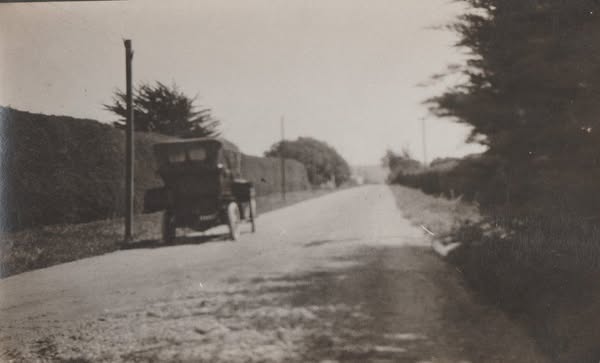
My Facebook friend Jason Blanco posted this photo and leave it to my historian friends Shirley Gibson and Michael Shannon, all of us are now pretty sure that this is Halcyon Road, somewhere between the mobile home park and the Halcyon store today.
Jason’s photo is from about 1908.
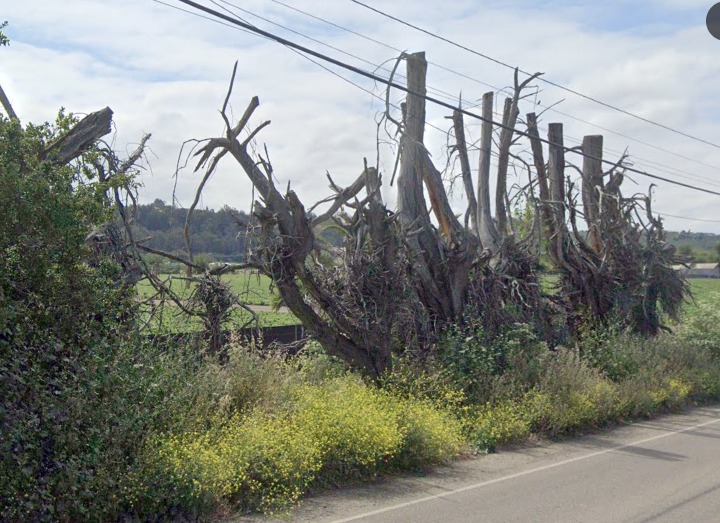
Those cypress trees are nearly all dead now, and ghastly-looking, but more than 100 years ago, they were dense. Halcyon Road was like a funnel, bounded by thick and dense green cypress, until you hit the County Highway, today’s Highway 1, to Oceano.
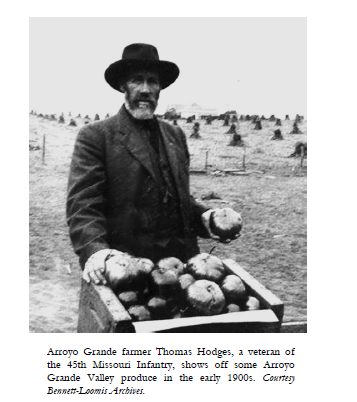
Shirley and Michael pinpointed the man who planted the cypress. He was Thomas Hodges, a Civil War veteran (45th Missouri Volunteer Infantry), who planted them as a windbreak to protect his fruit trees. He made a guest appearance in my Civil War book.
Arroyo Grande has always been famous for its row crops. You can read about them in old newspapers as far away as Kansas and South Carolina. Our pumpkins were astonishing.
But tree crops were important too—some of you may remember dense walnut groves that surrounded AGHS, until they were decimated by the husk fly larvae.
Arroyo Grande High School at the bottom of the photo with the vast walnut orchards beyond.
But even on the “farmette” (3 acres) where I grew up, on Huasna Road, there were fruit trees that preceded our house, built in 1956. So I grew up with:
–Plums
–Apricots
–Peaches
–Apples
–Oranges
–Lemons
–Avocados.
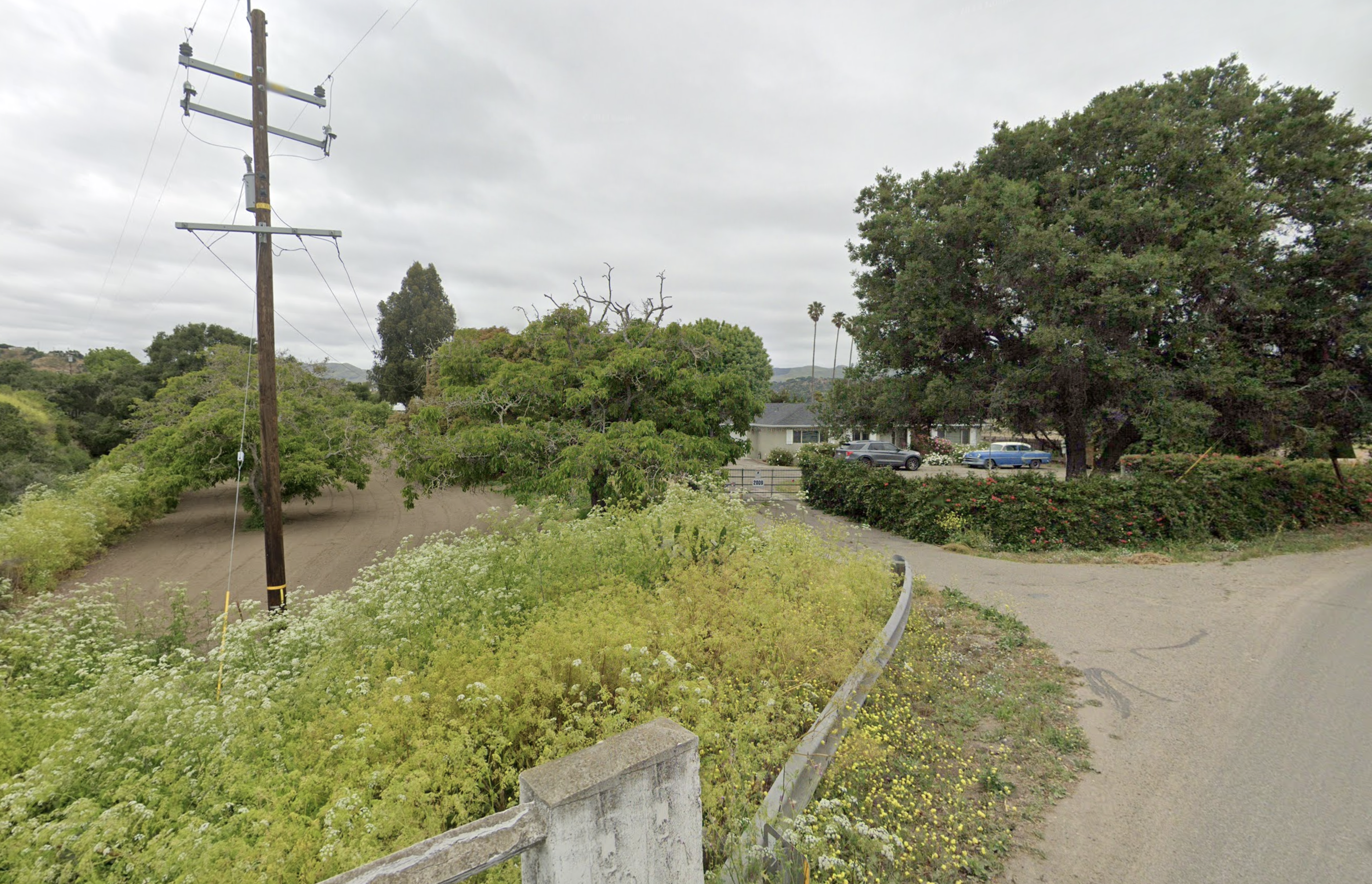
The house where I grew up, Lopez Drive and Huasna Road. Two walnut trees remain at left, in the lower pasture. The big fella out front is a loquat tree. The Queen Anne’s Lace in the foreground was always there. Arroyo Grande Creek is just beyond the left edge of this photo.
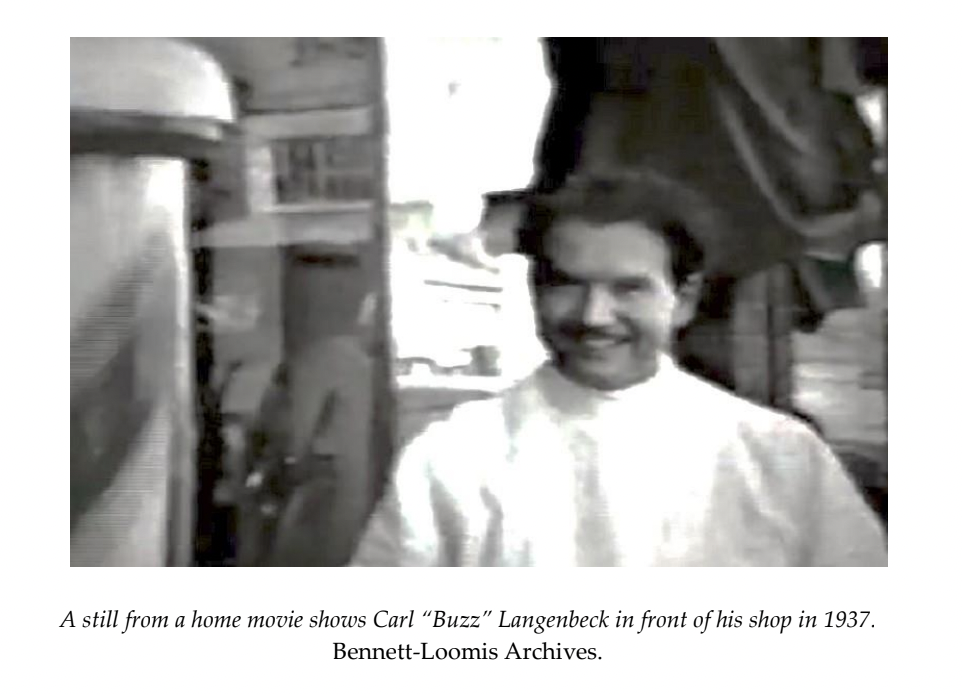
We had nine avocado trees. They were nowhere near the best. The best avocados were grown by barber “Buzz” Langenbeck, whose barbershop is today’s Heritage Salon on Branch Street. Sadly, I did not appreciate avocados until the day I discovered guacamole, probably when I was in my twenties.
And you can find, if you look for them, at least two more generations of Hodges at AGUHS, playing sports, starring in school plays, elected to class office, graduating–the venues varied–at the movie theater in Pismo or the one in Arroyo Grande, today’s Posies in the Village.
Like any other living thing, cypress trees get old, turn brittle, and die. I don’t think that my hometown’s ties to history, even to the Civil War, ever die.
Adapted from The Heritage Press, South County Historical Society
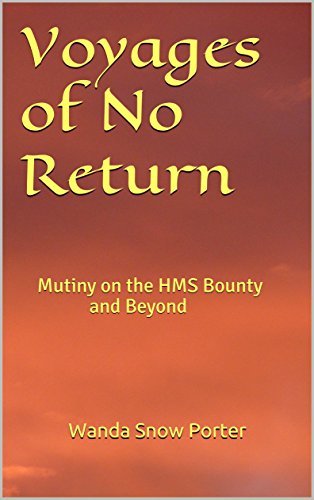
Wanda Snow Porter’s wonderful book about her husband’s ancestor. Charles Porter was a descendant of Isaac Sparks.
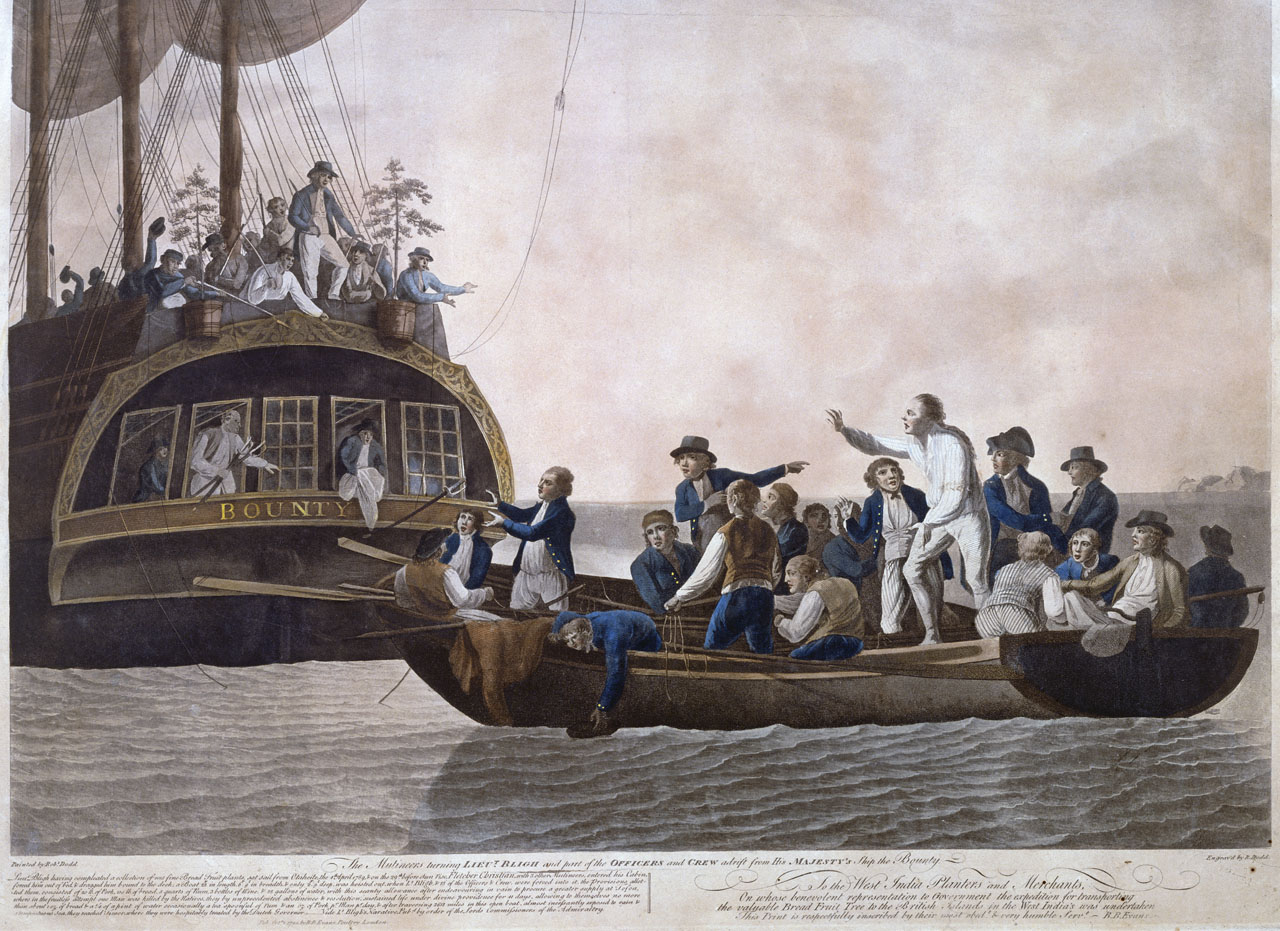
On April 28, 1789, mutineers led by Fletcher Christian put Capt. William Bligh and his loyalists into a longboat and sailed away with HMS Bounty. Bligh navigated his way to safety.
The mutineers sailed for Pitcairn Island and settled there, but violence was frequent. Some of their descendants still live on Pitcairn.
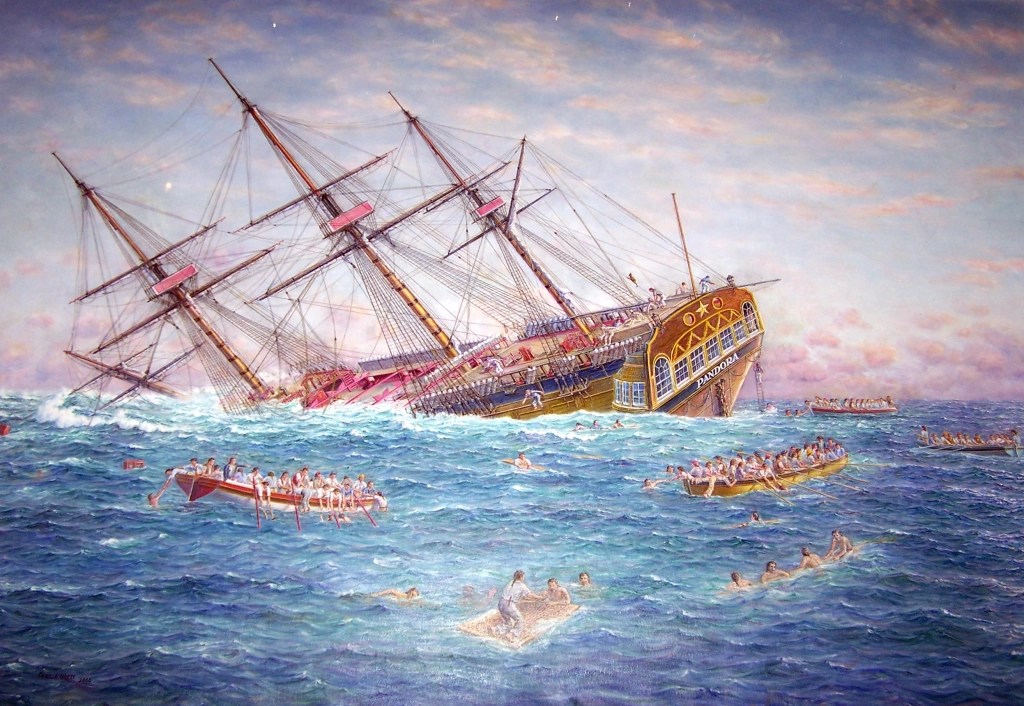
In 1791, the frigate HMS Pandora captured some of the mutineers and sailed for England for their trials. But Pandora wrecked on a reef near Australia and several mutineers died.
Among them was midshipman George Stewart, 21, killed by a falling gangway as Pandora broke up.
Stewart left behind his Polynesian wife, Pegue (“Peggy”) and their little girl, Maria Stewart (1790-1871).
Maria married George Washington Eayrs (1775-1855), an American ship captain, in Tahiti in 1809.
Their little girl, Maria de Los Remedios Josefa Antonio Eayrs, was born aboard Eayrs’s ship, Mercury, in Bodega Bay in 1813. (She died in 1871).
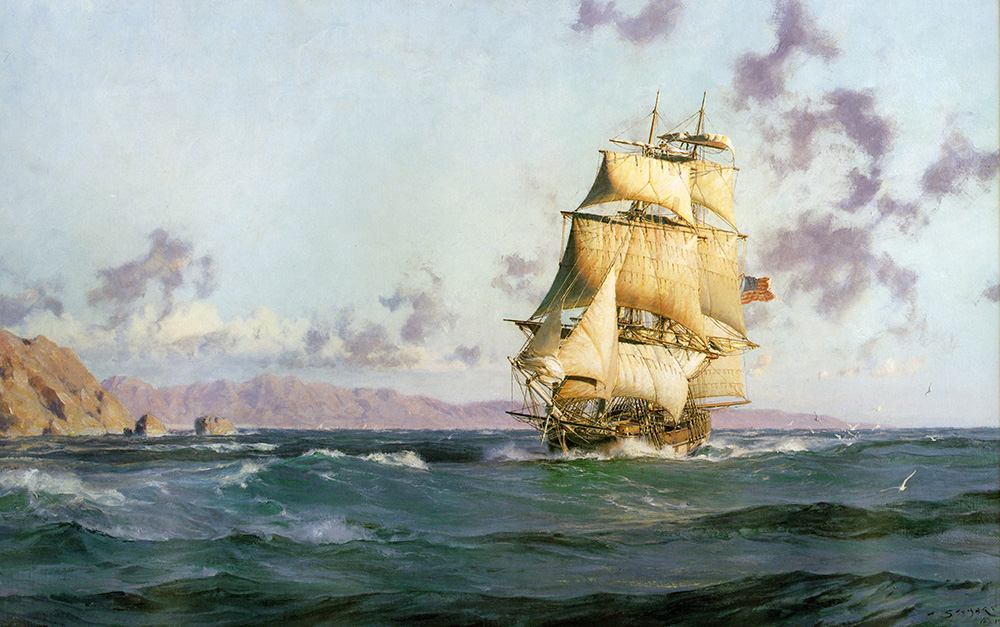
The brig Pilgrim, depicted leaving Santa Barbara for Monterey, was part of the active California trade with the East Coast, as was George Washington Eayrs.
She married Isaac James Sparks (1800-1865), the master of the Huasna Rancho, in Santa Barbara in 1836.
Their daughter, Maria Rosa, married Arza Porter in Santa Barbara in 187-.
The Porters still own the Huasna ranch today, and it’s still an active cattle ranch. This incredible pioneer family is our connection to the mutiny on HMS Bounty.
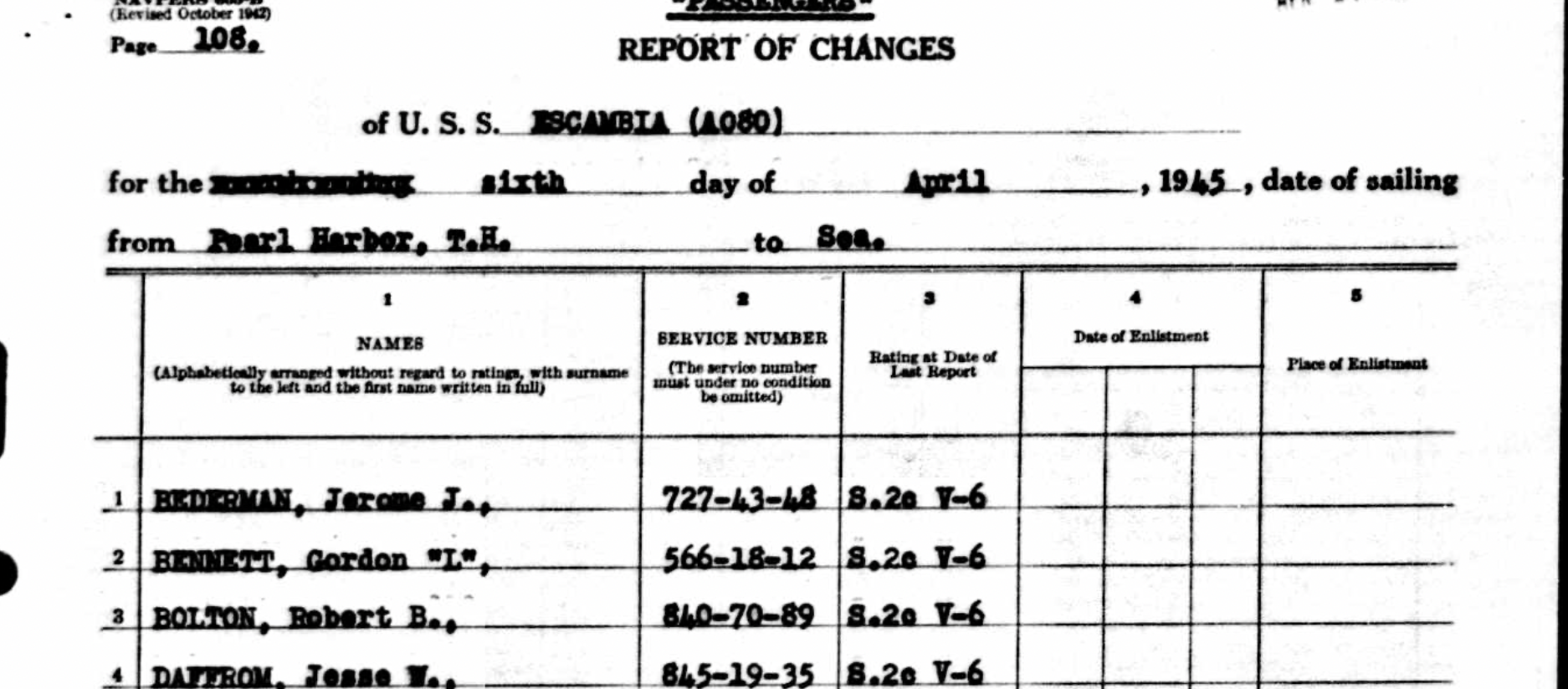
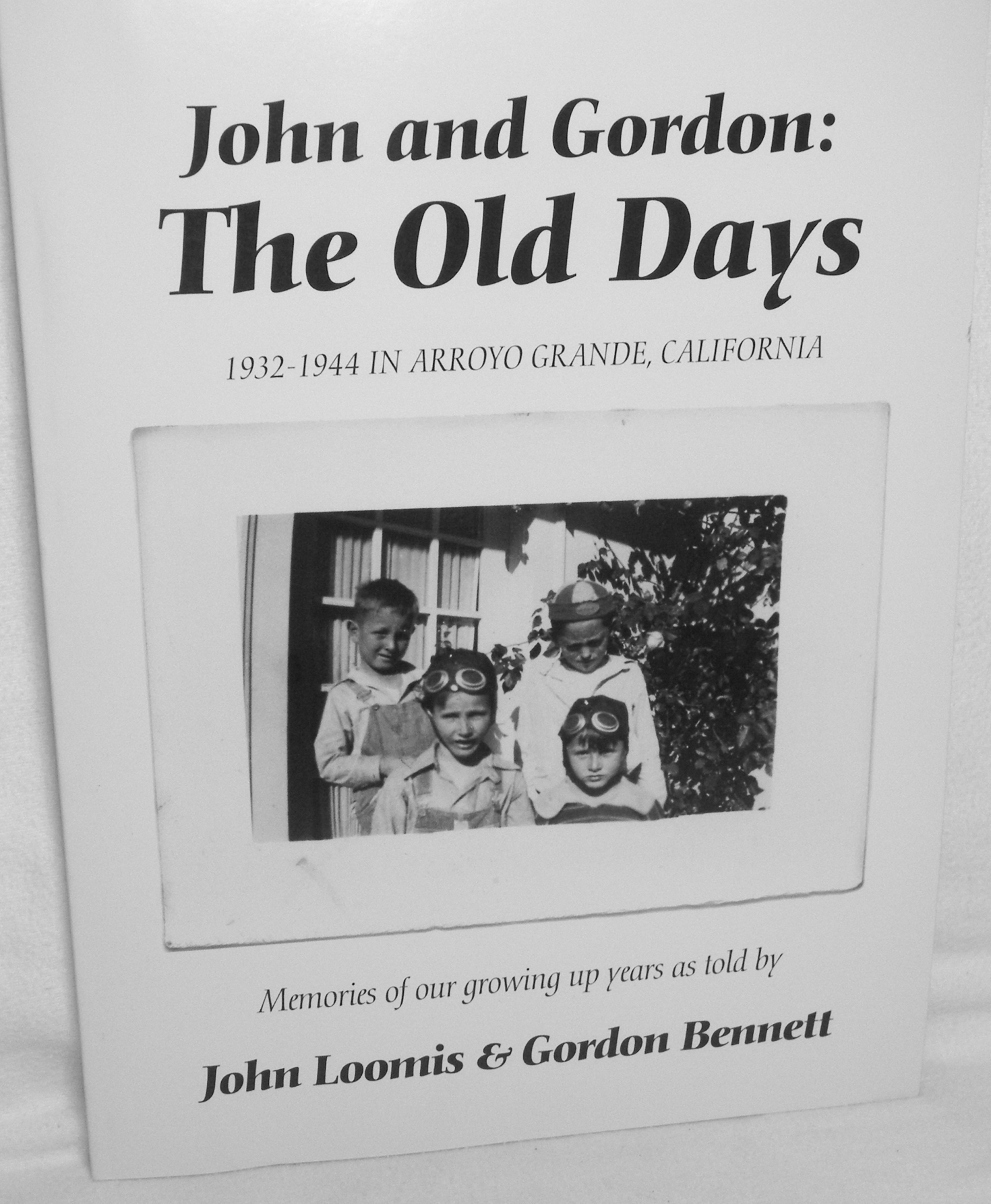
Gordon Bennett, Arroyo Grande Union High School ’44, was one of my students’ favorite guest speakers when I taught U.S. History at AGHS. He was a gifted storyteller with a sense of humor as dry as vermouth. My students and I loved hearing his stories about growing up in Arroyo Grande during the Depression and World War II.
World War II was waiting for them when both Gordon and his cousin, John Loomis, joined the service. The two found themselves not that far apart during the Battle of Okinawa, which had begun April 1, 1945. John was onshore with the 1st Marine Division, Gordon offshore serving as a sailor on the fleet oiler Escambia (named after a river in Florida).
Gordon and his shipmates serviced escort carriers (small carriers that carried around thirty planes, like Emerald Bay (above), during the height of the kamikaze attacks off Okinawa. Thirty-four Navy vessels were sunk and over 280 damaged during the last, desperate battle of the war. The little carriers that were Escambia’s responsibility escaped and launched a series of airstrikes on the island. Both Escambia and Emerald Bay were based at Ulithi, where Gordon, according to legend, experimented in the distillation of medicinal beverages.
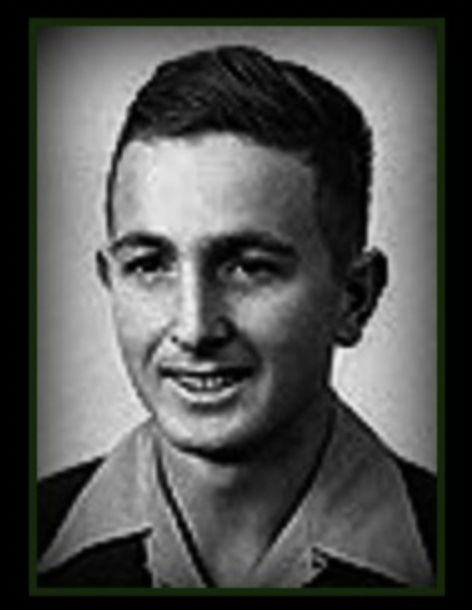
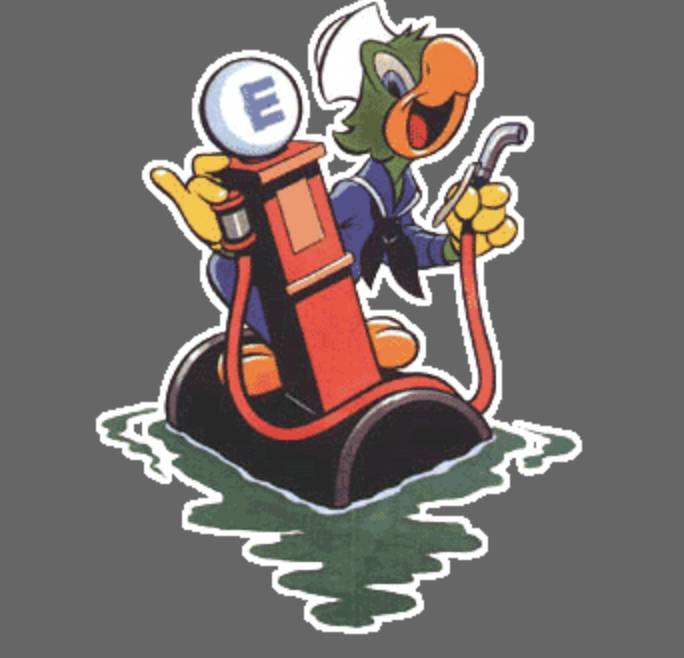
Above: The Ulithi anchorage; Gordon in high school; USS Escambia’s logo, designed by a Disney artist.
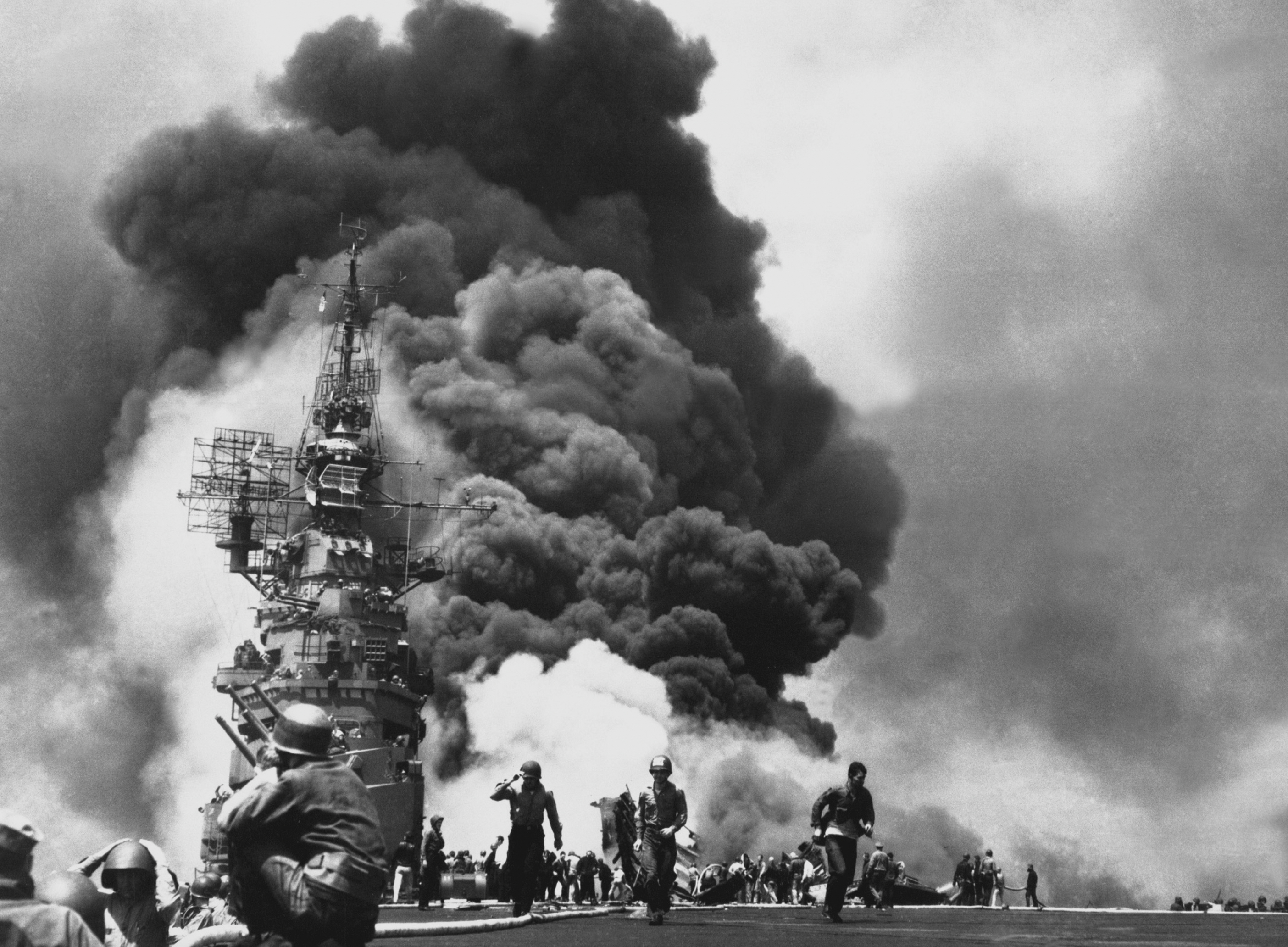
Which, given the ferocity of the kamikaze attacks, I might’ve sipped. The carrier Bunker Hill after once such attack, below.
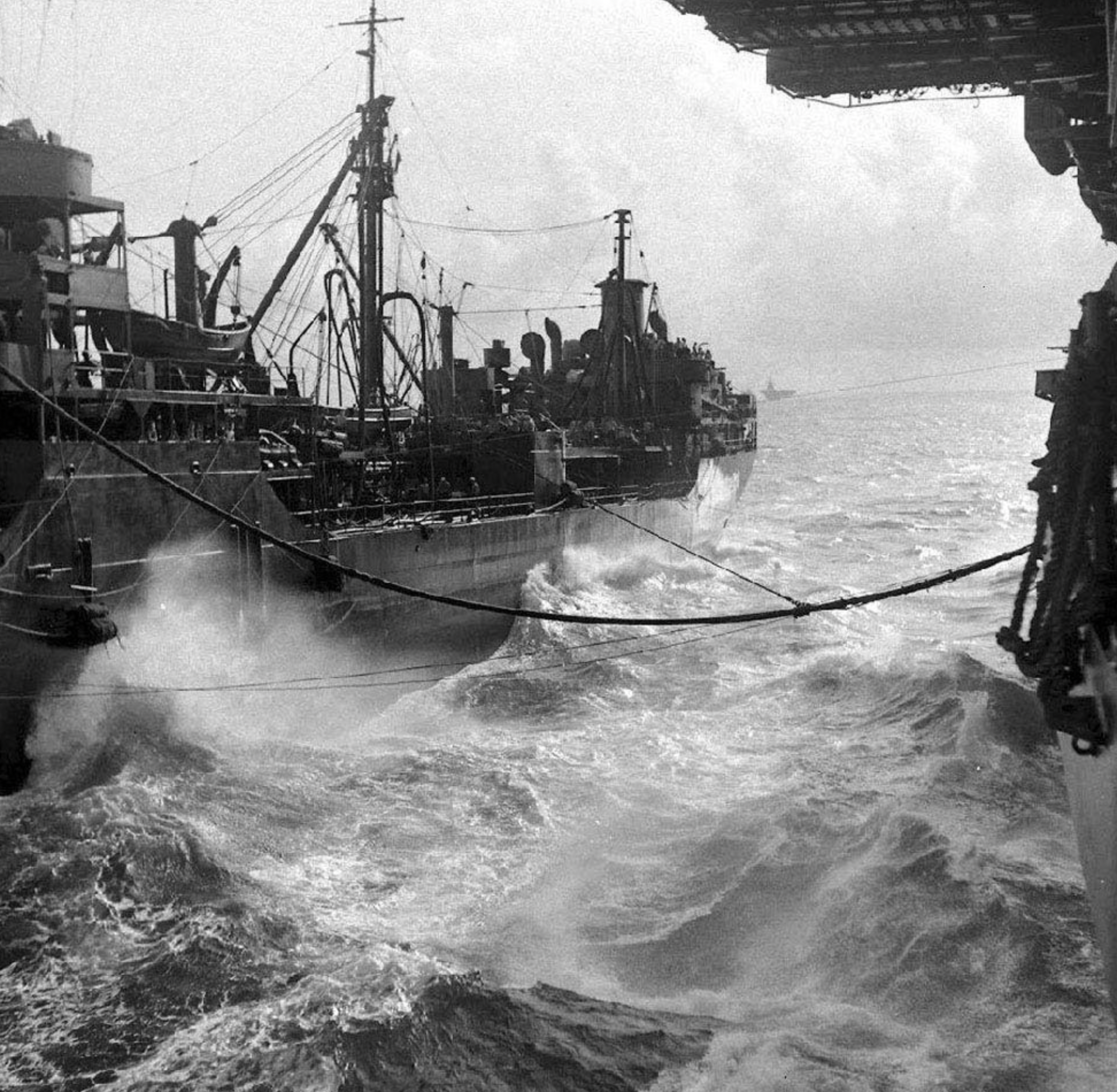
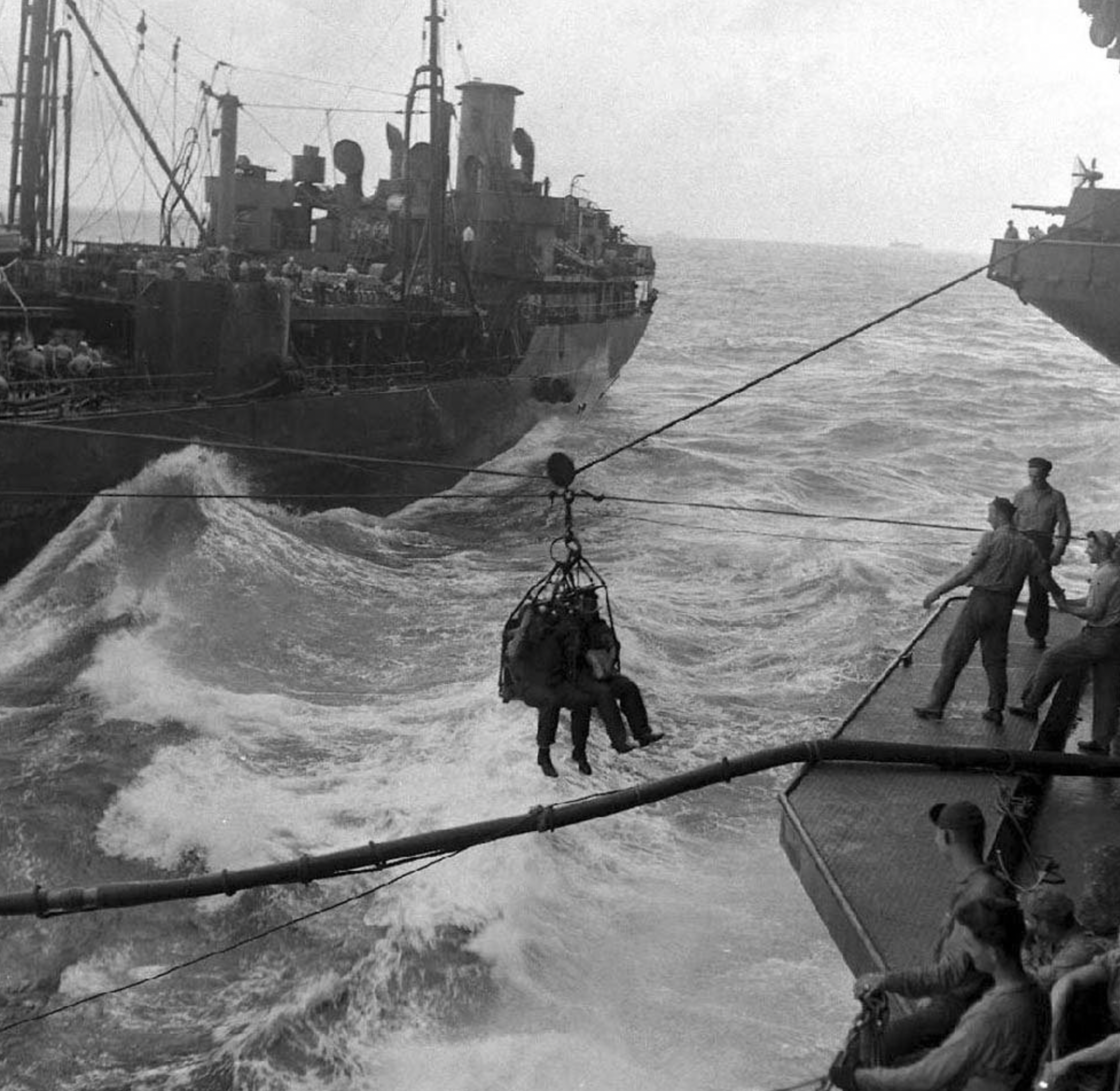
The sailors on the fleet oilers were tough men. Fueling at sea was smelly, dirty, and very dangerous. The two photos show a fueling operation between Escambia and the fleet carrier Ticonderoga in July 1945. The way Escambia sailors return to their ship, in that breeches buoy, does not seem safe to me, but my guess is that Gordon would have had his turn in the same kind of conditions.
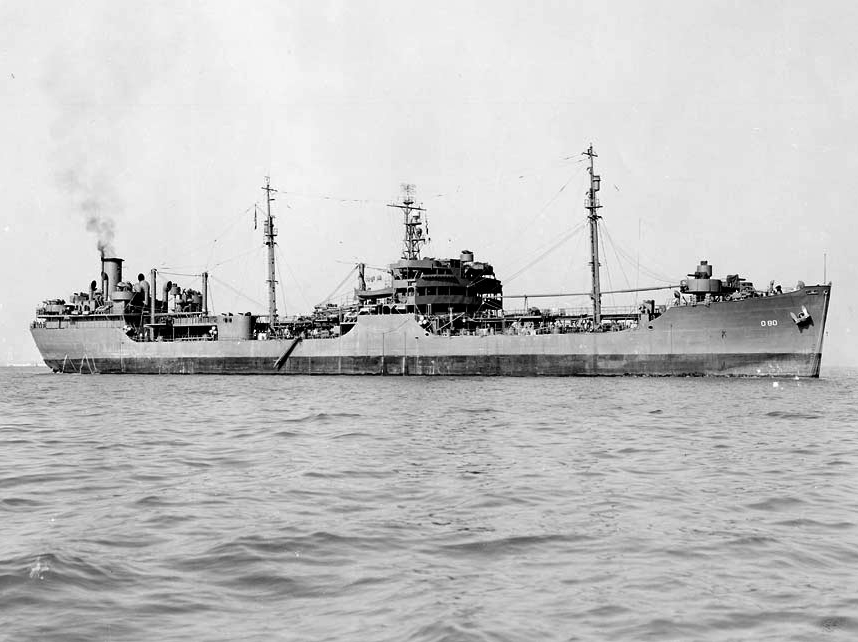
Sadly, Escambia (below, about 1950) would be used by, of all institutions, the United States Army during the Vietnam War as an auxiliary power plant. Transferred to the Vietnamese government in 1971, Gordon’t ship was scrapped.
Happily, Gordon came home safe. So did his cousin, John. They had many years of storytelling ahead of them. Gordon, in my classroom, fueled the imaginations of the young people who were high-school juniors in 2003, just as Gordon had been in 1943.
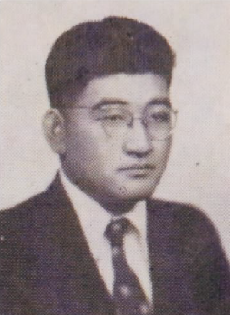
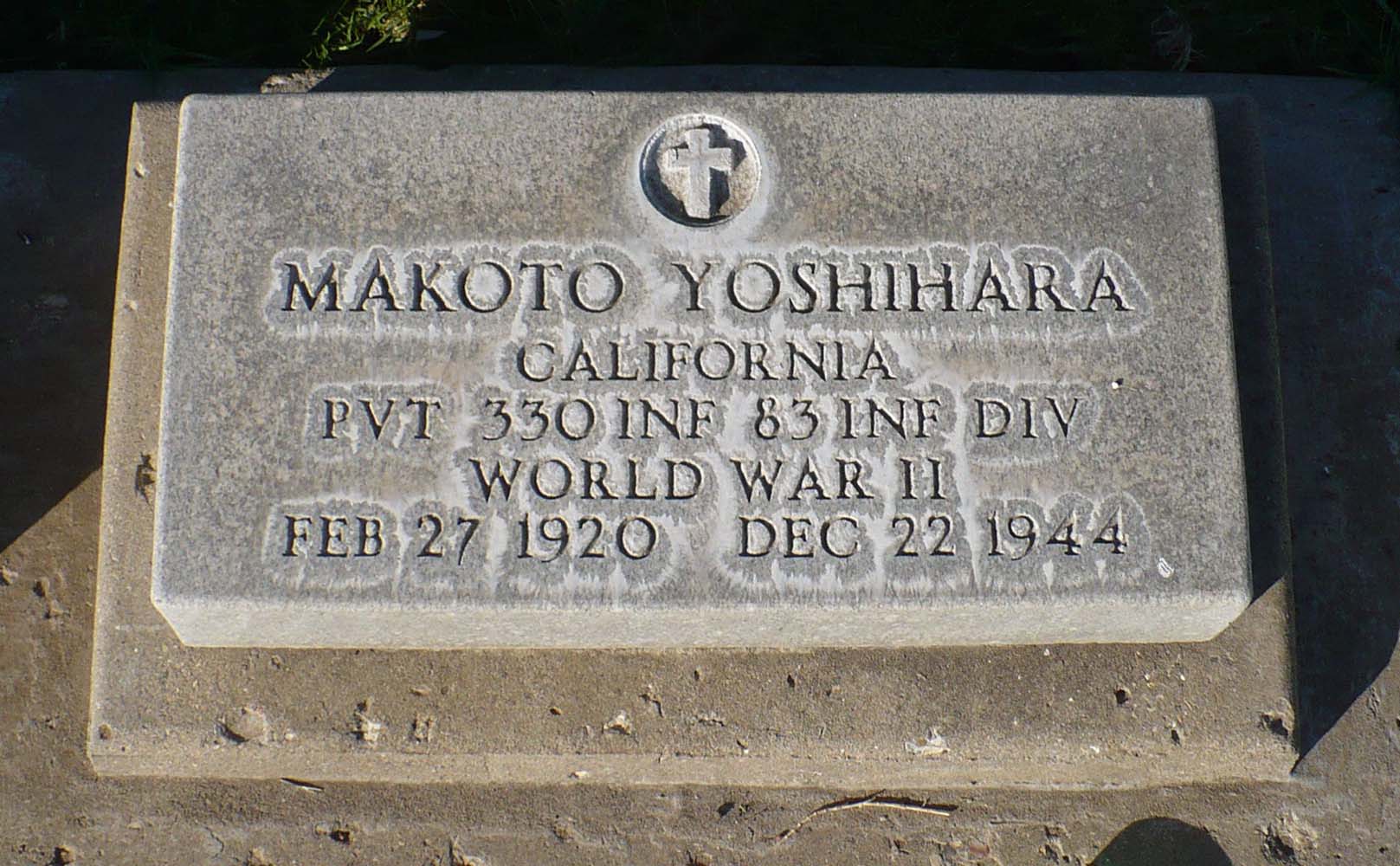
Makoto Yoshihra was a Guadalupe boy who played football for Santa Maria High School. He wanted to become an automobile mechanic, but Pearl Harbor intervened.
He instead became the only Nisei medic in the 83rd Infantry Division, a unit made up overwhelmingly of White boys from Ohio who’d never seen a Japanese-American in their lives.
This Japanese-American, once the 83rd went into action in Europe, began to save their lives.
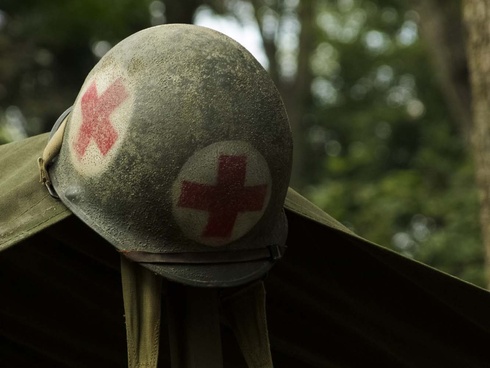
Because he was a medic, he wore the helmet insignia–a red cross on a white background–that designated him as such. Because medics wore that helmet, they became favored targets for German snipers. If a sniper could kill a medic, then he could kill, indirectly, the six or seven or twenty lives that the medic might save.
So that is why the sniper shot Makoto dead in the Huertgen Forest in late 1944. He was kneeling over a wounded comrade when the bullet hit.
Makoto’s helmet doomed him.
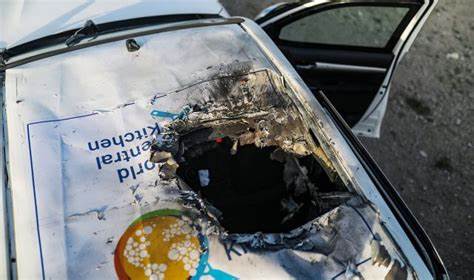
So did the logo of the World Central Kitchen convoy.
If you are about to accuse me of being anti-Semitic, you don’t know me. You don’t know what I taught my students about anti-Semitism and you don’t know the emotional toll that teaching the Holocaust took on me every year of the thirty years I taught.
You don’t know my mother, who never forgave Germany.
But now we have the Israeli airstrike on the World Central Kitchen convoy. My mother would never have forgiven that, either.
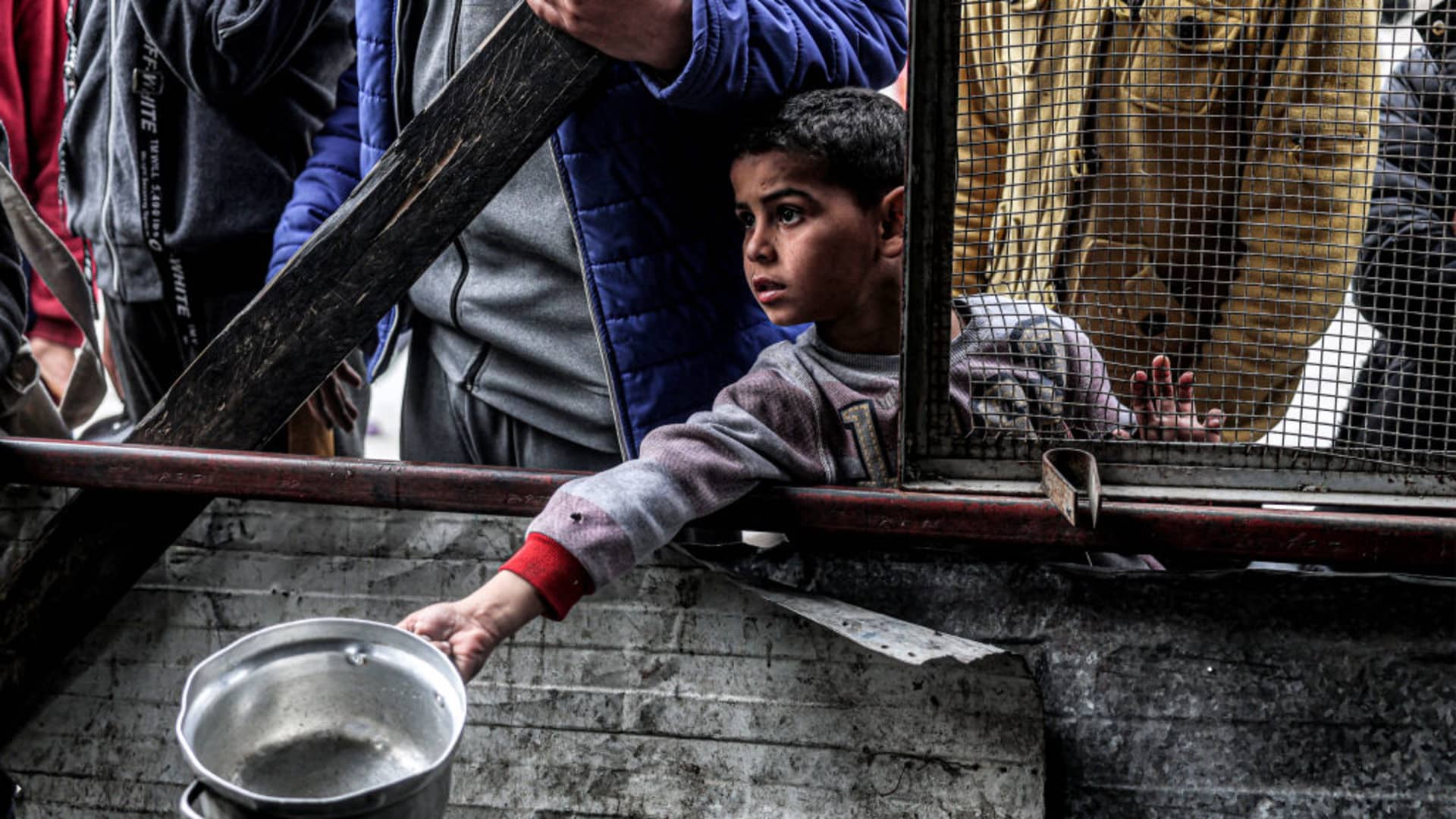
There is a difference between Israel and Bibi Netenyahu. I am convinced that he pulled the trigger on Chef Andres’ people. The impact? Now the people of Gaza are deprived of the 300,000 meals a day that the World Central Kitchen provided them.
And so they will die. They will die because that is what Netenyahu and the extremists in his cabinet want.
In the last great shipment of European Jews from Hungary to Auschwitz-Birkenau, once they’d been offloaded from the cattle cars, processed through the selection ramp and then shunted to a field near the gas chambers, there are photos of Jewish children who have only a half-hour or so to live.
They are eating bread provided by the SS. One photo shows another little girl still eating her bread on the way to her death.
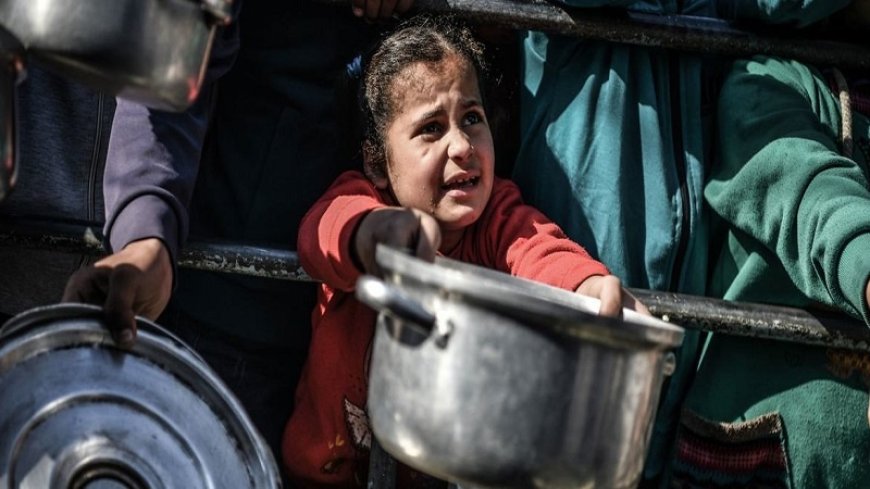
There will be no bread for the children of Gaza. They won’t enjoy even the cynical mercy of the SS.
This is mercy: The Army’s Graves Registration Teams gently carried Makoto’s body–it did not matter that he “looked” Japanese– away from the battlefield, perhaps with the body of the G.I. he could not save. They would have meticulously catalogued his personal effects, enclosed him in a canvas shroud, and then they would have taken him to a military cemetery on the Franco-German border.
When the war ended, the Army brought him home to Guadalupe. His coffin would’ve come across the Atlantic in the cargo hold of a Liberty Ship, inside a metal coffin draped in an American flag. We have a tradition of treating our war dead with care.
The children of Gaza will die now because now there is no one left to care for them. Because they will die in such great numbers, bulldozers will bury them.
You may bring up October 7, and you have every right to do so. I will counter with December 7.
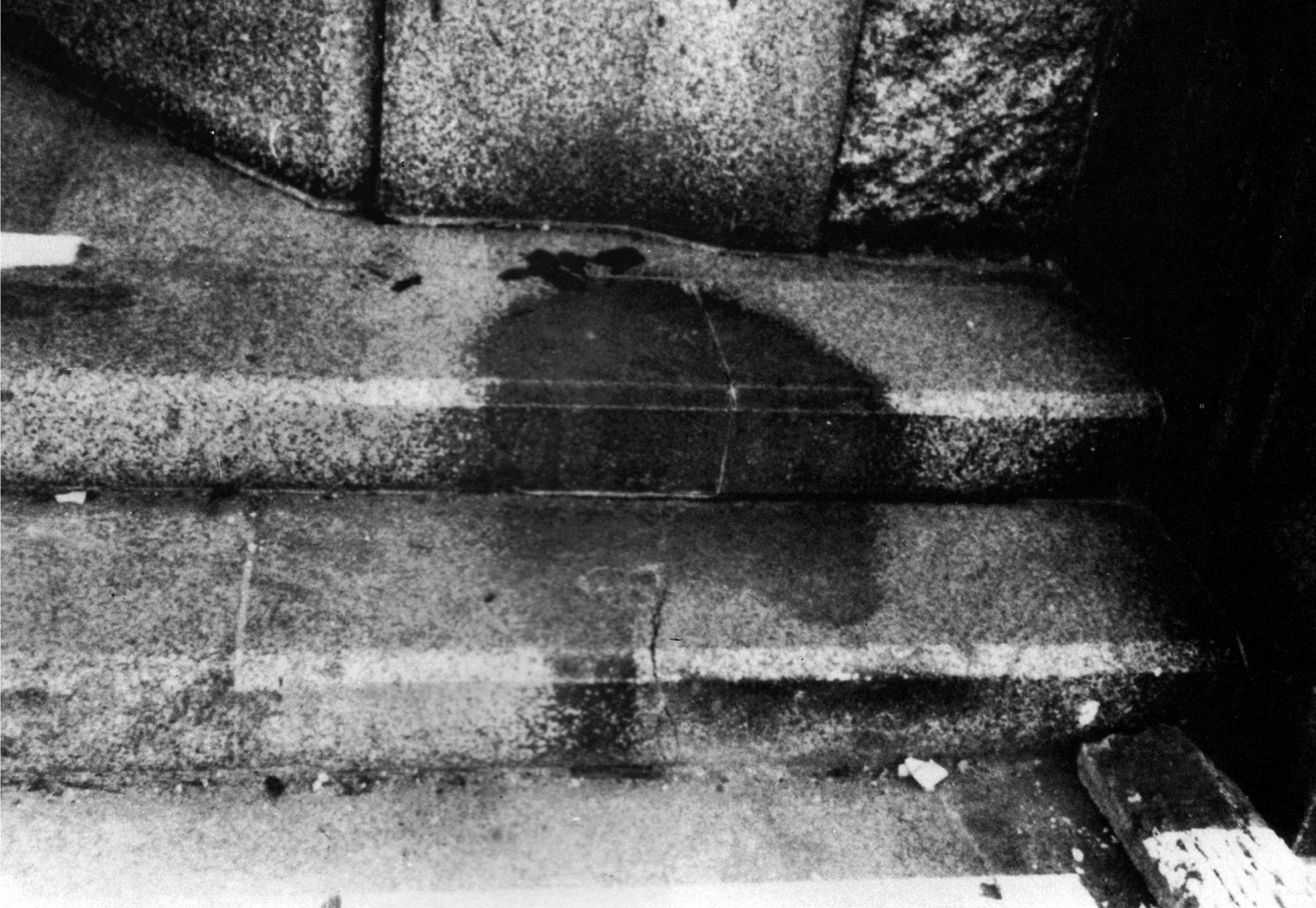
This is the image of a woman waiting for the bank to open in Hiroshima—rather, this is the shadow of her vaporized body. Can you tell me which plane she flew along Battleship Row? Was it a Zero? A torpedo bomber? Did she fly the dive bomber that dropped the fatal bomb on USS Arizona?
When my grandmother died in 1963, we buried her in Bakersfield and then were horrified when distant family members began to lay out blankets and carry immense amounts of food—sliced ham, fried chicken, salads and jello salads, biscuits and butter, sweet iced tea—to the graveside. We had not encountered this Midwestern/Southern tradition before.
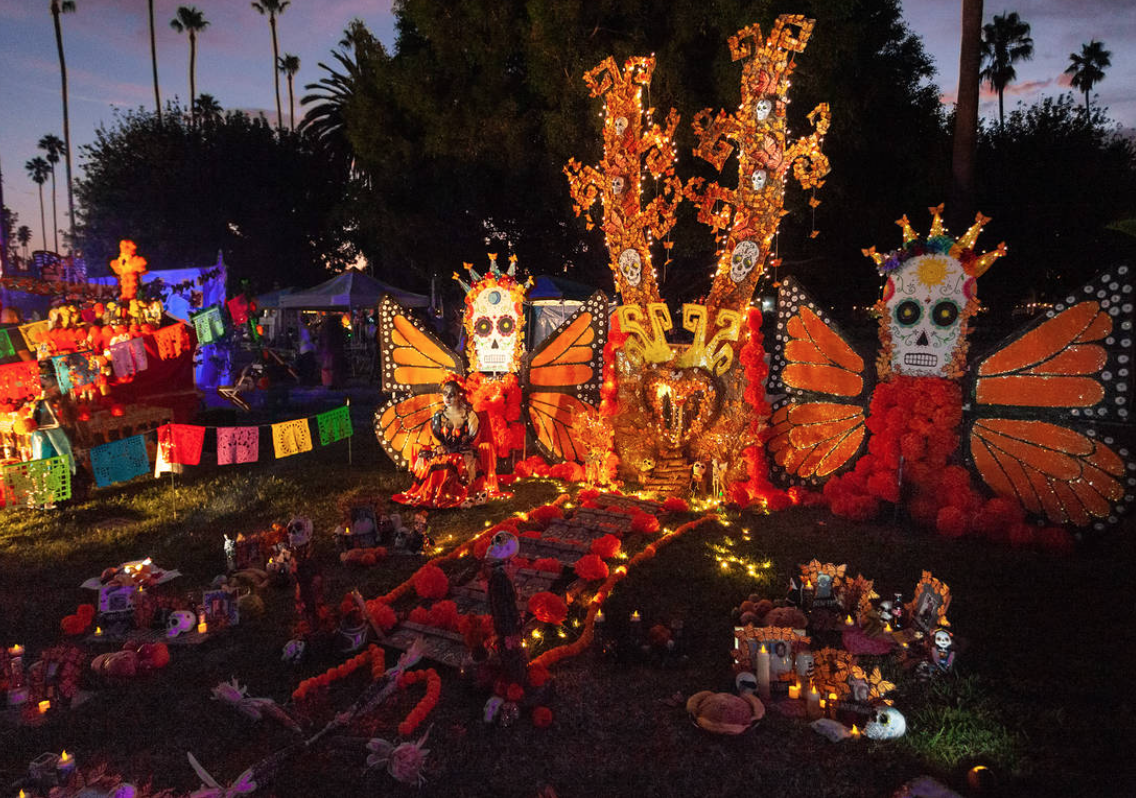
It made complete sense to me a year ago when I was at the Arroyo Grande cemetery soon after All Saints’ Day and noticed that the Catholic section, particularly among Mexican-American graves, with brilliant flowers and helium balloons, looked like the assembly point for the Rose Parade’s floats. (The Protestant side was Calvinist and austere.) I was delighted. This is a tradition that celebrates the lives of those we will see again. We had our paper pates of fried chicken and macaroni salad because we had one more chance to eat in my grandmother’s presence. It was her celebration, after all.
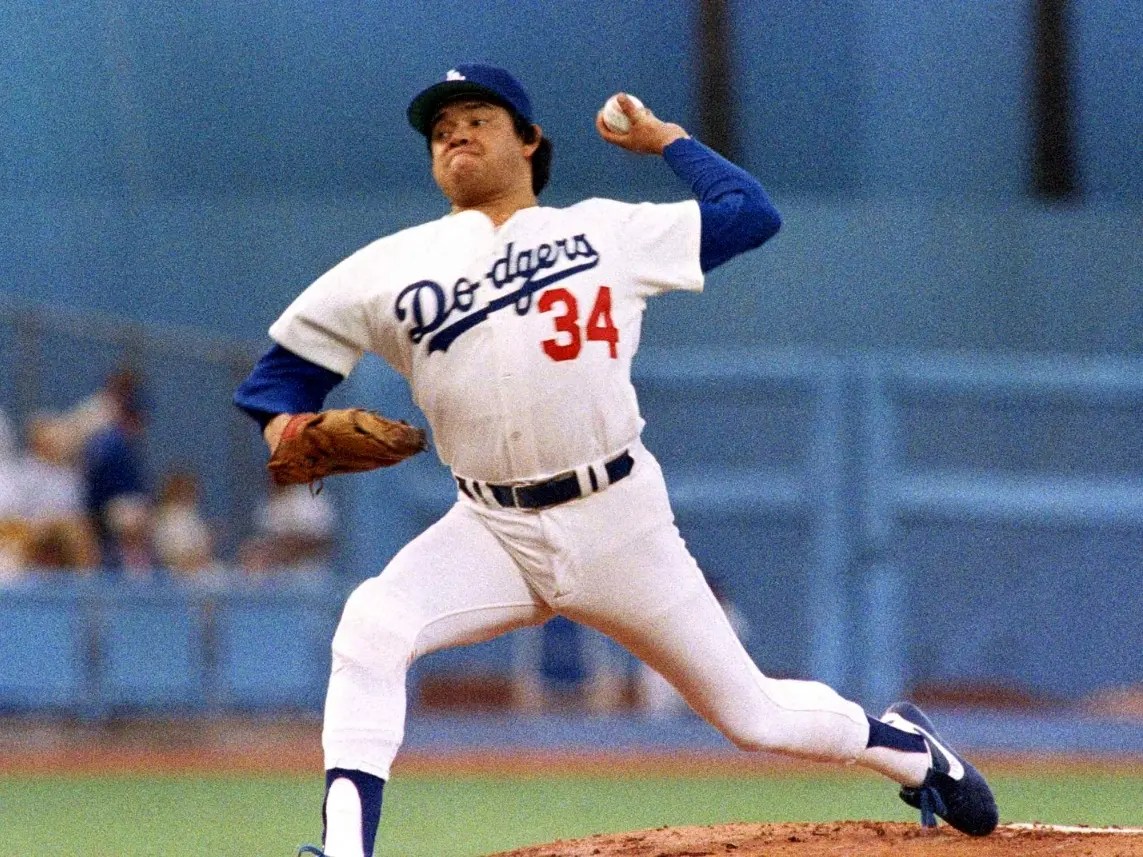
I wrote a piece about Chavez Ravine and Fernando Valenzuela earlier this year. In this slightly different version, November 1, All Saints’ Day, El dÍa de los Muertos, plays a more central role.
With that win, [May 14, 1981] the left-hander improved to 8-0 with a minuscule 0.50 ERA, 68 strikeouts over 72 innings while holding opponents to a .172/.225/.212 batting line. Four days later, Valenzuela fell short of throwing a complete game for the first time and suffered a loss.
–Writer Matthew Moreno on Fernando Valenzuela’s first full season.
He started on opening day when Jerry Reuss had injured himself. Valenzuela had appeared in ten games in 1980 and he’d been sharp, but he was still an unknown quantity. So instead of the tall blonde German-American (“Reuss” is derived from the German “Russian.” That’s uncomfortable), Dodger Stadium got a starter who was not tall, not blonde, not German (or Russian). He was from Sonora. the same state as Mexican President (1920-24) Alvaro Obregón, the “Happy Man with One Arm,” his right, lost in battle in 1915.
Obregón at his Presidential desk, 1920, when Mexico was emerging from the ten-year revolution that had claimed one million lives.
Luckily, Valenzuela was a lefty.
I could not watch him by myself. I needed to share him. I began to watch his games over at Ricky and Jane Monroe’s house, both because they were such good company and because Ricky, a born color man, has a knack for wit, sometimes caustic, at the exact moment it’s needed—not before, not after.
Valenzuela’s specialty was a screwball, a pitch that will eventually make some pitchers’ elbows explode spontaneously while they’re reaching across the dinner table for some mashed potatoes.
We soon learned, too, that another Valenzuela specialty was hitting. He won a Silver Slugger award in 1981 to put over his fireplace, probably resting on brackets just above his 1981 Cy Young and 1981 Rookie of the Year awards. Oh. And his Major League Player of the Year Award.
In 1981, after we’d seen a Fernando screwball strike out an Astro or a Giant or a Cub swinging, as if his bat was a feather boa, Ricky and I might look at each other without saying a word. And sometimes, once the Miller Beer commercial had begun, Ricky would shake his head in disbelief.
It was euphoric, watching that twenty-year-old pitch.
When Fernando Valenzuela came to the big leagues, Bob Lemon, then a Yankee scout, stared in disbelief. He leaned over and asked a Dodger scout, “How old is he?”
“Twenty,” was the reply.
Lemon thought about it a moment. “Twenty what?” he wanted to know.
–Los Angeles Times sports columnist Jim Murray
This is what is important, I think: Valenzuela may have been from Sonora, but Chavez Ravine was home.
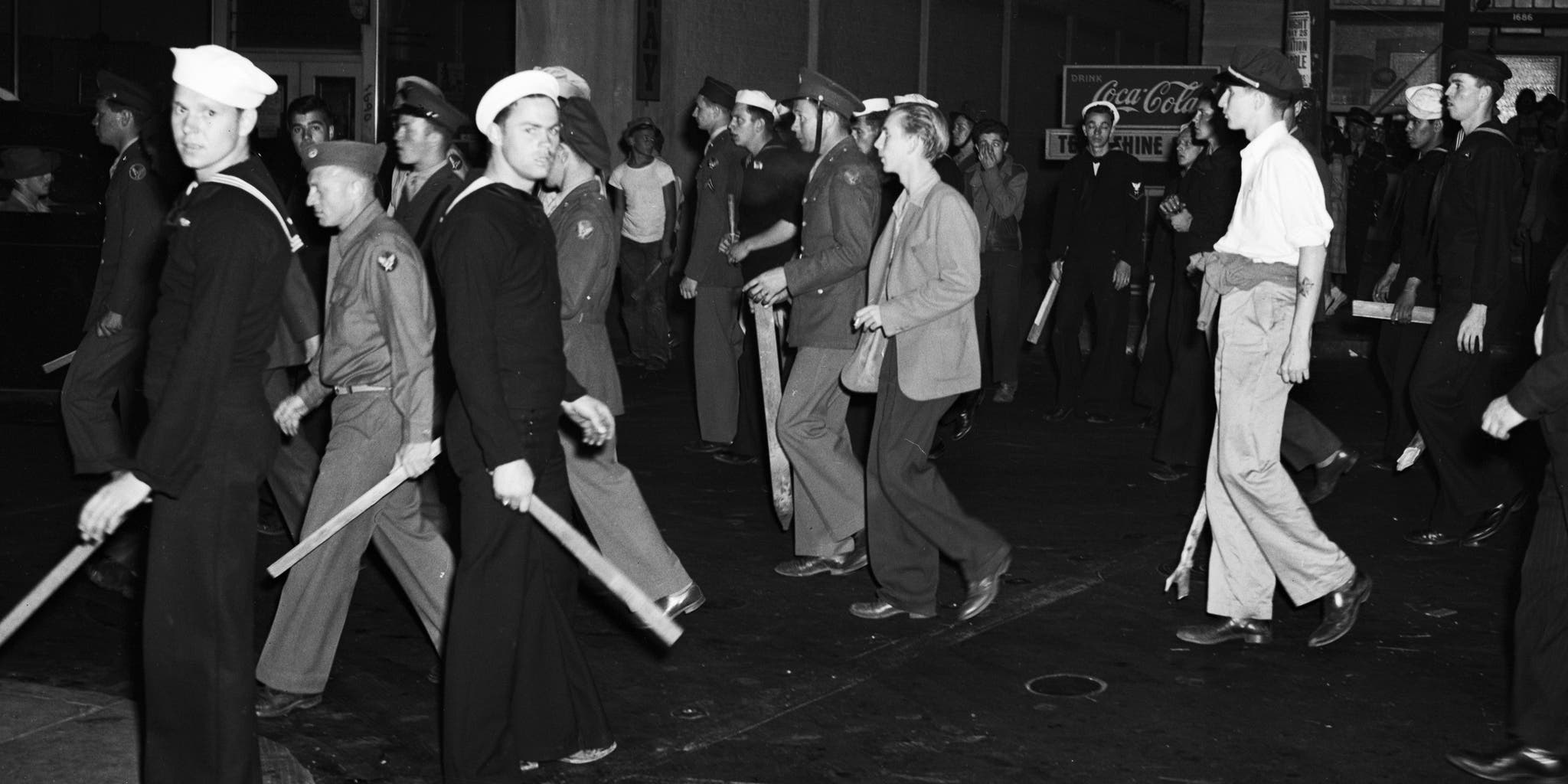
This was the barrio, demolished to make way for Dodger Stadium, where the Zoot Suit riots began in 1943. My kids and I learned about them, every year, when I taught U.S. History. It was important to me to teach them the dark side of the war even as we learned about its heroes, from Torpedo Squadron 8 at Midway to the 442nd Regimental Combat Team in Italy to the third of the wartime industrial force that was made up of women.
The Zoot Suit riots, along with the others that broke out across America and overseas that summer of 1943, represented a moment when we’d forgotten who we were and what we were fighting against. Racism was the sickness that typified the Imperial Japanese Army’s officer corps and Hitler’s SS.
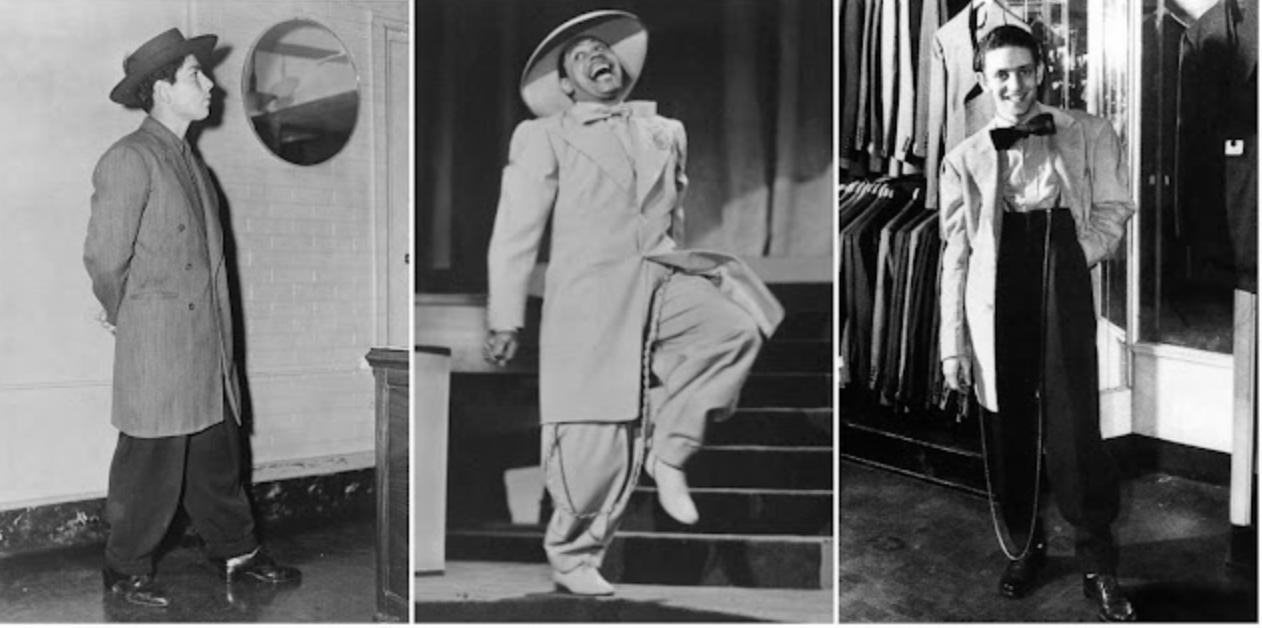
For several nights, then, in June 1943 gangs of roving sailors and soldiers beat the living hell out of East L.A. kids, pachucos, whose sole offense seemed to be the elegance of their clothes—the fashion, Zoot Suits, was popular with Black kids, too. The suits must’ve offended some servicemen in a time of wartime austerity, when suits, for civilians, lost their cuffs and wide lapels. Double-breasted suits were as rare as 1943 Ford coupes. and there was no such car. Ford was making B-24 bombers.
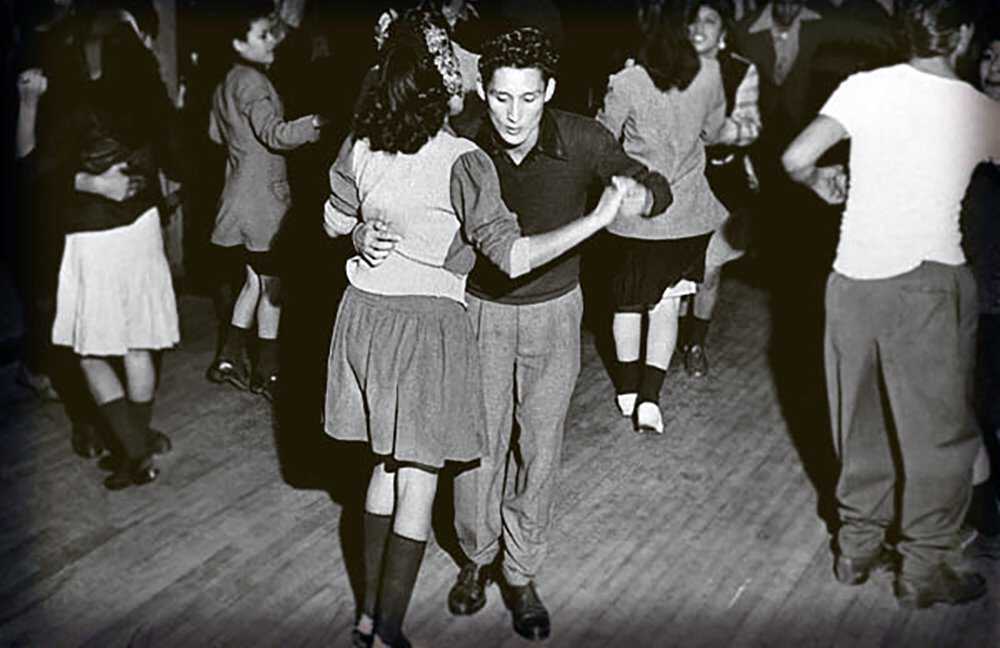
It’s possible, too, that the servicemen were a little envious of the Zoots’ mastery of the jitterbug, honed in hot L.A. jazz clubs. And they were, after all, brown people, those kids in those suits.
Cab Calloway (center) was perhaps the epitome of Zoot Suit style.
“Those” kids danced with lovely girls who rode the streetcars out of the oppressiveness of the Ravine, and of their rigidly traditional Mexican parents, to meet their dates downtown. They were Jitterbug Divines, those young couples on the dance floors inside noisy, smoky clubs.
The dancing was interrupted in June 1943 because of a U.S. Navy auxiliary post on the fringes of the Ravine. That’s where the fighting began. Sailors wolf-whistling at chicanas and shoving teen boys off the sidewalk were among the foreshocks.
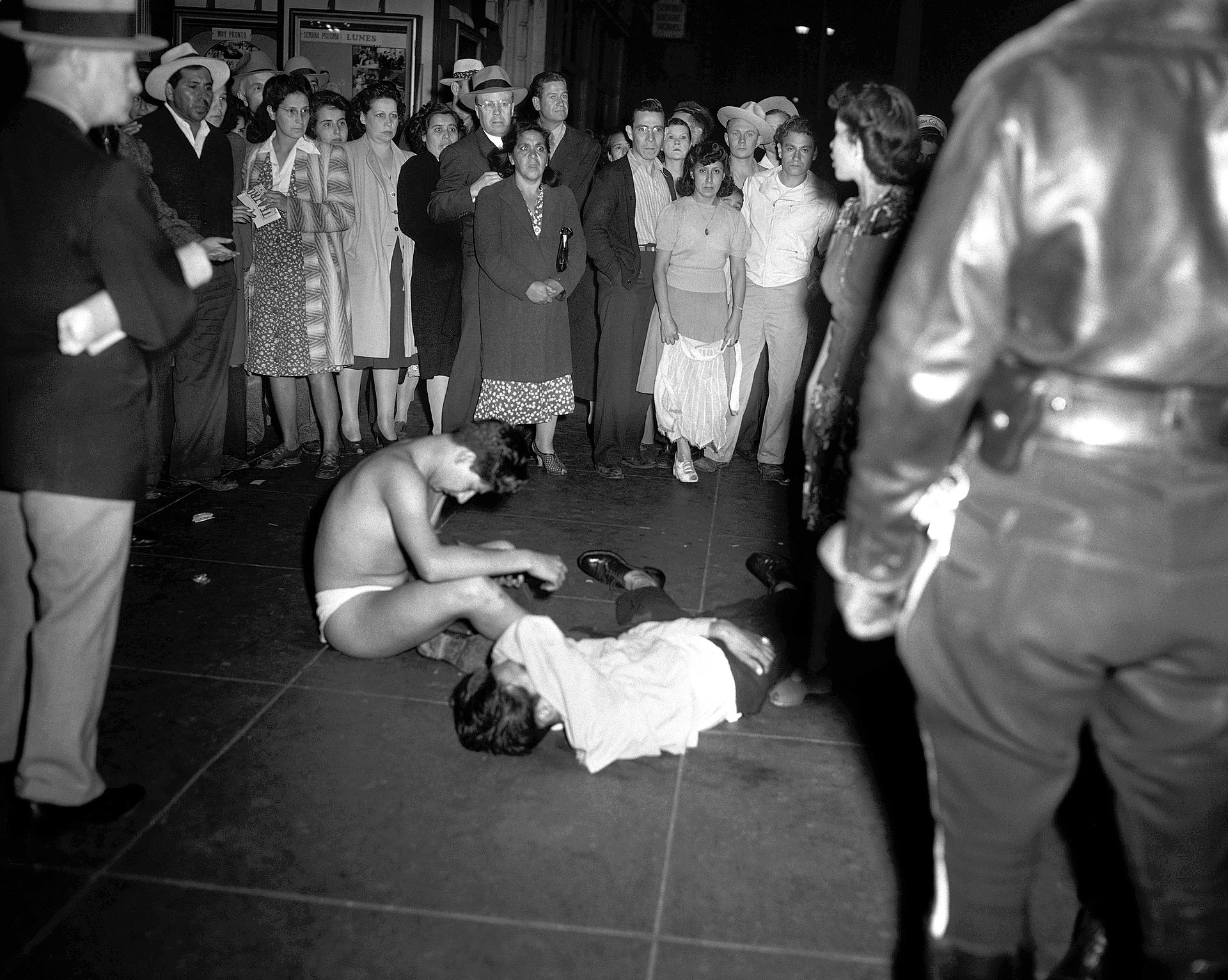
The riots soon took fire, spreading from Chavez Ravine to Boyle Heights and ending at what is today the 405. The LAPD watched passively as the G.I. gangs, sailors and soldiers from San Pedro and scatterings of Marines up from Pendleton, went after the Mexican-American kids with axe-handles.
The LAPD arrested the Mexican kids, but only after they’d had been bloodied and stripped naked by swarms of malevolent Nebraskans who were defending their country.
This is the history that colored the background of Opening Day 1981, when Valenzuela pitched a five-hit shutout over the Houston Astros, then in the National League.
Fernando humbled the Astros that day.
That year, what Fernando did was to restore Chavez Ravine to its people. Dodger Stadium, as trivial as it may sound, began to serve churros. Now you can get carne asada nachos in a Dodger helmet bowl. Tuesday night will be Mexican Heritage Night.
This is what I began to think about after his number was retired this week.
Fernando didn’t really “arrive” on that Opening Day 1981. Again, I think that he came home. So did all of those who shared his ancestry. They reclaimed the town once called El Pueblo de Nuestra Señora la Reina de los Ángeles de Porciúncula.
Perhaps that fall, on the Day of the Dead–el dia de los muertos–families spread blankets on the grass and unpacked hibachis and began to make carne asada or carnitas tacos. While the meat was grilling, they decorated the graves of the people they loved, whom they always will love, with white glass prayer candles that illuminate the image of Our Lady, and with flowers—a lot of flowers—with helium-filled balloons, with saints’ medals and with ofrendas, little clay pots filled with corn or chiles or sweets, and maybe a bottle of Mexican Coca-Cola—the real deal, like World War II Coca-Cola.
Then they sat down, those young people and their even younger children, and began to talk, across generations, to the tombstones, They told the jitterbuggers stories about Fernando Valenzuela.
After, it got graveyard quiet, but only because it was time to eat.
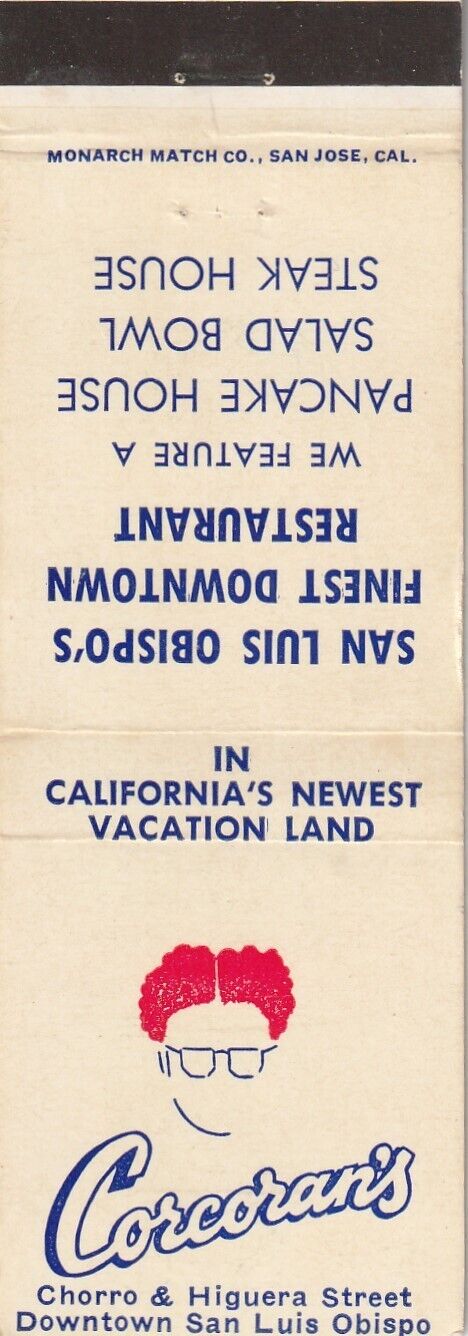
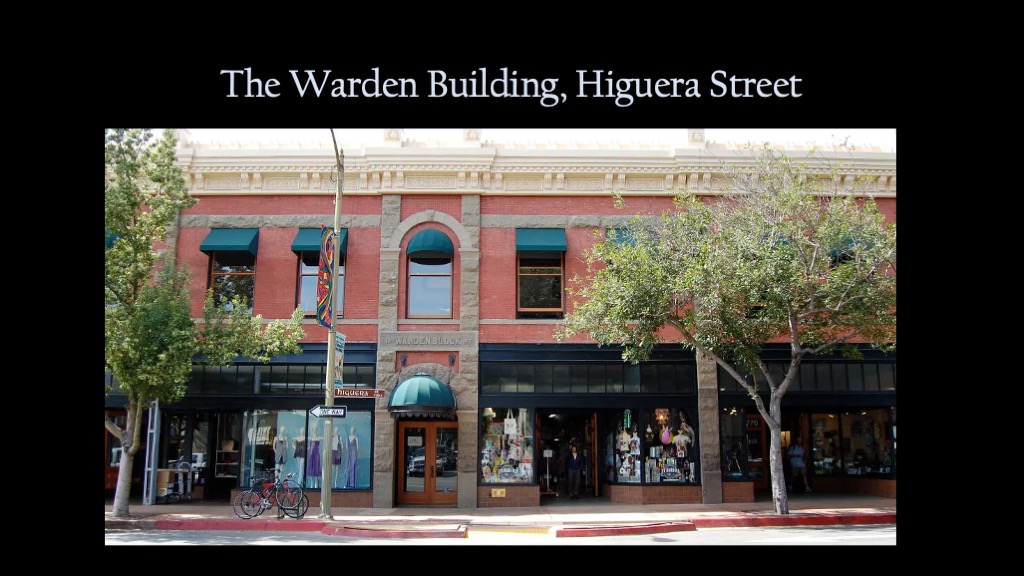
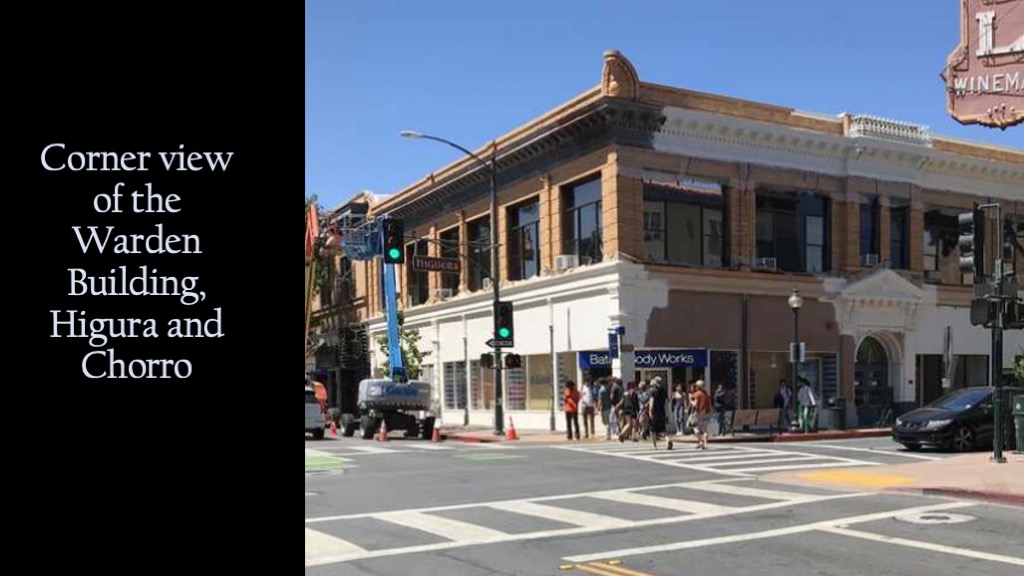
I guess they’re painting over the brick of the H.M. Warden Jr. Building (1905) in San Luis Obispo—most memorable to me as the onetime home of Corcoran’s Restaurant, in business at that site from about 1943 to 1974. The brick, of course, is beautiful on its own.
Throughout 1904 and into early 1905, a series of old San Luis Obispo Tribune articles follow its construction from the letting out of bids to its completion, when the building, which would become a beehive of retail stores and medical offices, was praised for its beauty.
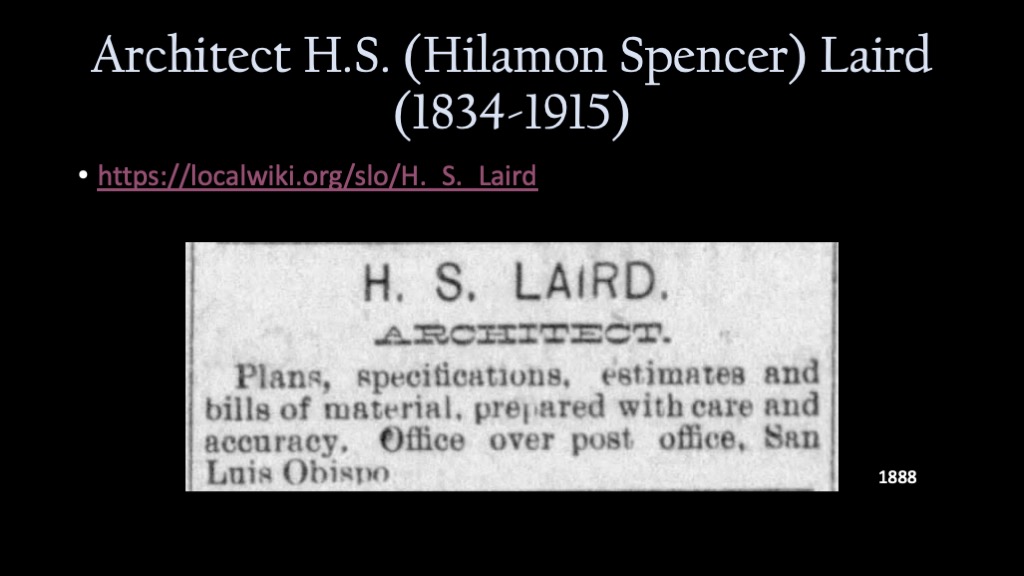
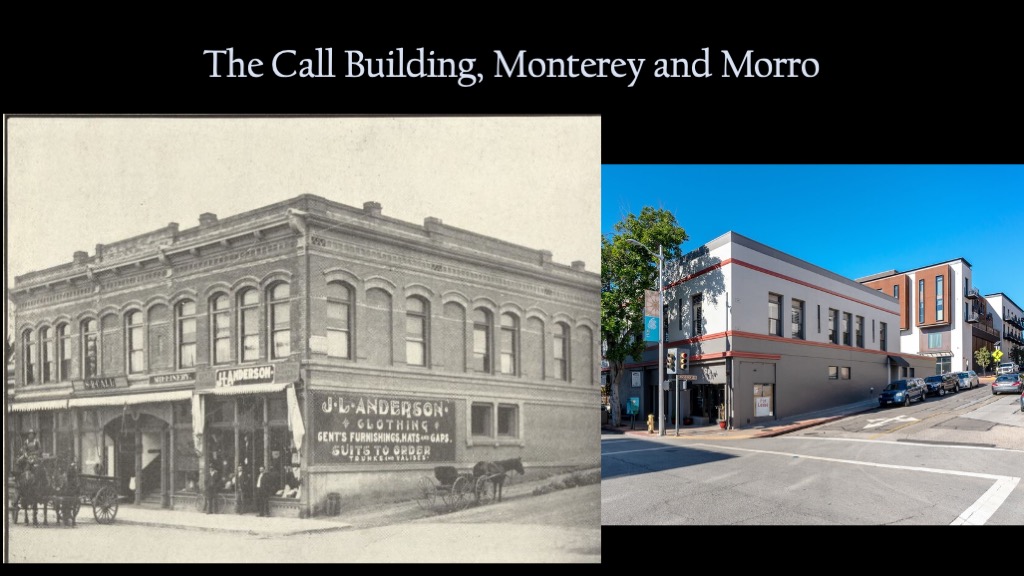
So I, being nosy, looked up the architect. It turns out that the man was a local—H.S. Laird was born in New York but came to San Luis Obispo in the late 1870s and lived out his life here. And during his time, he designed a stunning number of buildings, many of them still with us, from the 1890s and the early 1900s, are still with us. Some, like the Call Building (once the home of Gabby’s Bookstore) have been sadly reshaped, but all of them, I think, are a tribute to a remarkable architect.