American Twilight: The Golden Gate Exposition of 1939

Featured

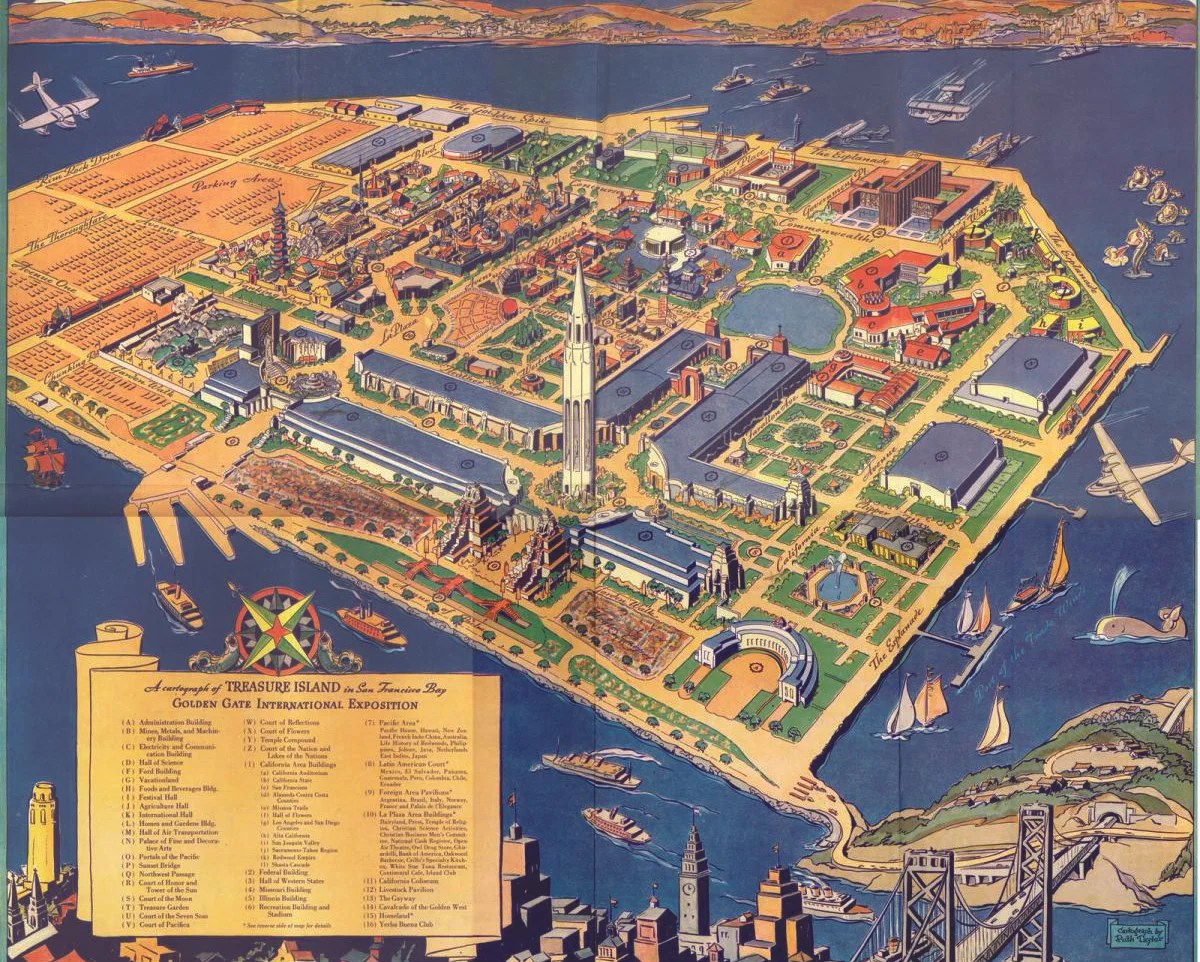
In 1939, San Francisco’s Treasure Island was the site for the Golden Gate Exposition, a showcase dedicated to a world beginning to emerge from the Great Depression. The Exposition was a masterpiece of Art Deco design and, with California comfortably distant from Europe, tinges of optimism must’ve remained awhile; I imagine the fall of France ended all that.

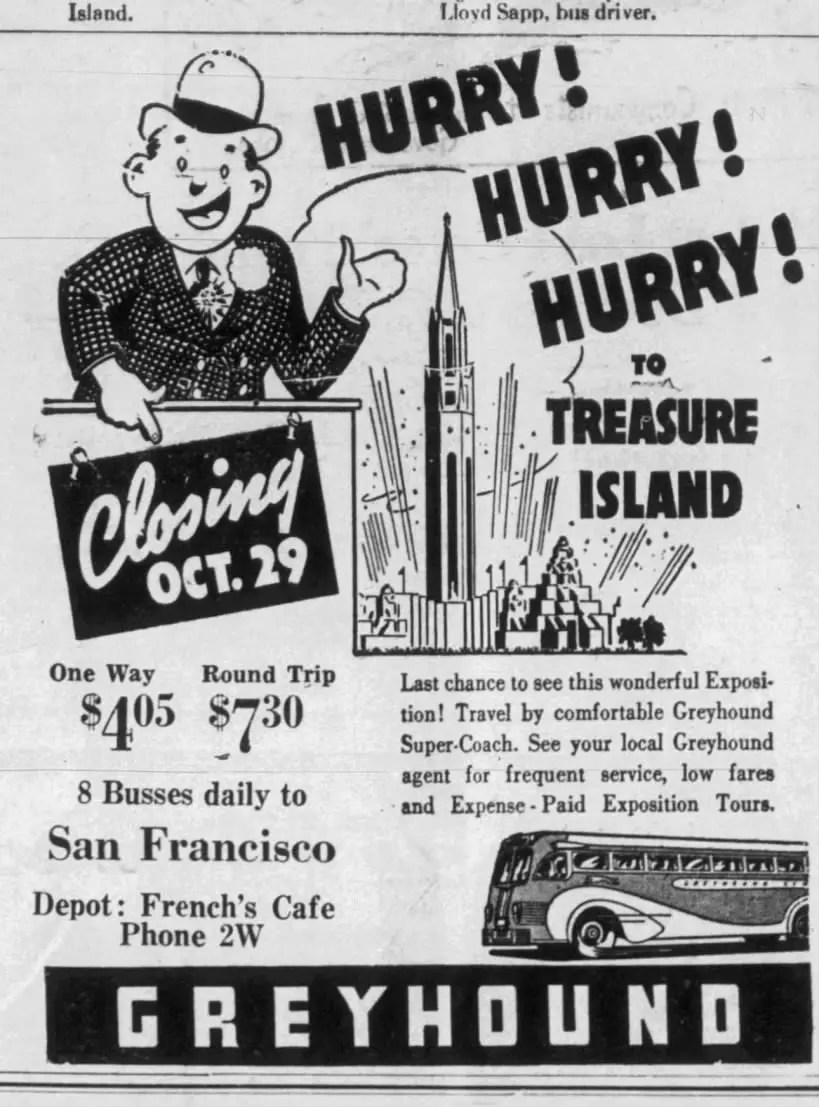
The Exposition even won periodic mention in the little Arroyo Grande Herald-Recorder, including this October 1939 display ad. I think the Greyhound station was in the Olohan Building, whose basement is now home to Klondike Pizza. A Klondike pizza is also good for transient moments of optimism, if I may be allowed to editorialize.

What had to be a highlight of the Exposition came in June and July 1939, when most of the Pacific Fleet, just off maneuvers, sailed into San Francisco Bay for a visit. Many years ago, my wife and my sons and I spent a delightful visit to our favorite city during Fleet Week, when we saw the Blue Angels, sailors from twenty nations, and, on a Muni Bus, a bearded lady (who was very nice) and a man who could do 360s with his dentures. I preferred the visits to the submarine Pompanito and the Liberty Ship Jeremiah O’Brien, but I’m built that way, I guess.

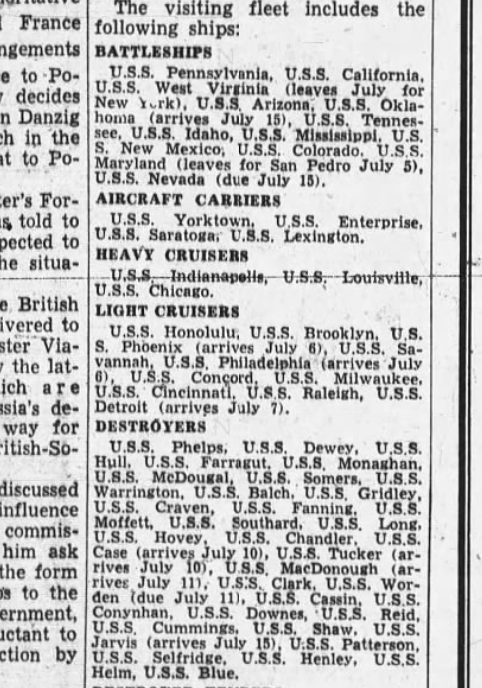
Here’s an article from an Oakland newspaper—with little seeming regard for what we’d call “national security” today— about the ships, and their 40,000 men, headed for the Exposition:


And here, also from British Pathe, is a remarkable video as the fleet arrives, led by battleships, then a light cruiser and finally the preciuus carriers. And then, best of all, happy sailors coming ashore for liberty.


The scale of these ships is hard to imagine, even though they’re relatively small when compared to modern aircraft carriers. A Pennsylvania-class battleship, like the one in the video below, displaced 32,000 tons, was 600 feet long and carried a complement of about 60 officers, 70 Marines and 1,000 enlisted men. These ships were small cities. And small cities need the mail delivered, even in mid-Caribbean. This film is from the early 1930s:


And the battleship in the newsreel—you had to know this was coming—was, of course, USS Arizona, lost with 1100 crew, including two sailors who were raised in Arroyo Grande, on December 7, 1941.

Maybe it’s just me, but I am a devoted fan of American film, and as a cultural barometer, 1939 was a sign of renewed confidence in the same way the Exposition was. My parents began dating that year, when their movie dates might’ve included The Wizard of Oz, Stagecoach, Goodbye Mr. Chips, Ninotchka, Destry Rides Again and Gone With the Wind.

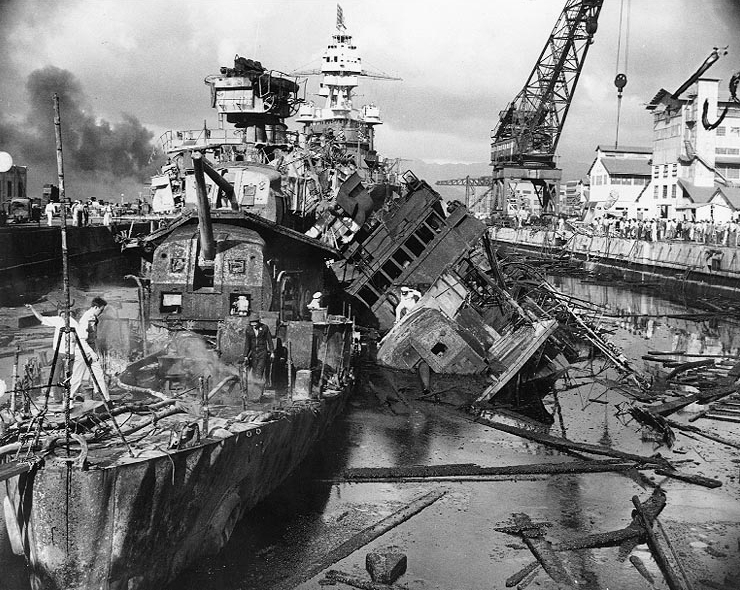
And that brief moment of renewed self-confidence, of hope, is what makes the images of these ships and their young men so poignant to me. These are the fates of some of the ships cited in the Oakland newspaper article above:

Downes and Cassin in the aftermath of the Pearl Harbor attack. The battleship Pennsylvania, also in drydock that day, is just beyond.


As devastating as the photograph above is, both destroyers were salvaged, rebuilt and returned to duty, as were the damaged battleships. One of them, Nevada, which made a heroic run under attack for the Pearl Harbor exit channel, was, on June 6, 1944, hurling 14-inch shells at the Germans defending the Normandy invasion beaches. Nevada, in fact, was granted the honor of firing the opening salvo that day.

One of my favorite lessons in U.S. History was devoted to the construction of the Oakland Bay Bridge, truly, to steal a term, an engineering marvel. It, and its sister bridge, are emblematic of the way we responded to the Great Depression.

We responded to the shattering of our confidence at Pearl Harbor with new ships and old ships pulled to the surface from Pearl Harbor mud and made new again. Vast fleets of warplanes, tanks, trucks, artillery and small arms, Spam and K-ration Lucky Strikes, a labor force that went to war— a third them women and many of them killed in factory accidents—and over 400,000 young men killed in combat, all of these made up our response.

These things happened because of a generation that, before the war, was dismissed by intellectuals as pleasure-seeking, selfish and shallow. This was my parents’ generation. My parents were hard-working, generous and deeply read. I became a history teacher because of the values they instilled in me.

Learning about the Exposition, in what remains—after a fair amount of European travel (Dublin, London, Edinburgh, Paris, Nice, Amsterdam, Munich, Salzburg, Florence, Venice, Rome) with twenty to forty of my closest teenaged friends, my students—the city I love the most. The Exposition reminded me of my mother and father and their generation. If this was a twilight time in our history, followed by four years of wartime dark, we were still here in the morning.


The New Jerusalem

Featured

Elizabeth, Thomas and I were watching the CNN series on the movies last night, and the installment we saw focused on the Eighties.

And, of course, Working Girl had to be one of the movies the documentary noted. They could’ve spent a lot more time on it, in my opinion.

If the big New Jersey Hair of Melanie Griffith and Joan Cusack is clearly dated, the film and its issues aren’t. This is a film about the obstacles women face, directed and written, I am proud to say, with great sympathy, by men.

I think it’s Mike Nichols’ finest film.

And I might still say that had Nichols ended Working Girl after the first three minutes.

The cinematography is stunning; the opening sequence, shot from a helicopter, is a loving study of the Statue of Liberty that then pulls back to reveal Southern Manhattan–including, tragically, the Twin Towers–the Jersey shore and the the camera swoops in again, gliding alongside the Staten Island Ferry until the dissolve that takes us to the ferry bench where, in an intimate closeup, Melanie Griffith and Joan Cusack share a birthday cupcake.

It is glorious, as is Carly Simon’s song “Let the River Run.”

This introduced me to a city that terrified me until I saw the Cooper Union, where Lincoln delivered the 1860 speech that made him president, saw the lobby and the city below the observation deck of the Empire State Building and saw, miraculously, the Chrysler building.

It took me two tries to “get” Paris. I fell in love with New York almost immediately. This stunning piece of film-making made that possible.

And I just found this version of Carly Simon’s song, from one of those European song competition shows, La Voz. The singer is Cuban-Spanish, her name is Lieta Molinet, and she nails it. If you are a female-type person, you might just notice that one of the male judges is both entranced and gorgeous. Be that as it may, I think this is a stunning performance of a stunning song.


For Paris, where there will be no fireworks. With love.

Featured

It sounds so pretentious–for an Arroyo Grande boy, raised with heifers and chickens—a little boy so sheltered that he was almost overcome by the velvet-suited Santa on the mezzanine of Riley’s Department Store in San Luis Obispo, California–but I miss Paris.

I didn’t get it the first time I took my students to the great city. I think I was overwhelmed. The second time, with my literature teaching partner, Amber Derbidge, and our wonderful Breton tour guide, Freddy, I got it.

It helped, I think, that we’d came south from Anne Frank’s Amsterdam, then through the Ardennes, and finally across Northern France–a stretch of the trip that had begun at Metz, where we saw trout feeding, describing ringlets on the surface of the Moselle, just like the ones I’d tried so hard to catch in the Arroyo Grande Creek when I was little.

At Verdun, a museum guide took me aside and whispered “Your students are so respectful,” which might just be one of the greatest compliments I’ve ever received, because she confirmed to me that they’d learned, in our classroom, what I’d taught them about Verdun.

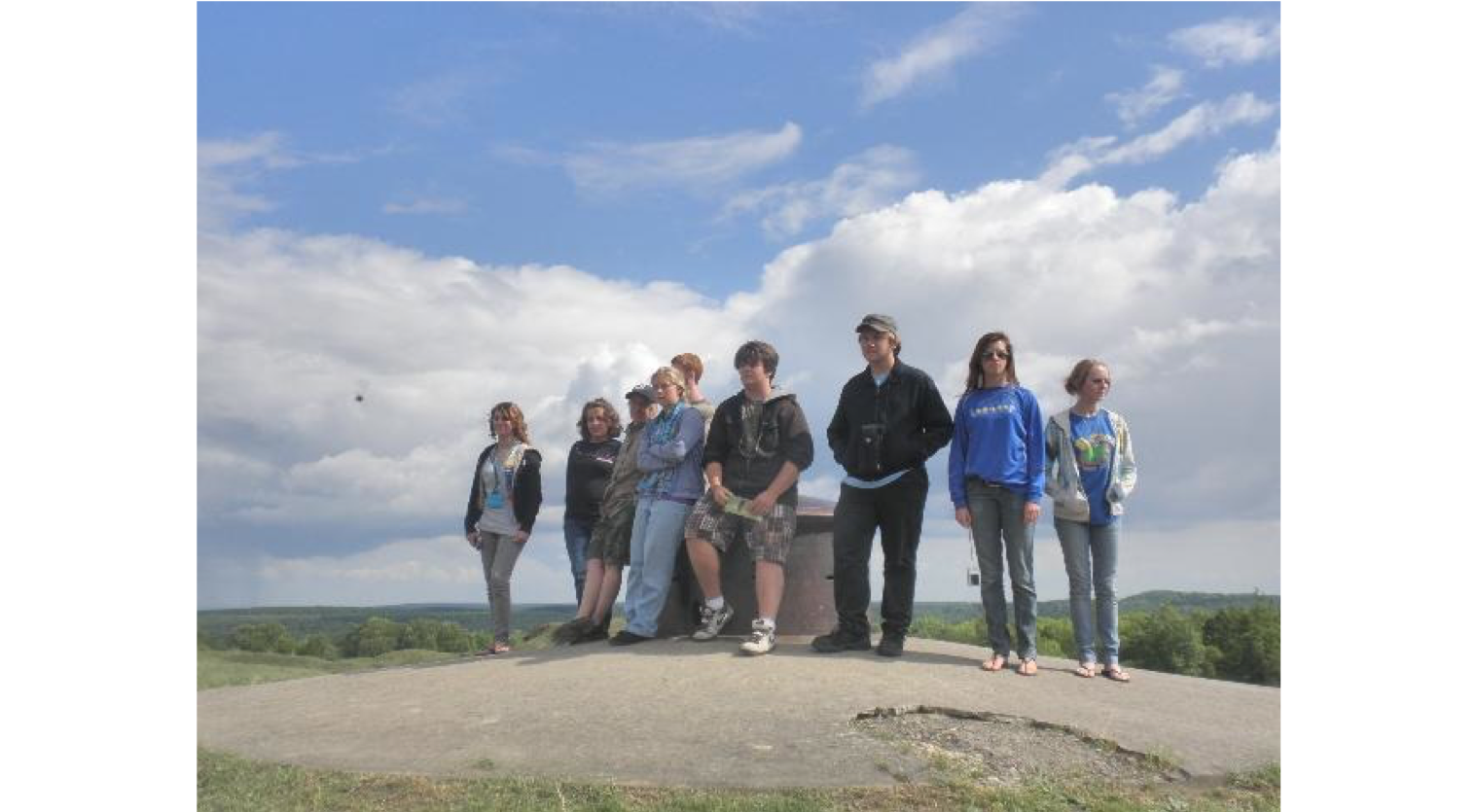
Some of my students at Douaumont. 100,000 French and German soldiers
were killed or wounded in the struggle to capture this fort.


We were greeted, in fact, with immense kindness. At Reims—I’d used, early in our school year, both Bernard Shaw’s St. Joan and Shakespeare’s Henry V to teach my students the meaning of nationalism —a local woman, delighted to meet young Americans, insisted on giving us a tour of the cathedral, one that wasn’t on our schedule.

We didn’t mind because she was so happy and she made us happy, too. It was Rockefeller Foundation money that was helping to repair shell damage to the cathedral facade from the Great War, and even though none of us could be mistaken for a Rockefeller, the important part, for this lovely woman, was that we were Americans.

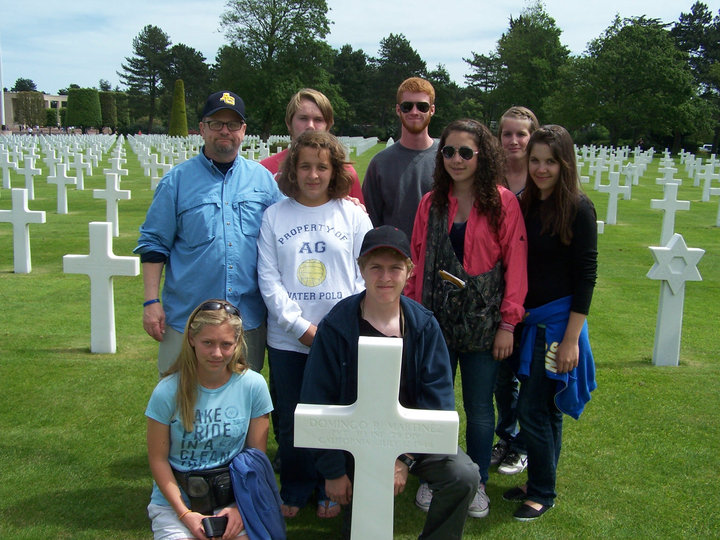
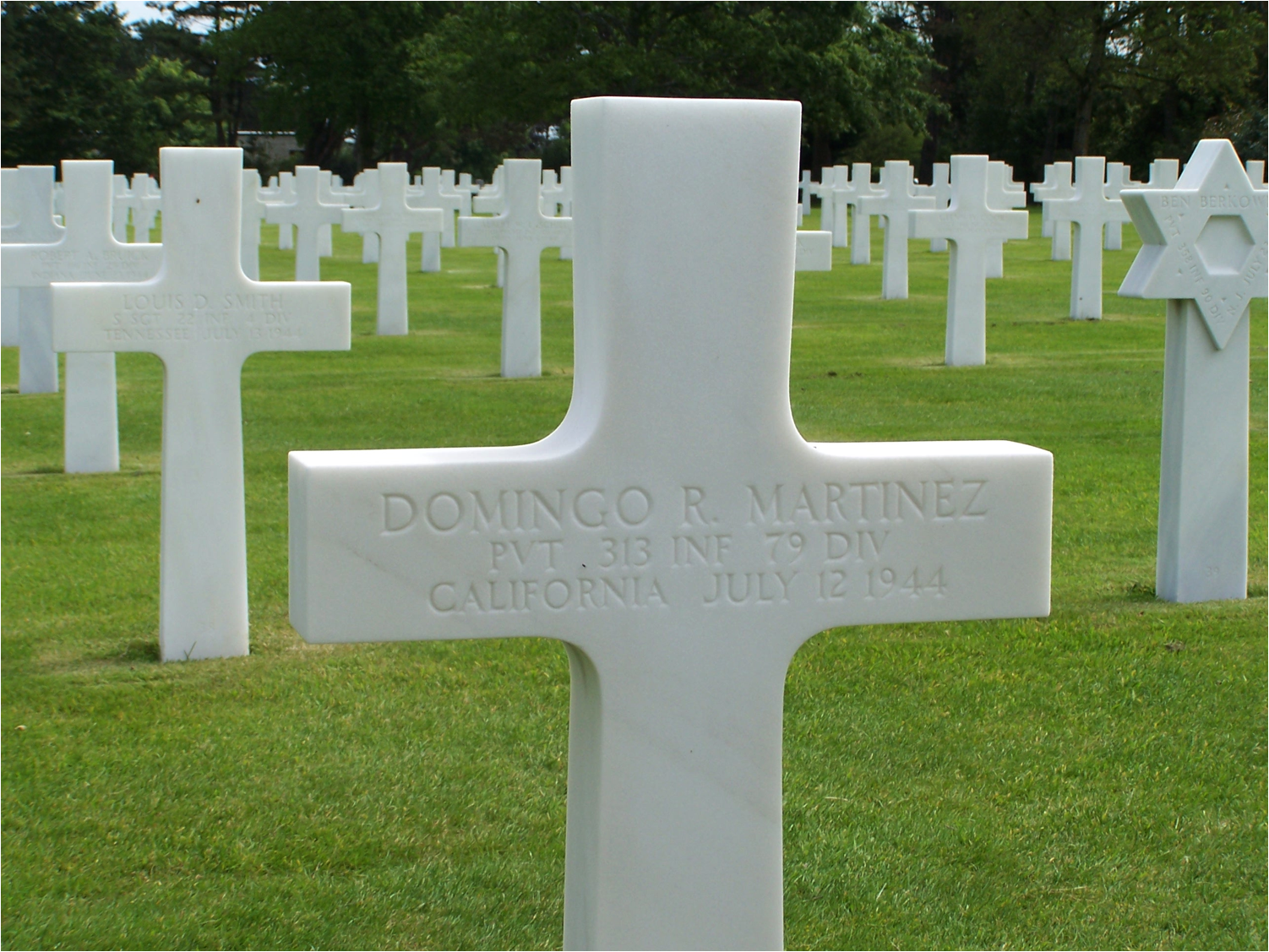
We reached the coast and the D-Day beaches and the American Cemetery above Colleville-sur-Mer, where we found a local farmworker, Domingo Martinez, a Mexican-American, a member of the 79th Infantry Division, who was killed by fragments from a German .88 shell near Le Bot in July 1944.

At Private Martinez’s grave.


Then, after the cruelty of the battlefields, we ended this trip in Paris. This time I realized how alive Paris is. I got it. I was as enchanted as a Nebraska farm boy—not that far a remove from my actual childhood near the farm fields that border the coast of central California—and when I briefly got lost in the Latin Quarter, I was unafraid. There was far too much for me to explore. I would get back to my students. Eventually.

In the classroom, I used to share the video below with my students to introduce them to my favorite unit—Nineteenth Century urban history, or La Belle Epoque—and they, and I, needed the sustenance we got here, in this chapter, if we were to survive the heartbreak of the First World War.

This year, another heartbreak—another disaster, this time in Covid—has forced the cancellation of the Eiffel Tower’s spectacular fireworks show.

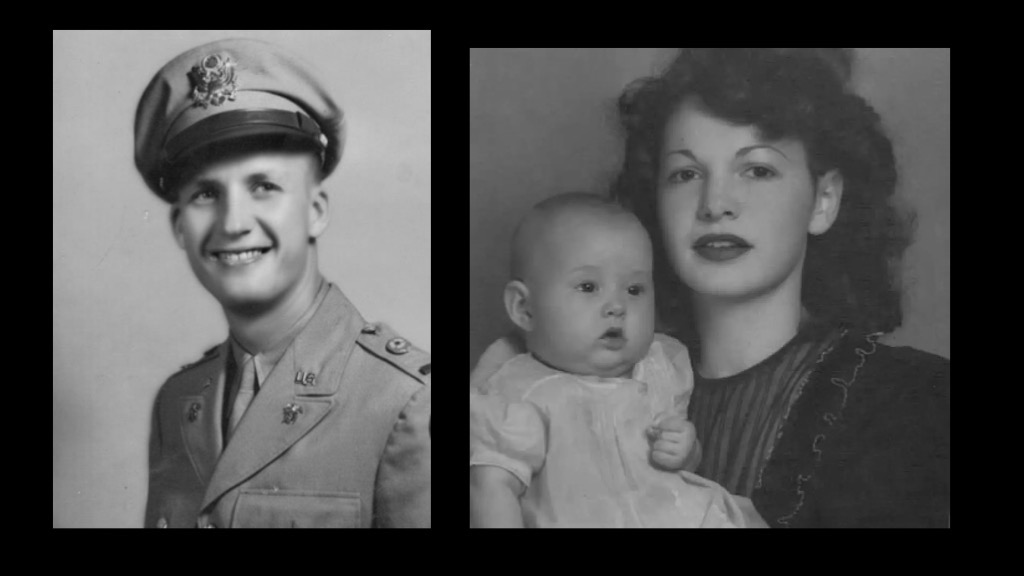
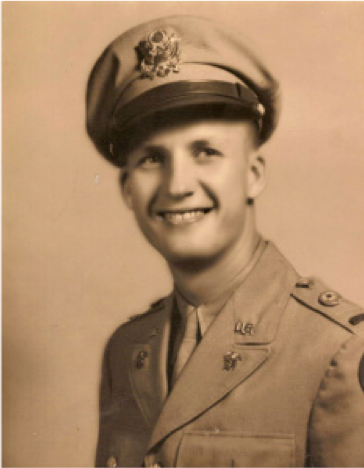
So this blog post is a very little attempt to make up for what we’ll miss this New Year’s Eve. It’s one of several love letters I’ve written to Paris, where my father, an American GI—he spent two years away from my Irish-American Mom, seen here with my big sister—was a tourist in the late fall of 1944.


To teach what I feel to my students, I made this video for them. It’s oddly matched to an oddly beautiful song, “Bittersweet Symphony,” by The Verve, a song that in its own way, is a kind of masterpiece.

Joyeux Noel, my friends.

My (very short) Journey through French Cinema

Featured

Filmmaker Barry Galperin.

One of the great joys of my teaching career was getting approached by this young man when he was a junior at Arroyo Grande High School. He had the sheer audacity—the kind that’s required of directors—to ask me to design a high school semester course in film history.

Which I did, because it was Barry’s idea, which made it an honor.

I once designed a course in Cultural Anthropology, so this was only my second attempt at inventing a class from scratch. But the Grand Poobahs at UC Berkley approved that course and, to my delight, they approved this one, too.

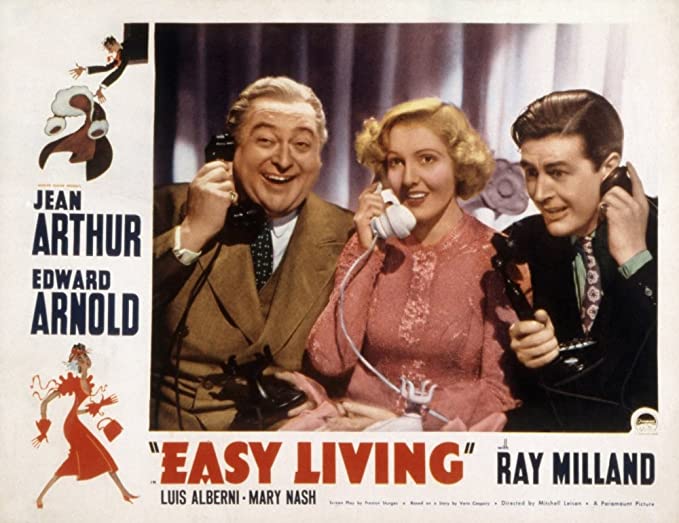
Designing the film course took me a long time, but I don’t much mind creating things. The only sadness was that I didn’t have room on my schedule to teach it—or to watch again films ranging from Chaplin’s The Gold Rush to Preston Sturges’ Easy Living (I have a great fondness for the actress Jean Arthur, who also finds James Stewart’s courage for him in Mr. Smith Goes to Washington) to John Ford’s The Searchers to Ridley Scott’s Blade Runner.

But I was pretty proud of myself—almost but not nearly as much as I am of Barry, a now-seasoned professional who directs and writes screenplays. He is possessed of immense courage.

Last night, I had an immense and badly-needed dose of humility. I was merely channel-surfing when—damn you, PBS!—I tuned in, midway, into a three-hour documentary from 2016, My Journey through French Cinema, about the critic Bertrand Tavernier.

No, I had no idea who he was.

The film was subtitled, but the French the narrators spoke bore no resemblance to the proper names I was reading in the subtitles. I was always sorry that I did not take French in my years as an AGHS student. The teacher, Mrs. Koehn, was enormously attractive to us teenaged boys. She took to driving a convertible MG at high speed in her later years, which endeared her to me in a whole new way when she became my teaching colleague.

But this documentary cured me of learning French. I could never force my American mouth to make sounds like that.

That’s not the point. The point that was brought home to me was how little I actually know about film.

The scenes they selected took my breath away—I don’t know enough yet to connect the scenes with their films—but I saw an interior scene with both the camera and three characters in constant motion until a lovely young woman suddenly uses a bottle to bludgeon her older lover unconscious. I saw another man die in a rollover car accident shot from both outside and inside the car, punctuated, at its end, by a surviving tire in its rim careening across the road. There were criminal escapes through tunnels and sudden screaming matches between couples who only seemed comfortably married and a Paris street scene with two young women chanting casually amid the sidewalk crowds they pass, while heads turn in their passage. There were exterior scenes, young couples walking beneath trees and holding hands in dappled sunlight, that would’ve made Renoir weep. There was a sudden and violent street robbery, shot in Milan with a hidden camera, in front of a shocked crowd who would learn only much later that they’d been film extras.

There was Belmondo, an ultra-cool alloy of Bogart and Paul Newman.

There were, of course, entire Gauloises assembly lines of cigarettes smoked.

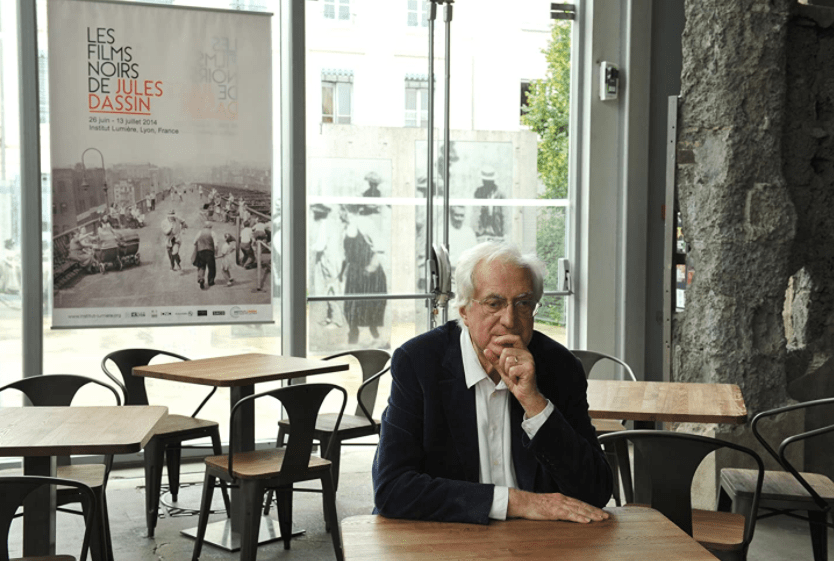
Bertrand Tavernier

I watched all of this without breathing too much. It was a wonderful humbling to realize how much you don’t know.

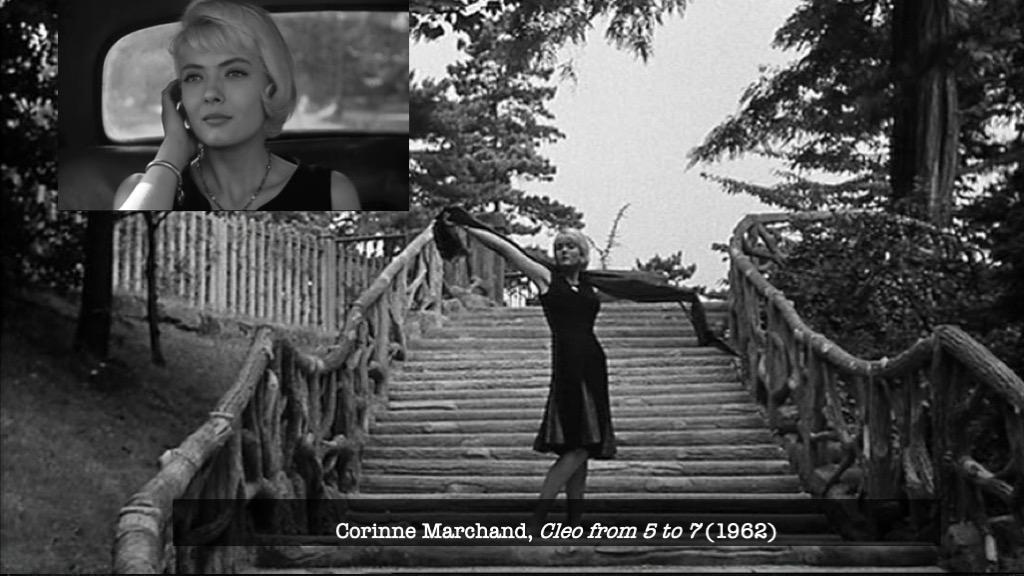
It was touching to feel your heart melt a little in watching the actress Corinne Marchand, her character doomed by cancer, sing as she descends a staircase in one of Hausmann’s Paris parks in a scene, filmed so gracefully, and sixty years ago, that it makes you fall in love with her.

It was exciting to know that I, even at sixty-eight, have so many films yet to watch, and that they are gifts from the French.

I spent most of my life dismissive of the French, in the American manner, until my students and I, ten years ago, took a trip across northern France where the Americans and Germans had left behind a path of destruction, in 1944 and 1945, from Carentan to Metz. In the ferocity of the fighting, entire towns were reduced to splinters by bombers and shellfire and in Norman pasturelands, GI’s took scant cover in the shelter of dairy cows, their udders still filled with milk, who’d been butchered by machine-gun fire.

We were typical tourists on our trip sixty-five years after that terrible war—in European history, that’s a hiccup— when the Frenchwoman, on discovering that we were Americans, insisted on giving us a tour of St Joan’s cathedral at Reims. She was insistent precisely because we were Americans.

This was the trip when I learned to love France and the French.

This was the trip where we visited the 1916 battlefield at Verdun. Verdun will cure you forever of the myth, broadcast by simpletons, that the French are cowards. The battle lasted nine months. The taking of one fortress—Douaumont—took 100,000 lives.

There is a vast ossuary beneath the Verdun Memorial. You can see, just below plexiglas panels, enormous stacks of the bones of French and German soldiers. These are the macabre remains of a generation of young men who were lost forever to their parents. And to us.

An attendant took me aside as we toured the Memorial. “Your students are so respectful,” she whispered to me.

So that moment, and the visit to Reims, cured me forever of the belief that the French are cold people. The woman who guided us through the cathedral was so immensely proud that she was French and so immensely happy that we were Americans.

My homework, for her, will be watching the French New Wave. Merci, my friend.

Lessons on Leadership from the Dead

Featured

In the early 2000s in Vilnius, in Lithuania, when construction workers began unearthing skeletons, they called in the anthropologists. The work these scientists do is familiar in this part of the world. Thanks to Stalin’s NKVD and Hitler’s einsatzgruppen, mass graves that would be a horror anywhere else are common in Eastern Europe.

The only place remotely familiar is Spain, where everyone knows about the mass graves, legacies of the Civil War, but no one speaks about them.

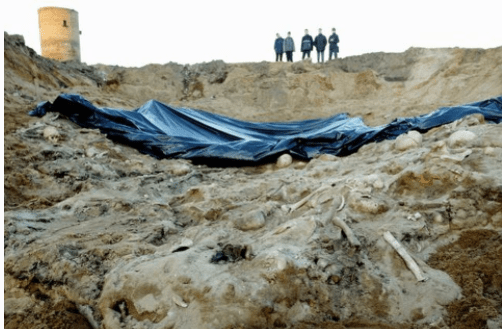
In Vilnius, the skeletons were even older than the ones left behind by Stalin and Hitler and Franco. These were Napoleon’s soldiers.

The Vilnius burials

Nearly four thousand individuals were isolated, only part of the estimated 20,000 soldiers who died here. The numbers are staggering: Napoleon had taken a multinational army of 675,000 men into Russia in 1812. Near the end of his retreat, at Russia’s western frontier, only 40,000 remained. Half of them staggered into Vilnius.


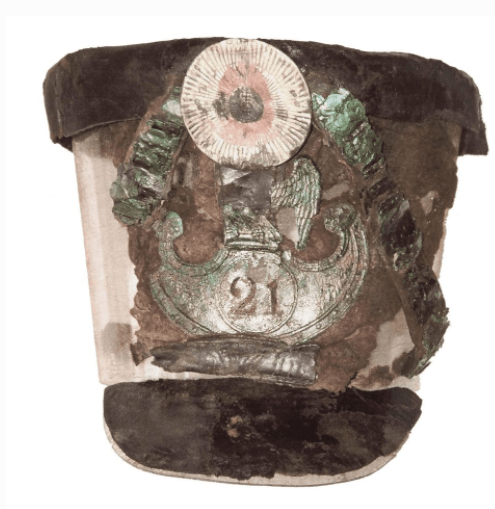
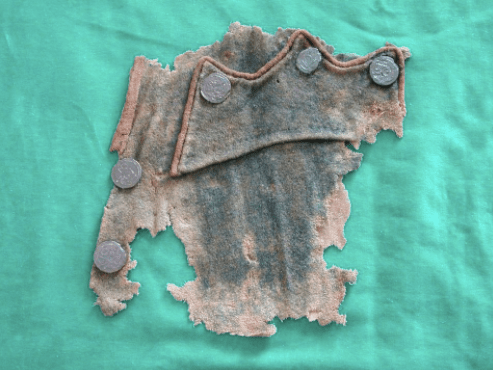
Some of the finds were fascinating. Many individuals had a notch in the front teeth of their lower jaws. This is where the stems of their clay pipes had fit. Bits of uniform cloth and infantry helmets, like this one, allowed archaeologists to match some soldiers with their units in what Napoleon called the Grand Armee.


Chemical analysis of the Vilnius bones hinted, from fragmentary nutritional evidence, at those soldiers who were more likely French and ate a diet based on wheat and those where millet was detected. These were the Italians.

By the end of the retreat, none of the Vilnius survivors was eating much at all. They’d slaughtered the horses that had drawn their baggage and then they’d begged the bewildered townsmen bare. Some starving soldiers broke into a medical office to steal the doctor’s anatomical specimens, suspended in formaldehyde.

Uniform fragments like this one revealed the final killer: The scat left behind that was evidence of typhus, the same opportunistic disease that would kill so many in Ireland’s famine thirty-five years later.


Some of the skeletons would’ve belonged to the military doctors who remained behind in Vilnius. Napoleon didn’t. He abandoned his dying army—just as he had in Egypt fourteen years before—and, wrapped in furs, safe inside a fast sled, he raced in relays of horses, killed in their harnesses, to get back to Paris, where he could minimize the news of this epic disaster, reshape it in the imperial press.

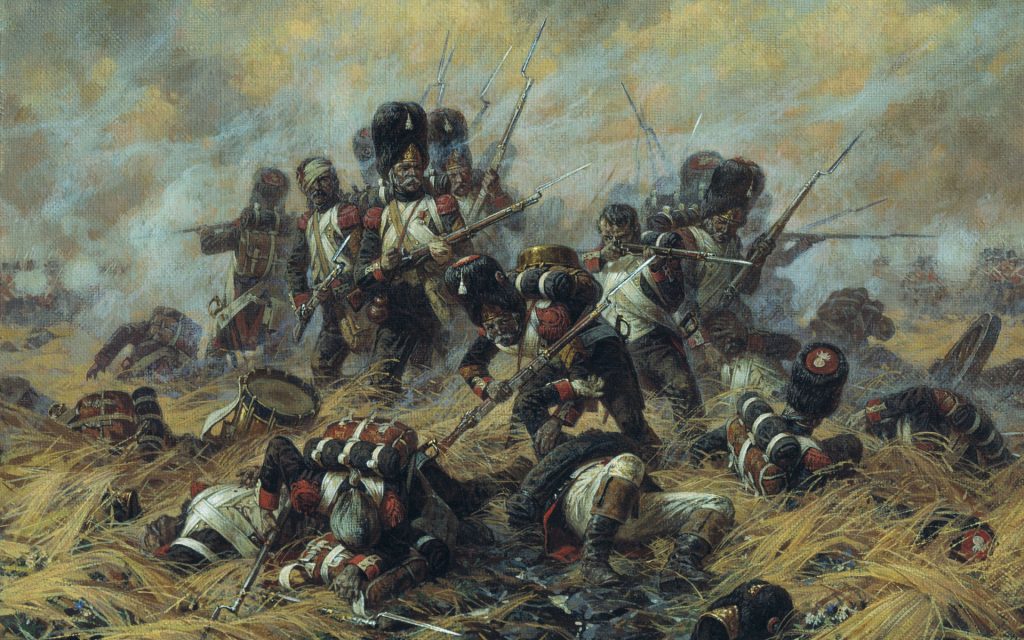
In this, he was spectacularly successful. He would make a comeback and lead let another army to spectacular failure at Waterloo two years later. This army included the troops esteemed more than any others, the Old Guard, his personal bodyguard. Many of them, tall men made taller by their bearskin helmets, were grey-mustached veterans who had been with him since the beginning. By the end, they were ironically the safest soldiers in his army. They were so venerated that they would always make up the emperor’s strategic reserve, to be used only as a last resort.

At Waterloo, that last resort came when the Guard was called on to cover the flight of the Emperor as his carriage sped, again at a horse-killing pace, toward Paris. The Old Guard would die, abandoned on the field in the moment that their emperor realized that the weight of late-arriving Prussian troops was more than his empire could bear. He realized, too, in the same moment and with perfect clarity, that his life was far more valuable than the lives of the veteran warriors who loved him the most.

The Old Guard at Waterloo


This week the president announced that “we are all warriors.” Here are warriors in New York City in a grave different only from the grave in Vilnius for the decency of its caskets and the symmetry of its trench.


But this grave, like the Vilnius grave, demonstrates some of the similarities between the emperor and the president. Like Napoleon, Trump has demonstrated a perverse genius for altering reality.

The president and his people are preparing to magically reduce the casualties of the last two months. They will claim that hospitals, eager for the Medicare money that comes with treating coronavirus patients, are inflating the numbers of admissions and, of course, the numbers of dead—the ones who lie unburied in a fleet of refrigerated trucks in Brooklyn, the trucks organized in neat rows where, in the distance, you can see the Statue of Liberty.

The president has blamed one of his more vivid leadership failures on hospitals, too. He obliquely and darkly implied that the lack of personal protective equipment was traceable to doctors, nurses and respiratory therapists who were selling the gear on some kind of coronavirus black market.

Yesterday, in the Oval Office, he quickly and sharply contradicted a nurse he was supposed to honoring when she revealed that the supplies of PPE were still sporadic and unreliable.

Nurses head to the White House to protest lack of protective ...
Trump prepares to humiliate an honored nurse.


“That’s not what I hear,” he said, without revealing, as he never does, where he’d heard it. “Many people tell me” is the closest we get to attribution from a president who constantly excoriates the background sources from the reportage of the New York Times or the Washington Post.

He was far more obvious in his repeated references to “The China Virus,” the one he claimed to have quashed at American ports of entry. But the tragic numbers in New York City came from Europe, from Heathrow and Orly and da Vinci-Fiumicino, as passengers made their transit through JFK and Newark.

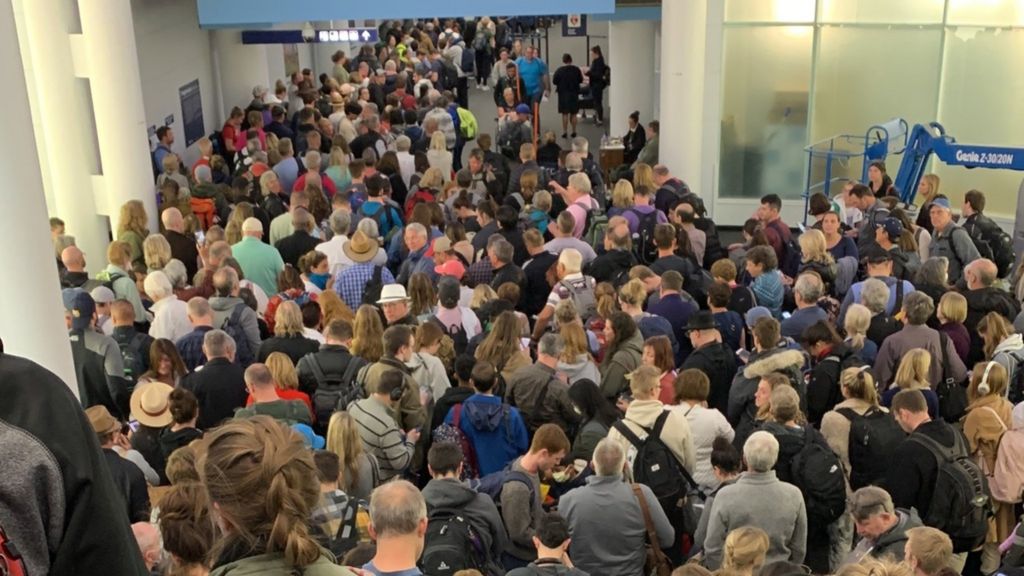
When he did respond to the East Coast threat, he did so with his customary incompetence, announcing “enhanced screenings” that left hundreds funneled into Customs hallways where they had far less freedom to move than the virus did.

But these were warriors, weren’t they?

Coronavirus: US airports in disarray over screening - BBC News
JFK International, March 2020


Trump’s ignorance of history remains his greatest and most enduring personal virtue. He knows nothing about Napoleon and Russia and does not care. He refers repeatedly to “the 1917” flu. You could see his restlessness on a visit to Gettysburg, early on in what he called, early on, his “reign.” (Someone in the West Wing got him stop using this term, one he used for previous presidents, as well.) Later he passed on a visit to Belleau Wood because it was raining. He did speak, to his credit, at Normandy on the same trip, but it was transparently empty because he spoke in the same uncomprehending monotone that he reserves especially for the dead. The words written for him meant nothing to him. He was, as someone so aptly pointed out, like a sixth-grader delivering a book report about a book he hadn’t read.

And he did speak, to be fair, in the rain. In a July 4 speech, he praised the Continental Army for seizing airports from the British during the American Revolution.

And so the ignorance he so carefully cultivates—the coronavirus deaths are fake news, after all—will shield him until, God willing, he leaves office. The man who has called himself “a wartime president” will be whisked away from the battlefield.

He’ll be flown home to Mar-a-Lago where he will finally be alone with the thing he loves the most: A New York steak, very well-done, with a a side of fries and plenty of ketchup. And then there will be a thick slice of chocolate cake with two scoops of ice cream.

All he will have left behind are trenches filled with warriors. But the country will be opened again. We will have that much. And, in truth, when the trenches are covered over, the scars they leave behind will grow over and so fade away.

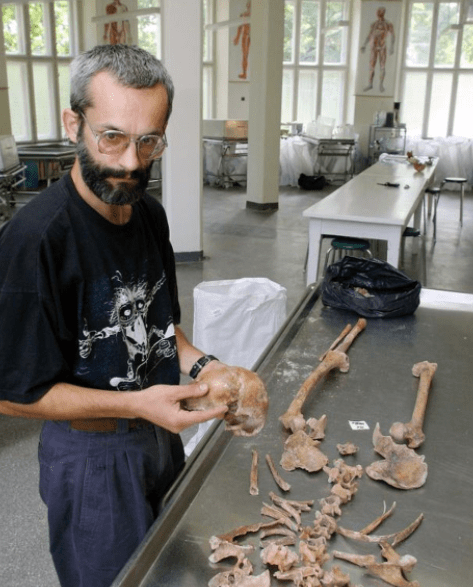
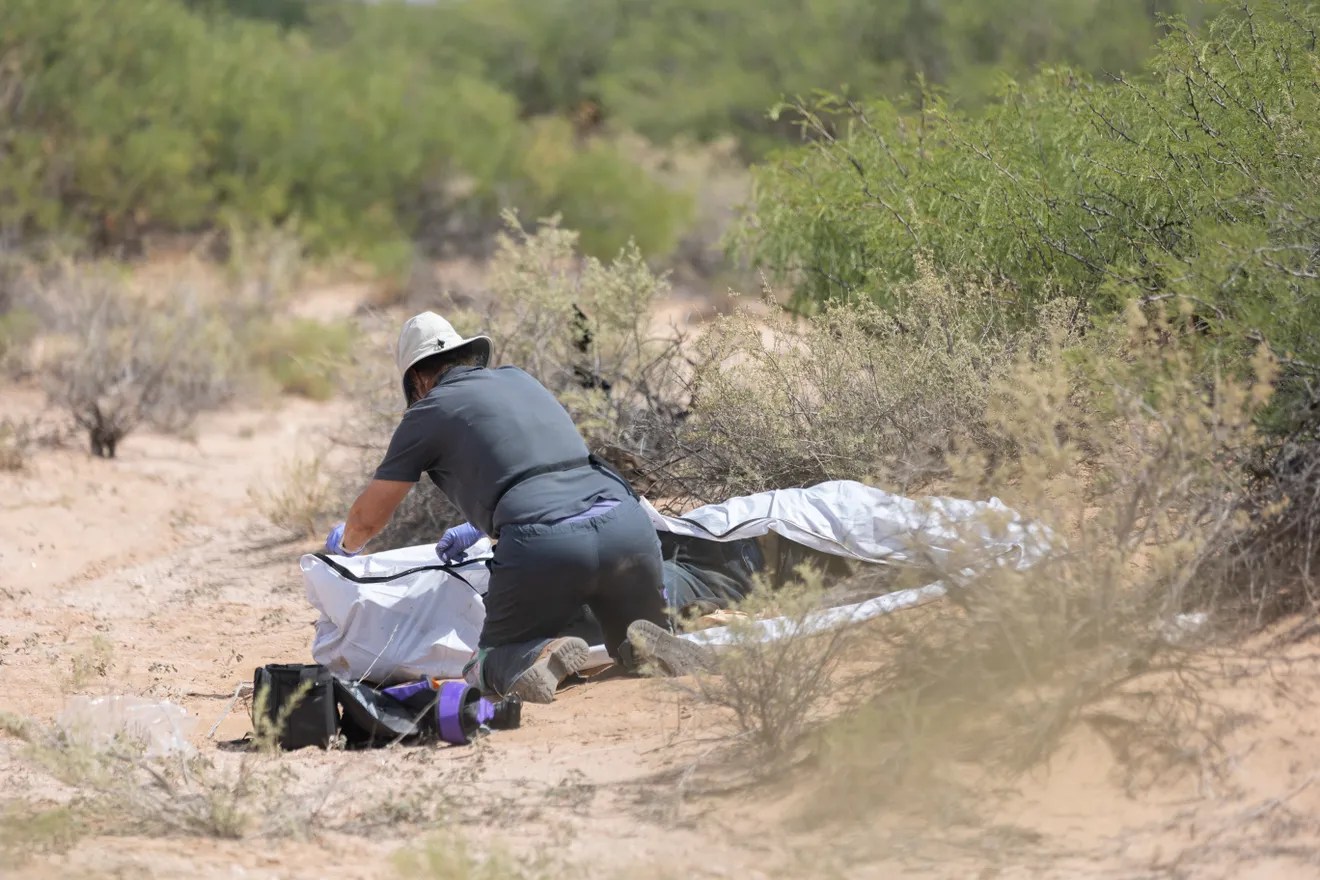
When the Vilnius warriors were finally unearthed, the scars there reopened. You can see it in the scowling face of the Lithuanian anthropologist. You can see it in the compassionate face of the young woman field technician as she reveals a young man who’d died nearly two centuries before she was born. What you see in both images, in both expressions, are human beings registering their humanity.

A little humanity is not too much to ask for. Unless you ask for it from the misshapen man who claims to leads us.

Our Mountain

Featured

This photo was taken near the intersection of Huasna Road and Lopez Drive, where I grew up. Here is the story of the mountain in the photo.

This view is what would we could see very morning from one of our living room picture windows, but, for the sake of accuracy, in this order:

  • Mom’s roses. Sutter Golds were among her favorites.
  • Pasture, with Morgans, whose discharge made the roses grow. Cars would stop to watch the foal, a little stallion made up of 78% legs.
  • Row crops, with the occasional crop duster dipping saucily beyond the power lines. Sometimes they were peppers, sometimes pole beans. A little up the Valley, Mr, Ikeda favored cabbages, which are blue. Just a tad to the left of the cabbages was the beaver dam into which I fell while fishing. Ineptly.
  • The Coehlo place (Kathy). Her Dad carved a model of the old St. Patrick’s Church that was astonishing.
  • The McNeil place.
  • The Shannon place.
  • Various pumphouses and barns.
  • The man who had an airplane in his yard. Just in case.
  • By the early 1960s, just a tad to the left and atop another hill, the Ikeda place.
  • In the late 1950s, Dona Manuela Branch’s redwood home–she’d come to the Arroyo Grande Valley, pregnant, in 1837–had been just a tad more to the left. When I was very little, the home burned in the night. It gave off a spark as bright as Venus. Only the palm trees that had shaded the home, its gardens and had once shaded the family at barbecue remain today. The Ikedas take respectful care of Manuela and her family, maintaining the graveyard up a little canyon five hundred yards away from the home her devoted children had built for her.

So I grew up with this mountain, sort of. It always looked to me like the top of a head with a receding oak tree hairline.

Once there was a brushfire that came up behind it and framed the top, like the sun’s aureola at full eclipse, and that became a passage, fifty years later, in a chapter about the Battle of Petersburg. It went like this:

The Third Battle of Petersburg began in the pitch-black pre-dawn of April 2, 1865. A Union army surgeon, watching the assault from a federal fort, could see nothing until the combined muzzle flashes of thousands of Confederate rifles lit the horizon the way a brush fire will when it crowns a hilltop. When a line of flashes went black again, the doctor knew that the Union assault had carried the Confederate entrenchments.

One day, when I was in my early teens, I decided to climb it. You could access it from behind the Cherry Apple Farm. I was by myself, which was stupid, and forgot about the poison oak, which was stupider.

It took me two hours.

When I reached the top of the mountain I considered to be very close to my own personal property–emotionally, if not legally–I found out I hadn’t reached the top at all.

What neither the photo nor my many morning views as a little boy revealed was that this was actually two mountains: There’s a razorback ridge in front and, behind it and beyond it, the bald man with his receding hairline of oak trees.

I was kind of angry. It took me until almost dark to get back down, by which time my family assumed I’d been eaten by cannibals, which meant that the Eskimo Pies brought us by Frank the Foremost Dairy delivery driver–a consistently cheerful man– would last a little longer.

So it turned out that I climbed mountains just as ineptly as I fished. I would live to climb a few more. I’d help the Mission Prep kids whitewash the “M” on San Luis Mountain and fell off it twice more, spraining an ankle both times. I am not going back.

Now people live on that mountain. This kind of audacity would never have occurred to me when I was thirteen. It may seem pretentious to call it a “mountain.” Visit the Midwest. It’d be a veritable Matterhorn to folks north of the Ozark Plateau.

You can still see the backside of this mountain, but from the Nipomo Valley, to the right off the 101, as you drive north from Santa Maria. The hairline is flipped as if it were a reversed photograph.

I hold it no hard feelings. Seen from Nipomo, it’s a little bare and humbled without the oak-studded proscenium seen from its Arroyo Grande side. This gave the mountain a little romance to a little boy looking sleepily out the window on a cold morning.

Climbing it–and then finding out that I hadn’t climbed it at all–taught me a lesson in humility that I need to re-learn every day of my life.

For Yoshi, who never came back

Featured

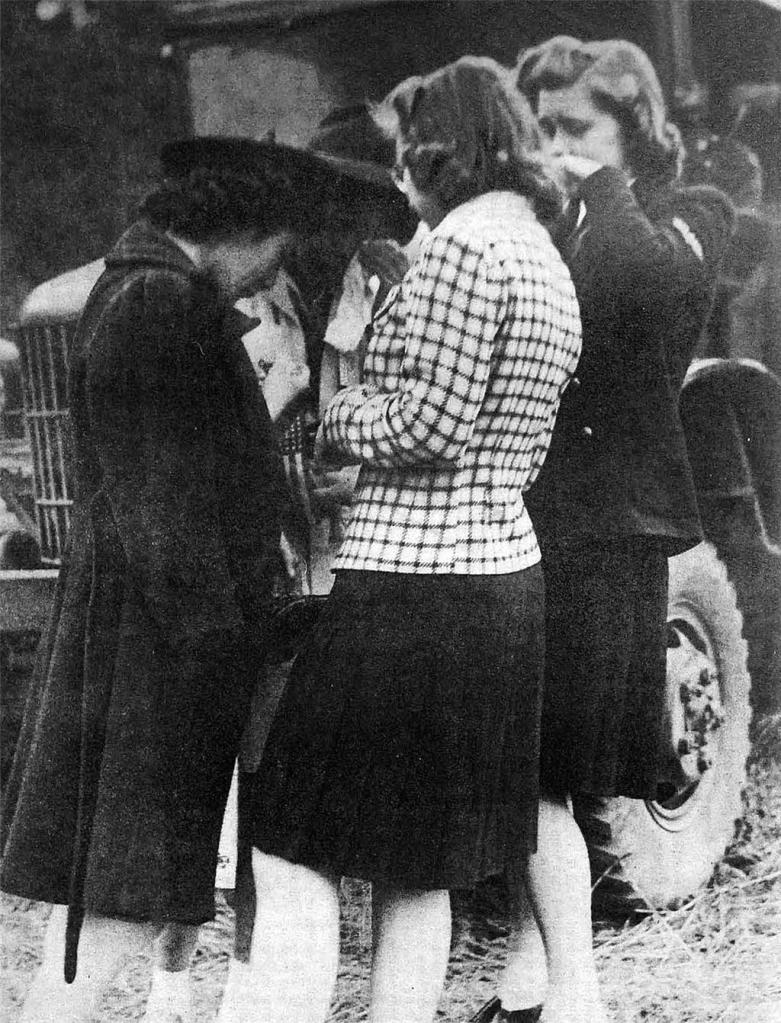
This photograph was taken on Bainbridge Island, Washington, on the day Executive Order 9066 was executed and these friends were separated.

There’s a good chance they never saw each other again.

When the buses came to take our Arroyo Grande, California, neighbors away on April 30, 1942, many of them—less than half—came back. I grew up here, and I don’t recognize many of the surnames in the old high school yearbooks.


One woman told me this: On the day the buses came to the high school parking lot, her mother saw a line of high-school girls, some Japanese, some not, walking up Crown Hill, walking up toward their high school, holding hands and sobbing.

Arroyo Grande’s Japanese-Americans went first to the Tulare County Fairgrounds, where they slept in livestock stalls, and then to the Rivers Camp in Arizona, where the temperature was at or above 109 degrees for twenty of their first thirty days there.

I interviewed a remarkable woman named Jean a few weeks ago. She is 94, is briskly intelligent, articulate and gracious. Her father owned the meat market on Branch Street in Arroyo Grande, population 1,090 in the 1940 census, and when his Japanese-American customers, farmers, came in to settle up before the buses came, he refused to take their money. “You keep it,” he told them. “You’re going to need it.”

When they came home three years later, he extended them easy credit until they could begin to bring in crops again. Jean showed me her father’s business ledgers, so I have no reason to doubt it when she told me that every one of those farmers paid her father back. In full.

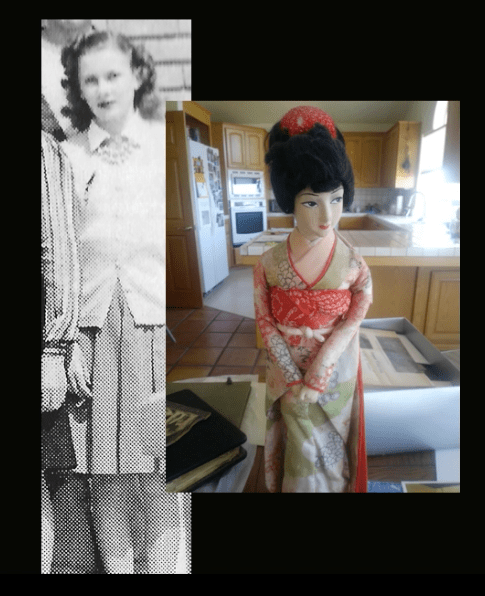
This is Jean as a high-school freshman. The doll, with her handmade kimono, came to Jean from Gila River in gratitude for her family’s friendship. For their loyalty.

At ninety-four, that loyalty runs in Jean as deeply as it ever has. One of her best high-school friends was named Yoshi. I can find a photo of the two together in second grade. I found a photo, too, of two second-grade boys in the Arroyo Grande Grammar School in 1926. They would die, about twelve minutes apart, on USS Arizona.

Yoshi’s brother became a war hero. He won a battlefield promotion to lieutenant when he went behind Japanese lines in China to rescue a downed American flier.

Yoshi’s brother brought that flier in and made him safe. Jean never saw Yoshi again and, because of April 30, 1942, there is a part of her that can never feel safe.

The war, at its outset for America, killed two of our sailors. It would claim many more local young men, killing them in Ironbottom Sound off Guadalcanal and on the beach at Tarawa. It would kill a young paratrooper in Holland during Operation Market Garden. It would kill, with a sniper’s bullet, a tank-destoyer crewman on the German frontier three days before his first child, a son, was born.

The war killed neither Jean nor Yoshi. They remain its casualties, nonetheless.

We had to stop the interview for a moment. In remembering her friend, Jean was fighting hard to stop the tears. One escaped. That moment taught me so much history, and with such intensity, that I almost couldn’t bear it.

Classmates, Shipmates

Featured

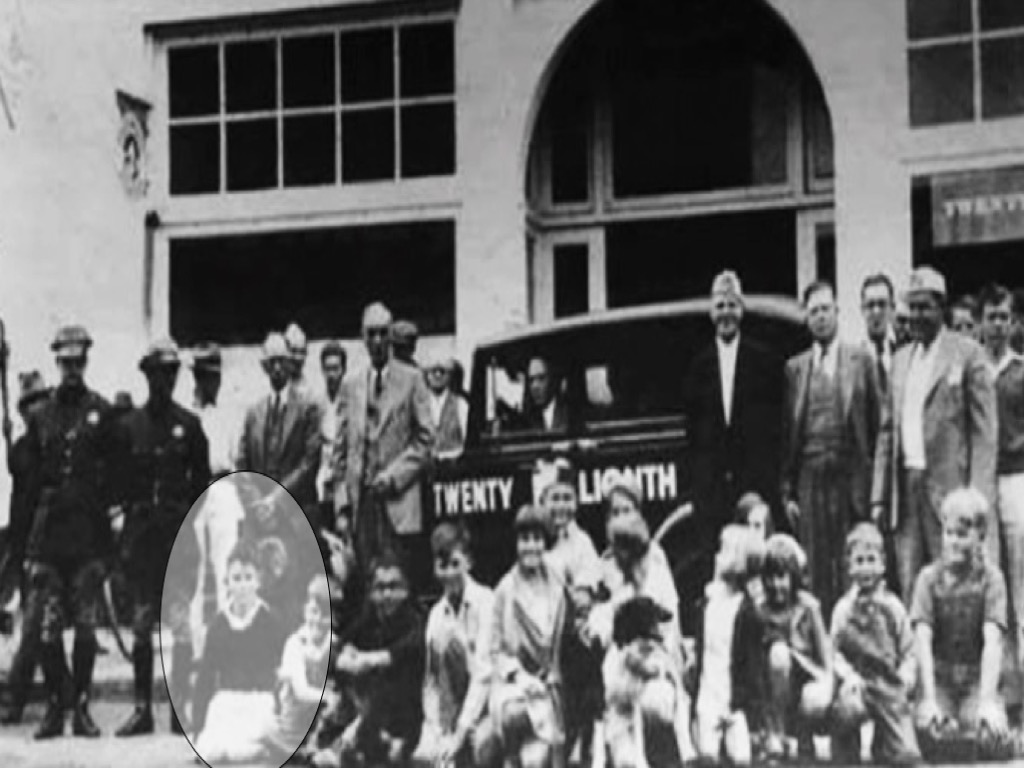
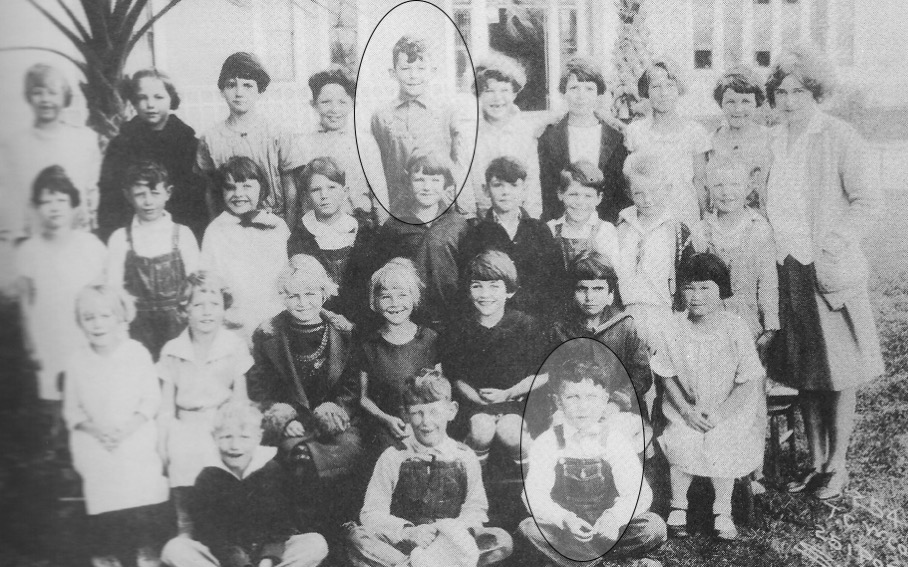
I was browsing an early 1980s version of Yesterday, Today and Tomorrow, the South County Historical Society journal, and I found this photograph of the Arroyo Grande Grammar School second grade in 1926-27.

The two boys who are circled are Wayne Morgan (top) and, in the front row, Jack Scruggs. Wayne’s father, Elmer, was a partner-owner of the Ford agency, today’s Doc Burnstein’s Ice Cream Parlor. Jack’s father had lost his farm earlier in the 1920s; at the time the class photo was taken, he worked with an oil prospecting company exploring the Huasna Valley.

That’s Wayne in the front, in a photo taken during this Ford Model A’s nationwide tour in 1931 (the car, fully restored, is owned by a Michigan car collector).

Nine years later, Wayne would join the Navy.

By the time Wayne Morgan graduated from eighth grade, Jack Scruggs’s family had moved to Long Beach. Both boys were musicians–Wayne played violin in Mr. Chapek’s orchestra (he was also an avid Boy Scout), but Jack would make music his career.

In 1940, Jack joined the Navy.


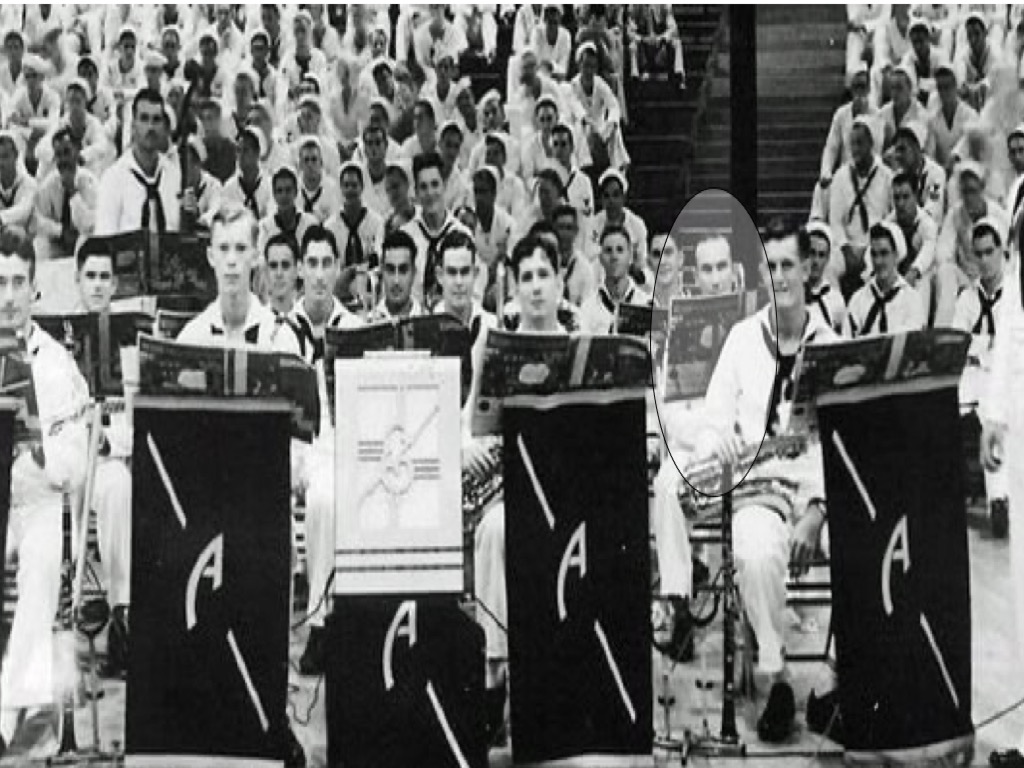
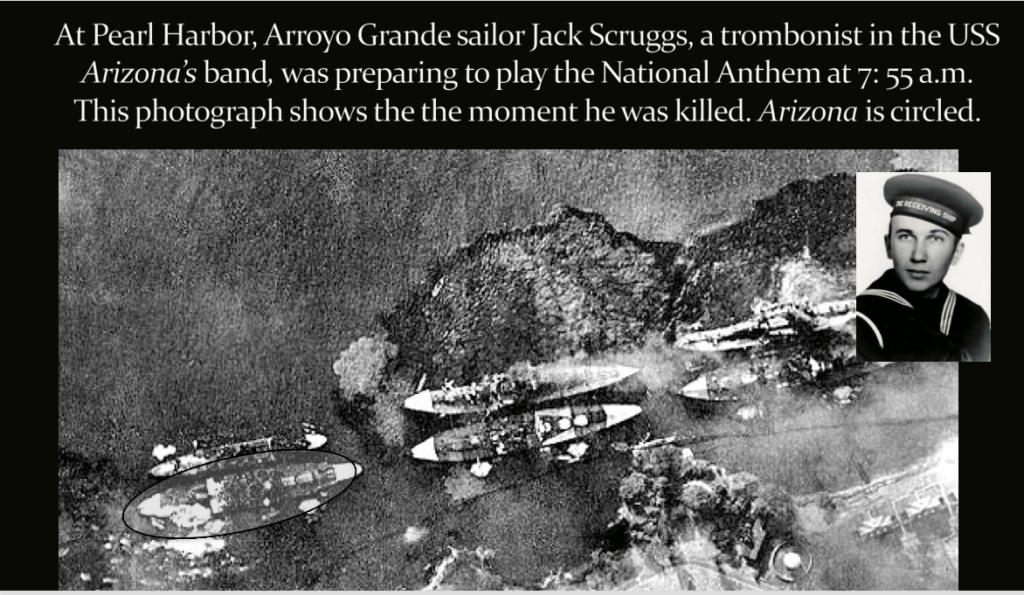
Jack is circled in this photo taken on November 22, 1941, during a Battle of the Bands competition among the ships of the Pacific Fleet. Jack was a trombonist in Navy Band 22–the band of USS Arizona.

So there’s a very good chance that the one-time classmates had a reunion on the great ship.

The tragic part of the story, of course, is that both were killed on Arizona. The concussion from a near-miss killed Jack just before 8 a.m. as the band was preparing to play the National Anthem during the colors ceremony. Wayne died about ten minutes later, when the ship blew up. So were all of Jack’s bandmates, killed at their action stations in the Number Two gun turret, just inboard from where the fatal bomb struck.

A few weeks before the attack, Jack had played “Happy Birthday” on the accordion for Rear Adm. Isaac Kidd’s wife–Kidd flew his flag on Arizona. All that was found of him after the attack was his Annapolis class ring, fused to a bulkhead.


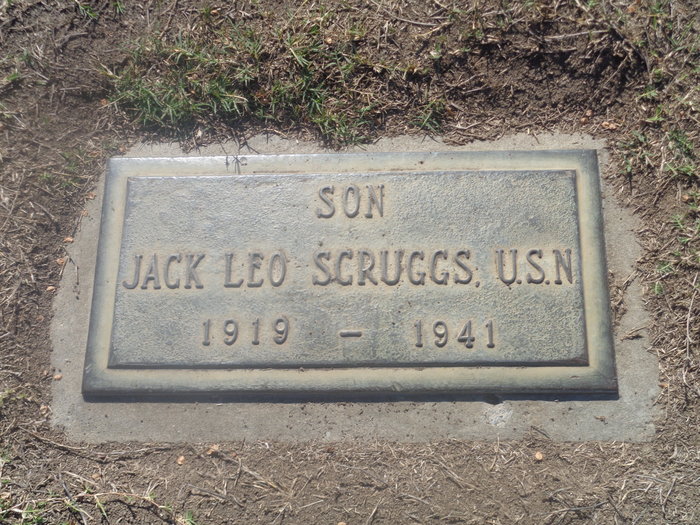
Jack’s body was recovered; he came home to Long Beach. Wayne rests with his shipmates.

185086433_1510535707


I knew both were from Arroyo Grande, population 1,090 in 1940. I thought it extraordinary that two young men from such a small town wound up serving on the same ship. I had no idea that they were in the same grammar school class. 

Sometimes even the smallest footnotes in history tell compelling stories.


The explosion at City Point

Featured

74366489_133912947730


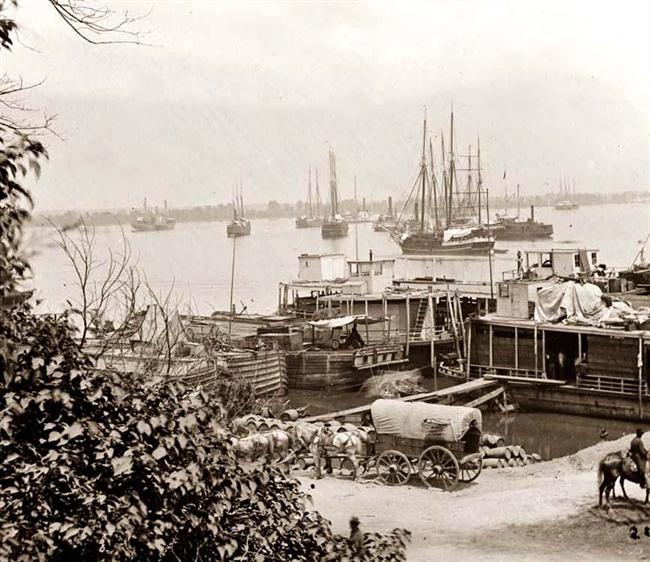
City Point, Virginia, was Grant’s supply base the last year of the war. It would would have astounded the men at Gone with the Wind’s barbecue because of its acres of artillery parks, stacked cannonballs, warehouses full of shoes, Springfield rifles, boxes of hardtack—the army cracker almost durable enough to build a home, and just as indigestible—row after row of tents in a city of soldiers, even its bakery, capable of turning out 100,000 loaves of bread a day. Quartermaster wagons offloaded cargo along a river controlled by navy ironclad gunboats; the wagons traveled in a never-ending stream so busy that it might have reminded the gentlemen from Margaret Mitchell’s Georgia of worker ants, charged with energy and purposeful.


waterfront-city-point

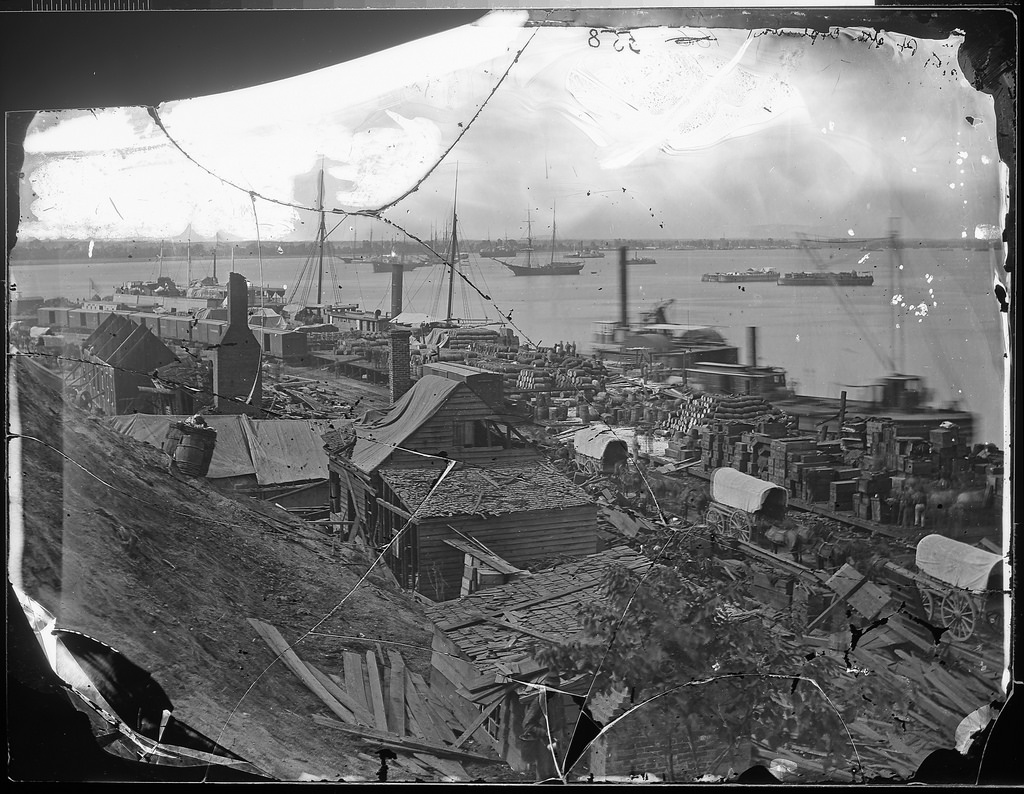
Wharf, City Point, Virginia


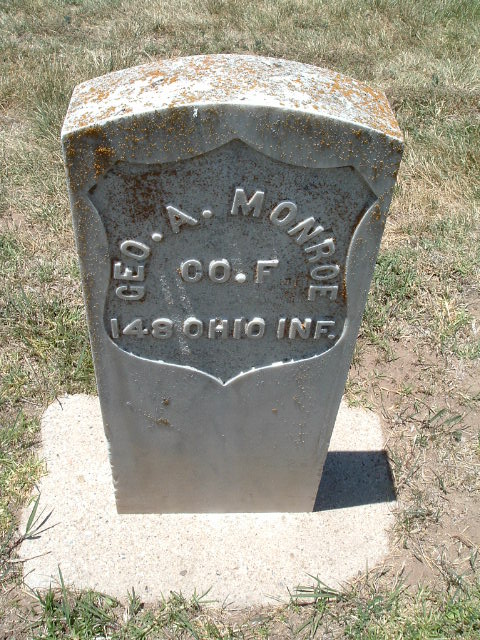
By 1865, even Lincoln’s presidential yacht, the River Queen, was anchored in the river when he visited with Grant and Sherman to sketch out the final acts of the war. Lincoln treasured these trips to see his soldiers, away from the constant assault of favor-seekers who paraded through his office. On another visit earlier in the war, to McClellan’s headquarters, Lincoln had idly picked up an ax on the deck of the Treasury Department yacht Miami, smiled, and lifted it, holding it straight out at arm’s length for several moments. None of Miami’s sailors, when they attempted it, could do the same. On April 14, 1865, John Wilkes Booth’s bullet would traverse Lincoln’s brain; logically, it should have killed him instantly, so it was only Lincoln’s will and physicality that allowed him to live for nine hours after the shot had been fired. George Monroe, another Arroyo Grande settler, would have felt the president’s loss in a very personal way: the 148th Ohio Infantry and Pvt. Monroe had been the recipients of a thank-you, a short Lincoln speech, in August 1864.

Even though  Monroe and his comrades were short-termers—100-day men, usually relegated to guard duty on railroads, at strategic bases like City Point, or as support troops—the 148th, came close, thanks to the spectacular attempt at sabotage, to never seeing Lincoln at all. On August 9, 1864, two Confederate secret agents penetrated the picket line that surrounded the wharves simply by crawling through it on their hands and knees. The letdown in security might at in part be traced to the heat that day. City Point’s pickets may have found themselves dulled by the kind of torpor ninety-eight-degree temperatures can induce. Even the stoic Grant found it hard to deal with the heat; he emerged from his tent and was doing his paperwork in his shirtsleeves.


c253652adce791f3e434aaffcd0c7062

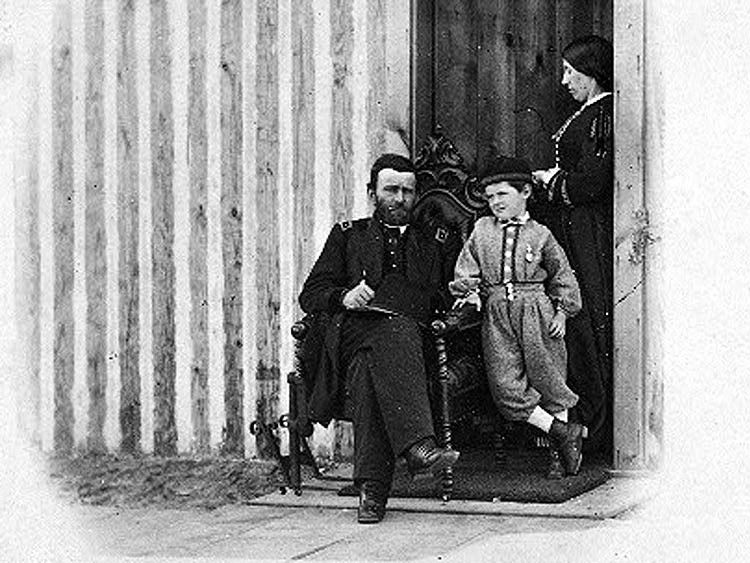
Grant, his son Fred and his wife Julia at City Point.


While Grant was at his labors, the lead Confederate agent, John Maxwell, left his companion behind and approached a barge, the J.E. Kendrick. From Maxwell’s report.

I approached cautiously the wharf, with my machine and powder covered by a small box. Finding the captain had come ashore from a barge then at the wharf, I seized the occasion to hurry forward with my box. Being halted by one of the wharf sentinels I succeeded in passing him by representing that the captain had ordered me to convey the box on board. Hailing a man from the barge I put the machine in motion and gave it in his charge. He carried it aboard.

The hapless man from the barge did not know that he’d just been handed–Maxwell’s “machine”—was a time bomb, packed with about twelve pounds of explosives. Maxwell and his accomplice did not know, since they were attempting both nonchalance and rapid flight at the same moment, that the box they’d delivered was now aboard an ammunition barge.


city-point-explosion-waud

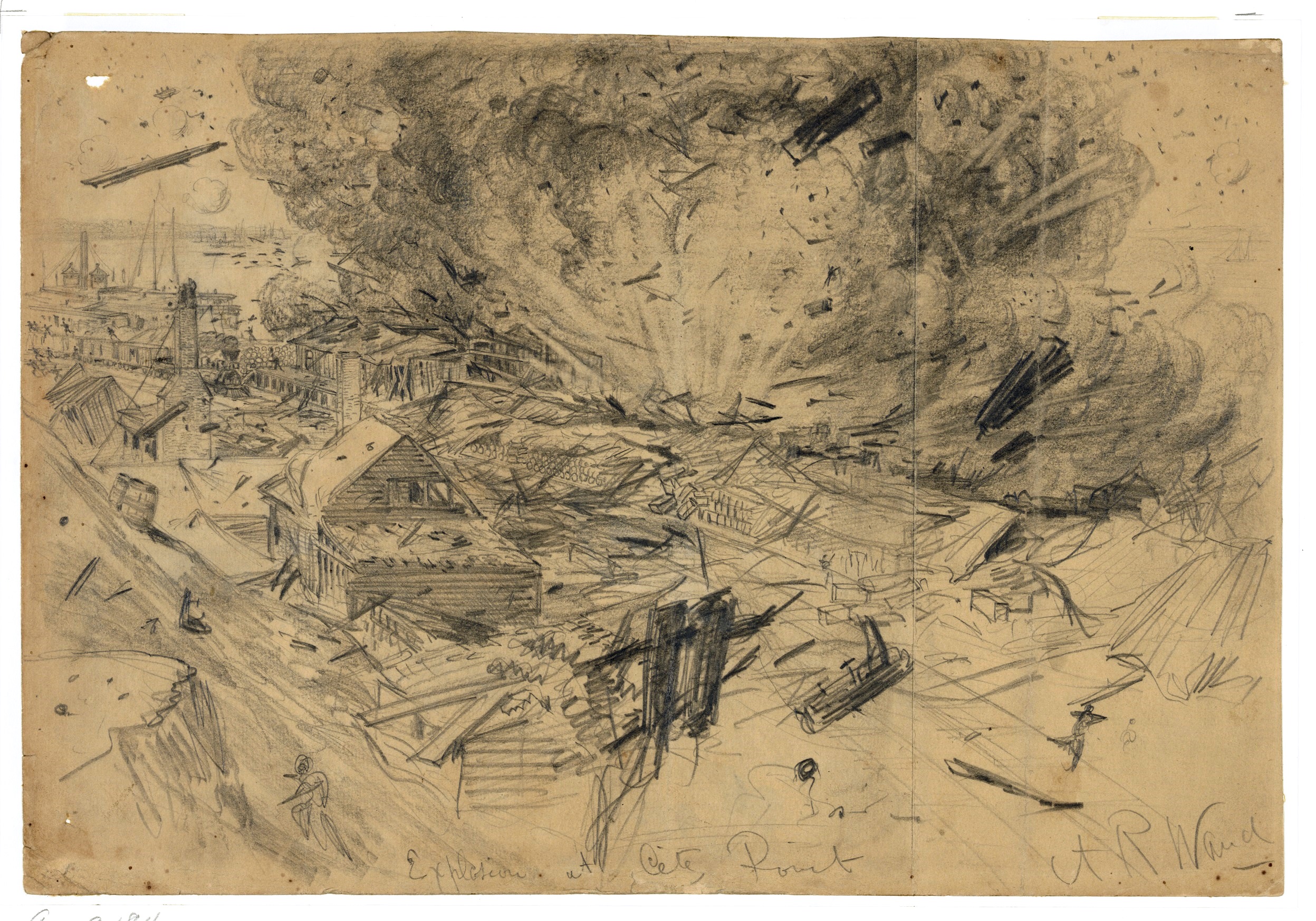
Artist’s conception of the August explosion.

What a Union soldier heard, ten miles away, in the trenches outside Petersburg, Virginia, was like a thunderclap. What a group of officers near Grant’s headquarters heard in the middle of their poker game was a cannonball ripping through the canvas of their tent, from one side to the other, after the explosion had sent it flying. What a soldier felt was immense pain at the sight of a white horse, on which a woman had been seated at the moment of the explosion. The woman was gone, and a Whitworth bolt—a shell from an artillery rifle—had gone through her horse, now standing, shivering in shock. The soldier held the muzzle of his rifle next to the animal’s head and fired. What a woman on a riverboat nearby felt was a dull thud on the deck beside her. She noticed it was a human head. She picked it up by its hair and placed it carefully in a fire bucket full of water. The only other person as nonplussed as she was Grant, who looked with concern after some slightly wounded staff officers, gave a few orders, and returned to his paperwork.

The barge Kendrick was gone, as was much of the City Point wharf. So were unknown numbers of contrabands, former slaves who were working for pay as stevedores. Three members of Monroe’s 148th Ohio were killed, along with forty other soldiers, clerks and civilians, and over a hundred were wounded. The disaster was deemed an accident—not until after the war would it be revealed that it had been the act of John Maxwell, who escaped.

Nine days later, the wharf at City Point had been rebuilt and was as busy as it had been in the moments before Maxwell’s bomb had detonated. What happened at City Point was a tragedy, but it did nothing to stop the industrial machine that would continue to grind the Confederacy down. George Monroe and the 148th Ohio would soon be headed home; Adam Bair, the soldier who would settle in the Huasna Valley, and his 60th Ohio were three-year men, not 100-day men, and so they were headed for wherever Robert E. Lee was headed.


Landscape

City Point after the explosion; damage can still be seen in the foreground.

Pvt. Martinez

Featured

Martinez


It is difficult to imagine Normandy in 1944; it is a beautiful place today, as are its people: a simple bonjour earns an American tourist a  smile of appreciation, and the little villages are lovely, separated by pastures and farm fields, each with its distinctive little parish church. During the Middle Ages, as the skilled writer and Francophile Graham Robb notes, few villagers ever went beyond the sound of their parish church’s bells. The world beyond was like the ends of the earth.

It is not the ends of the earth, but the D-Day beaches are 5,500 miles away from the Arroyo Grande Valley. Three local men, killed in the campaign to capture and then and break free from Normandy, are buried at the American Cemetery at Colleville-sur-Mer, an almost impossibly beautiful place above Omaha Beach.

Below the cemetery, just offshore, a visitor today can see young men as they should be—exuberant and free– as they race tiny sailboats, their sails bright oranges and reds, just beyond the surf line, where on June 6, young men floated like dead leaves on the water’s surface. The invasion of Hitler’s Europe nearly failed here. It didn’t, but only because of an American generation that includes those who still hold the high ground at Colleville-sur-Mer.

 

wpid-36189_1493079010696_3236651_n.jpg

Omaha Beach today.


Up there, on the immaculate cemetery grounds, and not far from a famous American—the ebullient and popular Gen. Theodore Roosevelt Jr., felled by a massive heart attack soon after the invasion– lies a soldier as far removed from the Roosevelts’ patrician (if rambunctious) Oyster Bay home as a human being can be, in terms of both distance and social class.

He was a farm worker, Pvt. Domingo Martinez: Plot C, Row 13, Grave 38. Martinez is the soldier who more than likely knew the bean-stakes and the smell of sweet peas of prewar Arroyo Grande. The best that can be said is “more than likely:” the Arroyo Grande Valley is where a farm worker, as he’s listed in his 1943 Army enlistment records, would have found a job, or a series of jobs, following different harvests, and migrant farm workers are elusive for both historians and for census-takers.

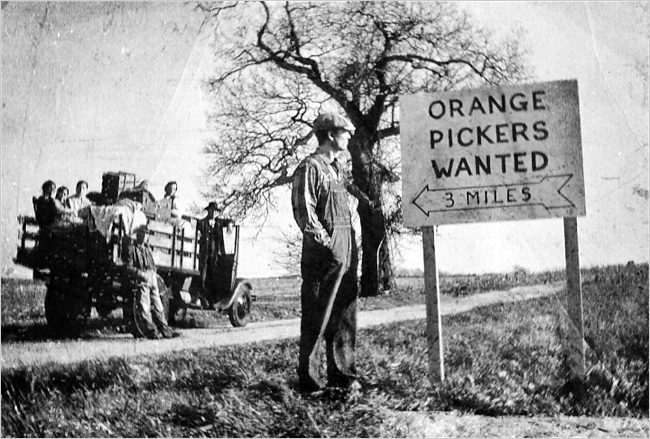
Domingo may even have been double-counted in the 1940 Census; there are two “Domingo R. Martinez” entries, both from New Mexico; one is living in San Miguel County, hit hard and recovering from the Dust Bowl; he is living with his father, Fulgencio; his mother is deceased. But a second Domingo R. Martinez, also originally from New Mexico, is counted in the same census, and in California. He is living in Redlands, picking oranges, with a man named Thomas listed as his father, and Thomas is married to Aliga Martinez.
 

grapes2


They must be different men. But “Aliga” Martinez is listed as “Aleja” in a postwar Redlands City Directory, and it is Aleja who will file the 1946 request for the marble cross that marks Domingo’s grave at Colleville-sur-Mer. The form lists Redlands as her hometown.

It is the measure of a poor man’s life: researchers can’t be certain of where he lived when the war broke out. They know exactly where he died.

Two more soldiers, city boys compared to Martinez, are honored here at the American Cemetery, both from the county seat just to the north, An artillery officer. 2nd Lt. Claude Newlin, from San Luis Obispo, is buried here. Ironically, Newlin’s battalion, attached to the 35th Infantry Division, had spent a year training at the camp just north of his home town. Newlin had survived some of the costliest fighting of the campaign, near St. Lo, only to die hours before the 35th broke out of Normandy to join George Patton’s breath-taking race across France to Metz and the German frontier.
 

4154150_f496

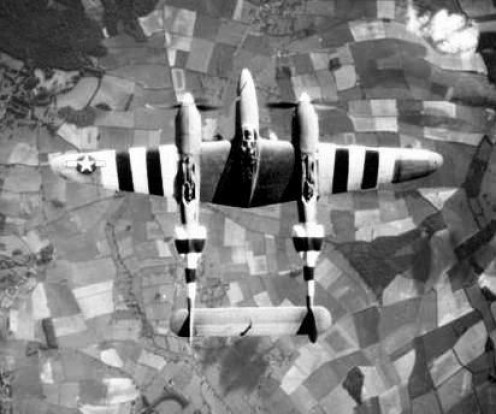
Lt. Jack Langston’s fighter would have looked like this P-38, with is distinctive D-Day identification stripes.


For another San Luis Obispo soldier, an airman, there is a memorial, but no grave. On June 22, 2nd Lt. Jack Langston was flying his P-38 in a low-level attack on Cherbourg with his 367th Fighter Squadron when that city demonstrated the folly of ordering low-level attacks. Langston died that day with four other 367th pilots. His body was never found.

The farm worker, Pvt. Martinez, 26 years old, born and raised in New Mexico, now a Californian, found himself  in the streets of Cherbourg in June 1944, far below the speeding fighter planes. Martinez was fighting with the 313th Regiment of the 79th Infantry Division, the “Cross of Lorraine Division”–their unit symbol had been St. Joan’s–and the 79th had seen hard fighting in France before, in 1918.

They were sent into action near Cherbourg soon after landing on Utah Beach, and they fought their way into the heart of the port city–a port the Allies would need, because a capricious Channel storm destroyed the “Mulberry,” the artificial harbor built off Omaha. The Allied armies in France therefore faced an enormous supply problem. They needed a port to help feed, arm, and fuel the growing numbers of Allied solders in France. For the Allied command, SHAEF, Cherbourg was critical.

It was also difficult to take. Its bristling anti-aircraft defenses would claim Jack Langston. Massive coastal batteries could keep naval support for the Americans at bay, and the city’s Wehrmacht defenders, though not elite troops (20% of them were non-German conscripts) were securely dug in and they had nowhere to go, for they were backed into a corner of France, and so isolated that the only alternative to fighting was to leap into the sea.

Once they’d gotten inside Cherbourg, G.I.’s learned to hate street fighting almost instantly. Death came instantly from illusory shadows that a fallen G.I.’s comrades never saw, and from gunfire they sometimes never heard. In peacetime, a French city block can be melodious with the sounds of cafe music or the singing of children at play. In combat, the same block, seemingly empty, can muffle the report of a sniper’s rifle or generate echoes that make soldiers look anxiously in every direction at once.
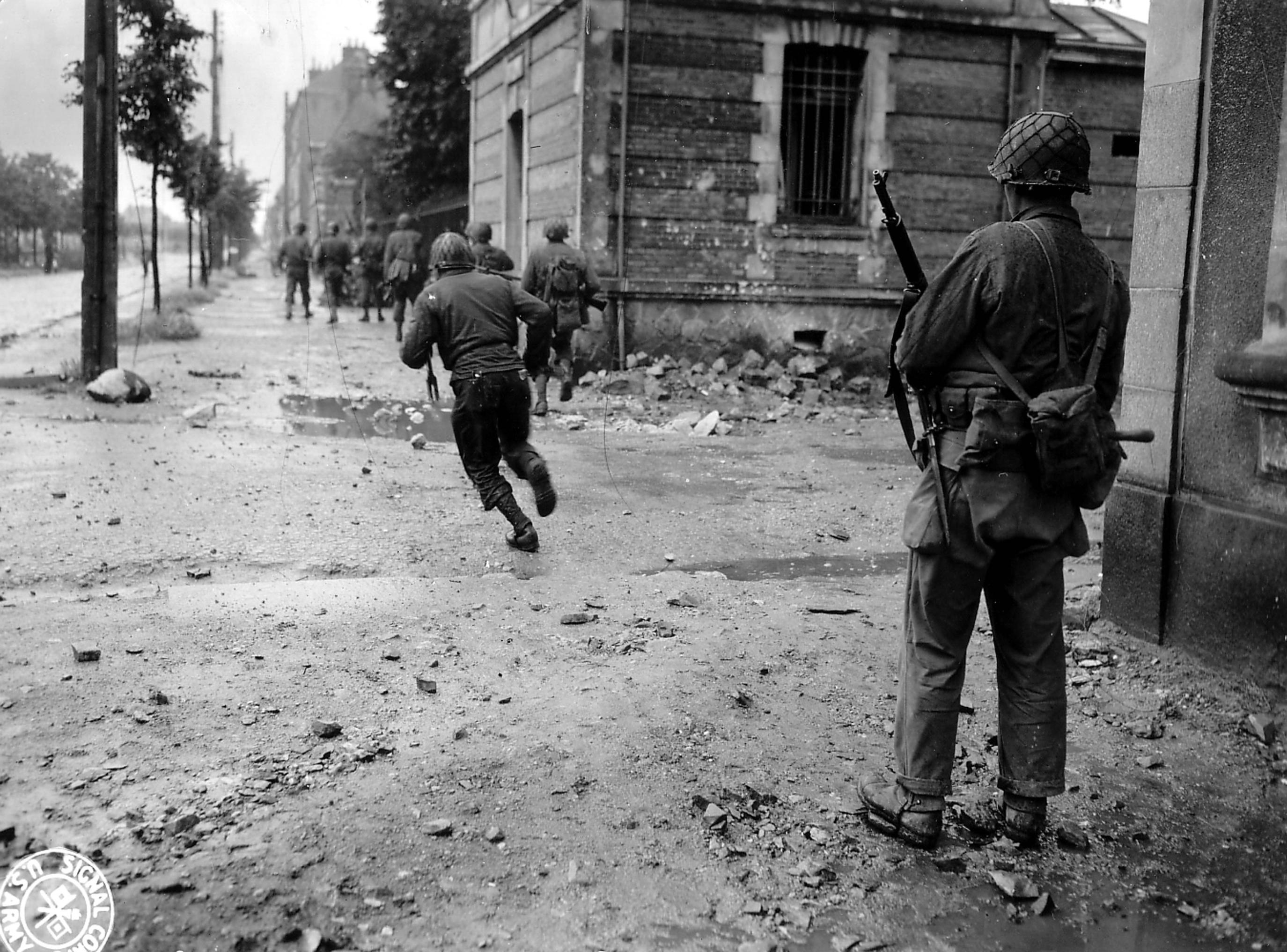
 

Street fighting, Cherbourg. These G.I.'s are from Martinez's 79th Division.

Street fighting, Cherbourg. These G.I.’s are from Martinez’s 79th Division.


It would be the 79th that would capture the fortress that dominated the city on June 26. Its commander surrendered three days later. Military historian John C . McManus notes that the men of the 79th that day were filthy, exhausted, and bearded, “like burlesque tramps,’ as one soldier said.  They got little rest. The division quickly shifted from urban combat to a drive through the farms and villages of the Cotentin Peninsula.

Now, American ground forces in Normandy faced a new, even more difficult challenge. Three weeks after D-Day, they had fallen far short of the objectives set for them by Allied planners and the staff officers working furiously over maps in Gen. Omar Bradley’s custom command trailer. The offensive in the Cotentin stalled in great part because the Germans had the advantage of fighting defensively, in the bocage, the Norman hedgerows, and they winnowed units like the 79th down.
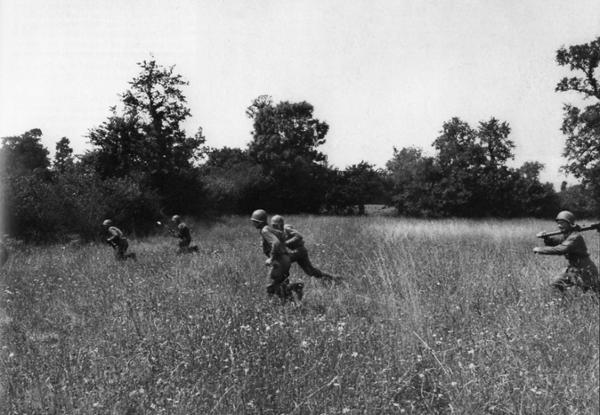
 

NM5204

79th Division GIs sprint across a field bound by hedgerows.


The hedgerows enclosed fields plowed since Agincourt, or pasturage for fat Norman cows, and were a hopscotch of natural fortresses—roots and compacted earth had formed defensible walls.  The G.I.’s had to assault them, one by one, to try to root the defenders out.

When G.I.’s broke through a hedge and entered a field, the superb German machine gun, the MG42, hidden in the next hedge beyond, or positioned on the Americans’ flanks, annihilated entire rifle squads. It fired so rapidly that a burst sounded like canvas ripping.  Army films had incorporated the sound to try to desensitize trainees.
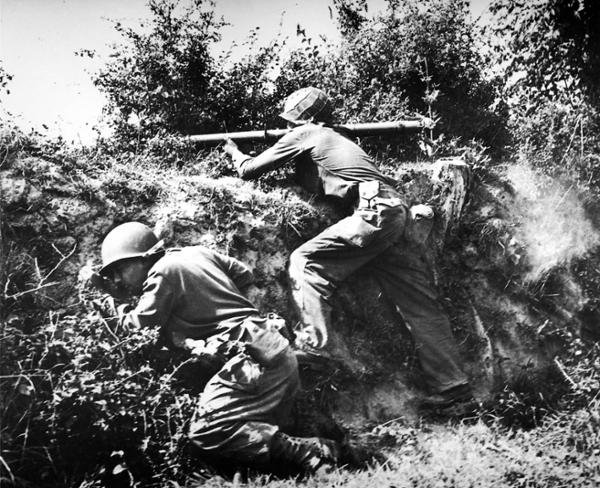
 

NM5093

Fighting in the bocage:  A 79th infantryman fires a bazooka.


So the Americans could hear, but never see, in the tangle of the hedges, who was killing them so efficiently. The bocage quickly transformed G.I.s, with supreme indifference, into either hardened veterans or into statistics.

American soldiers, adaptive and imaginative, eventually would develop the tactics to overcome the kind of war the Germans fought in the bocage. For the 79th, in early July, what was beyond the hedgerows may have been worse. The Germans would not wait for them this time.  They would attack.  This came soon after the 79th, along with the 82nd Airborne and the 90th Infantry Divisions, seized, at great cost, several hills around a key crossroads, Le Haye du Puits.

This should have compelled the enemy to abandon the town. They didn’t. They attacked instead, on July 7, intent on destroying the 79th in their positions on a ridge above the town.  The German soldiers, including SS-Panzer units, attacked with great ferocity and with great courage. These were not garrison troops, but hardened and determined professionals. In a day of fighting that ended only at nightfall, the 79th stopped them. This was the turning point. On the next day, another day of street fighting, the Americans would capture Le Haye du Puits.
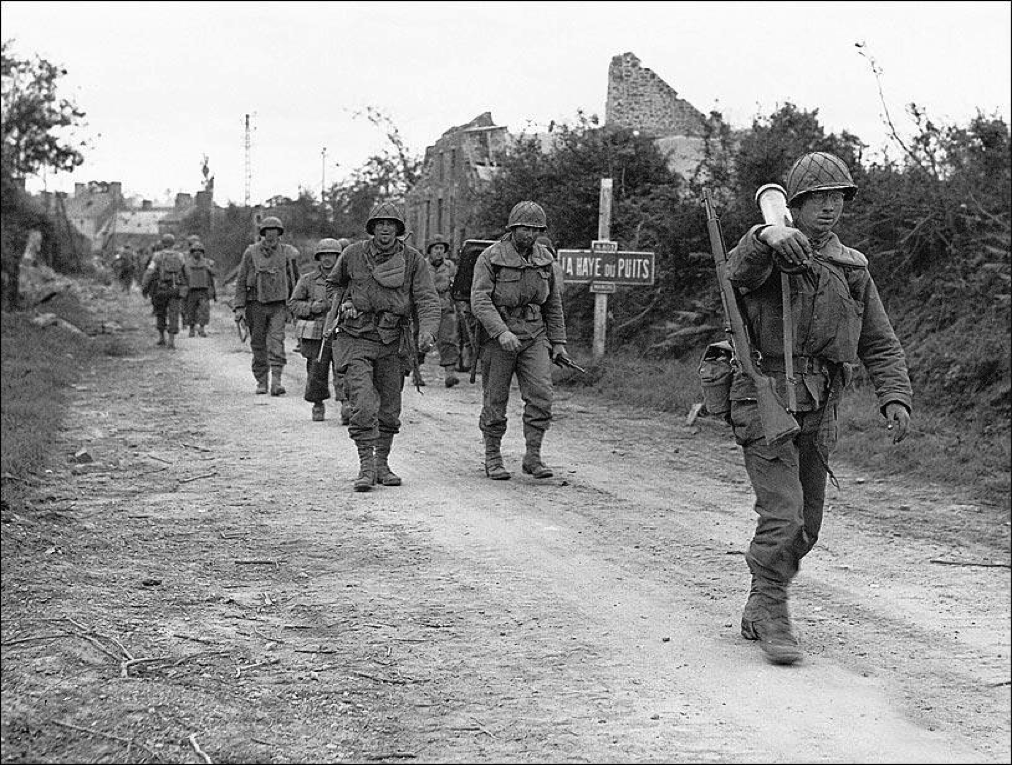
 

Le Haye de Puits

Le Haye du Puits is secured. The lead 79th division GI his carrying a mortar tube; one soldier behind him is carrying the mortar’s baseplate on his back.


Afterward, Signal Corps photographers attached to the 79th captured the images of some soldiers, like patrons arrived for their dinner reservation, enjoying a bottle of wine, sitting around a restaurant table set up on the street outside a partly-destroyed building; other photos reveal the faces of men as blank as those of sleepwalkers.  They are utterly worn out, used up,  by a month of ceaseless combat.
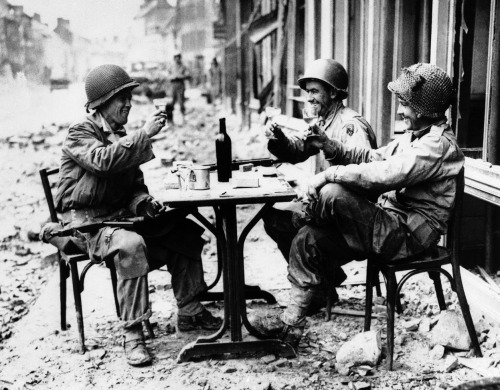
 

tumblr_n8xcs6euCD1rcoy9ro1_500

Le Haye du Puits, July 1944


Ironically, Domingo Martinez survived all this and was killed days later, after the division, including his 313th Regiment, had taken up defensive positions to regather itself. He died on July 12, near a village named Bolleville, and so would not experience the energy and the jubilation of the breakout from the bocage.

With the breakout at month’s end, the Americans would inexorably roll up the Germans, uncover Paris, and liberate the city in August, standing aside to let Free French units and their prickly commander, Gen. Leclerc, enter first. Leclerc would have been furious to learn that Ernest Hemingway and some of his camp followers had preceded him and they were, with great offensive spirit, but also with deteriorating unit cohesion, busy liberating the bar at the Ritz Hotel.
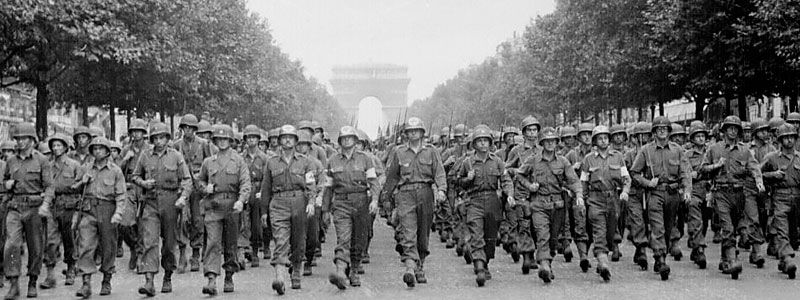
 

gal_artifacts_krations_03

GI’s on parade, Paris, August 1944. These soldiers, from the 28th Infantry Division, marched directly out of Paris and back into combat.


It’s hard not to wish that Pvt. Martinez had been granted at least time enough to celebrate, as well.  And maybe, for a migrant farm worker and Dust Bowl refugee, even more time than that.

It is hard not to wish Domingo Martinez the time for a quiet talk with a little granddaughter. She is wearing a crisp white dress–it might be her First Communion– and wide-eyed and attentive, she is looking up at him while they are sitting, nestled together–she is feeling the wonderful safety that a grandfather’s love can provide– on the sofa. They are waiting together for the Sunday lunch his daughters are preparing after Mass, and he is telling the little girl about the five-day leave granted him that summer of 1944.
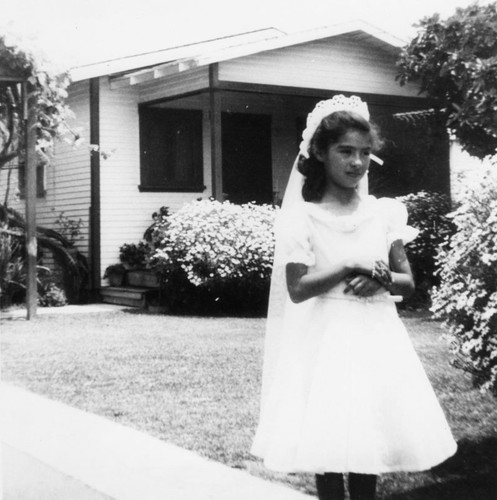
 

d8ce8cd1321cf29a626176be44aaf56a


He decided to visit Notre Dame. Once he’d entered the great church, he took his garrison cap off, crossed himself with holy water, and walked slowly down the nave, the silence pressing on his ears, past the clutter of the pews. There, delighted, he stopped and stood on a spot near the transept where he was suddenly bathed in brilliant, colored sunlight. This is the Rose Window’s gift to men and women of good faith.

 

stained_glass_rose_window_at_notre_dame_by_angela6331-d5pq0uy

An Oceano Sailor in Harm’s Way, 1944

Tags

, , , , , ,

Aerial photograph of Pearl Harbor’s West Loch, showing the burning LSTs at berths T-8 and T-9. Some LSTs are manuevering in the foreground, leaving the vicinity of the explosions and fire, while other ships have yet to get underway. Official U.S. Navy Photograph, now in the collections of the National Archives.

My Facebook friend Shannon Ratliff-Evans keeps a faithful record of Arroyo Grande High School Eagles who have passed on. I noted today this article she posted from the local weekly, probably from 1943, citing this sailor from the high school class of 1941, the last peacetime class for four years:


I had to find out more. I’m nosy that way.

Here’s Frank’s draft card (his father, as the article notes, had died by then: Knute was a Swedish immigrant, but Frank’s mother was a Californian)


After his time at Farragut–named for a Civil War admiral–Frank would be sent to another landlocked place, Ames, Iowa, home of Iowa State University, for specialized training as a mechanic.


After this, Frank would go to war. I was hoping he would see service on a carrier or a cruiser or a destroyer. No. His skills sent him to the Landing Craft Unit 34 at the Waipo Amphibious Operating Base, on a peninsula bounded by Pearl Harbor’s West Loch. So, if Frank wasn’t steaming into action against the Imperial Navy, he was doing something just as important: helping to train servicemen and maintain landing craft in preparation for the costly landings across the Central Pacific in 1944-45.
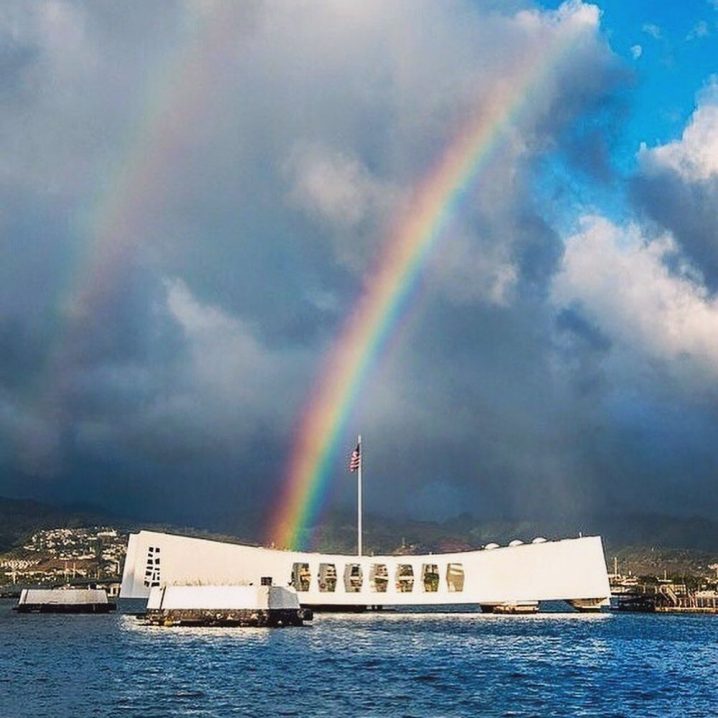
Among the craft at Waipo:


Amphibious tractors in the foreground as fires rage along the West Loch, May 1944.

According to U.S. Navy Muster Rolls, Frank (at the bottom, below) reported to Waipo in April 1944. He would be stationed there until the end of the war. But it only took a month for the war to come to him.


In May 1944, Unit 34 would have been preparing sailors, Coast Guardsmen and Marines for the invasion of the Marianas Islands, which included the horrific Battle of Saipan. The invading Marines included Archie Harloe, the son of the Arroyo Grande schoolteacher, and some of them witnessed civilians, convinced that the Americans would torture them, leaping to their deaths from sea cliffs.

Had the people who committed suicide waited, they would’ve met Americans like this one: A Marine shares food with a Saipanese child.


That was in June. Another tragedy–this one at Waipo–preceded Saipan’s. On May 21, 1944, the West Loch, in preparation for the Marianas, was packed with the big ships, the LST’s. Mortar ammunition was being transferred to one of them when a mortar round either fell or was detonated by gasoline vapors, The resultant explosion was massive, but not as massive as the second explosion, which showered the LST’s with burning debris, which in turn set off aviation fuel and ammunition.

The fires burned for twenty-four hours. Six LST’s were destroyed. One of them, LST-480, remains alongside the West Loch today:


The official Navy casualty list cites 163 killed. That is almost certainly an underestimate. It may not reflect the deaths of Marines from the 2nd and 4th Divisions and soldiers from Schofield Barracks acting as stevedores at Waipo. Some estimates put the deaths at 1,000 young Americans.

Frank Lofquist was there, and, as fate would have it, he would live a long life–he died, at eighty, in 2003. I’ll post below a video of some South County sailors and their ships, but it occurred to me that Lofquist’s service at Pearl Harbor was just as important, and, since I just learned about the West Loch disaster, almost as dangerous.

Using the World War II Army ratio, for every American combat soldier, there were 4.3 support troops (like my father, a quartermaster officer who sent gasoline supply companies to Omaha Beach, and like Lofquist). World War II was their war, too.

Thank you for your service, Frank Hugo Lofquist.

An LST takes on wounded Marines at Iwo Jima, March 1945, where Arroyo Grande Marine Louis Brown was killed three days short of his 21st birthday.


It was Lofquist’s war, and, of course, it was the war of the Black sailors at Port Chicago, near San Francisco. An explosion there three months later killed at least 320 of them, detailed as stevedores, when an ammunition ship blew up. What happened after is another story that needs to be retold every few years.


Cuter than bug’s ears

The MonaLisa Twins really are twins, fraternal sisters born in Austria—I think in Vienna. Their Dad , Rudolf, Wagner, is a Boomer, like me, taught the girls his love for playing music and his love for British Invasion music. The girls inherited both loves and, as young women, are the featured act in The Cavern Club, a Liverpool pub that duplicates the Hamburg Cavern where the four lads first made a big splash.

So they do Beatles. Like this:


And this:


They do Revolver:

They do Rubber Soul:


They let old guys onstage for one of my favorite Beatles songs:


They do Hollies.


And they cover one of my favorite one-hit wonders:

So,, if bug’s ears are cute, these two are. They are also great fun. And, no, I haven’t yet figured out which is Mona and which is Lisa


P.S. There’s “cute” and then there’s “beautiful.” Like this:


Kash Patel’s dive on USS Arizona

Wayne Morgan, top, and Jack Scruggs, bottom, as second-graders in Arroyo Grande, California. On the right: Electrician’s Mate 3c Charles Taylor, killed, missing in action, USS Arizona.

There was something terribly morbid and terribly wrong about FBI Director Kash Patel’s VIP snorkeling dive on USS Arizona. It’s yet one more example of this administration’s casual indecency.

I take it personally, and this is why.

Two sailors who died on Arizona were from my hometown, Arroyo Grande, population 1,090 in the 1940 Census. Wayne Morgan and Jack Scruggs had been second-grade classmates in Arroyo Grande in 1932.

Arizona’s destruction had a tragic impact here: 25 of the 58 seniors in the high school’s Class of 1942 were Nisei, or second-generation Japanese. On April 30, 1942, they were taken away to be incarcerated in the Arizona desert. Many never came back.

More than eighty years later, Project 85 is devoted to using refined DNA science to identify the battleship’s casualties. Many of the unidentified sailors and Marines were buried, some in mass graves, in the Punchbowl Cemetery on Oahu.

In December, those remains will be disinterred for DNA testing.

I just sent Project 85 a sample of my DNA. An Arizona sailor, Electrician’s Mate 3c Charles B. Taylor, is my cousin—we share a common grandfather—and, God willing, they might find him so that my family can bring him home.

“Home” would be the Boone Creek Cemetery in Missouri. His mother, my Aunt Aggie, is buried there, along with Charles A. Taylor, the sailor’s father. Despondent over his lost son, in July 1942, Charles A. Taylor walked out to the middle of one of his farm fields, put a .22 rifle to his heart, and pulled the trigger. Aggie Gregory Taylor carried the burden of those losses for the rest of her life, for thirty-eight years.

We got Christmas cards from her, and my dad a birthday card, every one of those years.


So, yes, Kash Patel, in my mind, you had no right to your little “joy dive.”


A poignant look inside postwar Japan

My knowledge of Japanese cinema pretty much begins with “Seven Samurai” and ends with “Rashomon.”

Director Yasujirō Ozu knew–directing, in the hat, above, knew to compose a frame, as John Ford did. Ozu’s, framed by Japanese interior screens, are particularly intimate. And, unlike Ford, he was much more understanding of women–his women were lovely, and they register emotion, including deep anger–and he worked particularly well with children. With children, he liked to include fart jokes in their scenes. I am okay with that.

That’s a good thing, because much of his work–he died in 1963–was focused on postwar Japanese families, bewildered and drifting apart in a sea of social change.

It reminded me of a song that played a lot on KSLY, our San Luis Obispo County, California, AM station in 1963, with the Americanized title “Sukiyaki.”

But it’s a song about the kind of loss that Ozu addressed. The lyrics follow the excerpt from his performance.

The singer, Kyo Sakomoto, born three days after Pearl Harbor, was killed in the 1985 crash of Japan Airlines Flight 123. It was the worst single-airplane accident in history; claiming the lives of 520 passengers and crew.

Hey! Let’s arrest some aliens!

Tags

, , ,

A mother and child are taken into custody, May 2025, Worcester, Massachusetts


Terrific talk this morning by historian Naomi Shibata about the Japanese–Nikkei– immigrant experience before, during and after World War II.

Her grandfather, Tameji Eto, farmed the Los Osos Valley. He was still in his work clothes, about to go to bed, when a knock on the door roused him about ten at night on December 7, 1941.

It was the sheriff and two FBI agents. They just wanted for him to come along for a few questions.

Mr. Eto asked them to wait for a few moments. He left the room and changed into his suit–it was a sign of respect for authority, including the three men inside his home.

On the way out the door, one of the FBI agents said, “you may want to bring your coat.”

Eto was bound for a prison camp for “enemy aliens” in Missoula, Montana. He spent a week or so first in the Santa Barbara County Jail.

He was allowed to tell his family where he was headed–his train would come through San Luis– but he had no clothes. Certainly, no clothes for Missoula, Montana, in December.

The family contacted Mr. Sinsheimer, who opened his store in the middle of the night so they could find some warm clothing. I’m pretty sure he told them to pay him later.

They were waiting at the SLO train station, with their purchases wrapped in paper and twine, for Tameji’s train. They waited all night.

It had been re-routed.

* * *

Vard Loomis, so deservedly lauded for the support he gave to the South County interned, made sure the property taxes on the Eto family’s farm were paid on time.

* * *

The FBI picked up Eto and, here, in Arroyo Grande, men like Shig Kobara, because they were successful men perceived as natural leaders. The aim was to decapitate Nikkei leadership. That would make the enforcement of 9066, five months later, a little easier.

* * *

Shibata made a stunning point about Executive Order 9066, which ordered the removal of “all alien and non-alien” Japanese. She found that a curious passage.

What do you call a “non-alien?” she asked the audience.

“An American citizen,” a man called from the back of the room.

* * *

Mr. Eto’s son-in-law, Leo Kikuchi, was killed in action in Italy. Here, in the South County, Arroyo Grande farmworker Sadami Fujita was killed in action in France.

They were American citizens.

Making omelets at 3 a.m.

Tags

, , , ,

By golly, that’s not bad. A 2 1/2 egg omelet (eggs and egg whites) with cheese, sauteed bacon, peppers, mushrooms and red onions. I made three of ’em for Elizabeth and our sons. The magic ingredient is that truffle spice. It goes on the inside. Parsley flakes on the outside. Ciabatta bread with avocado spread added to the omelet.

I think I’m up because I have a meningioma, a benign tumor attached to the brain lining, and that’s a common side effect. I have at least two sleepless nights a week.

My brain.


I’m having surgery at Stanford in June to remove what I call Manny the Meningioma, so I’m sure anxiety plays a part.

But why waste a sleepless night? So I make omelets. And I watch movies on Turner Classic Movies. Tonight it was this one.

To be truthful, it wasn’t all that good. The lead, Shirley Knight, is very attractive, a woman running away from her husband in a Ford Galaxy station wagon the size of USS Nimitz, so it’s kind of a road picture like so many from the late 60s and early70s—Easy Rider, Vanishing Point, Sugarland Express, but not, say Rosemary’s Baby.

I kept watching it because she befriends James Caan, as an ex-football player with traumatic brain injury. Right up my alley. And, in mid-movie, Robert Duvall appears as a motorcycle cop who woos Knight. Not well.

It was pretty thin soup, but it kind of compelling, too. Then, at the end of the film, TCM host Ben Manciewicz informed us that the director (his fourth film) was Francis Ford Coppola.

Wowsers.

I don’t know what Wheaties Coppola ate in the next three years (maybe it was omelets?), but he gave us, with Caan and Duvall, The Godfather in 1972.

A quantum leap. Casablanca is the only film I’ve watched more than The Godfather.

And seeing Caan and Duvall, no longer with us, as young actors was an honor. I miss them.

Now go out and buy some truffle spice.


My USS Arizona cousin

I thought this was kind of cool, in an immensely somber way.

Our grandfather, John Smith Gregory (1862-1933) may help to find his lost grandson.

*  *  *

Yesterday, I contacted an organization in Hawaii in the hope of identifying Wayne Morgan, one of two Arroyo Grande sailors killed on the ship on December 7, 1941.

Some of the victims, unidentified, were buried onshore and new DNA techniques make their identification possible.I got the most thoughtful reply from the group, called Project 85, this morning. Evidently, the DNA trail for Morgan has run out–not enough living relatives. Damn.

However, they asked me if I’d like to donate a sample to potentially identify Electrician’s Mate 2c Charles Taylor, an Arizona sailor from Rock Island, Illinois.

He’s my cousin. We share a common grandfather; his mother was my Aunt Aggie.

Sadly, his father took his own life seven months after Pearl Harbor.

I was just told by telephone that my DNA would be a close enough match, and they’re sending me a DNA swab kit.

I am deeply touched.


Arizona in the van, 1930s.


World War II took a toll on my father’s family. Like Charles B. Taylor, Roy Gregory was his nephew—and my cousin.

Homage to the last Ronette

Nedra Talley Ross, the last Ronette, has passed away. Here they are performing “Be My Baby,” 1963.


Wow.

I loved those girl groups, even if I as only ten or eleven. When a song of their came on the local AM station, KSLY, I couldn’t help but dance along, if nobody was looking.

Love the Big Hair, too.

What the Ronettes did was to pave the way for other girl groups, just as electric, especially if they were from Motown. For example:

Double Wow!

And, of course, The Supremes. That little hip-check thing they do in this 1965 video is devastating.


Paris, 1965. This one makes me a little nervous.

One of the best song titles ever.


The Chiffons, 1963.


The Shirelles. Pretty darned sexy song. And the lead singer, Shirley Alton Reeves, is beautiful.


And, damn, I am old. I don’t think that’s true of the music.

Donald Trump has cost us this, too…

This is what the president* has cost us. These are World War II reenactors.

The people in the first two photos are French.

Those in the second two are British.

They want to play heroes, and to honor them, too. So they chose us.

When Amber Derbidge and I took AGHS kids to northern France, a Frenchwoman insisted on giving us a tour of the Rouen Cathedral simply because we were Americans.

When AGHS German teacher Mark Kamin took his students to Bavaria, an older woman approached the group with tears in her eyes.

“Your soldiers,” she said, “were so kind to me when I was a little girl. I just wanted to thank you.”

A little Berlin girl meets her first Yank, a soldier with the army of occupation, 1945.

How to write a letter of complaint

Dear [redacted]

Can you kindly inform your creative team, the creators of “Don’t Look in the Fridge?” that they are soulless assholes?

Doubtless, all of them are far too young–and far too ignorant– to remember Jeffrey Dahmer (below) who, thankfully, was beaten to death by a fellow inmate, with workout weights, in 1994.

Dahmer killed at least 17 young men and stored their body parts, on which he sometimes dined, in his fridge and freezer.

Your commercial is not funny, is not “darkly humorous,” nor is it clever. It’s not even Dexteresque or Lecteresque. It is mean-spirited and inept. Most of all, it’s reprehensible.

Jim Gregory

Who used to eat Cinnamon Toast Crunch on occasion.