
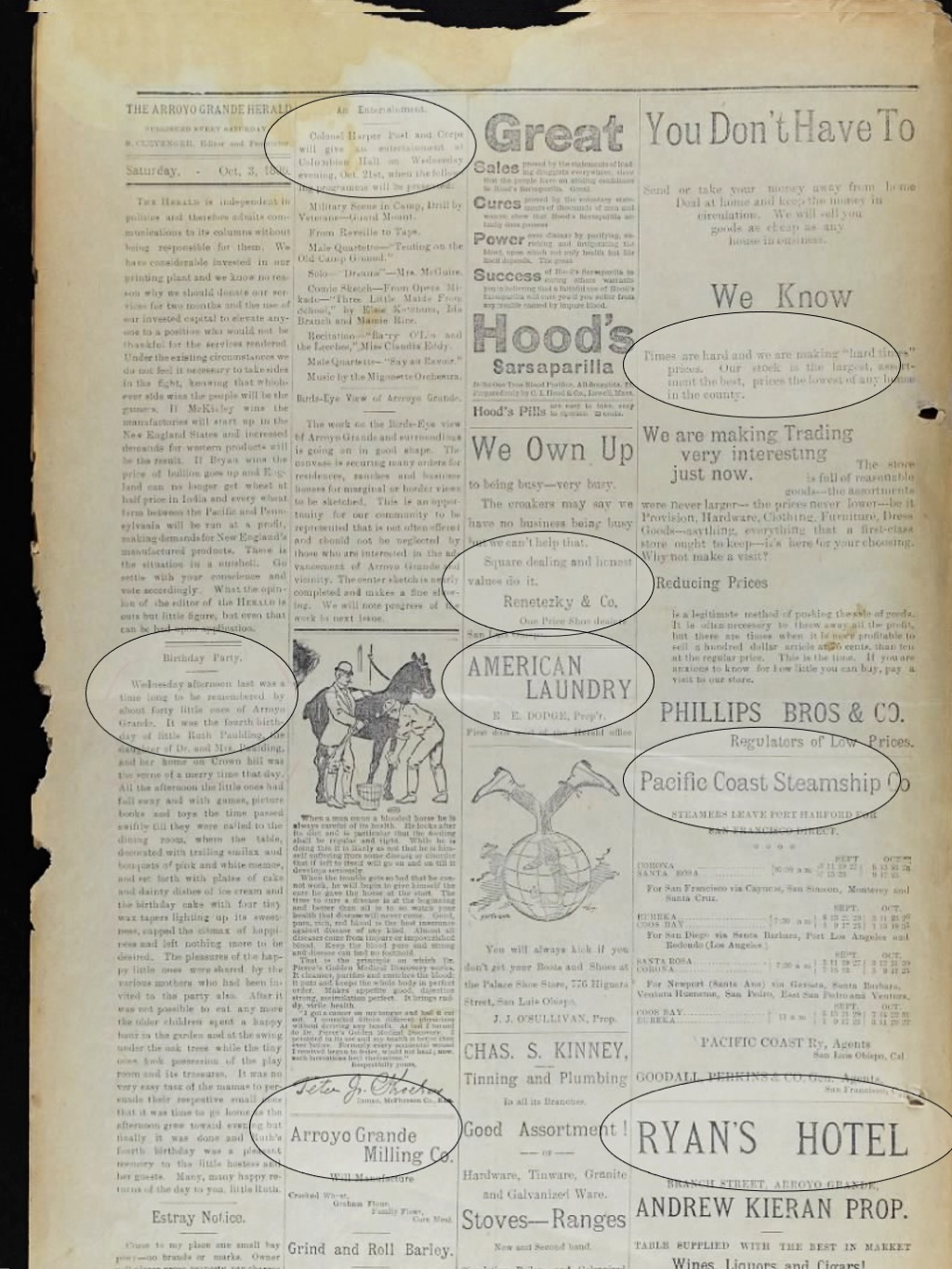
A kind of glossary to a page from the October 3, 1896 Arroyo Grande Herald, the town’s weekly.
Birthday Party: Ruth Paulding was the daughter of Dr. Ed Paulding and Mrs. Clara Paulding, who taught in local schools for forty years. Clara was a Force of Nature. Like her mother, Ruth became a teacher. She taught languages at Arroyo Grande Union High School, just across the street from where Ruth lived nearly her entire life (1892-1985). Ruth was much-loved by her students; the middle school is named for her.
“An Entertainment:” The Col. Harper Corps was the local chapter of Union Civil War veterans, the Grand Army of the Republic. Nearly sixty veterans are buried in the local cemetery (four fought at Gettysburg; one, Otis Smith, was awarded a Medal of Honor after the 1864 Battle of Nashville). The “Columbian Hall” was a steepled assembly/lecture/concert hall on Branch Street, later disassembled and moved to become the IDES (“Portuguese”) Hall. A new hall was built in 1948 but the floor remains from the 19th-century Columbian Hall.
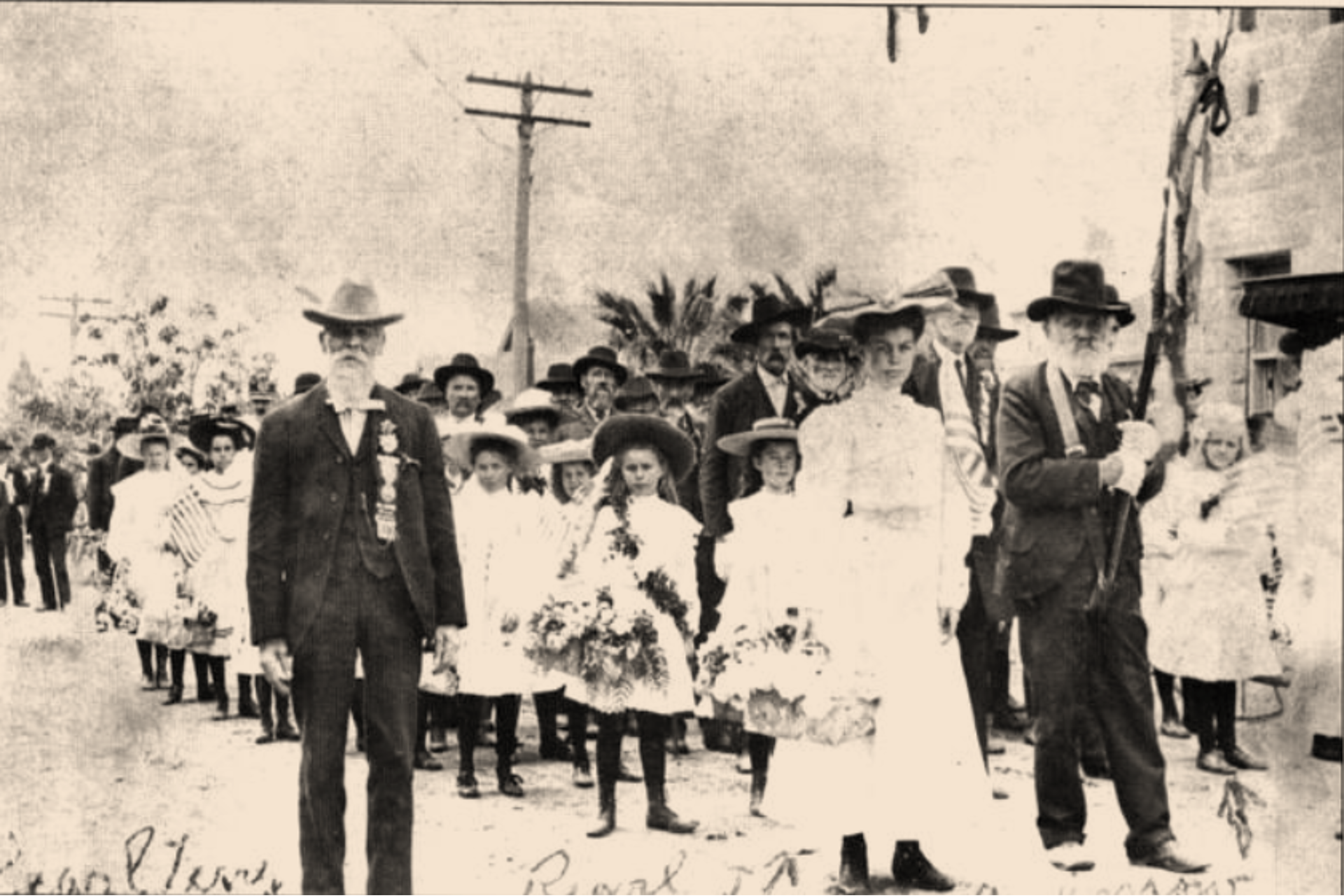
Arroyo Grande Milling: Newton Short, who built the Swinging Bridge, operated this mill behind Branch Street along the creek. Barley was a big crop in the interior of San Luis Obispo County so this must’ve been a nice source of income for Mr. Short, also a farmer. The mill was later sold to the Loomis family—like the Shorts, an important part of Arroyo Grande history. Barley, of course, was an important component in animal feed and in beer, the fluid that floated the six saloons at or near the corner of Branch and Bridge Streets in 1903. (One more in 1906. See below.)
Renetzky and Co.: This family was related to the Dana family, whose patriarch, William G. Dana, founded Rancho Nipomo. Dana, Francis Branch, John Michael Price and Isaac Sparks were the “Big Four” rancheros in the South County. Joanna Renetzky, schoolteacher, would later marry Clair Abbott Tyler of Morro Bay at the Old Mission; Alex Madonna was Clair’s best man. In 1943, Lt. Clair Abbott Tyler was killed in his co-pilot’s seat by cannon fire from the German fighter that brought his B-17 down after a raid on the sub pen complex at Lorient.
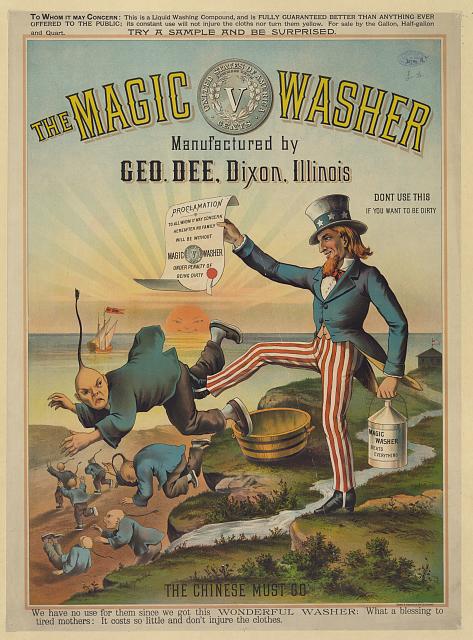
American Laundry: This is ominous. The name implies that this is not a Chinese laundry at a time when anti-Chinese bigotry was common. Masked men had driven Chinese residents out of Arroyo Grande in February 1886, only about six weeks before masked men lynched the Hemmis, father and son, suspected killers, from the railway trestle at the foot of Crown Hill. Meanwhile, there was an attempt to dynamite Sam Yee’s laundry in San Luis Obispo and an even less-subtle rival laundry was formed there: The Caucasian Steam Laundry. The notorious ad below, from about 1886, suggests that buying this detergent will help drive Chinese immigrants out of business and so out of America.
“Hard Times:” The Phillips Brothers operated the store, from about 1895, now occupied by Bill’s Place on Branch Street. The reference is to the Panic of 1893, a severe depression that persisted into 1897 and was a centerpiece in this year’s presidential campaign between William McKinley and the Democratic/Populist candidate, William Jennings Bryan.
Pacific Coast Steamship Company: The railway had a spur that ended at the end of the Port Harford (Avila) pier; before the completion of the Southern Pacific, the best way to travel to San Francisco or Los Angeles was by steamship, at least one operated by Capt. Marcus Harloe, the father-in-law of longtime schoolteacher Margaret Harloe, herself from another prominent family, the Phoenix family. Margaret married Capt. Harloe’s son, Archie. (Archie’s mom was Manuela Sparks, from the Huasna Rancho family, a working ranch today still run by Isaac Sparks’s descendants, the Porters.)
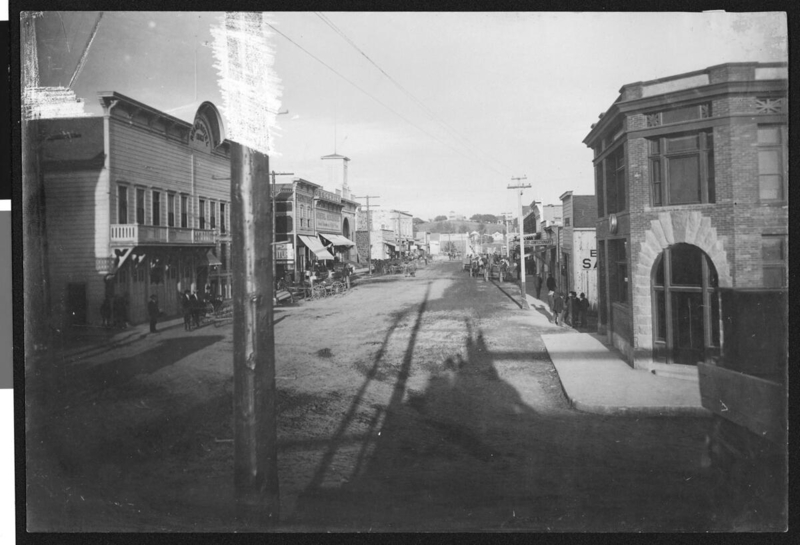
Ryan’s Hotel: Built in 1873, roughly on the site occupied today by Village Grill and the adjacent parking lot. A pretty classy place for its time, with a restaurant, barber, full-service bar, pool room and, in the back, a stable where stagecoaches changed teams. The Ryan is on the left in the photo of Branch Street from about 1906; the steepled building just up the street is the Columbian Hall; Crown Hill, where Ruth Paulding grew up and the high school was built, is in the distance, at the end of Branch Street. On the right side of the photo is the just-completed Bank of Arroyo Grande; the Bank Saloon would have made it seven saloons at or near this street corner. One of them, The Eagle, is just beyond the bank building. The Capitol Saloon stood across the street, just out of the picture frame, at left. Town policeman Henry Lewellyn was shot in the Capitol doorway in 1904; he died the next day in a room at the Ryan.
 A Work in Progress