

I can’t tell you how much I love this song. I was doing some local history research when I made a connection with Pan American extending its routes into Rio in the early 1930s, at the same time that Halcyon’s Sigurd Varian was flying seaplanes into Mexico and Central America.
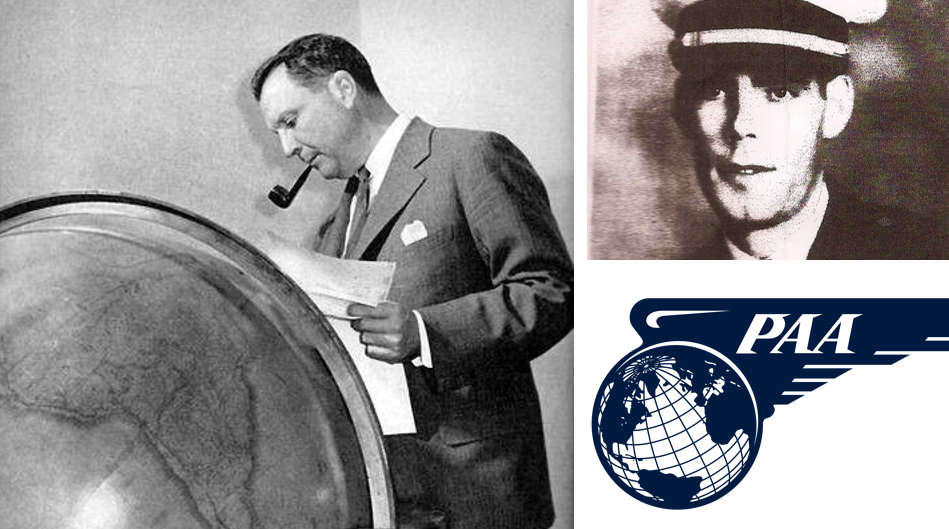

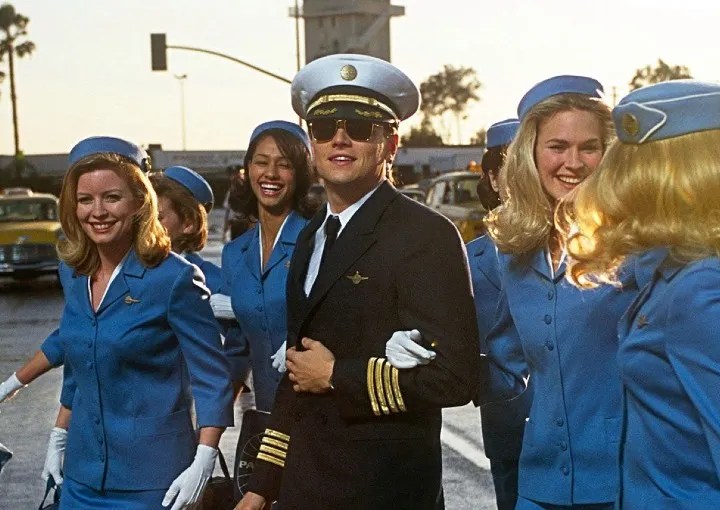
Above: Juan Trippe, a handsome Sigurd Varian at upper right; Alec Baldwin as Trippe in Scocese’s The Aviator; Leo Dicaprio, in the film that changed by mind about Leo Dicaprio (I loved this performance, and his Howard Hughes was several notches higher), as a bogus Pan Am pilot in Catch Me If You Can.
“Mas, Que Nada” (roughly translated: “So WHAT?”) was first performed by Jorge Ben in 1962.
Sergio Mendes and Brasil ’66, a group I still love, quickened the tempo and made the song a big hit.
It’s such an infectious, happy song. I like this version, very close to that of Brasil ’66:
But the “Playing for Change” people do a marvelous version, as well, a little downtempo and likely closer to the song’s original version (if you’re down in the dumps, may I also recommend, from Playing for Change, “Guantanamera,” Cuban, and “La Bamba,” Mexican.)
There’s even a choral version. I like this one. Dang, they’re cute. (They also do a fine version of Annie Lennox’s “Walking on Broken Glass.”)
Finally, this is my favorite version. I can’t tell you how many times I’ve posted this on Facebook and then taken it down, lest I be accused of being a dirty old man, a label I cannot abide. Nossa is a French group, and they are gorgeous and sexy (equal time: so’s the young man wo pursues them through Rio alleys). But this video makes me happy, because they are beautiful, but they’re not the most beautiful element of the video.
The street dancing scene, albeit brief, is the beautiful part. There’s a little girl, about twelve, multiracial, learning the dance’s elbow moves, then there’s a a young Black man, a dancer, with tight curls, whose smile is ebullient. Because the Nossas are so glamorous, the camera doesn’t stray from them for too long. It’s those two minor players, however, who generate inside me little waves of volcanic joy.
We’re struggling just now with the idea of being a multiracial society. So has Brazil struggled.
Among the immigrant families that have enriched Arroyo Grande history are the Coehlos, from Brazil. Growing up with them has enriched my life immensely. And, as beautiful as Nossa is, they are no match for Mrs. Coehlo, maybe the most beautiful woman, along with my Mom, that I’ve ever known.
She, born in Rio, like her husband, Al, used to drive by our house on Huasna Road in a navy-over-powder blue 1954 Cadillac (Mr. Coehlo, a farmer, did well because he worked so hard) and the eight-year-old me would run out to the front yard to wave to her. I was a hopeless Romantic even then.
So this video, and this song, make me happy. Seeing Mrs. Coehlo made me happy. This song, that place, that family, that mother, refresh the waters that are my hope.
 A Work in Progress