Arroyo Grande’s Japanese-Americans and World War II
09 Friday Oct 2015
Posted in American History, California history, History, World War II

09 Friday Oct 2015
Posted in American History, California history, History, World War II
04 Sunday Oct 2015
Posted in Uncategorized
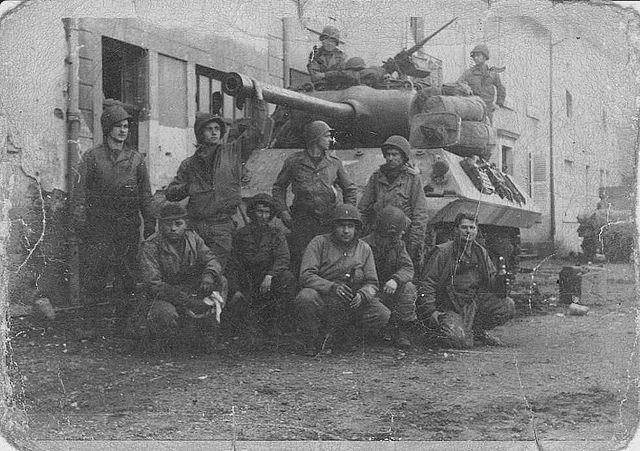
“Old Faithful,” a tank destroyer, with members of Frank Gularte’s 607th TD Battalion.
For the summer and fall, the 607th—its main armament at this point was a three-inch gun, towed by a half-track or ¾ ton truck–sprinted across France under the command of perhaps the most famous American combat general: they were a part of George Patton’s Third Army, and so undoubtedly infused with Patton’s fighting spirit. Patton wanted his tanks and trucks infused, not just his men, and in his drive during the breakout from Normandy—the grand chase across France that Domingo Martinez would not live to see—the general wasn’t hesitant about sending details back to Omaha Beach to steal entire gasoline supply companies. My father, a Quartermaster officer in London, was responsible for sending those units to the beachhead.
Their absence one day led to what had to be the most extravagantly profane cross-Channel phone call ever placed. An irate divisional commander, his division immobilized on Omaha with his men lying on their backs looking for clouds shaped like Rita Hayworth, bellowed that Lt. Gregory would be Pvt. Gregory within 24 hours, and added that there wasn’t a foxhole in northern France deep enough to protect him from the enemy artillery bombardment that the general would be happy to arrange. My father got off the hook when the gasoline’s disappearance was traced to Third Army.
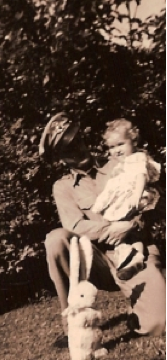
2nd Lt. Robert W. Gregory and his daughter, Roberta, 1944.
03 Saturday Oct 2015
Posted in Teaching
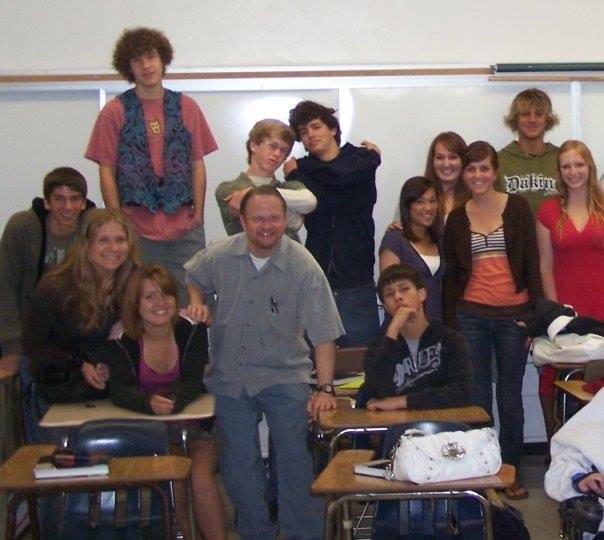
This is very difficult for me to share–and probably it’s just me. I need to share it in case it’s not.
All teachers, myself included, have confrontations with students. [We don’t sleep that night. At all.] When that happens, you wonder, somewhere in the back of your mind–fleetingly, because mostly you think about how badly you screwed up and how you could have handled the situation so much more effectively–if you’ve turned yourself and your kids into the next victims.
You don’t think about it every waking moment, but you certainly do when you lock the doors, close the curtains, and get them quiet for yet another lockdown drill.
And it’s not so much dying that you think about: it’s dying in such an apparently meaningless way.
I can’t imagine that my teachers ever had thoughts like mine. I also can’t imagine, with this added to the absurdity and the weight of all the expectations placed on teachers today, why any young person would want to become a teacher.
In the last few years, in the mandated anarchy of No Child Left Behind, which involved teaching to the test, and then The Common Core, which involves a curriculum of great enrichment (Not for students. For the textbook publishers who designed it), it was the kids who saved me and my career. They kept me going.
But the shock–and, paradoxically, the monotony– of school shootings is a reality that teachers have to think about every day, and it’s poisoning our nation at its most important juncture: in the classroom, where adults and young people are supposed to be in partnership, where they are to work together to ensure that the nation has a future.
I always worked, very purposefully, to make my classroom safe for the students I loved to teach. I think I taught with high expectations, but I also wanted them to have a place–a place that belonged to them–where they would find humor, kindness, and acceptance. But neither my classroom, nor any classroom today, is a sanctuary. Not anymore.
02 Friday Oct 2015
Posted in American History, California history
The more I learn about Mr. Branch, the more respect I have for him. The 1862-63 drought wiped out his cattle–cost him $8 million in today’s money—but he’d already started to make the shift to dairy farming, and that millstone brought in some nice income, too. At the same time–1862– he lost three daughters to smallpox. Despite these setbacks and a lawsuit that dogged him in his later years, he was fighting his way back to the very day of his death in May 1874.
“Setbacks” is an inadequate word. He was in San Francisco when his daughters became ill, traveled hard, at sixty, to get home, but when he arrived, two were already gone. The third died soon after. He saw to it that when he was buried, his three little girls would be close alongside. He missed them–one of the girls was named for his wife–and you wonder if he didn’t blame himself for not being there to protect them, even, as fathers want so badly to do, to protect them from events beyond a father’s control.
He doesn’t look it here, but he was said to be a good-humored man–his actions speak to a someone with a positive outlook–and he was small, spare, wiry. Tough as nails. The energy, too, that he had to have must have been electric. It had to be, to drive an ambition that was much like Lincoln’s: “a little engine that knew no rest,” one of Lincoln’s law partners said.
(Lincoln had lost his mother when he was nine, and, although his stepmother was immensely sympathetic, he was estranged from his father–he would refuse to attend Thomas Lincoln’s funeral–and so he struck out early. Branch, as a toddler, lost his father; his impoverished mother had to divide her children among relatives, so he, too, got out and on his own as soon as he could.)
Now I’m reading a biography of the Lakota chief Red Cloud, and even that bears on Francis Branch. He was a mountain man, but gave up fur-trapping to become a Santa Barbara grocer, marrying Manuela, about 1835. He’d start running his first cattle on the Santa Manuela Rancho two years later.
The book suggests that this is about the time the bottom fell out of the market for beaver pelts: cheap English silk now became the main component for gentlemen’s hats. No demand for beaver pelts meant, simply, that by 1837, mountain men were obsolete.
But Branch, by then, was a rancher. He’d had the foresight to re-invent himself, at 35, for about the fourth career change of his young life.
His outlook on life reminds me a little of a favorite character of mine, Lucinda Matlock, from Edgar Lee Masters’ Spoon River Anthology, a collection of poems about the residents of a little Illinois town who tell the stories of their own lives with their tombstones’ epitaphs:

28 Monday Sep 2015
Posted in American History
Tags
9/11, Hal Moore, Ia Drang, Joseph Galloway, Rick Rescorla, Vietnam
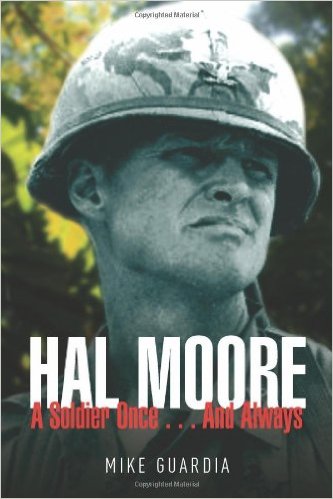
When I taught U.S. History, we spent a day every year studying the 1965 Battle of Ia Drang. There is a brand-new biography out of Hal Moore, the commander of the young Americans there. Moore was, and is, to put it mildly, a “quality human being.” His men came close to being overwhelmed by North Vietnamese regulars. One company was virtually annihilated, like their predecessors, the 7th Cavalry. But Moore and his men–he was, to his boots, both commander and father— hung on, calling air and artillery strikes virtually on their own positions, and they defeated superb North Vietnamese troops.
Sadly, we drew the wrong conclusion from that victory. We were assured, I think, that air mobility and firepower would defeat the NVA in a standup fight, which was absolutely right. But the lesson the North Vietnamese learned was to never fight Americans that way again. (To say we missed the lesson of our own Revolution is another story for another time.)
The fact remains that Moore and his men were unbelievably brave and tenacious. One of them, a British immigrant, Rick Rescorla, would go on, in civilian life, to become a civilian security consultant. After the Lockerbie Pan Am bombing, Rescorla urged his bosses, Morgan Stanley, to move out of the World Trade Center, which he sensed would be an inviting terrorist target. Morgan Stanley agreed with him, but their lease ran until 2006.
So Rick Rescorla died in the South Tower on 9/11.
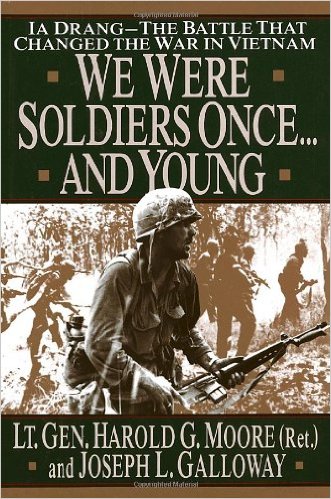
That’s his photograph on the cover of Joe Galloway’s gripping account of the battle. The paradox–of discovering such admirable people in the midst of such unspeakable violence–is something I find heartbreaking. They may be heroes, but they are also very human, and so make me feel very human, as well. That kind of connection is a gift, and it is a generous and deeply moving gift to get from men you will never get the chance to meet.
23 Wednesday Sep 2015
Posted in Uncategorized

A crippled B-17 begins its plunge to earth over Berlin.
[Dear Editor Lady]:
It was good to talk to you today! You did mention the book title in passing. Arroyo Grande in World War II, to me, has the kind of appeal that would sell twelve—maybe fifteen—books. I am thinking and consulting Lincoln, Shakespeare, Exodus, Wilfred Owen and Ernest Hemingway. Nothing yet. Then there are several passages in the book that come from soldiers’ or sailors’ letters home. I was re-reading Elliot Whitlock’s—he would win the Silver Star for his conduct in bringing his crippled B-17 back to base in England—and a particular sentence arrested me:
…At that time Jim’s parachute caught fire as did an extra one we carried. Mine was burnt but not seriously. With his chute gone, Jim couldn’t jump. I decided to stay with the ship while Jim put out the fire. He succeeded in getting it under control, but his hands were so badly burnt that he couldn’t do anything the rest of the trip.
He held the ship level while I finished putting the fire out…Somebody handed a fire extinguisher through a hole the fire had burnt, and so I looked back and everybody was there (in the tail) for which I thanked God. Nobody…had bailed out. They had not heard the order.
…I had dived the ship immediately after the fire so that nobody would pass out it the oxygen was cut off. Suddenly we started to get an awful lot of flak (anti-aircraft fire from the ground) so I had to hurry back to the cockpit to do some evasive action which worked okay, incidentally. I had one of the boys get the maps…and had the radio operator get fixes so I plotted a course for home with as little flak as possible. The radio operator did a fine job so we came out on course and landed OK. All this was above the clouds, so I think I can qualify for navigator now as well as pilot…
…Your prayers are standing by me. I was praying up there and all the rest of the men were praying, too…
Lots of love,
Elliott
So, this came to mind:
One of the major reasons I wrote this book was to connect an obscure and seemingly unimportant little town with events both famous and world-changing. These events happened so far away, so the theme of distance—spatial, temporal, emotional–is one that comes up over and over in the book. The book shifts between those distant events and the home front. Elliot’s poetic sentence represents, to me, a bridge between the distant and Home, between a plane in trouble over Berlin and a father and mother running a little grocery on Branch Street—in their prayers, almost willing the plane safely home. The book, likewise, is intended to be a bridge between Arroyo Grande and the war, and even more, between living generations and one that has almost disappeared. Frankly, I like it also because it’s organic: it comes from a kid who was in the AGUHS Drama Club and the Diction Club and not from Thucydides, whose high-school yearbook I can’t find. The fact that this is a religious sentence is, to me, irrelevant: it’s a bridge.
Here are just a few examples of that idea of “distance” and of “connectedness:”
>…its characters will enter the Arroyo Grande Valley, many after long and dangerous journeys; World War II will call their descendants—part of “The Greatest Generation”– away on journeys more dangerous still…
>…there were deep hurts that would need time to heal, hurts inflicted all the way from the hedgerows of Normandy to the desolate, shell-blasted landscape of Iwo Jima and, finally, to now-empty baseball fields in internment camps like Gila River.
>…the war, for Americans at home, was both distant and, for grieving families, painfully intimate…
>…Winds had carried the copper-red soil as far east as the mid-Atlantic to drop it, like gritty rain from a place that had none, onto ships still sailing freely between continents…
>…The U-boats would someday kill that young field worker, if indirectly, as part of a inexorable chain of events that would lead him to Normandy, so far away from the fields that border Arroyo Grande Creek, and to pastures bound by hedges and grazed by fat dairy cows…
>… The first gunshot heard in the Arroyo Grande Valley came a few weeks before Victoria ascended the English throne. It was probably fired from an 1825 Hawken rifle…
>… By the early part of the new century, some of the workers in those fields, their wide-brimmed straw hats like mushroom caps as they bent to their work, would figure prominently in the American history that Clara loved. They were first immigrants to arrive from Japan, most of them from the southern island, Kyushu, but a few of them from farther north, in the prefecture that surrounded the city of Hiroshima.
>…The next day, he and his classmates at Arroyo Grande Union High School gathered in their new gymnasium—a New Deal WPA work project that still serves as the Paulding Middle School gym today—to listen to Franklin Roosevelt’s dramatic eight-minute address…
>… Many years later, [a local cattlewoman] would tell Port San Luis Harbor Commissioner Donald Ross that she’d seen a sub—during I-21’s combat patrol– surface offshore during her shift on a volunteer shore patrol, somewhere along the beach in what is today Montana de Oro State Park. She let fly with her 30-30 carbine. The range was too great, she told Ross, but she had the satisfaction of seeing the crew scamper below and the captain dive the boat…Within weeks, I-21 would be sinking shipping off the coast of Australia, would shell Sydney Harbor, and would be lost with all hands near Tarawa in 1943.
>–I just saw one of the swellest sights. You will never believe it when I tell you. It was fresh green peas in a field…if you had been where we were and as long as we were, you would know why we thought so much of seeing a field of vegetables. We saw many wonderful sights….We saw country that reminded my of the Cuyama, some places reminded me of the scenery between San Simeon and Monterey. For the past few months we have seen nothing but country like that at Devils’ Den, except there is more wind and sand here.
–A letter home from North Africa
>That was Frank Gularte’s last full day of life. On the 28th, the 607th was ordered to take another town, Merten. Everything that could go wrong did… Somewhere in the melee, a German sniper took the life of the young man who would never see his son.…Five days later, Sally Gularte gave birth to Frank Jr. Only a few days after that–after she’d first held her son close in her arms–she received the War Department telegram that took her husband away from her.
>Juzo Ikeda’s life had been a successful one, too, marked by hard work. But his workplace had been beautiful—green hillsides, fields of black earth and, in the distance, above the ears of his team of horses, he could see shimmering white sand dunes. He could smell the sea…Japan had destroyed his family’s fortunes and so had trapped those who stayed behind; in coming to America, Juzo had set himself and his sons free.
But when death came for him in 1943, Juzo was in a makeshift hospital in a barren desert camp. He died not long after asking his son to remain loyal to the nation that had made them prisoners.
–On the other hand, I could be full of beans.
Jim
22 Tuesday Sep 2015
Posted in Uncategorized
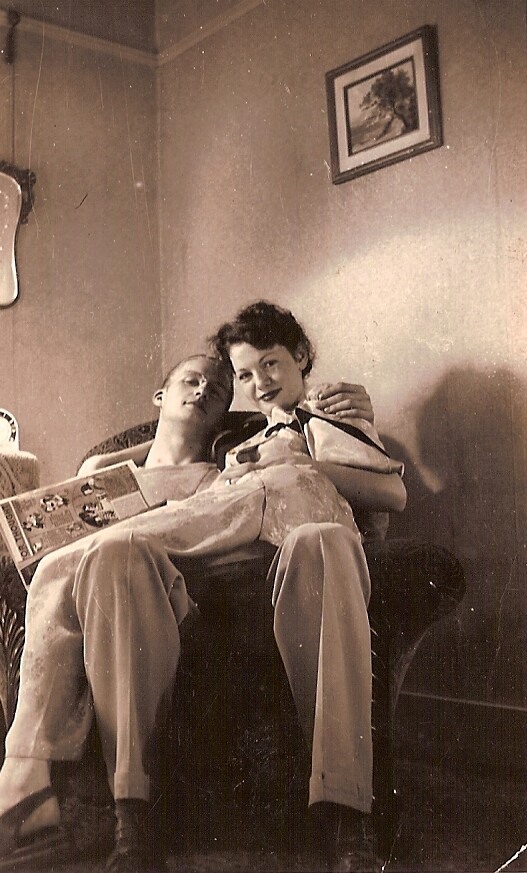
I took Mom some flowers yesterday (I also said “Howdy” to a lot of people. If you are of Portuguese or Japanese descent, I probably visited your ancestors.) and realized this week would have been Mom and Dad’s 75th wedding anniversary.
He came from the Ozark foothills to Taft, at 21, on a technically illegal baseball scholarship–Dad was a gifted and graceful athlete–and she was a soda jerk,18, and I think they fell in love over the ice-cream sundae she made for him. And, what a year–1939–to date! “Gone with the Wind,” “Wizard of Oz,” “Goodbye Mr. Chips,” and so on. Thank you, Hollywood, for making us four kids possible!
He was incredibly quick-witted and funny, an absolutely mesmerizing storyteller, brilliant (especially with numbers); she was sensitive, artistic, a brilliant, lifelong learner, intensely spiritual and she had a powerful sense of social justice. Me? I was lucky.
But if you know me, you know them.
Forty-six years after my Mom’s death, I still miss her, and she still inspires me. Each and every one of my life’s accomplishments was meant as a gift for her, and, if you’ve been one of my students, my Mom loves you every bit as much as I do.
I also inherited their deep and destructive flaws–Dad’s temper and his alcoholism, too, Mom’s struggles with depression–and the truly marvelous thing about getting older is how you begin to appreciate those things, as well. In confronting and enduring them, they become your strengths.
My parents may be my greatest strength of all.
Happy 75th, Mom and Dad. I love you forever.
22 Tuesday Sep 2015
Posted in American History, California history, World War II
When you meet someone like Johnny Silva, you say to yourself, “this has to be the best and kindest man I have ever met. Nobody can be like that.” But then you meet Johnny’s wife, Annie Gularte Silva, and you find that somebody can. And when you remember what their kids were like when you were growing up with them, you realize that these things are not coincidences: your life has been blessed.
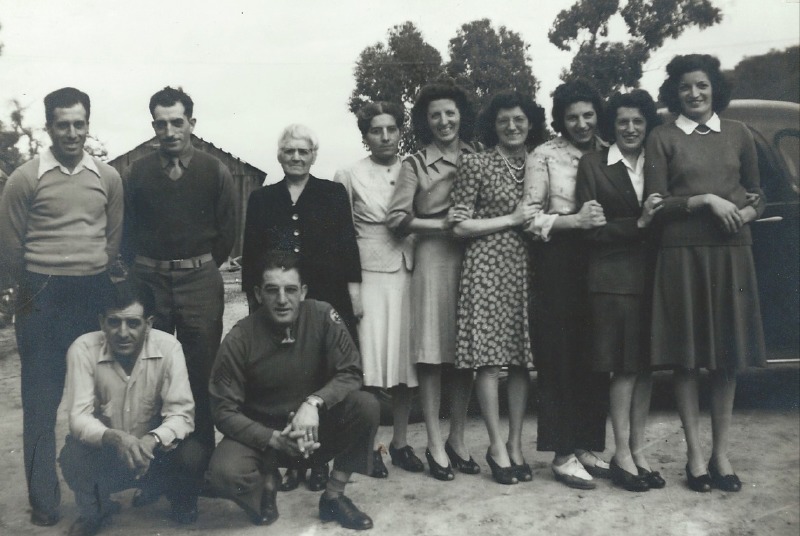
The last time the Gularte children were together, 1944. Frank, in uniform, in front of his mother, would be killed in action in November 1944. Just above him is Manuel, who would serve as an artilleryman and survive the war. Joe and Tony, at left, would run the family farm during the war; Mrs. Clara Gularte is flanked by her six daughters: Mary, Edwina, Clara, Rose, Annie, and Barbara. Photo courtesy Annie Gularte Silva.
…The Americans’ breakout from Normandy, after claustrophobic weeks in the death traps of the hedgerows, must have been a jubilant one, but the 607th would encounter another death trap whose brutality sobered them. The Americans, under Omar Bradley, and the British and Canadians, under Bernard Law Montgomery, had the chance to encircle the entire German Army in Normandy. They would fail, and thousands of Germans would escape, battle-weary, some of them now barefoot, running for their lives along narrow roads and cattle trails through what became known as the Falaise Gap. American artillery units found them there–artillery spotters were nearly incoherent because there were so many targets to call in on their field radios–and the slaughter they inflicted was horrific. Seventy years later, one of the 607th’s soldiers, Frank Kunz, remembered the results in an interview with his hometown newspaper: “ Christ help me. There were 6 to 8 inches of bodies and horses ground up on the road. There was nothing you could do. You had to drive through it.” People, Kunz added, don’t understand what war is.
Patton’s chase would end in September on the Moselle River at the old Roman garrison town of Metz. It would take him two months to break down German resistance and Gularte’s 607th, now attached to the 95th Infantry Division, fought in several actions around the city. In one of them, a company of the unit was credited with firing the first Third Army shells into Germany, aimed at a church steeple in the town of Perl.
By November 23, the battalion was fighting along the river, six miles south of Metz. The Moselle, beautiful, calm, and, in summer, a soft blue, might have made Gularte homesick if he’d had the opportunity to see it then, and in peace. The river’s surface is punctuated by ringlets as trout nose up to feed, and on summer nights, with their long twilight hours, little French boys do what little boys in the Arroyo Grande Valley do—they go fishing.
But with winter descending in 1944, it’s along the Moselle where the unit saw one of its finest hours: Company C, unsupported by infantry, was charged with holding a little town, Falck. By now, the 607th had made the important transition from a towed to a self-propelled unit. Their main anti tank weapon was a robust 90mm gun—with its armor-piercing shell, it was a match for the German 88—mounted on a tank chassis. This was the M36. C Company, commanded by 1st Lt. George King, came under mortar and artillery fire, then repeated infantry assaults from the woods, still dense around the town today. The enemy wanted Falck back, but they would not get it. Smith’s tank destroyers and their crews alone would turn them back in their repeated assaults, and the young officer would earn a Silver Star for his leadership that day: November 27, 1944.
“Old Faithful,” a tank destroyer, with members of Frank Gularte’s 607th TD Battalion.
That was Frank Gularte’s last full day of life. On the 28th, the 607th was ordered to take another town, Merten. Everything that could go wrong did. The infantry that was to support the big M36s never materialized. The 3rd Platoon of Company C took on Merten by itself: the first M36 to advance down the road was fired on, returned fire but then, in moving around a tank barrier, got mired in the mud and so was easily destroyed by a German anti-tank crew. The next destroyer turned back, the third tumbled into a ditch and enemy fire set it ablaze, and the fourth had its gun jam. When it turned to return to Falck, this last destroyer, too, became bogged down in the mud. Somewhere in the melee, a German sniper took the life of the young man who would never see his son. Frank Jr. was born five days after the sniper fired the shot that killed his father. Frank’s wife, Sally, would have gotten the terrible War Department telegram a few days after that.
The squad leader/writer, Sgt. Gantter, wrote in his memoirs of a young man in his company who carried, from his arrival in France to the German frontier, a box of cigars to share once he had word of the birth of his first child. Gantter liked the young man: he was earnest, friendly, and desperate for word from home. But mail was slow—Gantter would be sharing Christmas cookies with his fellow dogfaces in March—so the young soldier eventually gave up the waiting and gave out his cigars when the due date had safely come and gone. Gularte must have been waiting anxiously for word from home, as well—receiving it would be a joyful distraction from the filth, the cold, the constant, dull exhaustion—and it would be a sign, too, that there was a new reason to survive the war, a new reason to get himself home.
Many at home, and in the front lines in Europe, as well, according to Gantter, hoped the war would be over by Christmas. The chase across France had given both false hopes. It would instead be a hard Christmas, hard in the Ardennes, with the onslaught of Nordwind, the great German offensive; hard, too for the Gularte family: on Wednesday, December 13, Father Thomas Morahan celebrated a Mass at St. Patrick’s Church in Frank’s memory.
Even then, the war would not leave the family alone: four days later, Frank’s brother, Manuel, and his 965th Field Artillery Battalion began a desperate fight around St. Vith, Belgium, in support of the Seventh Armored Division, charged with holding the town in the face of the massive German offensive that would become known as the Battle of the Bulge. The Americans would lose the town to the Germans, but the 965th’s heavy guns—155 mm cannons—would be one of the factors that would make them pay dearly for it, wrecking, in the process, the enemy’s timetable. The Seventh Armored abandoned St. Vith, but only after holding on for a full four days past the German target date, December 17, for its seizure.
That was the day that the 101st Airborne Division arrived to take up defensive positions in and around Bastogne. Their stubborn resistance in holding this town, in the rear of the German advance, was another decisive factor that prevented the Bulge from becoming the breakthrough that Hitler so desperately wanted: the German drive to the west lost momentum as thousands of Wehrmacht soldiers were thrown into the attack on Bastogne. There, among the tough and battle-wise Americans—some of their foxholes are faintly visible today– was a young sergeant from Arroyo Grande, Arthur C. Youman. December 17 was his twenty-third birthday.
20 Sunday Sep 2015
Posted in American History, History, News, Teaching
Tags
 When I retired from teaching last year, it was time. I hadn’t lost my love for young people, or for teaching, but I couldn’t think of a better graduating class for my goodbyes than the Arroyo Grande High Class of 2015.
One of my very favorites—she’s just starting her freshman year at Poly—is named Leila. The smile you see on her face is a constant: she radiates the kind of warmth and openness that captures others, but there is nothing calculated in the capturing. Leila’s smile comes from Leila’s heart. At the end-of-the-year Senior Assembly, she gifted me with a farewell bouquet. She was fighting tears, and seeing her struggle to master her feelings was an even greater gift. It’s good to know the love you’ve spent means something to someone so important.
I have rarely read a college letter that brought me to tears, but Leila’s did. One part told of her family’s trip to Egypt, to visit her grandmother. I saw photos of the woman and she has a kind of Leila-ness about herself, as well. You wonder if there are applications you can send for to become her adoptive grandson. Her health has not been good. She had to have surgery, and the passage I remember is when Leila volunteered to change the dressing on her wound. Her grandmother apologized for its appearance, but Leila did not hesitate and did not flinch, and I don’t think anything so clinical has been done with such gentleness and compassion.
The experience only reinforced Leila’s dream to become a doctor. We have common heroes–Doctors without Borders—and I could easily see Leila doing their work. I immediately thought of her while listening to an NPR story about a doctor who lost 19 of the first 20 patients he’d treated for Ebola in West Africa. It was heart-breaking, but this doctor was a man of spiritual depth. “Curing disease isn’t the most important thing a doctor does,” he said. “The most important thing a doctor can do is to enter into another’s pain.” Leila has that kind of empathy and she has the spiritual strength to sustain it.
I will come to the obvious part. Leila is an observant Muslim, and as captivating and welcoming as her smile is, there are those–some have been in the news lately–who are blind to kindness because it’s so threatening to the comfort they find in hating. Leila can take care of herself–she gets those reservoirs of strength from the deep wells her family has made for her–but she also is the kind of student who can provoke every paternal instinct a male teacher has. You want to protect her from the blind and the bigoted who also have the unpleasant tendency to be loud.
The comfort is knowing that those people do not matter and have no enduring impact, unless you count, of course, the agonizing depth of the pain God feels when they broadcast their hatred.
I gained a lot of wisdom by talking to Haruo Hayashi in researching a book I’m writing about Arroyo Grande during World War II. In 1942, his family was among those interned Japanese-Americans who slept in stinking animal stalls at the Tulare County Fairgrounds; they were then sent to the remote Rivers Camp in the Arizona desert, where the hot winds, carrying the spores for Valley Fever, began to kill their grandparents.
When I visited the Hayashis, I saw three generations of a family whose bedrock is hard work relaxing on a Sunday, watching television, reading, raiding the refrigerator, and all of them were present, were living in the moment, and the devotion you sensed among them was unforced and unpretentious, which only made it more powerful. Haruo’s extraordinary wife, Rose, was dying. Her son, Alan, remained at her side, attentive but respectful and unobtrusive, his love for her a mirror-image of the love she’d always given so selflessly.
Haruo went through, after Pearl Harbor, the kind of bigotry that I fear so much. But, while the bigots were loud and threatening, they do not matter to him 75 years later. They were small people whose names he’s lost. He hasn’t lost the names of Don Gullickson or Gordon Bennett or John Loomis, constant friends whose constancy has lasted four lifetimes. He smiled when he remembered another name, of a tough classmate, Milton Guggia, who told Haruo he would personally beat the living crap out of any kid who called Haruo a “Jap.”
Milton Guggia. That’s a real American name.
As is Leila’s. She’s the girl who went to Proms, who served on the ASB, who played Powderpuff Football, who participated every year in Mock Trial, who played in the school band. Haruo played in the school band, too. And you can see him in a yearbook photo with the 1941 AGUHS Lettermen’s Club–his bad eyesight ruled out sports, but he managed for every team and earned his spot, with all the jocks, right next to Coach Max Belko, the kind of big, boisterous and indestructible coach whom every kid idolizes.
He was destructible, it turned out. Belko, a Marine lieutenant, died on Guam in 1944.
But there, and forever, in the old yearbook, are Max Belko and Haruo Hayashi, shoulder to shoulder: two real Americans. Leila—and Leila’s marvelous family, so much like Haruo’s—are no different. Their fidelity to each other, their quiet insistence on hard work and service to others, and the openness of their daughter’s heart–all of these have been blessings in my life. They are, I think, the kind of Americans we would all wish to be.
22 Saturday Aug 2015
Posted in American History, California history, World War II
It is difficult to imagine Normandy in 1944; it is a beautiful place today, as are its people: a bonjour from an American tourist has more traction here than it does in Paris, and the little villages are lovely, separated by pastures and farm fields, each village with its distinctive little parish church. During the Middle Ages, as the skilled writer and Francophile Graham Robb notes, few villagers ever went beyond the sound of their parish church’s bells. The world beyond was like the ends of the earth.
It is not the ends of the earth, but the D-Day beaches are 5,500 miles away from the Arroyo Grande Valley. Three local men, killed in the campaign to capture and then and break free from Normandy, are buried at the American Cemetery at Colleville-sur-Mer, an almost impossibly beautiful place above Omaha Beach.
Below the cemetery, just offshore, a visitor today can see young men as they should be—exuberant and free– as they race tiny sailboats, their sails bright oranges and reds, just beyond the surf line, where on June 6, 1944, young men floated like dead leaves on the water’s surface. The invasion of Hitler’s Europe nearly failed here. It didn’t, but only because of an American generation that includes those who still hold the high ground at Colleville-sur-Mer.

Up there, on the immaculate cemetery grounds, and not far from a famous American—the ebullient and popular Gen. Theodore Roosevelt Jr., felled by a massive heart attack soon after the invasion– lies a soldier as far removed from the Roosevelts’ patrician (if rambunctious) Oyster Bay home as a human being can be.
He was a farmworker, then an Army private, named Domingo Martinez. He is buried in Plot C, Row 13, Grave 38. Martinez is a soldier who more than likely knew the bean-stakes and the smell of sweet peas of prewar Arroyo Grande. The best that can be said is “more than likely:” the Arroyo Grande Valley is where a farm worker, as he’s listed in his 1943 Army enlistment records, would have found a job, or a series of jobs, following different harvests, and migrant farmworkers are elusive for both historians and for census-takers. My students, though, found his grave on a trip to Normandy in 2010, and spent some time with Domingo, who’d become “their” GI.
Two more soldiers, city boys compared to Martinez, are memorialized at the American Cemetery, both from the county seat, San Luis Obispo, just to the north. An artillery officer, 2nd Lt. Claude Newlin, is buried here. Ironically, Newlin’s battalion, attached to the 35th Infantry Division, had spent part of its training at Camp San Luis Obispo, just north of his home. Newlin survived some of the costliest fighting of the campaign, near St. Lo, only to die hours before the 35th broke out of Normandy to join George Patton’s breath-taking race across France to Metz and the German frontier.
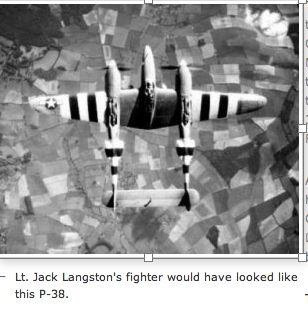
For another San Luis Obispo soldier, an airman, there is a memorial, but no grave. On June 22, 2nd Lt. Jack Langston was flying his P-38 in a low-level bombing and strafing attack on Cherbourg with his 367th Fighter Squadron when that city’s flak guns demonstrated the folly of ordering low-level attacks. Langston died that day with four other 367th pilots. His body was never recovered.
The farmworker, Pvt. Martinez, 26 years old, was in the southern suburbs of Cherbourg with the 313th Regiment of the 79th division and would have been grateful for the contributions of Langston and his fellow pilots: a furious eight-minute bombardment to soften the city Martinez and his comrades were ordered to take.
The 79th was sent into action soon after landing on Utah Beach. The division moved west and then turned north to push up the Cherbourg peninsula. The city, at the peninsula’s tip, needed to be taken because the Allies faced an enormous supply problem. They needed a port to help feed, arm, and fuel the growing numbers of Allied soldiers in France—the artificial “Mulberry” harbor that allowed the offloading of ships off Omaha Beach would be destroyed in a capricious Channel storm. For the Allied command, SHAEF, Cherbourg was critical.
It was also difficult to take. Its bristling anti-aircraft defenses would claim Jack Langston. Massive coastal batteries could keep naval support for the Americans at bay, and the city’s Wehrmacht defenders, though not elite troops (20% of them were non-German conscripts) were securely dug in and they had nowhere to go, for they were backed into a corner of France, and so isolated that the only alternative to fighting was to leap into the sea.
That would have been a blessing for Martinez and the 313th Infantry Regiment, because their march north, to the suburbs of Cherbourg, on the right flank of the 79th Division, taught them a bitter lesson in German military engineering. A network of concrete pillboxes guarded the southern approaches to the city. They contained machine guns pre-sited for interlocking fields of fire, for maximum effect on the American dogfaces.
These pillboxes were impervious to frontal attack—57 mm artillery shells bounced of the steel-and-concrete walls—so two battalions of the 313th engaged the enemy while a third looped to the left and came in on the rear of the fortifications, where they were more vulnerable. The 313th leap-frogged closer to the city, only to discover that the Germans they thought they’d subdued had been hiding deep in underground galleries and had reoccupied some of their fortifications—for a short time, they would cut all of the regiment’s contact with divisional headquarters. So the 313th would have to do what field officers hated—fight over the same ground twice. It must have been a hard lesson for these soldiers, new to combat, to learn.
Once they’d gotten inside Cherbourg, 79th Division GIs learned to hate street fighting almost instantly. Death came instantly from illusory shadows that a fallen soldier’s comrades never saw, and from gunfire they sometimes never heard. In peacetime, a French city block can be cacophonous with the sounds of cafe music, or cheers inside during the World Cup, with the comic honking of little cars or the squeals of children at play. In combat, the same block, seemingly empty, can muffle the report of a sniper’s rifle or generate echoes that make soldiers look anxiously in all directions at once.

79th GIs, Cherbourg.
 A Work in Progress