Tags









25 Thursday Jun 2015
Posted in Family history, Personal memoirs
Tags
22 Monday Jun 2015
Posted in Uncategorized


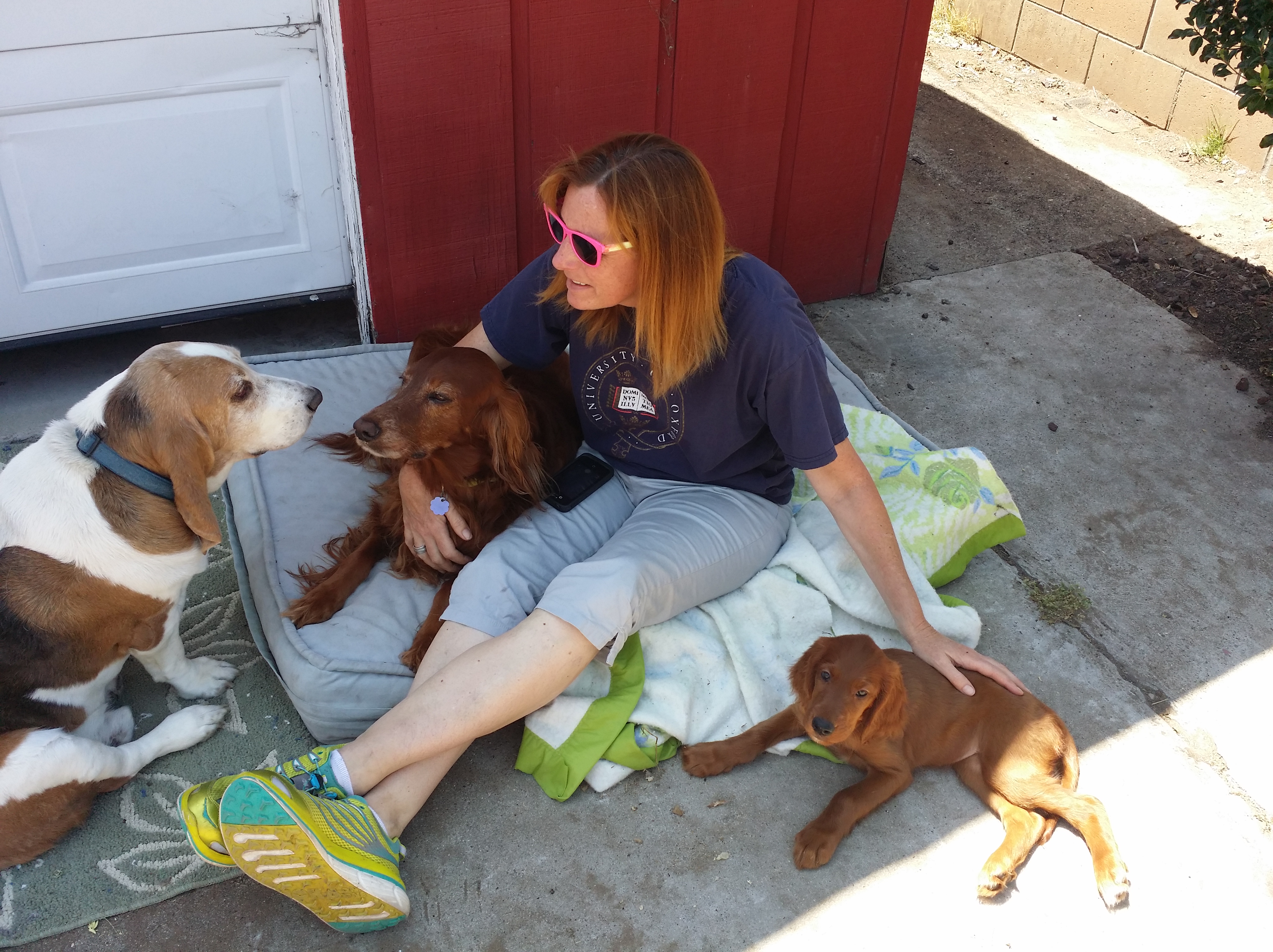
 Our newest family member: Eight-week-old Irish Setter Brigid.















20 Saturday Jun 2015
Posted in Uncategorized

South Carolina state representative Doug Brannon, a Republican, will introduce a bill to bring down the Confederate battle flag at the state house because he lost a friend and colleague this week. He’s got the full support of Russell Moore, a Mississippian and the head of the Southern Baptist Convention–the sect that seceded along with the Confederacy–because, as Moore put it, he lost a brother in Christ.
I’m named after my great-great grandfather, a Confederate brigadier general, and my middle name is his son’s, a Confederate staff officer killed in action in 1862. Because of that connection, we had a Confederate battle flag, too, a souvenir from a 1913 veterans’ reunion. We kept it hidden in a closet. Maybe we were proud of our ancestry, but nobody in my family had the appetite to celebrate treason or to celebrate the kidnaping, brutalization and enslavement of human beings.
Put away the flag. Better still, burn it. Burn them all. Can you really cite “freedom of speech” to defend an object that symbolizes the denial of all human freedom?
18 Thursday Jun 2015
Posted in Uncategorized

There was an elderly black couple at Costco today and they were discussing the merits of buying locally-produced honey. They had been married a long time, I think, and were very comfortable in the easy way they talked together, and there was a dignity there that you can see in good marriages that have been tempered.
I could not fight my eavesdropping, but I successfully fought the urge to ask permission for a hug when I could whisper to each that everything will be all right. I studied a box of Stevia instead, which was infinitely more sensible, while they, in a moment of unexpected grace, brought unexpected tears to my eyes.
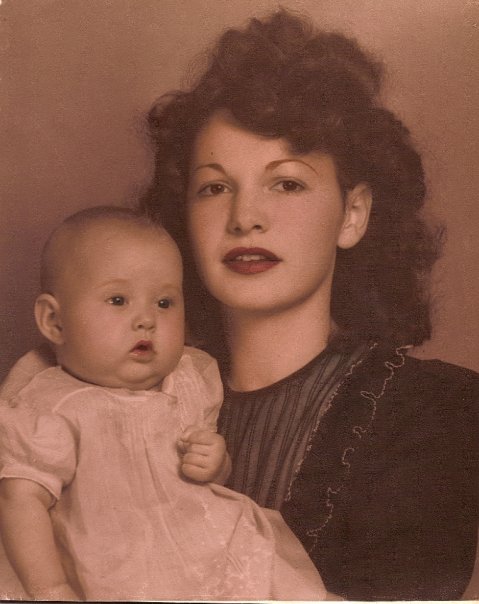
All of this, of course, is my mother’s fault: the twin curses she left me were compassion and the hopeless belief that we are, all of us, family.
I am my mother’s son, and, because of her, I know that I have lost sisters and brothers in Charleston that I will never have the chance to hold close—so close that we could, together, create a transformative moment when it really would be all right.
I lost family last night. I miss you all.
That lady who is now holding you close would be my Mom.
04 Thursday Jun 2015
Posted in Uncategorized

Leila and Claire at the Prom.
Leila will graduate next week and I will retire, so our ways really are parting. In the past, kids always knew where to find me when they came home on break from Cal or Davis or from the Army. Room 306 will belong to someone else next year, so the future of the Class of 2015 with me is less certain.
Each class leaves its mark–when last year’s Seniors broke into a mass flash dance at graduation, it was so unexpected and so delightful that I will never forget them.
Leila is one reason why I have a special fondness for this year’s graduates. The smile you see on her face is a constant: she radiates the kind of warmth and openness that captures others, but there is nothing calculated in the capturing. Leila’s smile comes from Leila’s heart. Today, at the Senior Assembly, she gifted me with a bouquet and fought her tears and seeing her struggle to master her feelings was an even greater gift. It’s good to know the love you’ve spent means something to someone so important.
I have rarely read a college letter that brought me to tears, but Leila’s did. One part told of her family’s trip to Egypt, to visit her grandmother. I saw photos of the woman and she has a kind of Leila-ness about herself, as well. You want to volunteer to be her grandson.
Her health has not been good. She had to have a mastectomy, and the passage I remember is when Leila volunteered to change the dressing on her wound. Her grandmother apologized for its appearance, but Leila did not hesitate and did not flinch, and I don’t think anything so clinical has been done with such gentleness and compassion.
The experience only reinforced Leila’s dream to become a doctor. We have common heroes–Doctors without Borders, a group I donate to even when I can’t really afford to. I could easily see Leila do their work. I immediately thought of her while listening to an NPR story about a doctor who lost 19 of the first 20 patients he’d treated for Ebola in West Africa. That had to be daunting, but this doctor was a man of spiritual depth. “Curing disease isn’t the most important thing a doctor does,” he said. “The most important thing a doctor can do is to enter into another’s pain.” Leila has that kind of empathy and she has the spiritual strength to sustain it.
I will come to the obvious part. Leila is an observant Muslim, and as captivating and welcoming as her smile is, there are those–some have been in the news lately–who are blind to the kindness of others because it’s so threatening to the comfort they find in hating. Leila can take care of herself–she gets those reservoirs of strength from the deep wells her family has made for her–but she also is the kind of student who can provoke every paternal instinct a male teacher has. You want to protect her from the blind and the bigoted who also have the unpleasant tendency to be loud.
The comfort is knowing that those people do not matter and have no enduring impact, unless you count, of course, the agonizing depth of the pain God feels when they broadcast their hatred.
I gained a lot of wisdom by talking to Haruo Hayashi this weekend. The Hayashis are a lot like the Assals–I saw three generations of a family whose bedrock is hard work, relaxing on a Sunday, watching television, reading, raiding the refrigerator, and all of them were present, were living in the moment, and the love you sensed among them was unforced and unpretentious, which only made it more powerful.
Haruo went through, after Pearl Harbor, the kind of bigotry that I fear so much. But, while the bigots were loud and threatening, they did not matter to him, 75 years later. They were small people whose names he’d lost. He hasn’t lost the names of Don Gullickson or Gordon Bennett or John Loomis, who were constant friends whose constancy lasted four lifetimes. He smiled when he spoke another name, of a tough Italian-American kid, Milton Guggia, who said to him in the week after Pearl Harbor: “Haruo, if any kid calls you a ‘Jap,’ I will personally beat the shit out of him.”
Milton Guggia is a name worth remembering, because there, I think, is a real American.
As is this American girl, who goes to Proms, who serves on the ASB, who plays Powderpuff Football, who participates every year in Mock Trial, who plays in the school band. So did Haruo. You can see him with the 1941 AGUHS Lettermen’s Club–his bad eyesight ruled out sports, but he managed for every team and earned his spot, with all the jocks, right next to Coach Max Belko, the kind of big, boisterous and indestructible coach whom every kid idolizes. The Japanese would destroy Max Belko–a round to the gut–soon after the Marine landing on Guam.
So there, in the old yearbook, are Max and Haruo, shoulder to shoulder: two more real Americans. The faith of the Assal family, their fidelity to each other, their quiet insistence on hard work and service to others, and the openness of their daughter’s heart–all of these have been blessings in my life. They are, I think, the kind of Americans we would all wish to be.
04 Thursday Jun 2015
Posted in Uncategorized
A story worth sharing–over and over again.
Warning: This is a long post. But if you read through it. It is definitely worth it.
“Vard was really friendly,…not only to the Japanese. When he talked to …farmers, ..he sat and talked for a half-hour or an hour. He really cared about people, ” said Kazuo “Kaz”, a prominent Arroyo Grande farmer.
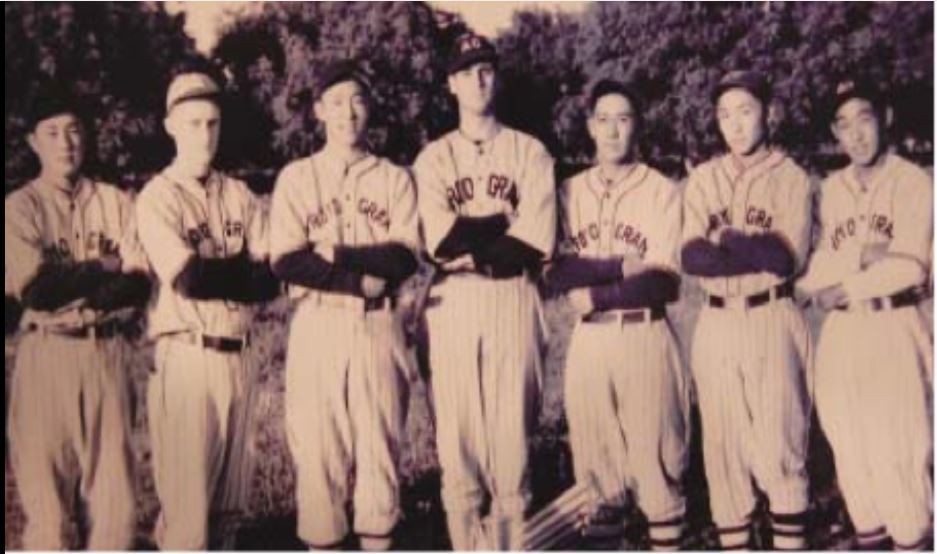 Vard in the middle with the first Arroyo Grande Japanese-American baseball team that he coached. (Photo courtesy of Lilian Sakarai and the South County Historical Society, Heritage Press, Volume II number 6, August 2007)
Joseph Vard Loomis, better known as “Vard” is one of those people that is hard to forget. He was described as friendly, personable and loyal by those who knew him. However, what he is likely remembered most for, is his love and kindness to the Japanese-American citizens of Arroyo Grande.
According to The Heritage Press, “The most prominent supporters of Japanese Americans…
View original post 1,880 more words
25 Monday May 2015
Posted in Uncategorized
Not far away from us is the grave of Marine Sgt. Pete Segundo, killed in action in Vietnam in 1969. Pete was once President of the Arroyo Grande High Letterman’s Club, and his yearbook photo is typical: his broken arm is in a sling, and a bright, contagious smile crosses his face. To know Pete was to love him.
Twelve feet from Pete’s grave are two people I love. My parents are buried here. My father was a captain in the U.S. Army. I am writing a book about Arroyo Grande in World War II—my father’s war–and because it is the 70th anniversary of that war’s end, I am thinking of another grave in a cemetery 5,500 miles from here.
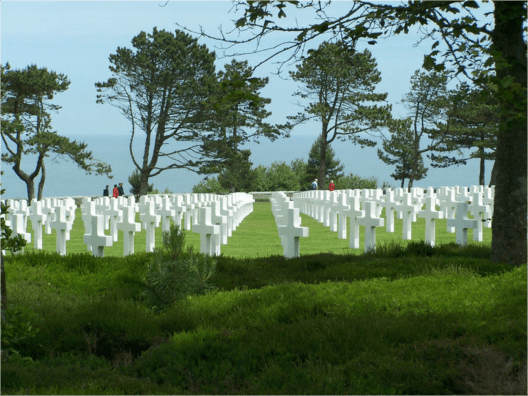
It is the American Cemetery at Colleville-sur-Mer, above Omaha Beach in Normandy.
That beach is the exclusive property of the men and women of my parents’ generation. We honor the fallen of all American wars today, but I would like to direct my remarks to the World War II generation and, by extension, to their families.

Omaha Beach today.
9,000 young men who will always be young men are buried at that impossibly beautiful cemetery in Normandy. Three came from our county.
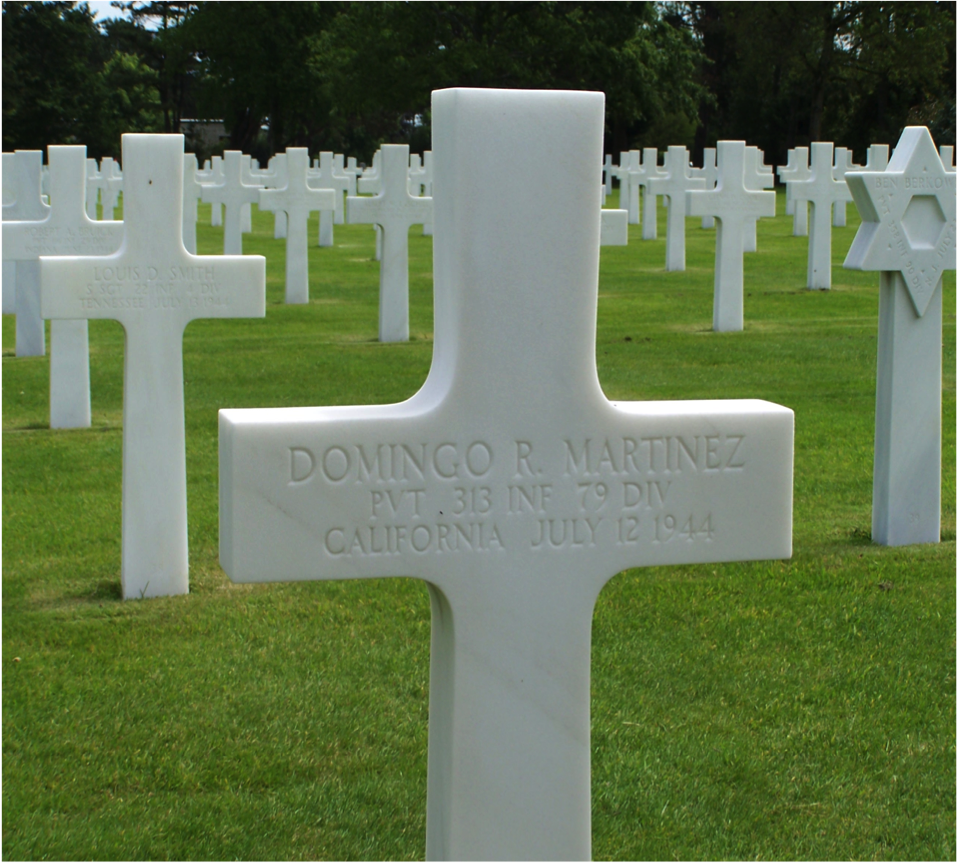
One of them was Pvt. Domingo Martinez. He is buried at Colleville-sur-Mer in Plot C, Row 13, Grave 38. Martinez knew the hard work of driving bean-stakes into the soil and he knew the smell of sweet peas of the prewar Arroyo Grande Valley. He was a farmworker, a refugee from Dust Bowl New Mexico.
But in late June 1944, Martinez was a rifleman, fighting in the streets of Cherbourg with the 79th Infantry Division.
Cherbourg was vital to securing the Allied supply line after D-Day.
It was also difficult to take. Its bristling anti-aircraft defenses would kill a San Luis Obispo fighter pilot named Jack Langston. Massive coastal batteries kept naval support for the Americans at bay, and the city’s defenders, although garrison troops, were securely dug in.

79th Infantry Division GIs, Cherbourg.
They had nowhere to go, for they were backed into a corner of France, and so isolated that the only alternative to fighting was to leap into the sea.
Once they’d entered Cherbourg, 79th Division G.I.’s learned to hate street fighting almost instantly. Death came instantly from illusory shadows that a fallen soldier’s comrades never saw, and from gunfire they sometimes never heard.
In peacetime, a French city block can be noisy with the cheers of a cafe crowd during the World Cup or the comical horns of tiny cars or the singing of children at play.
In combat, that same block, seemingly empty, can muffle the report of a sniper’s rifle or generate echoes that make soldiers look anxiously in every direction at once.
So the 79th fought house by house and street by street and eventually they captured the fortress that dominated the city, on June 26. Military historian John C .McManus notes that the men of the 79th that day were filthy, exhausted, and bearded, “like burlesque tramps,’ as one G.I. said.
They got little rest. The division quickly shifted from urban combat to a drive through the farms and villages of the Cotentin Peninsula.
American soldiers in Normandy now faced a new, even more difficult challenge. By the third week after D-Day, they were falling far short of the objectives set for them by Allied staff officers in crisp uniforms working over crisp maps that lacked one crucial detail.
The offensive in the Cotentin stalled because the Germans had the advantage of fighting defensively, in the bocage, the Norman hedgerows, and they winnowed units like the 79th Division down.
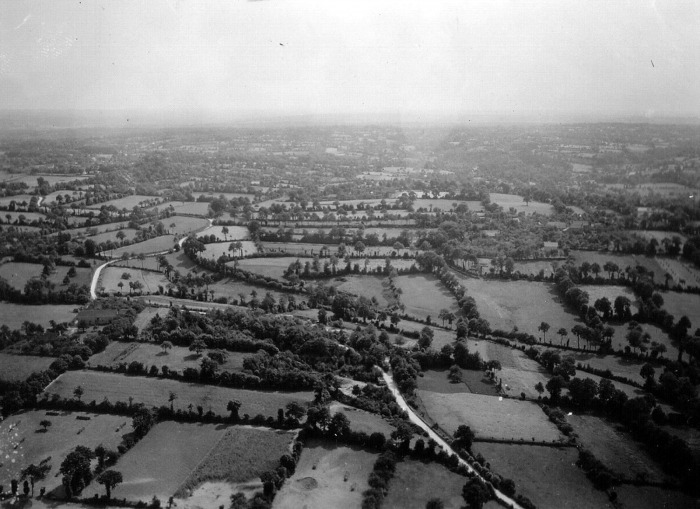
The bocage, Normandy.
The hedgerows the maps never showed enclosed fields plowed since Agincourt, or pasturage for fat Norman cows, and were a hopscotch of natural fortresses.
This meant that the G.I.’s had to assault them, one by one, to try to extract defenders who gave ground and their own lives stubbornly.
When G.I.’s broke through a hedge and entered a field, the superb German machine gun, the MG42, hidden in the next hedge beyond, or positioned on the Americans’ flanks, annihilated entire rifle squads. It fired so rapidly that a burst sounded like canvas ripping.
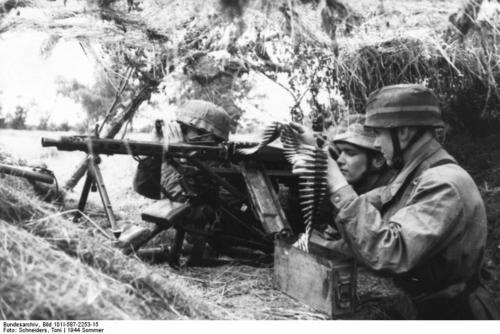
The MG 42 machine gun.
So the Americans could hear, but never see, in the tangle of the hedges, who was killing them so efficiently. The bocage quickly transformed G.I.s, with supreme indifference, into either hardened veterans or into casualties.
American soldiers, adaptive and imaginative, eventually would develop the tactics to overcome the kind of war the Germans fought in the bocage.
But for Martinez’s 79th Division, what lay beyond the hedgerows in early July may have been worse, because the Germans would not wait for them this time: this time they would attack.
The 79th, fighting in echelon with the 82nd Airborne and the 90th Infantry Divisions, seized a ridge and several hills around a key crossroads at a village called Le Haye du Puits.
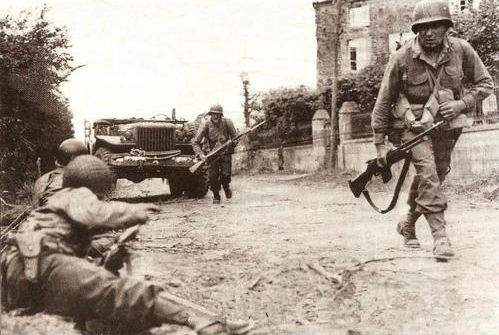
79th Division GIs taking fire, Le Haye du Puits. The GI at the right carries a Browning Automatic Rifle.
This should have compelled the enemy to abandon the town. They didn’t. They attacked instead, on July 7, intent on destroying the 79th in their positions on the ridge above the town.
The German soldiers, including SS-Panzer units, attacked with great ferocity and with great courage. These were not garrison troops, but hardened and determined professionals. They attacked in surges all day and only at nightfall did it become clear that the 79th had stopped them.
This was the turning point. On the next day, in another day of street fighting, the Americans would capture Le Haye du Puits.
Afterward, Signal Corps photographers attached to the 79th captured the images of some soldiers, their faces as blank as those of sleepwalkers. They are utterly worn out, used up, by a month of ceaseless combat.
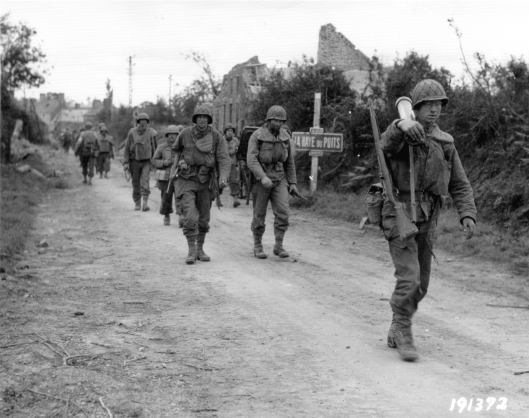
By the time Le Haye de Puits was secured, Domingo Martinez was gone. He was killed during a furious series of assaults on a little village called Le Bot, just to the south, and so would not experience the energy and the jubilation of the breakout from Normandy, which came soon after.
For the next three weeks, the Americans would roll up the Germans, then uncover Paris and liberate the city, standing aside to let Free French units enter first.
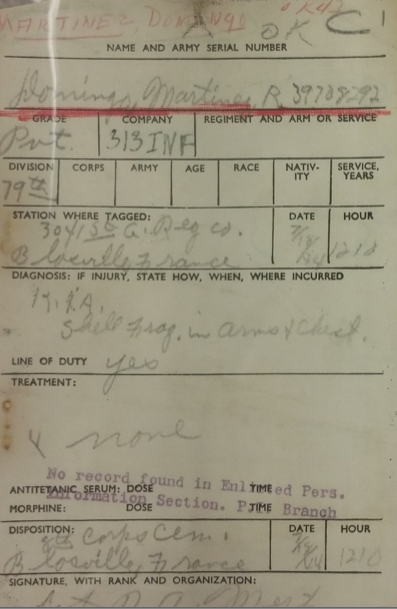
The Graves Registration record of Martinez’s death. He was most likely killed by German artillery–his regiment came under intense fire from 88mm guns.
You cannot help but wish that Pvt. Martinez had been granted enough time enough to follow the French into Paris, and maybe, even better, a week’s furlough for a farmworker, now a soldier, to explore the incredible city.
Domingo would decide to visit Notre Dame. Once he had entered the great church, he would remove his garrison cap, dip his fingers in the holy water font, then cross himself.
He would turn, blinking a little, to take in the vastness of the place, and then he would walk up the nave—the silence pressing on his ears–slowly past the clutter of pews. There, at the transept crossing, he would stop suddenly to stand, smiling with delight, as he was bathed in brilliant, colored sunlight.
This is the gift of the Rose Window to men and women of good faith.
It is your good faith, and your faith in your country, that has marked the World War II generation. Your faith sustained America during the war, and it made my life as a free American possible afterward.
I can’t thank you adequately enough today. But five years ago, I found your brother, Domingo Martinez, in the American Cemetery at Normandy. I gently touched the cold marble of his soldier’s cross and so did eight of my Arroyo Grande High School students. We spoke to him without the encumbrance of words.
That was one way of saying thanks. Now this young soldier belongs to a new generation of Americans.
15 Wednesday Apr 2015
The Breed Act forbade borrowing another California’s driver’s vehicle without permission, but neglected to assess a penalty for its violation. This old article points out the folly of such a law by spinning this story:
The Bakersfield Californian
April 10, 1925
Keefe Arrested Now comes Ed Keefe of Taft into the story. Not so long ago Keefe. a young man, became intoxicated In Taft, borrowed a car without leave of the owner and in a wild-eyed attempt to emulate the harrowing speed of the wilder-eyed Darlo Resta, wrecked the machine, authorities allege. With dispatch, officers of the Taft constabulary incarcerated the young man and the new charge made one of its maiden appearances opposite the name of Keefe, who Is no relation to the ball player.
The charge was “driving an automobile without the owner’s consent.” Keefe pleaded guilty to the felony and asked for probation. The court considered that It was his first offense; that he had a young wife and baby to support and granted the plea for leniency.
Shortly after probation was allowed Keefe was arrested again by the Taft police who accused him of doing everything except making an attempt to roll the streets of the oil town. Again Ed Keefe appeared before Judge Mahon last week. Keefe denied before the court that he had attempted to apply the crimson brush to the portals of the West Side city, explaining that he had merely gone home to “sleep it off” in a genteel manner. After a severe reprimand and an order to behave, Keefe was given his freedom. He promised faithfully to accept the mandate of the court.
Third Time
Today, Keefe appeared In court for the third time. Taft officers had pounced on the young hopeful again. They argued that he had attempted to mitigate the woes weighing upon his weary shoulders by a prolonged absorption of paint remover, often labelled synthetic gin or Scotch, according to the whims of the labeller.
The Taft officers informed the district attorney’s office that Keefe after “getting likkered up” had gone home where he endeavored to “beat up” his wife until the majesty of the law crimped his style. Judge Mahon made the young man the subject of a third excoriating reprimand, regretting that he was unable to imprison Keefe. The court reviewed his leniency granted In the hope that the defendant would “behave himself” and then predicted that Keefe would soon appear In court again with the label of some bona fide charge with a penalty attached.
Given Freedom
To the neglect of the framers of the Breed Act, young Keefe owes his freedom. His wife wants to give him even more freedom for she has filed a complaint for divorce…
The writer is heavy-handed, too arch for his own ability, but young Keefe is too rich and too pathetic a target to pass up. He deserves every lash of this bush-league Mencken’s whip.
The problem is, Ed Keefe is my grandfather.
He was Irish–his father was born in the Famine years—and Ed would be the tenth of eleven children born on a Minnesota homestead, would become the love of my grandmother’s life, and, when he had disappeared by 1927, he left an emptiness in my mother’s heart that would never be filled.
She spent the rest of her life wondering about him. My parents even hired a detective to try to find him, and I’ve spent years searching for him on the internet–uncovering instead a cache of respectable, middle class, well-educated and pious Keefes, including an unexpected nun. I found their ancestral village, Coolboy, in Wicklow, then traced where nearly every one of them, in a trail that leads from Ontario to Minnesota to Kern County, was married and buried, and Edmund is not even a whisper. Not even a footnote.

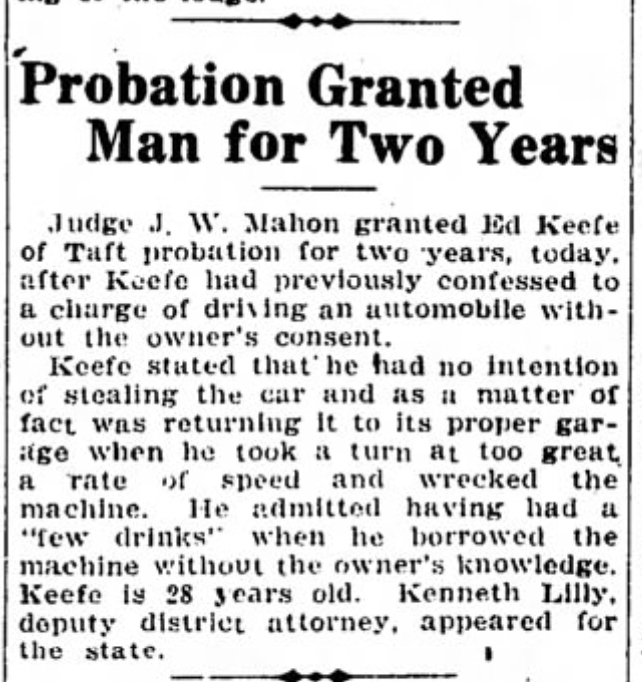
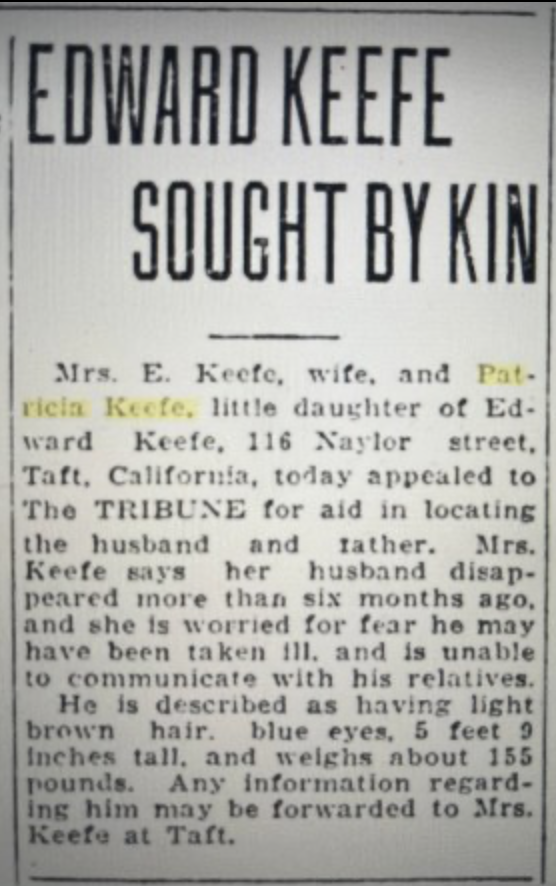
Update, May 2025. That wasn’t that Ed “borrowed” a car. The first two articles are from July and August 1924; the third, when he’d gone missing, was from an October 1925 Oakland Tribune.
Last night I accidentally googled this story. I reflexively wanted to punch out the man who would strike my grandmother–my Grandma Kelly, when she married another, more reliable, Irishman, a Taft police constable–and who would have so terrified my mother, four years old at the time of this news story, with all the violence it implies, buried or lost in her memory, a good thing. She never found him, which she thought a bad thing.
Ed Keefe didn’t to deserve to play the ghost that haunted my mother’s memories– he hadn’t enough character or weight or importance. But he was her father. And he’s not important enough, either, for me to hate. But he was my grandfather. Actions like these–impulsive, thoughtless, outrageous–suggest to me that he was already a lost cause at 28, and that his alcoholism almost certainly had deeper roots, possibly in bipolar disorder or in the depression that has stalked both lines of my family and has followed me in my own life from the day that it took my mother’s.
My step-grandfather, the police officer, George Kelly—my Gramps–was the grandfather any boy would want. Once, long before I was born, in a story that made me shiver when my Dad told it, three oilfield roughnecks jumped him in an alley while another officer, Pops Waggoner, was enjoying a Coke-and-something-else in the Prohibition-era Taft Elks Lodge. Pops heard the scuffle and stumped, with his wooden leg, down the stairs to the alley and was too late. He found three unconscious men and one intact and upright Irish cop, in need of a new uniform. That was the same Gramps who played catch with my two-year-old son two decades ago with a little rubber ball and played so gently and talked such soft and silly nonsense—the language of very small children– that my son, John, fell a little in love with him. As I had.
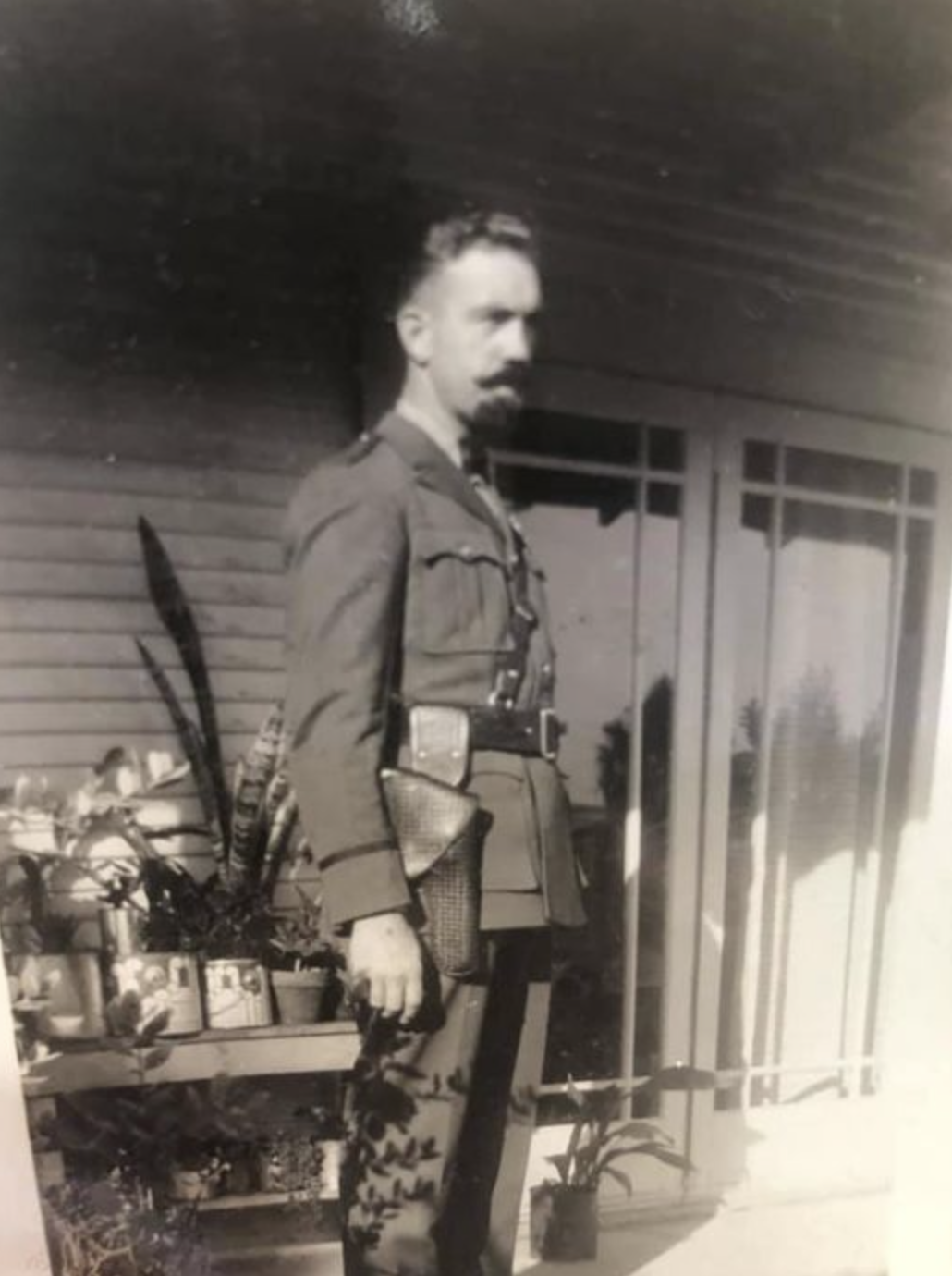
So I am no more comfortable about feeling sorry for myself over the accidents of biology and genetics that have flawed the lives of my mother and me than I am with punching a dead man. In fact, the story about Ed Keefe only made me love my mother more. She never had the inclination, or the self-regard, to understand that no victory she won in her life was too small. I am fascinated by this page from her senior yearbook, the 1939 Taft Union High School Derrick.
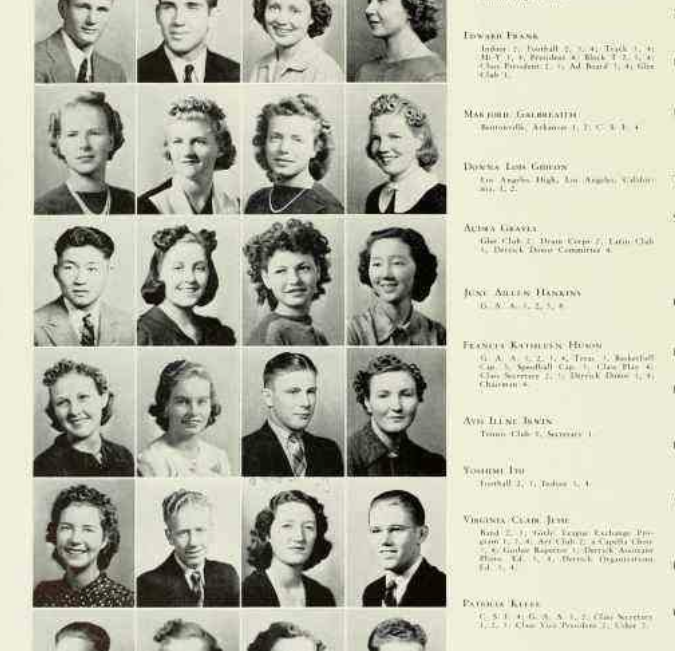
Her natural curls are shaped in a way that’s suggestive of Shirley Temple’s moppet locks or Gone with the Wind’s Butterfly McQueen–1939 was the year that film premiered–and in her pose, she’s looking backward, over her shoulder. What’s pursuing her might have destroyed anyone else far earlier: Her father was a drunk, a kind of charming and feckless village idiot, the butt of the Bakersfield Californian, with all the literary majesty that this newspaper possesses, and so she would have grown up with that inheritance and with all the cruelties children can inflict on each other, in bloodless wounds that never heal.
But.
She is in CSF, GAA, she is class secretary, class vice president, and there is nothing in that face that hints at defeat or humiliation or isolation. With a father as absurd as hers it is not absurd at all to draw an inference from a source as trite as a yearbook page and its little clutters of honoraria, from such a distant time and place.
So this is what I have learned in the last two days about my mother:
She would never stop glancing back over her shoulder. But, at 17, at Taft Union High School and Junior College, at the end of an era that had wounded and humiliated an entire nation and on the cusp of one that would make our power nearly unlimited, a lonely little girl had found her identity. She was a year away from marriage and four from motherhood, which would become her greatest and most enduring gift. She would strike sparks in my life: a love for learning, a fierce sense of social justice and a hunger for God’s presence–the last, a lifelong irritant that I cannot get rid of, no matter how hard I try.
I cannot tell you how much I admire her.
09 Monday Mar 2015
Posted in Uncategorized
02 Monday Mar 2015
Posted in Uncategorized

My Grandfather’s farmhouse and the Blue River in Texas County, Missouri. It is beautiful there, but this is where a gunman killed six and then shot himself last week.

There was a very disturbing article in The Daily Beast: Texas County today is marked by the suffocation of Pentecostal and fundamentalist churches who keep vigilant watch over the ugodly, which probably includes a smattering of Episcopalians and Catholics. They’ve bought up nearly all the local liquor licenses to keep the area dry, in an Ozark variation on Sharia Law.
Life there is also marked by chronic and deep-rooted joblessness, by a thriving trade in meth and by meth addiction, and by violence. Sometimes folks just vanish.
It sounds like a scary, hopeless place, and it was once a place of pretty little farms, pasturage grazed by horses that were a family’s pride, forests full of game, and neighbors who looked out for each other.
During the Great Depression, the New Deal and electricity–and hope–came to Texas County, because we agreed that we all have an obligation to look out for each other. Today, all Congress can do is bicker, delay, posture and sulk. These are good people. What is to be done?

 A Work in Progress