Devotion

Franklin comes home to Brooklyn.

…In the spring of 1945, an Arroyo Grande sailor and a native of Luzon, Camilo Alarcio, would find himself fighting for his life and for the life of his ship off the Japanese coast in after-combat action that went beyond the dramatic: it was miraculous.

Alarcio, as Felix Estibal had been on the doomed destroyer Walke, was a mess attendant, assigned to the aircraft carrier Franklin. In March 1945, Franklin’s 100 aircraft were engaged in raids on Kagoshima, Kyushu—the seat of the prefecture from which most Arroyo Grande Japanese had emigrated—when the Japanese struck back on March 19.

It was a little after 7 a.m., and Alarcio likely was serving breakfast, which that day included the Navy’s infamous powdered eggs, to some of Franklin’s 3,000-man crew when a Japanese “Judy” bomber somehow penetrated the carrier’s defense screen and made direct hits with two 500-lb. bombs. More than thirty aircraft, their ordnance and their fuel lines were packed on the main deck: Franklin seemed likely to share the fate of Admiral Chuichi Nagumo’s Pearl Harbor striking force when, at Midway in June 1942, American fliers had discovered four of his carriers, their flight decks laden with bombs, gasoline lines and aircraft, and sent them to the bottom in flames.

The bomb forward flipped a 32-ton elevator high into the air. like a flapjack, in a pall of smoke, instantly killing hundreds of crewmen. Twelve of the 13 pilots in the famed Marine Corps “Black Sheep” Squadron, based, since the beginning of the year, in Goleta, died in their ready room. The concussion knocked survivors flat. The second bomb exploded belowdecks. These were, or appeared to be, two mortal wounds.

It wasn’t over. Secondary explosions shook the carrier as fires reached twenty more aircraft, fueled and ready for flight on the hangar deck; those fires continued, throughout the day, to set off stores of bombs, rockets, anti-aircraft ammunition and aviation gasoline. At one point, the violence inside Franklin made the 32,000–ton ship shudder and spun her, like the needle on a compass, hard to starboard, where she lay dead in the water. She then began to list ominously to starboard, threatening, as the hours passed, to founder under the weight of the thousands of tons of water used to fight the fires onboard. 

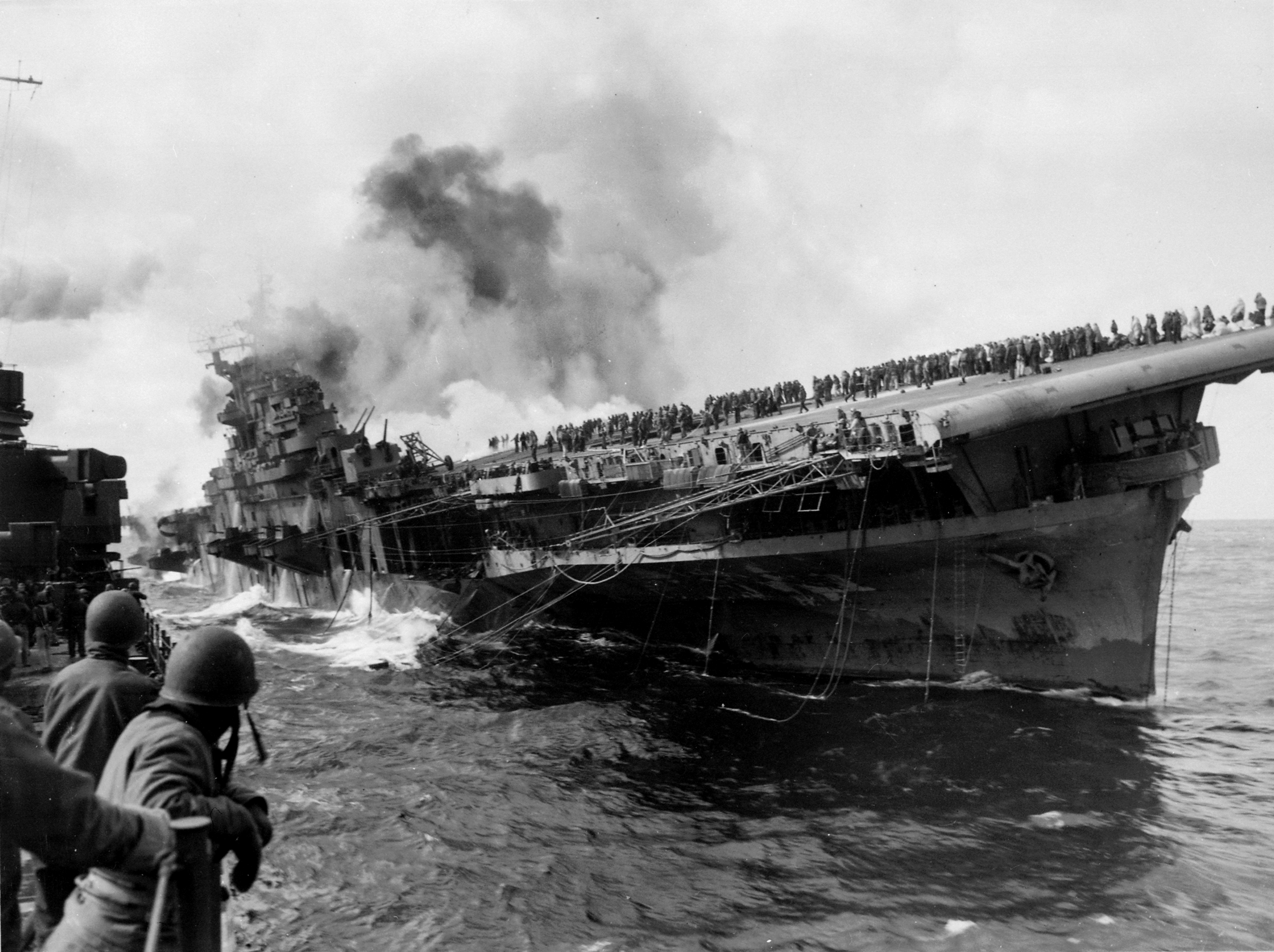
The cruiser Santa Fe alongside the crippled Franklin

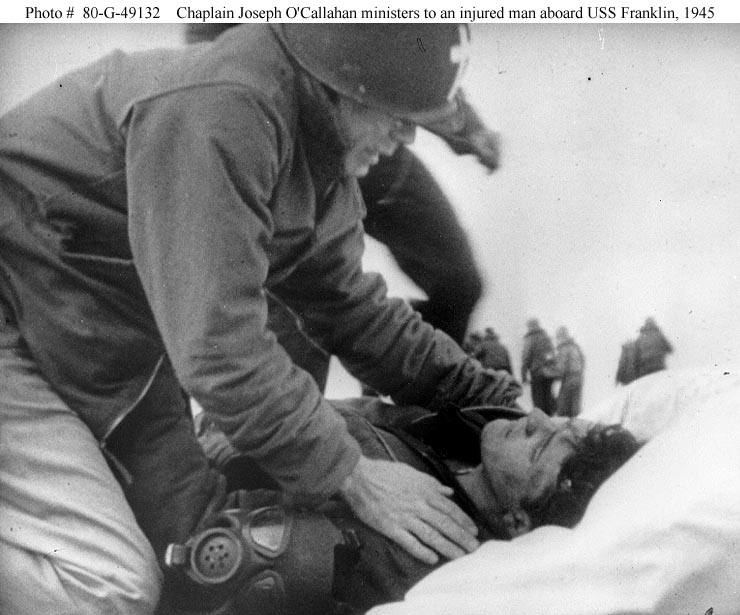
The explosions had killed or wounded a third of the carrier’s crew–the biggest single-ship toll since Arizona–but the survivors refused to give up on their ship and their home. Among them were Alarcio and a man, from shipboard Mass, well known to him: Father Joseph T. O’Callahan. Franklin’s chaplain was immortalized that day in a moment of combat footage that shows him, with immense tenderness, giving the last rites to a dying sailor. Survivors remembered him everywhere as the ship struggled to survive–he was easily identified because of the white cross he’d painted on his helmet–encouraging his boys, directing fire control parties, and leaning in close to hear the weakening voices of those who’d been wounded. He was constantly motion as were his lips, constantly in prayer.

O’Callahan would win the Congressional Medal of Honor.

OCallahan_JT_g49132 (1)

While her crew worked to stabilize the ship, the cruiser Santa Fe was a constant companion alongside, fighting fires and evacuating the wounded.  Eventually, Franklin was taken under tow, but only until her boilers could be re-lit and she could begin to make for Ulithi, in the Caroline islands, for emergency repairs. Two admirals had recommended that the crew abandon ship. Instead, 24 hours after the bombs struck, Father O’Callahan had fallen asleep halfway down a ship’s ladder and Alarcio and his shipmates were able to return to the task of feeding the crew: they were making Spam and bacon sandwiches.

Franklin’s voyage would not end at Ulithi. She would put in at Pearl Harbor and then, on April 28, 1945, the “Big Ben.” her scars still visible and grievous, would return home, to New York harbor and the Brooklyn Naval Yard.  The carrier’s flight deck that day is shown below.

The ship would survive, and so would Camilo Alarcio, who would live to be 97. He became the much-beloved father and grandfather of a large, vital and attractive family; his children and grandchildren would make their mark in Arroyo Grande as superb athletes. 

A single adjective in his obituary and on his tombstone seems to summarize his character, and the characters of his brother Franklins, best: “Devoted.”

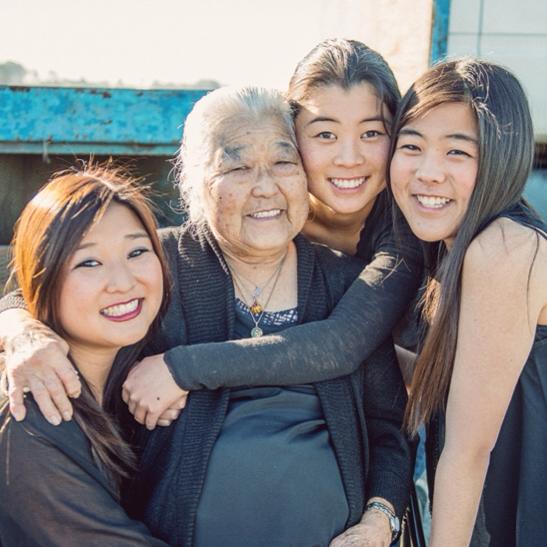
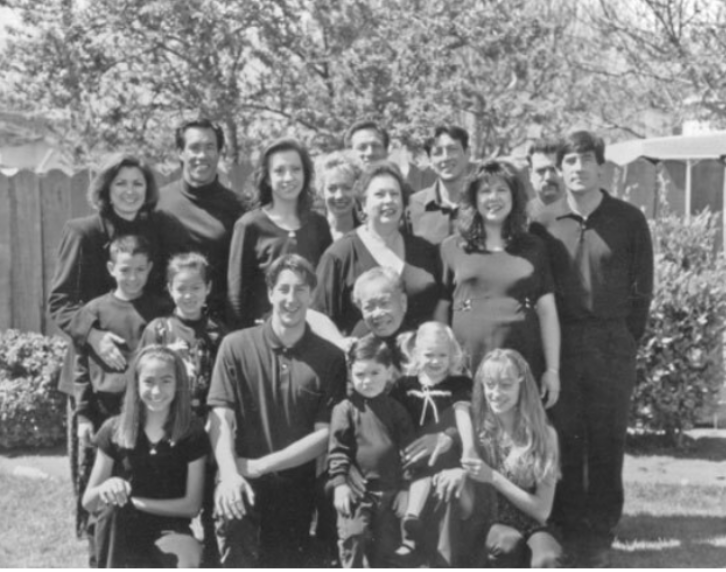
Alarcio and that family that loved him.

Brother and Sister

20150705_164657

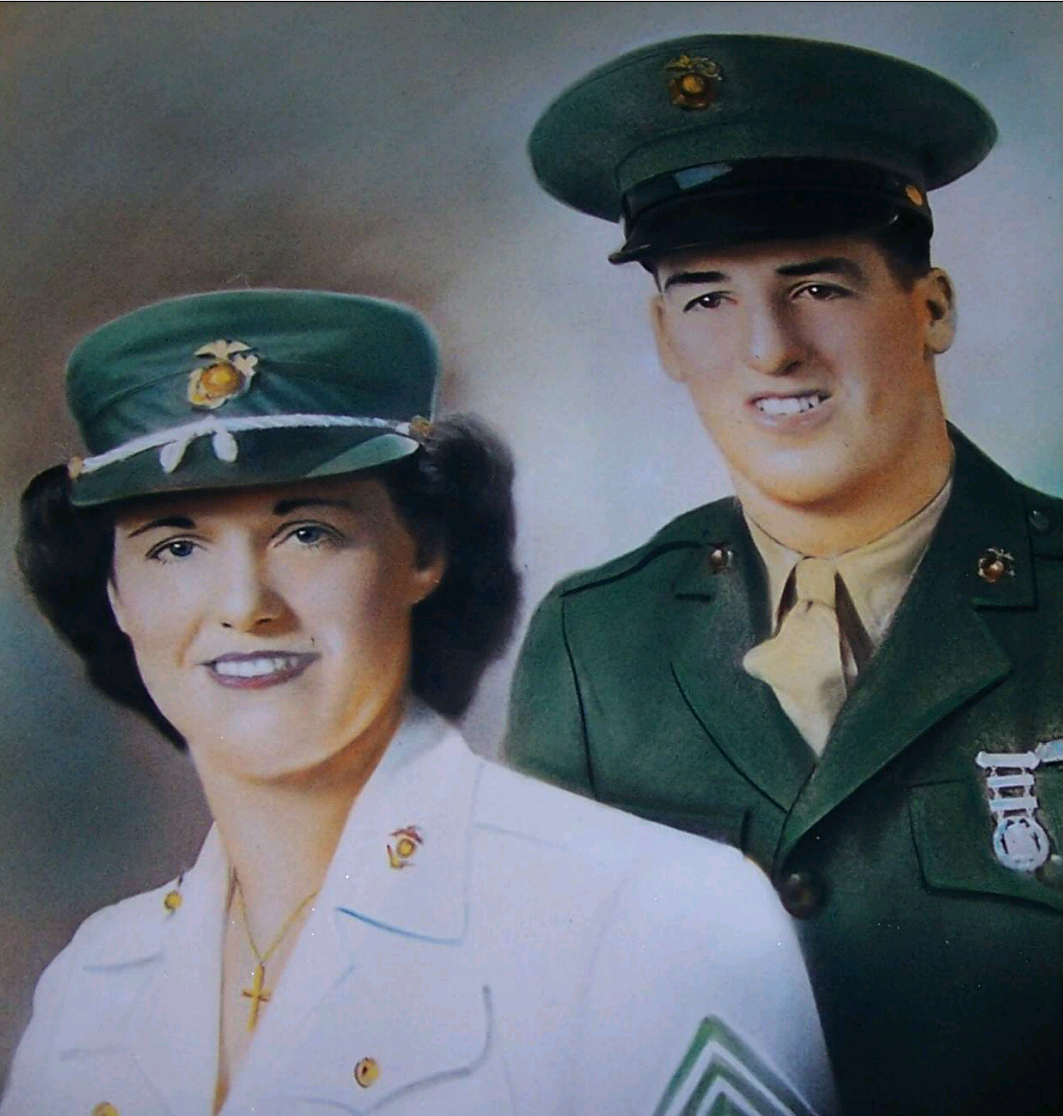
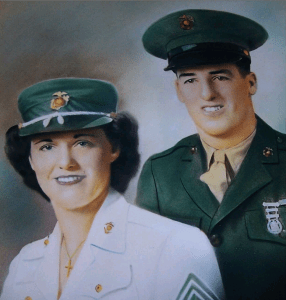
Thelma and George Murray, in a composite made for their mother.

If Guadalcanal was a turning point, Tarawa was one of the most terrible teaching moments of the American war, and it led to two close encounters with history for a brother and sister from the Lower Arroyo Grande Valley, from the little town of Oceano. This is where the farm fields end at steep seaside sand dunes, and here are the packing sheds and the loading docks alongside railroad tracks that carry Valley produce to distant markets.

The brother was a Marine private, George Murray, who was killed in action in the in the Battle of Tarawa in the Gilbert Islands in November 1943.  It was a horrific battle—one of the best accounts of it comes in an aptly-titled book, One Square Mile of Hell–in which many mistakes were made. Murray didn’t die in vain, for the mistakes made at Tarawa, the first objective in Adm. Chester Nimitz’s Central Pacific island-hopping campaign, would save the lives of later Marines and of the dogfaces who landed on the coast of Normandy seven months later.

One of the mistakes in this pioneering amphibious assault was in was in the miscalculation of the tides at Betio Island, the key objective in the Tarawa Atoll, which shifted capriciously and so left many of the Marines unable to land on D-Day, on November 20. Their landing craft, the Higgins boat, was unable to surmount the coral reef that guarded the approach to Betio’s landing beaches.

George Murray was among them. While earlier units took such intense fire that 2200 of the 5000 Marines in the initial wave were killed or wounded, his unit, the 1st Battalion, 2nd Marine Regiment, spent most of D-Day, November 20, circling, hour after hour, outside the reef, impotent. It must have been maddening for them, and they were hungry, wet, seasick, and terrified.

It was close to 10 p.m. when Murray’s company was finally ordered to land in support of the first waves, desperately clinging to a sliver of beach below a sea wall and flanking a pier on Betio. The Marines had to transfer from their landing craft—the Higgins boat was essential to the war effort but this day was impeded by the reef—to LVT’s, the smaller amphibious tractors that also were facing their first test under fire. Murray’s company would hit the beach at about 11:30.
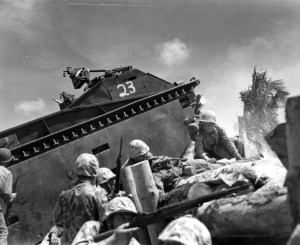
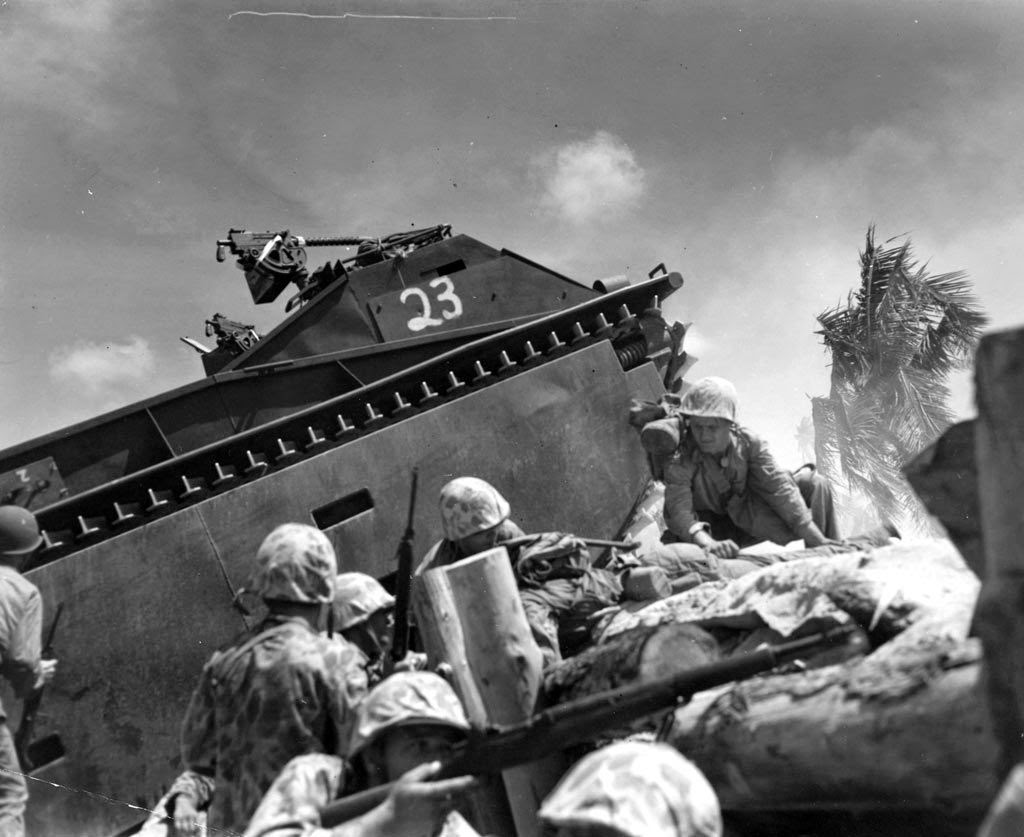
Marines use an amphibious tractor for cover on the beach at Betio Island, Tarawa.

Marines use an amphibious tractor for cover on the beach at Betio Island, Tarawa.

A Department of Defense summary prepared for Murray’s descendants is both colorless and oddly moving in its description of what happened at that moment:

Three tractors of Company B landed on the left side of Red Beach Two. When the men tried to disembark from the first two tractors, only nine of the twenty-four men actually reached the beach…Private First Class Murray’s Casualty Card indicates that he died of gunshot wounds to the head and chest on 20 November 1943. Private First Class Murray was reported buried in East Division Cemetery…Row A, Grave 6. Based on PFC Murray’s recorded circumstances of death and the indication that he was initially buried at this location, it seems likely that PFC Murray did make it to the beach before being killed.

PFC Murray didn’t make it home. His remains have since been lost. Local historian and museum curator Linda Austin has joined Murray’s nephew and namesake, George Winslett, in a long and emotionally-charged search, lobbying the Defense Department and winning the support of JPAC—the Joint POW/MIA Accounting Command—in the search for Murray. In a tragedy of errors, Navy SEABEE teams reorganized and reconfigured East Division Cemetery after the battle; after the war, Army Graves Registration teams, guided by information from Marine Corps chaplains present for the original burials, could not find the cemetery. After digging several cross trenches, the team finally began to find graves—but only 129 of the more than 400 they’d expected. Several sets of remains were transferred to Hawaii for identification, but Murray was not found, either on Betio or in the forensic labs on Oahu.  For his mother, Edith, it was like losing her only son twice: she now had no formal way to honor him. She was heartbroken.

So was Murray’s sister, Thelma. She wasn’t willing to wait to honor her younger brother—they were two years apart–so she, too, joined the Marines. She became a driver–and a good one—stationed at Camp Lejeune, North Carolina. Thelma eventually would marry another good driver, a truck driver, Elmer Thomas Anderson, with whom she’d hitched a ride from home in Oceano to a new duty post in San Francisco; Anderson drove for what would become Certified Freight Lines, located where the Bank of America now stands on Branch Street. An honorably discharged Army Air Force staff sergeant, Elmer would sometimes debate good-naturedly with his bride of more than forty years on who, precisely, outranked whom.

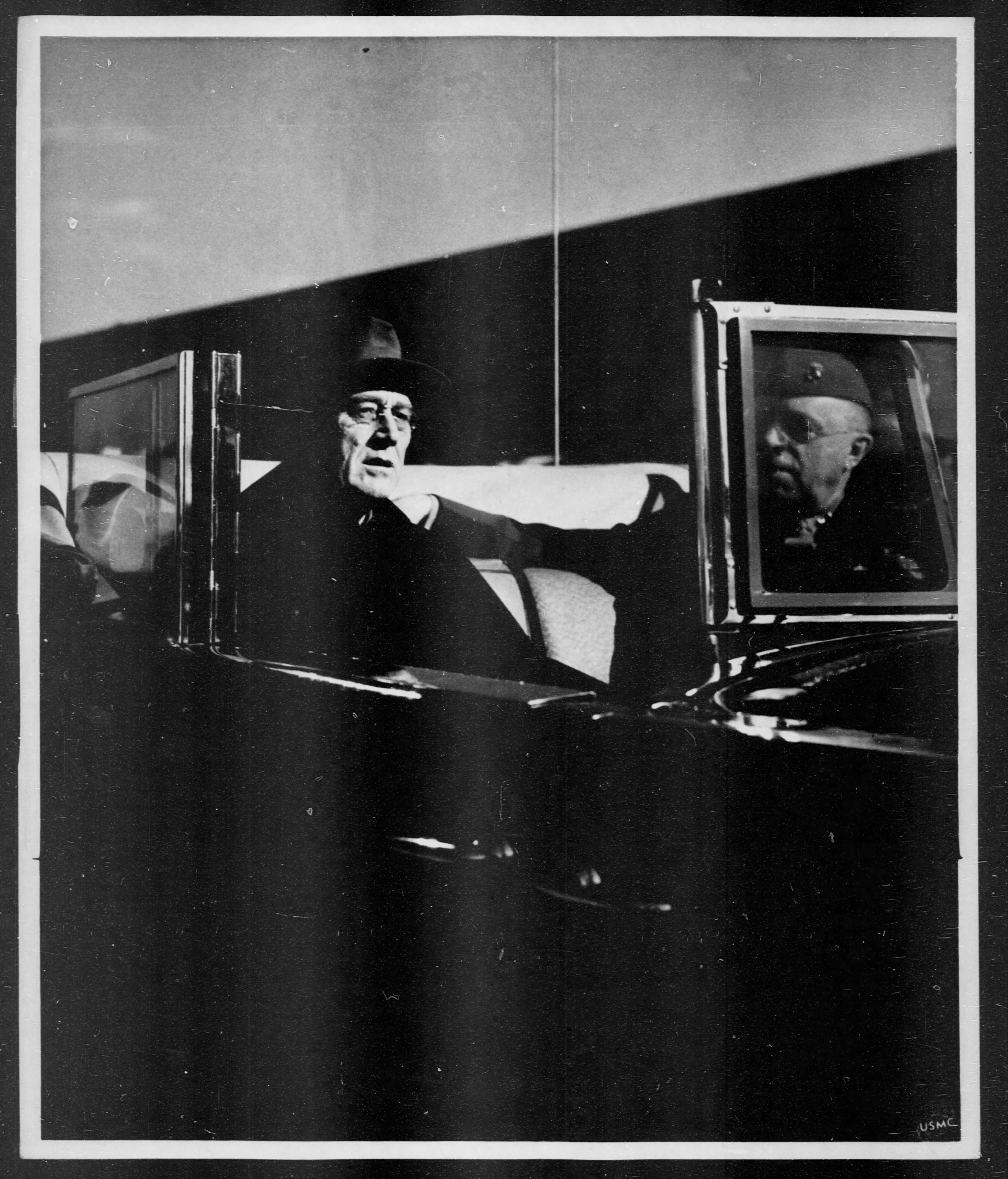
One of Thelma’s assignments as a driver at had come when a dignitary visited Camp Lejeune on December 18, 1944, and he had to have the best Marine possible to transport him. Marine Lt. Gen. Herbert Lloyd Wilkerson, a Guadalcanal veteran, was an officer trainee that day. He remembered, in a 1999 interview:

The black cabriolet, with its top down, pulled up close to our commanding officer, LTCOL Piper, who presented us to the Commander-In-Chief. I was in the front rank within 20 feet from the auto and could hear their voices. The auto was driven so close to the commanding officer that he hardly needed to move to reach the side of the vehicle.

The driver needed to be exact, because the dignitary couldn’t get out of the cabriolet and so reveal his paralysis to the fit young Marines.

Thelma’s passenger that day, of course, was President Roosevelt.
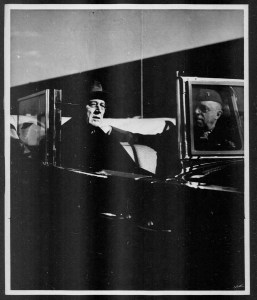
FDR at Camp Lejeune 18 Dec 1944

FDR with the Camp Lejeune commanding officer, December 18, 1944.

Deep waters

b17298183bd616eed9101deebf3312259dd3c7f9

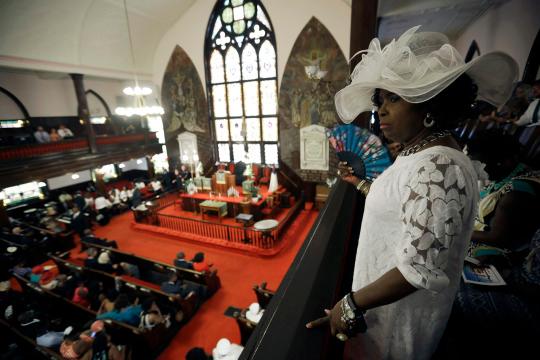
Mother Emanuel this week reminded me of this lesson, in the link, that I used to teach in European history.

Christianity, it seems to me, is sustained by humility and forgiveness, and those two are streams fed by deeper waters still. The AME congregants I saw this week, just like the Amish in the Reformation lesson, drink from those waters. By contrast, I see so much barrenness in so much of modern American Christianity.

What I see instead of humlity and forgiveness are arrogance and sanctimony. I see hypocrisy. I see the comfort the weak and ostensibly victimized find in divinely-justified hatred. I see a passion for retribution, a weakness for corruption, and a smug anti-intellectuallism. What a sad waste, since we already have a Congress for these kinds of things.

How life-affirming and how liberating real Christianity can be! Mother Emanuel reminded me of that–as does Pope Francis– and so this week a Charleston church in deepest grief gently humbled me down to Jesus’ level, down to where I would always aspire to live were my own life not so narrowed by pride.

 http://www.aghseagles.org/apps/video/watch.jsp?v=58842

Little Sister

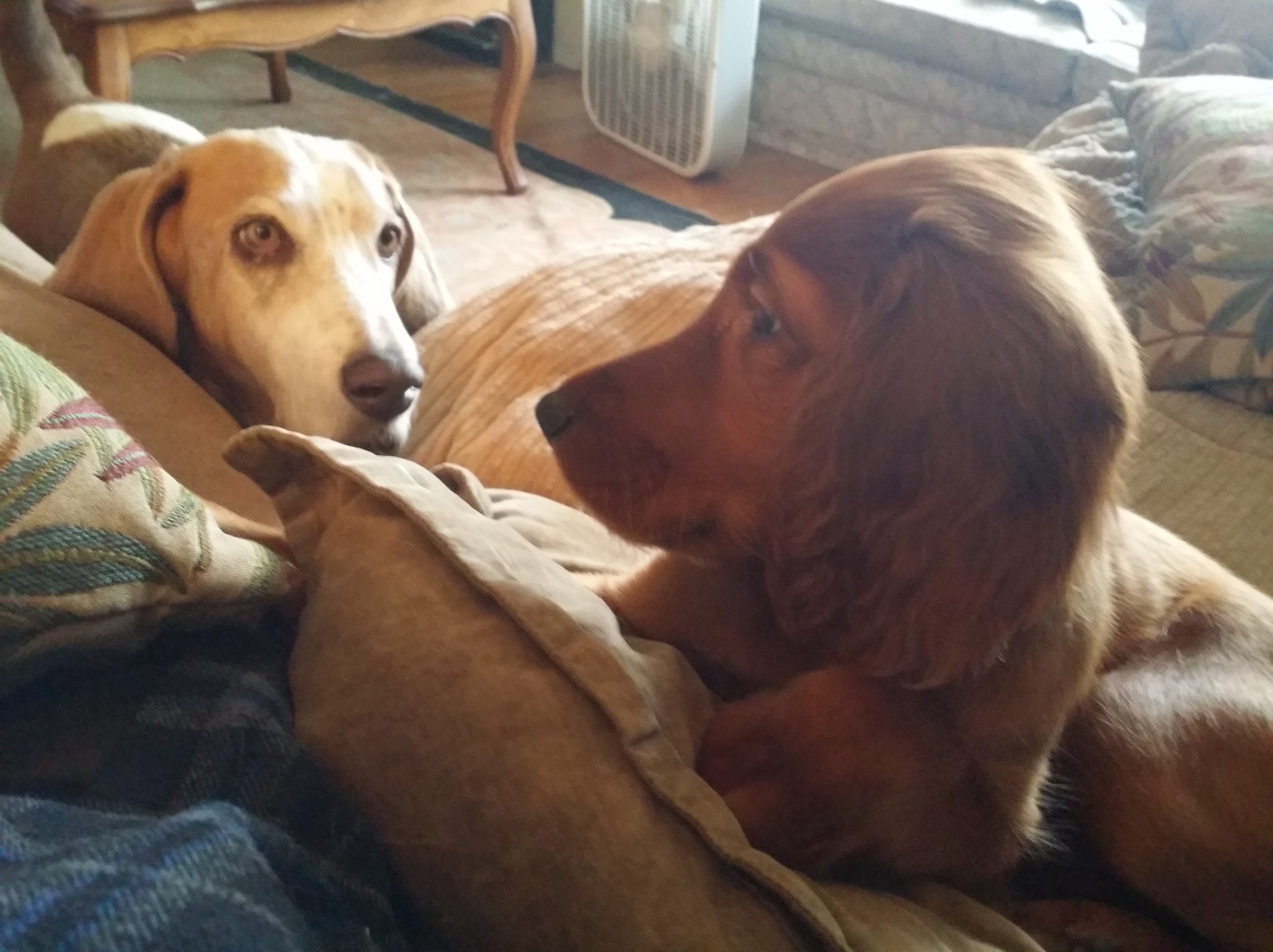
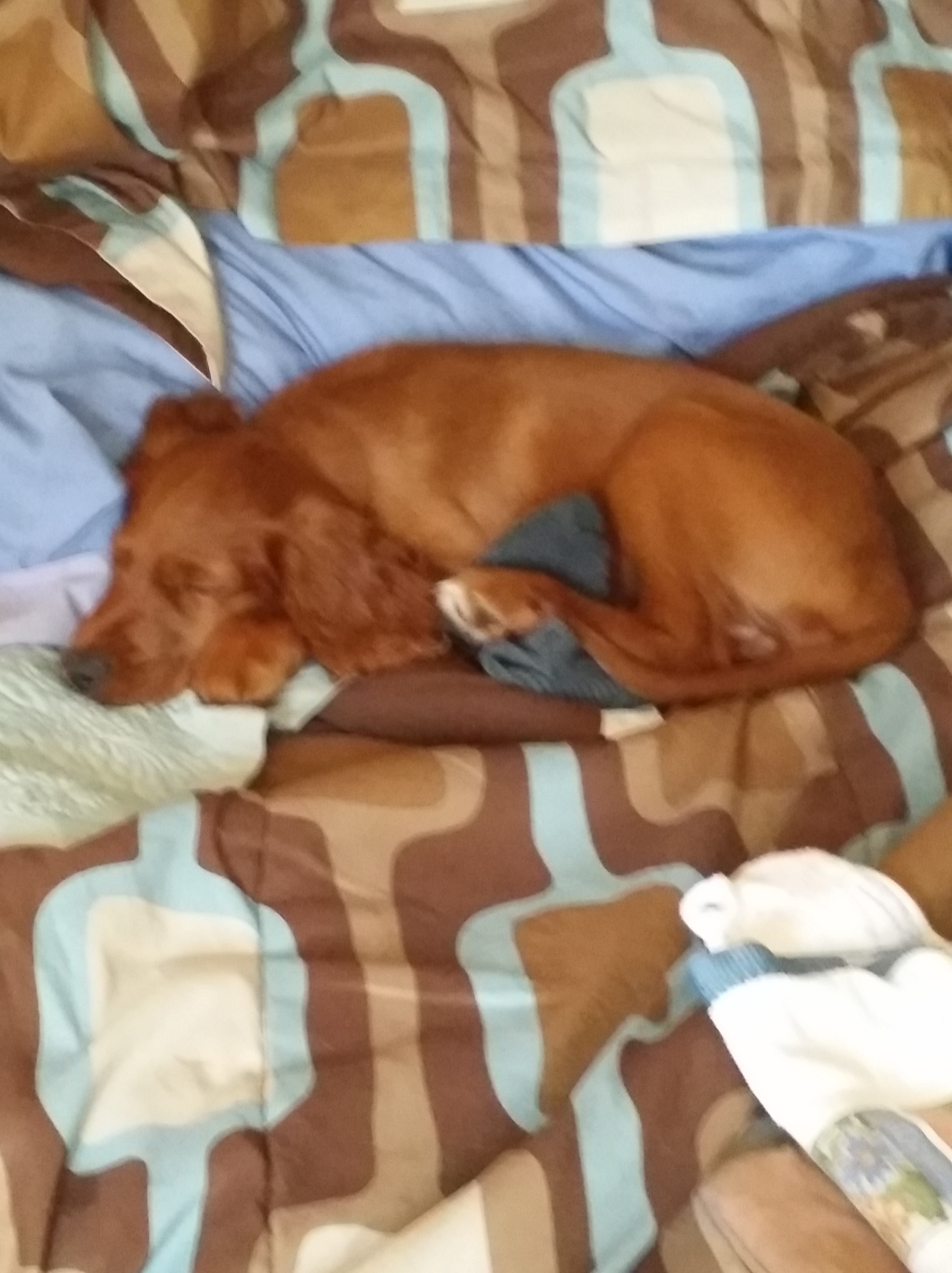
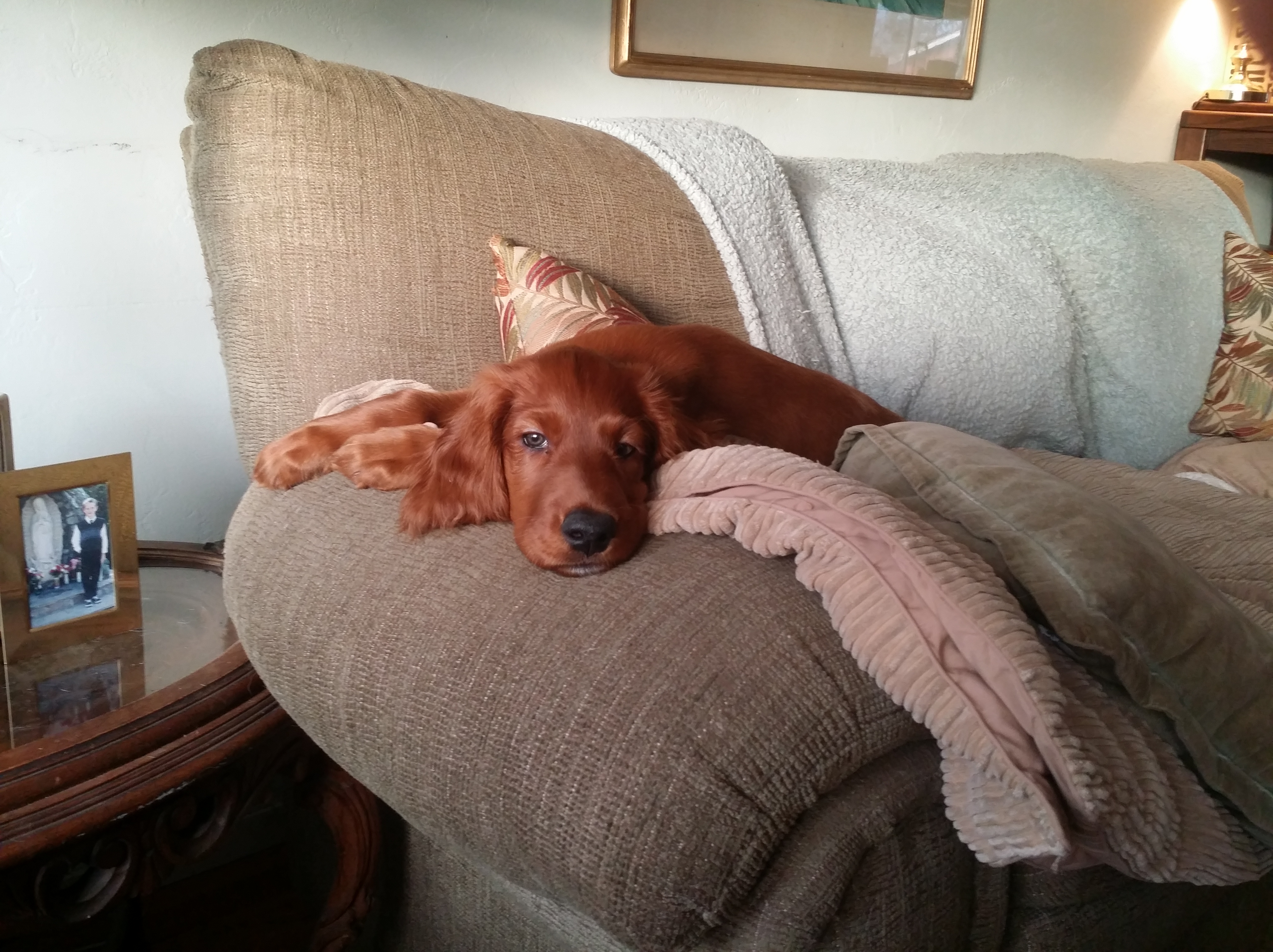
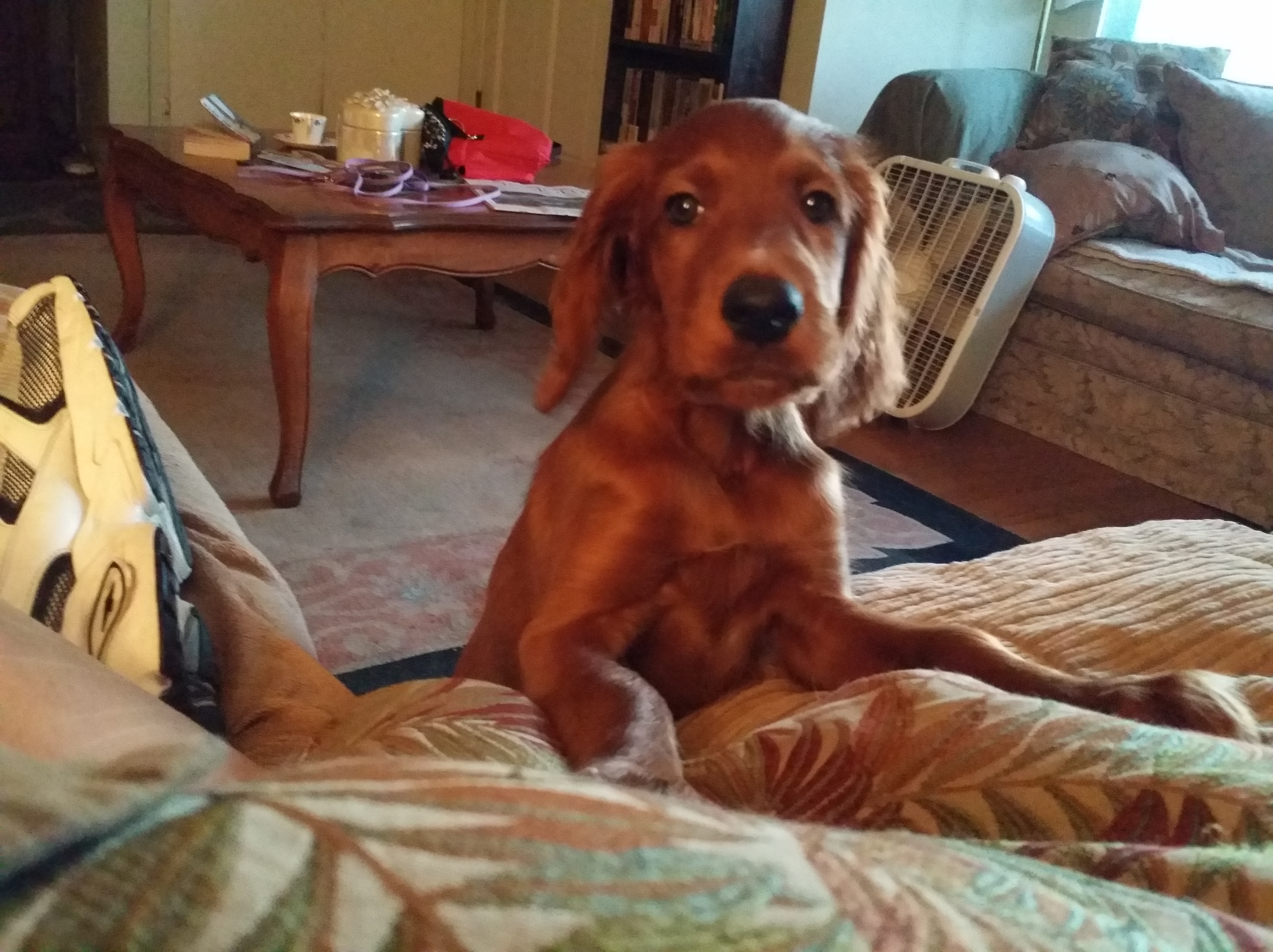
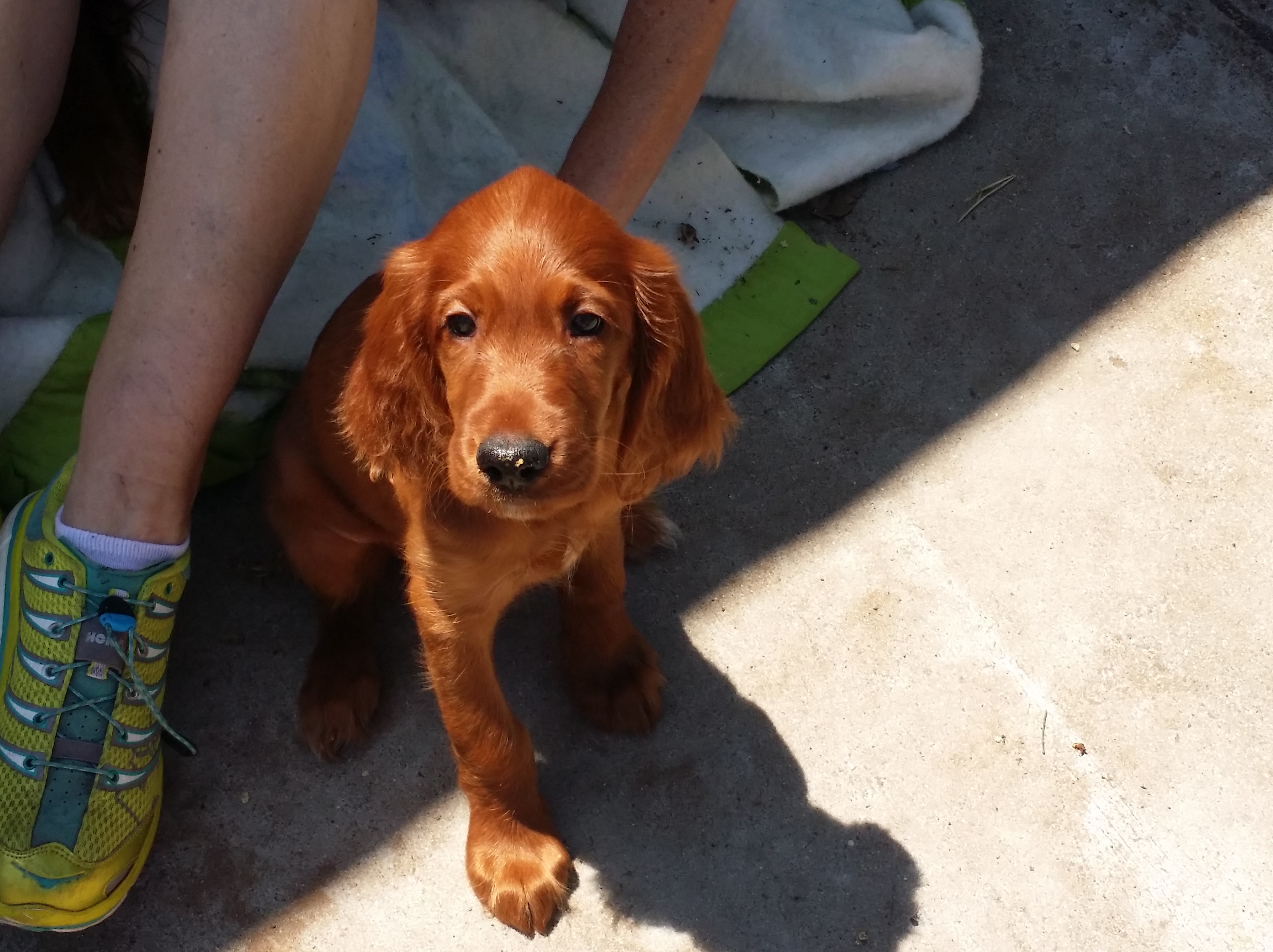
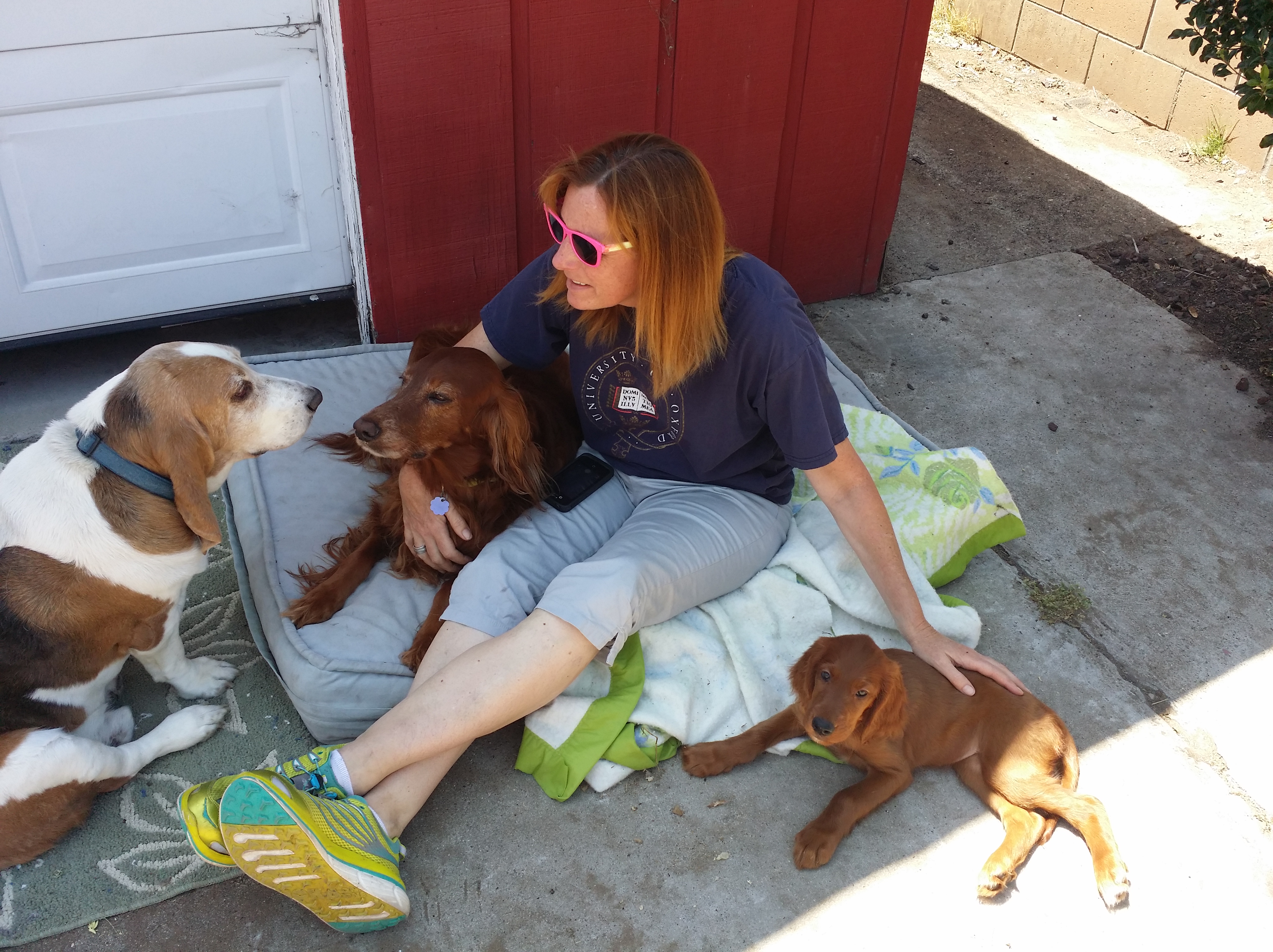
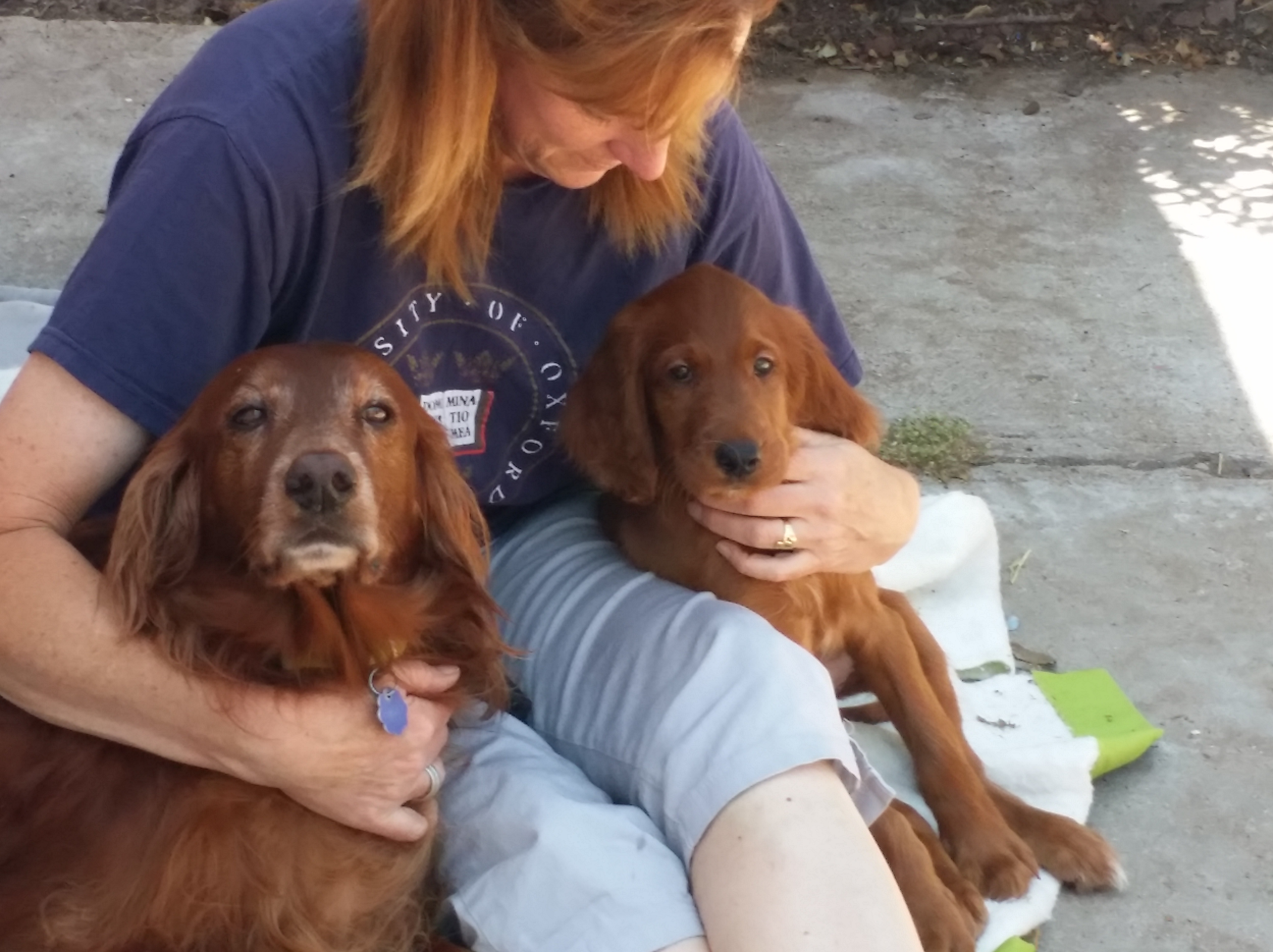
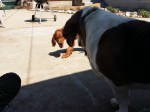
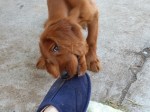
20150621_16151020150621_14343720150621_14374820150621_144021Our newest family member: Eight-week-old Irish Setter Brigid.

Burn them all

Confederate-flag-South-Ca-007

South Carolina state representative Doug Brannon, a Republican, will introduce a bill to bring down the Confederate battle flag at the state house because he lost a friend and colleague this week. He’s got the full support of Russell Moore, a Mississippian and the head of the Southern Baptist Convention–the sect that seceded along with the Confederacy–because, as Moore put it, he lost a brother in Christ.

I’m named after my great-great grandfather, a Confederate brigadier general, and my middle name is his son’s, a Confederate staff officer killed in action in 1862. Because of that connection, we had a Confederate battle flag, too, a souvenir from a 1913 veterans’ reunion. We kept it hidden in a closet. Maybe we were proud of our ancestry, but nobody in my family had the appetite to celebrate treason or to celebrate the kidnaping, brutalization and enslavement of human beings.

Put away the flag. Better still, burn it. Burn them all. Can you really cite “freedom of speech” to defend an object that symbolizes the denial of all human freedom?

Charleston Reflection

o-OLD-COUPLE-HOLDING-HANDS-facebook

There was an elderly black couple at Costco today and they were discussing the merits of buying locally-produced honey. They had been married a long time, I think, and were very comfortable in the easy way they talked together, and there was a dignity there that you can see in good marriages that have been tempered.

I could not fight my eavesdropping, but I successfully fought the urge to ask permission for a hug when I could whisper to each that everything will be all right. I studied a box of Stevia instead, which was infinitely more sensible, while they, in a moment of unexpected grace, brought unexpected tears to my eyes.

All of this, of course, is my mother’s fault: the twin curses she left me were compassion and the hopeless belief that we are, all of us, family.

I am my mother’s son, and, because of her, I know that I have lost sisters and brothers in Charleston that I will never have the chance to hold close—so close that we could, together, create a transformative moment when it really would be all right.

I lost family last night. I miss you all.

That lady who is now holding you close would be my Mom.

The American Girl

Leila and Claire at the Prom.

Leila and Claire at the Prom.

Leila will graduate next week and I will retire, so our ways really are parting. In the past, kids always knew where to find me when they came home on break from Cal or Davis or from the Army. Room 306 will belong to someone else next year, so the future of the Class of 2015 with me is less certain.

Each class leaves its mark–when last year’s Seniors broke into a mass flash dance at graduation, it was so unexpected and so delightful that I will never forget them.

Leila is one reason why I have a special fondness for this year’s graduates. The smile you see on her face is a constant: she radiates the kind of warmth and openness that captures others, but there is nothing calculated in the capturing. Leila’s smile comes from Leila’s heart. Today, at the Senior Assembly, she gifted me with a bouquet and fought her tears and seeing her struggle to master her feelings was an even greater gift. It’s good to know the love you’ve spent means something to someone so important.

I have rarely read a college letter that brought me to tears, but Leila’s did. One part told of her family’s trip to Egypt, to visit her grandmother. I saw photos of the woman and she has a kind of Leila-ness about herself, as well.  You want to volunteer to be her grandson.

Her health has not been good.  She had to have a mastectomy, and the passage I remember is when Leila volunteered to change the dressing on her wound. Her grandmother apologized for its appearance, but Leila did not hesitate and did not flinch, and I don’t think anything so clinical has been done with such gentleness and compassion.

The experience only reinforced Leila’s dream to become a doctor. We have common heroes–Doctors without Borders, a group I donate to even when I can’t really afford to. I could easily see Leila do their work. I immediately thought of her while listening to an NPR story about a doctor who lost 19 of the first 20 patients he’d treated for Ebola in West Africa. That had to be daunting,  but this doctor was a man of spiritual depth. “Curing disease isn’t the most important thing a doctor does,” he said. “The most important thing a doctor can do is to enter into another’s pain.” Leila has that kind of empathy and she has the spiritual strength to sustain it.

I will come to the obvious part. Leila is an observant Muslim, and as captivating and welcoming as her smile is, there are those–some have been in the news lately–who are blind to the kindness of others because it’s so threatening to the comfort they find in hating. Leila can take care of herself–she gets those reservoirs of strength from the deep wells her family has made for her–but she also is the kind of student who can provoke every paternal instinct a male teacher has.  You want to protect her from the blind and the bigoted who also have the unpleasant tendency to be loud.

The comfort is knowing that those people do not matter and have no enduring impact, unless you count, of course, the agonizing depth of the pain God feels when they broadcast their hatred.

I gained a lot of wisdom by talking to Haruo Hayashi this weekend. The Hayashis are a lot like the Assals–I saw three generations of a family whose bedrock is hard work, relaxing on a Sunday, watching television, reading, raiding the refrigerator, and all of them were present, were living in the moment, and the love you sensed among them was unforced and unpretentious, which only made it more powerful.

Haruo went through, after Pearl Harbor, the kind of bigotry that I fear so much. But, while the bigots were loud and threatening, they did not matter to him, 75 years later. They were small people whose names he’d lost. He hasn’t lost the names of Don Gullickson or Gordon Bennett or John Loomis, who were constant friends whose constancy lasted four lifetimes. He smiled when he spoke another name, of a tough Italian-American kid, Milton Guggia, who said to him in the week after Pearl Harbor:  “Haruo, if any kid calls you a ‘Jap,’ I will personally beat the shit out of him.”

Milton Guggia is a name worth remembering, because there, I think, is a real American.

As is this American girl, who goes to Proms, who serves on the ASB, who plays Powderpuff Football, who participates every year in Mock Trial, who plays in the school band.  So did Haruo.  You can see him with the 1941 AGUHS Lettermen’s Club–his bad eyesight ruled out sports, but he managed for every team and earned his spot, with all the jocks, right next to Coach Max Belko, the kind of big, boisterous and indestructible coach whom every kid idolizes. The Japanese would destroy Max Belko–a round to the gut–soon after the Marine landing on Guam.

So there, in the old yearbook, are Max and Haruo, shoulder to shoulder: two more real Americans. The faith of the Assal family, their fidelity to each other, their quiet insistence on hard work and service to others, and the openness of their daughter’s heart–all of these have been blessings in my life. They are, I think, the kind of Americans we would all wish to be.

Joseph Vard Loomis – A Silent Hero

A story worth sharing–over and over again.

wendelboek's avatar

Warning: This is a long post. But if you read through it. It is definitely worth it.

“Vard was really friendly,…not only to the Japanese. When he talked to …farmers, ..he sat and talked for a half-hour or an hour. He really cared about people, ” said Kazuo “Kaz”, a prominent Arroyo Grande farmer.

Captures Vard in the middle with the first Arroyo Grande Japanese-American baseball team that he coached. (Photo courtesy of Lilian Sakarai and the South County Historical Society, Heritage Press, Volume II number 6, August 2007)

Joseph Vard Loomis, better known as “Vard” is one of those people that is hard to forget. He was described as friendly, personable and loyal by those who knew him. However, what he is likely remembered most for, is his love and kindness to the Japanese-American citizens of Arroyo Grande.

According to The Heritage Press, “The most prominent supporters of Japanese Americans…

View original post 1,880 more words

Memorial Day Remarks, Arroyo Grande District Cemetery, May 25, 2015


The American Cemetery

Not far away from us is the grave of Marine Sgt. Pete Segundo, killed in action in Vietnam in 1969. Pete was once President of the Arroyo Grande High Letterman’s Club, and his yearbook photo is typical: his broken arm is in a sling, and a bright, contagious smile crosses his face. To know Pete was to love him.

Twelve feet from Pete’s grave are two people I love. My parents are buried here. My father was a captain in the U.S. Army. I am writing a book about Arroyo Grande in World War II—my father’s war–and because it is the 70th anniversary of that war’s end, I am thinking of another grave in a cemetery 5,500 miles from here.

It is the American Cemetery at Colleville-sur-Mer, above Omaha Beach in Normandy.

That beach is the exclusive property of the men and women of my parents’ generation. We honor the fallen of all American wars today, but I would like to direct my remarks to the World War II generation and, by extension, to their families.

Omaha Beach today.

Omaha Beach today.

9,000 young men who will always be young men are buried at that impossibly beautiful cemetery in Normandy. Three came from our county.

One of them was Pvt. Domingo Martinez. He is buried at Colleville-sur-Mer in Plot C, Row 13, Grave 38. Martinez knew the hard work of driving bean-stakes into the soil and he knew the smell of sweet peas of the prewar Arroyo Grande Valley. He was a farmworker, a refugee from Dust Bowl New Mexico.

But in late June 1944, Martinez was a rifleman, fighting in the streets of Cherbourg with the 79th Infantry Division.

Cherbourg was vital to securing the Allied supply line after D-Day.

It was also difficult to take. Its bristling anti-aircraft defenses would kill a San Luis Obispo fighter pilot named Jack Langston. Massive coastal batteries kept naval support for the Americans at bay, and the city’s defenders, although garrison troops, were securely dug in.

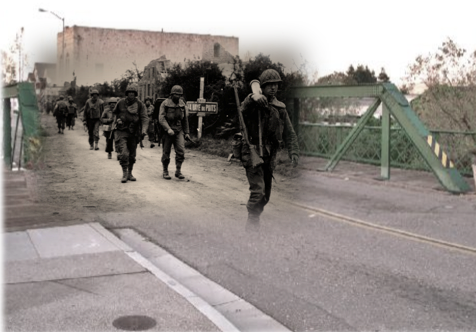
79th Infantry Division GIs, Cherbourg.

79th Infantry Division GIs, Cherbourg.

They had nowhere to go, for they were backed into a corner of France, and so isolated that the only alternative to fighting was to leap into the sea.

Once they’d entered Cherbourg, 79th Division G.I.’s learned to hate street fighting almost instantly. Death came instantly from illusory shadows that a fallen soldier’s comrades never saw, and from gunfire they sometimes never heard.

In peacetime, a French city block can be noisy with the cheers of a cafe crowd during the World Cup or the comical horns of tiny cars or the singing of children at play.

In combat, that same block, seemingly empty, can muffle the report of a sniper’s rifle or generate echoes that make soldiers look anxiously in every direction at once.

So the 79th fought house by house and street by street and eventually they captured the fortress that dominated the city, on June 26. Military historian John C .McManus notes that the men of the 79th that day were filthy, exhausted, and bearded, “like burlesque tramps,’ as one G.I. said.

They got little rest. The division quickly shifted from urban combat to a drive through the farms and villages of the Cotentin Peninsula.

American soldiers in Normandy now faced a new, even more difficult challenge. By the third week after D-Day, they were falling far short of the objectives set for them by Allied staff officers in crisp uniforms working over crisp maps that lacked one crucial detail.

The offensive in the Cotentin stalled because the Germans had the advantage of fighting defensively, in the bocage, the Norman hedgerows, and they winnowed units like the 79th Division down.

The bocage, Normandy.

The bocage, Normandy.

The hedgerows the maps never showed enclosed fields plowed since Agincourt, or pasturage for fat Norman cows, and were a hopscotch of natural fortresses.

This meant that the G.I.’s had to assault them, one by one, to try to extract defenders who gave ground and their own lives stubbornly.

When G.I.’s broke through a hedge and entered a field, the superb German machine gun, the MG42, hidden in the next hedge beyond, or positioned on the Americans’ flanks, annihilated entire rifle squads. It fired so rapidly that a burst sounded like canvas ripping.

The MG 42 machine gun.

The MG 42 machine gun.

So the Americans could hear, but never see, in the tangle of the hedges, who was killing them so efficiently. The bocage quickly transformed G.I.s, with supreme indifference, into either hardened veterans or into casualties.

American soldiers, adaptive and imaginative, eventually would develop the tactics to overcome the kind of war the Germans fought in the bocage. 

But for Martinez’s 79th Division, what lay beyond the hedgerows in early July may have been worse, because the Germans would not wait for them this time: this time they would attack.

The 79th, fighting in echelon with the 82nd Airborne and the 90th Infantry Divisions, seized a ridge and several hills around a key crossroads at a village called Le Haye du Puits.

79th Division GIs, Le Haye du Puits

79th Division GIs taking fire, Le Haye du Puits. The GI at the right carries a Browning Automatic Rifle.

This should have compelled the enemy to abandon the town. They didn’t. They attacked instead, on July 7, intent on destroying the 79th in their positions on the ridge above the town.

The German soldiers, including SS-Panzer units, attacked with great ferocity and with great courage. These were not garrison troops, but hardened and determined professionals. They attacked in surges all day and only at nightfall did it become clear that the 79th had stopped them.

This was the turning point. On the next day, in another day of street fighting, the Americans would capture Le Haye du Puits.

Afterward, Signal Corps photographers attached to the 79th captured the images of some soldiers, their faces as blank as those of sleepwalkers.  They are utterly worn out, used up, by a month of ceaseless combat.

9vmfcsuzi9eu6jo8agvrm1so5zmfptsweoc_p_6vvdk-1

By the time Le Haye de Puits was secured, Domingo Martinez was gone. He was killed during a furious series of assaults on a little village called Le Bot, just to the south, and so would not experience the energy and the jubilation of the breakout from Normandy, which came soon after.

For the next three weeks, the Americans would roll up the Germans, then uncover Paris and liberate the city, standing aside to let Free French units enter first.

The Graves Registration record of Martinez's death. He was most likely killed by German artillery--his regiment came under intense fire from 88mm guns.

The Graves Registration record of Martinez’s death. He was most likely killed by German artillery–his regiment came under intense fire from 88mm guns.

You cannot help but wish that Pvt. Martinez had been granted enough time enough to follow the French into Paris, and maybe, even better, a week’s furlough for a farmworker, now a soldier, to explore the incredible city.

Domingo would decide to visit Notre Dame. Once he had entered the great church, he would remove his garrison cap, dip his fingers in the holy water font, then cross himself.

He would turn, blinking a little, to take in the vastness of the place, and then he would walk up the nave—the silence pressing on his ears–slowly past the clutter of pews. There, at the transept crossing, he would stop suddenly to stand, smiling with delight, as he was bathed in brilliant, colored sunlight.

This is the gift of the Rose Window to men and women of good faith.

It is your good faith, and your faith in your country, that has marked the World War II generation. Your faith sustained America during the war, and it made my life as a free American possible afterward.

I can’t thank you adequately enough today. But five years ago, I found your brother, Domingo Martinez, in the American Cemetery at Normandy. I gently touched the cold marble of his soldier’s cross and so did eight of my Arroyo Grande High School students. We spoke to him without the encumbrance of words.

That was one way of saying thanks. Now this young soldier belongs to a new generation of Americans.

wpid-martinez-cross.png.png