
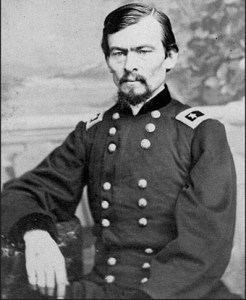
Franz Sigel
Ven I comes from der Deutsche Countree,
I vorks somedimes at baking;
Den I keeps a lager beer saloon,
Und den I goes shoe-making;
But now I was a sojer been
To save der Yankee Eagle,
To schlauch dem tam secession volks,
I goes to fight mit Sigel.
–A Civil War marching song
Hunger stalked Europe in the 1840s. It was most visible in Ireland’s Famine, where, even in good years, the vast majority of Irish lived out their lives without ever tasting meat and where, after the blight from America blackened just-harvested potatoes, turned to tar overnight in their cellars, mothers gathered nettles to make soup where they grew best—in graveyards. But cold winters and poor crop yields marked life on the Continent, as well, in 1848, as they had in France on the eve of revolution in 1789, when the price of scarce bread in Paris ate the wages of an urban worker even as the worker ate his bread. And so revolutions erupted throughout Europe—two in France—in 1848. In “The Communist Manifesto,” Marx proclaimed the birth of the Revolution. He was wrong, of course: the one common thread to 1848 was that every European revolution was crushed.
Germany—or, rather, the collection of north European states that would someday become Germany—endured a failed revolution, as well, one led by idealistic intellectuals who, at the Frankfurt Assembly, sought, looking to England’s example, a modern liberal democracy—a constitutional monarchy—and a united Fatherland. When they offered the crown of their Germany-on-paper to the King of Prussia, he refused to accept it, since it came, as he put it, “from the gutter.”
When their 1848 revolution collapsed, thousands of disillusioned Germans—the largest single national immigrant group in our history– emigrated to America. Called “The Forty-Eighters,” they would bring their liberalism to Lincoln’s Republican Party: they were anti-slavery, pro-union and when Fort Sumter signaled the opening of the war, they became soldiers, “mit Sigel.” They brought their language, too, in everyday words from “kindergarten” to “dumb;” they settled densely in Milwaukee, St. Louis and Chicago; settled, too, in lonely places like the Hill Country in Texas, where some of them died at the hands of Comanches, in Oklahoma, where many walked behind the plows that broke the Plains, only to find a generation later that the topsoil they’d shattered was just a crust and that, once disturbed, great winds would carry it away to darken the East Coast or to fall on ships in mid-Atlantic. With the justice that is too infrequent in history, many of them—with names like Eisenhower and Nimitz, Eichelberger, Vandenberg and Spaatz—would be instrumental in the destruction of the Nazis and their allies. Another, earlier, military man, Franz Sigel, was a Forty-Eighter who had commanded Union troops with some distinction in Missouri and Arkansas early in the war. In 1862, he became commander of the XI Corps, largely made up of German immigrants with a portion of “native” units like those of three future Arroyo Grande residents: Sylvanus Ullom’s 25th Ohio, Jefferson Wright’s 55th Ohio and Erastus Fouch’s 75th Ohio.
Sigel, inspirational to his foreign-born soldiers, was liked far less by his superior officers: The Eleventh was the smallest corps in the Army of the Potomac, and his repeated appeals to enlarge his command were turned down, so he resigned and XI Corps passed to Gen. Oliver O. Howard shortly before Hooker’s spring l863 Chancellorsville campaign. This would be a critical command change, and one that would have a decisive impact on the battle to come. Sigel’s departure demoralized his German-born and German-American soldiers, and Howard, a Mainer and a man whose Christianity resembled that of an implacable Nathaniel Hawthorne Puritan, was, as historian Stephen Sears puts it, “the wrong general in the wrong place with the wrong troops” at Chancellorsville.
 A Work in Progress