
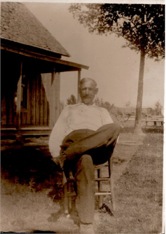
My grandfather, John Smith Gregory, was born in Shelby County, Kentucky, in 1862. He was a father of eight, a farmer in south-central Missouri, a lumber estimator, outdoorsman, and a sipper of life, in that life included lovingly fermented batches of blackberry wine. Harry Truman was a fan of that wine. On campaign swings downstate, he made it a point to pay court to my grandmother, a local Democratic powerbroker with money ties to Truman’s patrons, the Kansas City Pendergast Machine, but after those formalities, the heart of the Senator’s visit would be a sip or four of John’s blackberry wine.
That wine may have made me possible. When my father–who was a kind of miraculous afterthought, the last of eight children, born in the vigor of my grandfather’s fifty-sixth year–went into the Army in World War II, he stood as good a chance as any other country boy of being vaporized by a German 88 shell somewhere in the dark canopy of the Ardennes. Instead he spent the War, as a Quartermaster officer, in a series of frontal assaults on London’s pubs, or, as he did one evening, bellowing seditious rebel songs– after splitting a bottle of Johnnie Walker Scotch with an Irish elevator operator he’d befriended–and this was thanks to Sen. Truman’s endorsement of his candidacy to Officers’ Candidate School at Camp Lee, Virginia.
(By the way, London Bobbies tried to arrest Dad and the elevator operator, who knew ALL the verses to “Wearin’ of the Green,” but he was a good elevator operator. Up to the fifth floor. Down to the third. Up to the fourth floor. Up to the sixth. Down to the second. After sprinting up the hotel staircase and clumping down it, the exhausted Bobbies gave up.)
This is the song they were singing, as performed, logically, by the Orthodox Celts. They’re from Serbia.
Since my family’s forebears were Virginians, teaching dance had been central to the way they socialized their children. My family must have raised their children that way from the days they’d emigrated, in the 1690s, from the dismal Midlands of England to the banks of the James River, so Grandfather’s most formidable talent may have been his dancing. (On the other hand, the Gregorys had no gift for real estate. They sold Mount Vernon to the Washingtons.)
So his Virginia roots meant that John Gregory had become, by reputation, a kind of Ozarkian Astaire and every girl who had the chance to be his Ginger Rogers would have a moment on the dance floor with him where she would realize, with a sudden pang of delight, that she was gliding, as if the sawdust-strewn floor had become polished glass.
My grandmother was not amused by the line of pretty teenagers who shyly sought a place on Mr. Gregory’s dance card. She suspected, too, and I’ll bet she was right, that those girls liked also his twinkly eyes and the soft smile beneath his silky white mustaches. My Grandmother was not given to smiling. She had a temper and, with it, a strong and wide body: she was a hard woman to knock down in a windstorm.
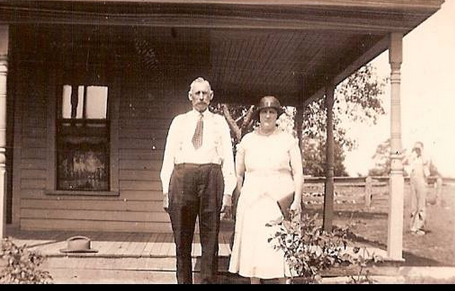
Years later, on her visits to us in Arroyo Grande–visits we regarded with as much enthusiasm as an Irish monastery might muster for a Viking raid–she’d absently whack us with her cane, and she had a forehand that would’ve shamed Rafael Nadal. She had been a schoolmarm and we think it was PTSD, and where veterans might see phantom Vietcong, Grandma saw farm boys eighteen hands high spitting streams of tobacco juice at recess. Something snapped inside her then and set her to whacking the nearest target of opportunity.
We hid her glasses, or, if that particular whack had an extra sting, her dentures, in revenge, but gave them back because she otherwise tended to describe, in graphic clinical detail, how every person in Texas County, Missouri had died between the end of the War Between the States and the Eisenhower Administration. Her grandfather, by the way, had been a Confederate brigadier general of modest accomplishment and minimal talent–I was named for him, and for his son, a staff officer killed in action, thanks to a lucky but devastating Yankee artillery shot, in Arkansas–so that branch of the family saw themselves as gentry. They were insufferable. Despite that, John Gregory indulged my grandmother; he was a tolerant man.
He had a genius for math. My Dad inherited this gift; he became a gifted accountant and, for almost twenty years, the comptroller for Madonna Construction. I, as my geometry teacher at Arroyo Grande High School, Mrs. Otsuji, noted ruefully, had no talent in that direction, nor in any plane. But lumber companies sought out Grandfather because he could eye a stand of pine and calculate, with eerie precision, how many board-feet it would yield.
He was a competent but unorthodox farmer: in the Ozark foothills any money there was to be made–and there wasn’t much–was to be made in tobacco and corn and hogs. John accepted that reality but his real passion was an anomaly. Cultivating ginseng was to John Gregory was what stamp collecting was to Franklin Roosevelt; given my grandmother’s personality, it was his outlet—he was not a talkative man, but I can imagine him, almost poetic, winning over dubious neighbors at the local grocer’s about the miraculous attributes of ginseng. He won them, too. In a little shirtpocket notebook I still have he has meticulously recorded his sales figures: J.K. Davis, $250; John Helsey, $50; W.T. Eliot, $62.50.
But his hallmark, the essence of his character, was his kindness. My father remembered this most of all: during the Depression, there’d be an occasional knock on the farmhouse door. It’d be a jobless man on the move.
–May I sleep the night in your barn, sir?
–Young man, you may not. Grandfather would eye the stranger coldly, for dramatic effect.
–However, we DO have a spare bed. How about some bacon and eggs?
It was these visits that so impressed my own father with the cruelty of the Great Depression. These strangers, who wolfed down my grandmother’s meals (beneath her stony exterior there was a deep humanity she didn’t like to let out much), were not “bums:” they were college students, engineers, veterans of the Great War, and one, a violinist, paid for his supper and bed with a solo concert: Bach and Boccherini found a rapt audience in a little farmhouse on the Ozark Plateau, in a kitchen warmed by a wood stove and lit by kerosene lamps instead of footlights.
When they hung a ne’er-do-well –the local bully–at the Missouri State Penitentiary, the barbershop crowd bet that not even John Gregory, in town for his every-other-day shave, could find anything nice to say about him. There was a pause, but not a long one, underneath the hot towels: ”The man,” he said, “had a beautiful set of teeth.”
My grandfather was killed by a driver from Wichita Falls, Texas. He was deaf in the direction of the Texan’s Ford roadster, traveling fast; Grandma had called Dad back to the house because he was barefoot and no son of hers–what would the general think?– was going to make a social call to Mr. Dixon’s looking like a hillbilly. He never forgave her. Had my father been crossing the road with his father, he would’ve heard the Ford’s approach.
The impact broke both of John’s legs. But even at seventy, he had an athlete’s body and he fought hard to live in a Catholic hospital that must have caused my Church of Christ grandmother intense anxiety, looking out for Grandfather while listening intently for any Papist heresy, like the click of Rosary beads.
As a teenager, Grandfather had accepted a dare from two friends to swim across the Red River in flood, and John was the only survivor. Not this time: the river was too strong and there was nothing to do but to watch him, as graceful then as he’d ever been waltzing with a pretty girl, when he finally made the choice to let the current carry him away.
After they drove him back home from Springfield, there was a big funeral. I still have the yellowed obituary. Despite the fact that it was the darkest year of the Great Depression–1933–there would have been big honey-cured baked hams and fried chicken and candied yams and mashed potatoes smooth as clouds and a battery of salads, casseroles, and pies, dusted with sugar, from every farmhouse in a twenty-mile radius.
Both my father and his sister, my Aunt Bill, talked about him always in Homeric terms. He was their father, and he was their hero. They found it hard to let him go, so they never did. That turned out to be a good thing, for me. It’s good to love a man you never met.
 A Work in Progress