
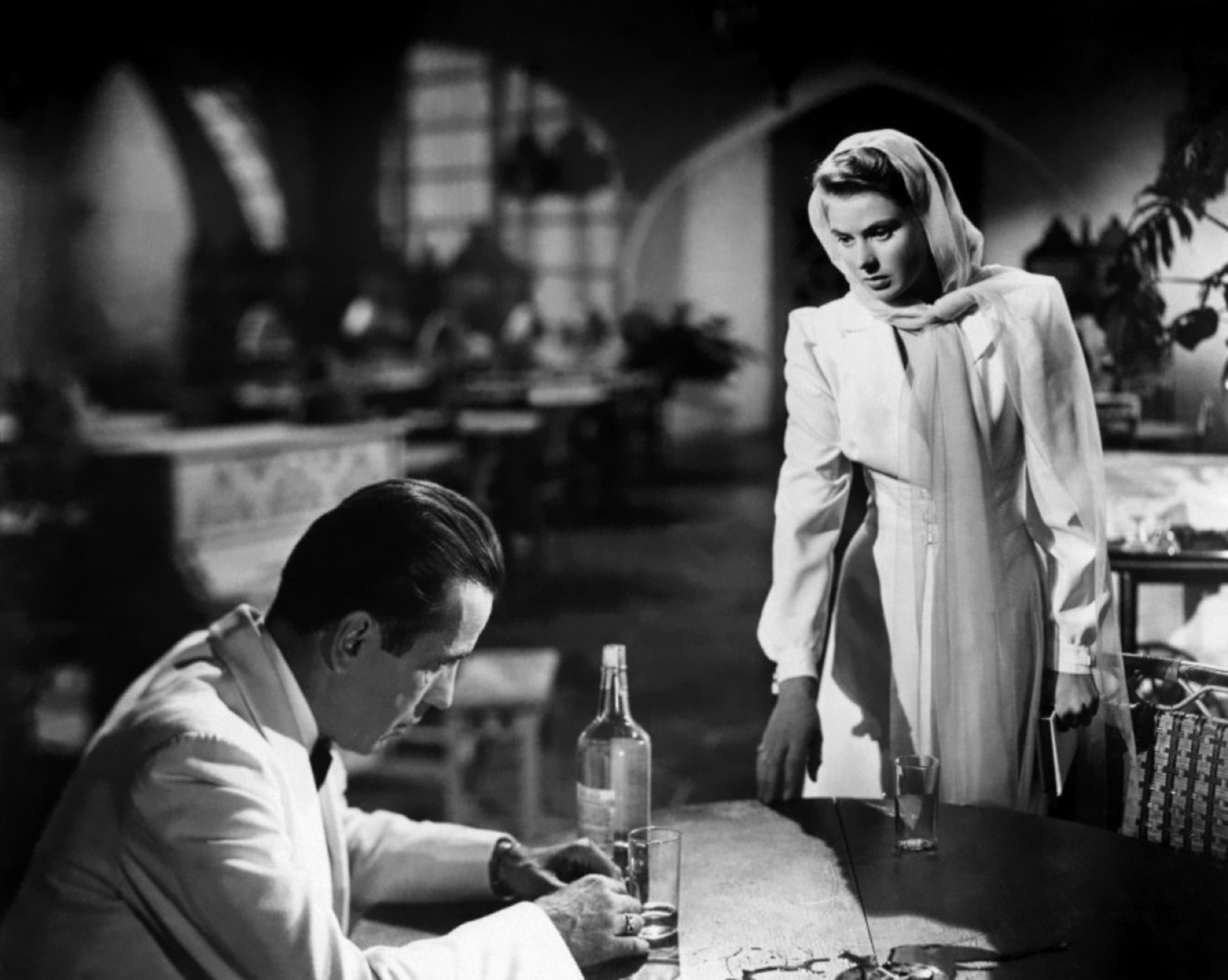
 Since it’s Bastille Day, and we’ll always have Paris. I’m thinking about Casablanca.
It is fascinating to read about this film because so much of the cast was caught up in the events of the day: A native Berliner, Conrad Veidt, had played one of the principal roles in the 1920 Expressionist masterpiece The Cabinet of Dr. Caligari. Veidt, who despised the Nazis, played the remorseless and humorless Major Strasser and thus set the standard for a generation of faux-Nazi film officers. He was not remotely like Strasser in real life: he loved golf as much as he hated Hitler, but died, tragically, of a heart attack only a year after Casablanca’s release, while playing at the Riviera Country Club.
Strasser’s nemesis, the freedom fighter Victor Laszlo, was played by an Austrian who was living in England when war broke out in 1939, Paul Heinreid. The English were about to deport him as an enemy alien when Veidt spoke up for his friend and made his Hollywood career possible.
Peter Lorre was another Austrian—his character, who has the stolen Letters of Transit, is shot ten minutes into the film—and Lorre was, like Veidt, a star in German Expressionist film: he was the child-killer in the sensational and controversial 1931 film, M. Lorre, a Jew, recognized quickly the nature of Hitler’s rule and fled Germany. Several of the lesser players are, like Lorre, refugees from the Third Reich: Hitler was indirectly responsible for a real Golden Age in American film.
Neither the studio nor Bogart thought much of Casablanca at the time–it was just another job for him, for Warner Brothers, just another assembly-line feature; it was shot in a little over nine weeks. Off the set, Bogart’s major concern was surviving the violent temper tantrums of his alcoholic wife—his third—Mayo, whom he sardonically nicknamed “Sluggy.” On the set, Bogart was extremely uncomfortable with the love scenes: he didn’t consider himself a romantic lead, and his favorite part of the film must have been when he finally got a revolver in his hand. That was his moment—not, as is the case for the rest of us, the closing dialogue with Ingrid Bergman’s Ilsa.
Bergman wasn’t even thinking about Casablanca. She was preoccupied with snagging the role of Maria in For Whom the Bell Tolls. The bromide that “the camera loved her” was certainly true in Casablanca; director Michael Curtiz’s cinematographer, Arthur Edeson, used soft focus skillfully in her closeups–not to hide Bergman’s age, because there wasn’t a need to, but to idealize her beauty, which, for Rick, would always be a dream. She was delighted, near the end of the filming of Casablanca, to hear that she had been cast as Maria, never realizing, of course, that her Ilsa would be the role that would endure.
Other than Ilsa, my favorite part of the film–my favorite film–is the banter between Bogart’s Rick and Claude Rains’s corrupt Captain Renault. I am always thinking of Renault when I tell my students that wonderful things MIGHT happen to their essay grade if a latte magically appears at my table at Cafe Andreini while I’m grading them.
If you read the script alone, this is a melodrama that is graced by some of the funniest dialogue in American film. The policeman, Captain Renault, gets my favorite line:
“I’m shocked, shocked to find that gambling is going on in here!” [Pocketing his winnings from the roulette wheel in Rick’s Place.]
One of Bogart’s lines is a very close runner-up.. Major Strasser asks Rick his nationality.
“I’m a drunkard,” Bogart deadpans.
 A Work in Progress