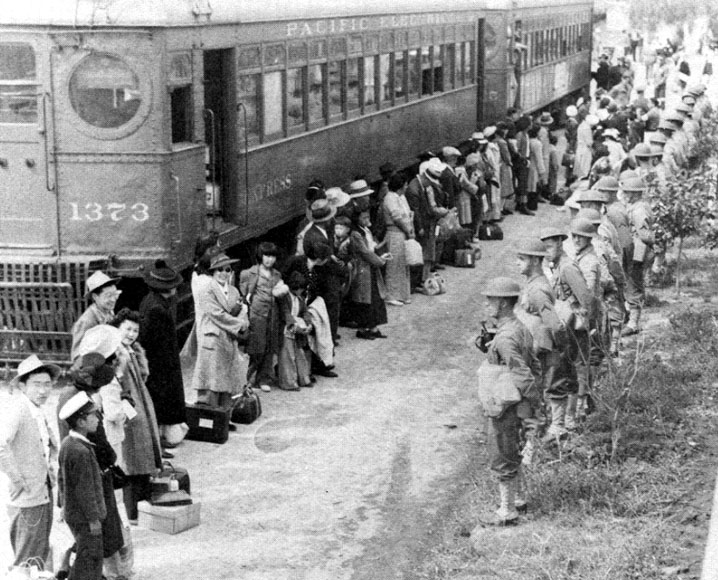
Japanese-Americans await transport at the Santa Anita Racetrack. They slept in the stables.
From a letter to a University of Oregon alumni magazine that ran an article on the internment of World War II:
“In 1942, U.S. Marines were battling the Japanese in the Guadalcanal jungles. American aircraft carriers were sunk by Japanese warplanes. So many ships were sunk in the Solomon Islands ‘slot’ that it was nicknamed Iron Bottom Sound. The fighting was a match of equals that could have gone either way. The American public was frightened of a West Coast invasion. We cannot condemn 1942 policy using our 2013 mores and sensibilities. The prospect of a ready made collaborationist population, following a Japanese invasion, impelled the internments of Japanese Americans.”
This, of course, excuses the irrational. Consider the other coast of the United States:
–In 1941, German U-boats were already attacking American warships: the destroyers Greer and Kearny came under fire before a torpedo took the Reuben James and 115 of her 159-man crew in October, five weeks before Pearl Harbor. Even before then, with the fall of France in June 1940, war hysteria in America had been intense. With FDR’s blessing, J. Edgar Hoover would compile voluminous lists, aided by wiretaps, of suspected German Fifth Columnists living in the United States; the agency included more lists of any American who subscribed to periodicals written in German or Italian, and until FDR ordered the registration and monitoring of all aliens, there were isolated but frightening cases of Germans or German-Americans who were attacked–one was murdered–by wrongheaded “Patriots,” deprived of our 2013 mores and sensibilities.
–By 1942, American troops were fighting Rommel’s Afrika Korps—and getting routed, at Kasserine Pass. In general, the war was going against the Allies on both the Western Front—the disastrous Dieppe Raid is a notable example–and Eastern Front, with Gen. von Paulus’s Sixth Army, which would eventually surrender at Stalingrad, defeating Soviet forces in combat around Kharkov.
In the Pacific war, we had lost the Philippines, just as the War Department knew we would, and our Pacific possessions, but we’d taken the war to Japan with the Doolittle Raid in April and achieved a much more substantive victory–the first American turning point–at Midway in June with destruction of four of the six carriers that had begun the war against us at Pearl Harbor, along with the cadre of the Japanese naval air forces.
–German U-boats sank 82 American ships in all waters in December 1941 alone; In 1942, they sank 121 American ships off the East Coast and 42 along the Gulf Coast out of a total of 500 American merchant marine ships sunk by German submarines that year. Americans on holiday, from Coney Island to Miami, could see our ships glowing at night as they burned,, with their crews. A U-boat also delivered a team of Abwehr saboteurs onshore near Jacksonville, Florida. We were bleeding ships and English children were beginning to go hungry: they were allowed one small egg every four weeks.
During the same period, Japanese submarines sank a total of four ships off the West Coast.
–120,000 Japanese-Americans were interned under Executive Order 9066. Fewer than 3,000 Italian-Americans or Italian aliens and 11,000 German-Americans or German aliens were interned.
 A Work in Progress