

The Pacific Coast Railway Bridge
The civilizing and the Americanizing of the once-wild Arroyo Grande Valley begun in 1837 by pioneer ranchero Francis Ziba Branch and his wife, Manuela, should have accelerated with the 1881 arrival of the railroad, the narrow-gauge Pacific Coast Railway. It did achieve this, to a large, extent, tying the Valley to the Pacific Ocean, where there was a commercial wharf at Port Harford, to the Lompoc Valley to the south and to markets in the county seat, San Luis Obispo, to the north.
The railroad’s efficacy as a tool of civilization was dampened when the citizens of Arroyo Grande, in 1886, hanged a fifteen-year-old boy from the PCRR Bridge that forded the Arroyo Grande Creek in the heart of town. The lynch mob strung up the boy’s father, too, and the bodies were found by little boys on their way to school. They gawked at the corpses for a long time, from the soles of their feet to their stricken, clay-colored faces, and once they got to school, tardy, they were punished for telling the story of what they’d seen.
It was the morning of April Fool’s Day, after all.
Although a local pastor would praise the ad hoc Committee of Vigilance for its work that day, it didn’t sit well with all the participants. One of them, in great, great old age, talked to my brother’s class at our two-room school, Branch Elementary, in the late 1950s. The victims of the vigilantes were a father named Peter Hemmi and his son, Julius. or P.J. The elderly man who told the story must have been about P.J.’s age when this happened.
Mrs. Hemmi was sitting in the anteroom of what passed for a jail, and when the crowd –some of them may have had their faces covered–burst he said, the look on her face revealed that she knew exactly what was about to happen. The old man had never forgotten that face at that moment; it haunted him like Marley’s Ghost, but Mrs. Hemmi was with him always, not just at Christmas.
They wanted to lynch a third man, Peter’s nephew, but the elder Hemmi defended him. The mob let the nephew go, and he ran for his life with a noose still around his neck. Peter could not save his son. P.J. was, one longtime local historian, Madge Ditmas, once wrote, a boy of “cruel disposition,” and he had ended a long-running boundary dispute over property near the source of Arroyo Grande Creek with a rifle. In a confrontation between the Hemmis and their neighbor, Eugene Walker, P.J. began shooting: Walker died in his garden amid his vegetables. P.J. then shot Walker’s dog and, finally, shot Mrs. Walker twice. She would live— until November—but now, only hours after he’d started firing, no amount of pleading could save the terrified boy. This was justice.
It was justice carried out by mob violence that was not at all coincidental. Five weeks before the lynchings, a similar mob had appeared in Arroyo Grande’s nascent Chinatown and ordered the residents to leave within two weeks or there would be “justice.” Three days after the Hemmis died, a similar group, mounted, their faces covered, descended on a Chinese road gang working on an extension of the railroad to Nipomo and they were similarly ordered to leave. Or die. (Meanwhile, in San Luis Obispo, the county seat, someone attempted to dynamite a Chinese laundry owned by Sam Yee; at about the same time, a rival business opened called, without equivocation, “The Caucasian Steam Laundry.”)
Hemmi was not Chinese, but he was an immigrant; possibly his English was heavily accented, and that wouldn’t have helped him.
Even fifty years later, Madge Ditmas (to Madge, Evil Incarnate resided in Filipino immigrants and in the New Deal) refused to call Peter Hemmi by name in her history columns in the local weekly, the Arroyo Grande Herald-Recorder, referring to the Swiss-born Hemmi as “The Frenchman.”
There was not the slightest chance that the two would be allowed burial on sanctified ground, amid their neighbors. The 71-year-old Manuela Branch had their bodies brought to her family’s graveyard, and the two were buried a few feet away from her husband, whose reputation was indestructible.
The little burial ground, by the early 1960s, had reverted to pastureland, and generations of cattle with itches to scratch had knocked down, one by one, the elegant Victorian obelisks and tablets that had marked the graves of the pioneer family. But at some point, someone had built a heavy-gauge steel pipe fence around the graves of Julius and P.J., so their tombstones stood upright and unrepentant.
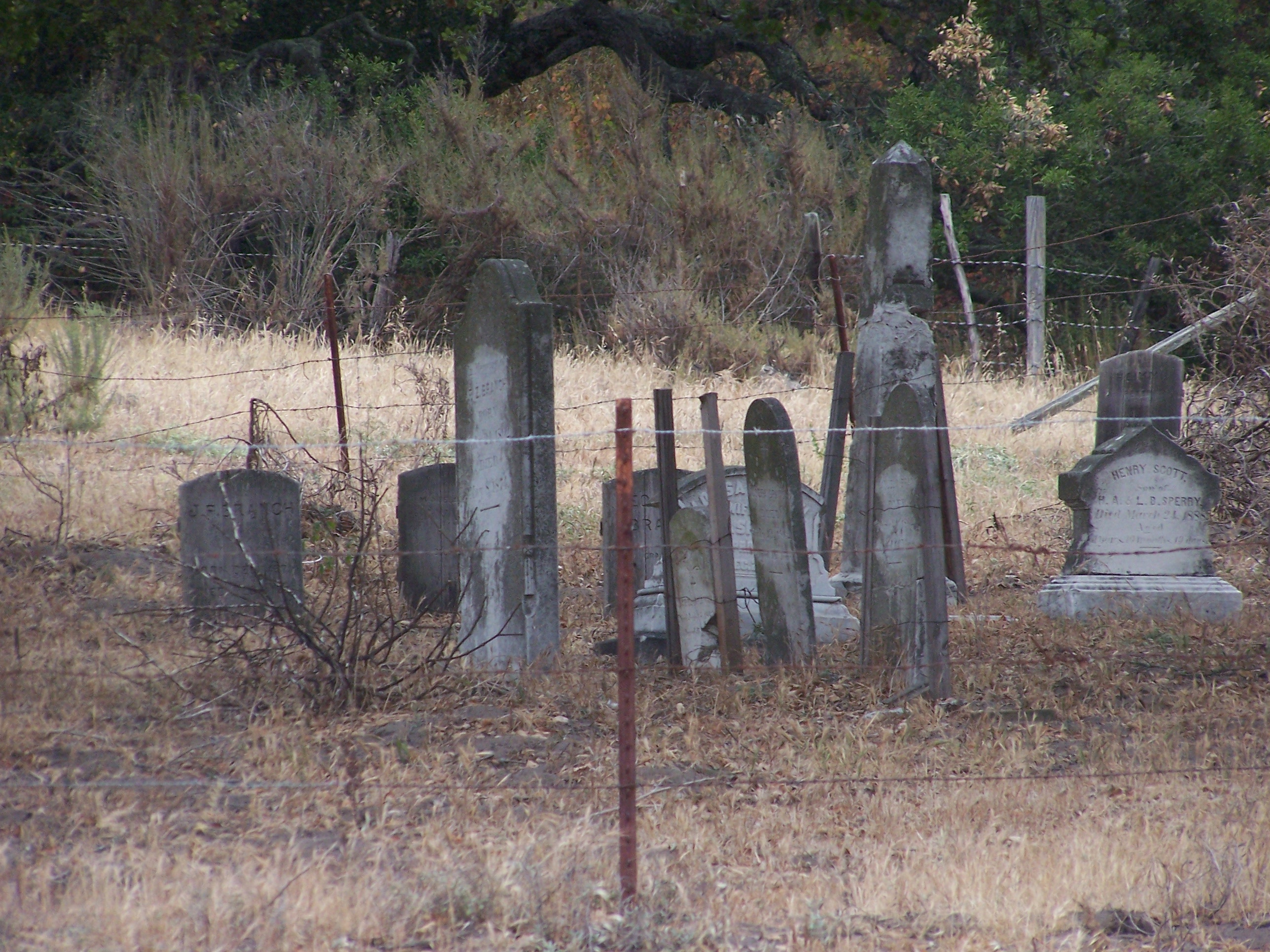
Francis Branch’s tombstone is the largest, at left-center; the Hemmis’ tombstones were damaged at some time during the mid- to late 1960s, and an Eagle Scout replaced them with a single wooden marker, at far right.
 A Work in Progress