
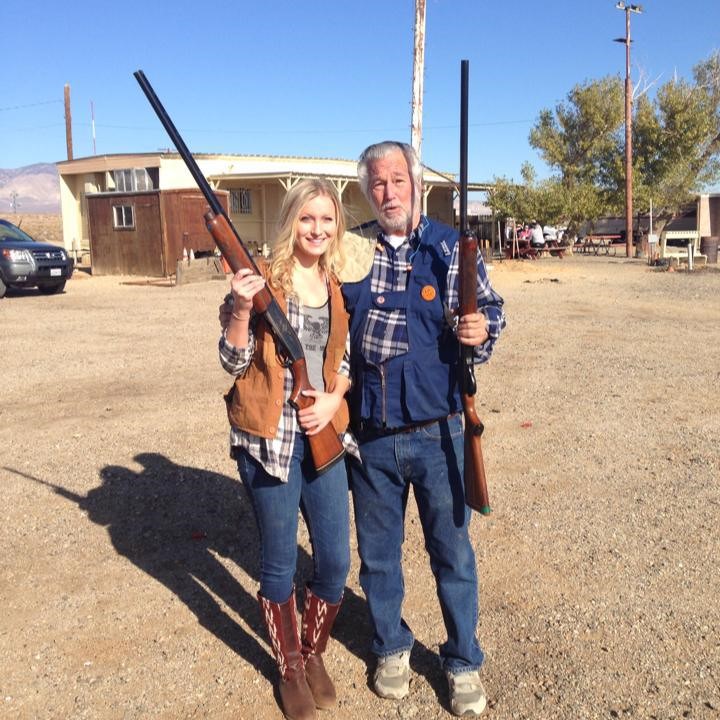
 A wonderful Facebook exchange began when Kali, a a former student, posted a photo of herself and her late grandfather, trap shooting. I think, to use a trite phrase I would never tolerate from any student, that he looks like a really cool guy. Look at their faces and you can see they loved each other–and there’s plenty to love about Kali.
She was my student, I was a sponsor in her confirmation class at St. Patrick’s, and she is an outstanding young woman. You can tell, too, that they loved being together.
Sometimes, and I had this experience with a photo of Joey Rodgers’s Grandpa, a World War II Marine, you can see a man and know instinctively that you would’ve loved him, too. That’s what struck me about this photograph. Kali has just lost him, but another reason I know he was a good man is that he’s released a flood of memories from my own life, about my own family, and I’m old enough now to know that those things don’t happen accidentally. I know, as well, that Kali will discover that memories don’t die, and as long as they live, so will he.
This photo reminded me of another, of my father in the Ozark foothills of south central Missouri, in Texas County, where he grew up. Dad’s on the right, and that may be Mr. Dixon, who owned the farm across the road from my grandfather’s farm. Mr. Dixon was one of my grandfather’s best friends, and Grandfather, deaf in one ear, never heard the Ford roadster that hit him and killed him in 1933 as he crossed that road to visit his friend. But Grandfather left my Dad some important gifts. That Ford had killed the strongest swimmer, even in his seventies, and the sweetest waltzer in Texas County. My grandfather was a born athlete, graceful and powerful, and keenly intelligent. He would have been one hell of a quarterback. 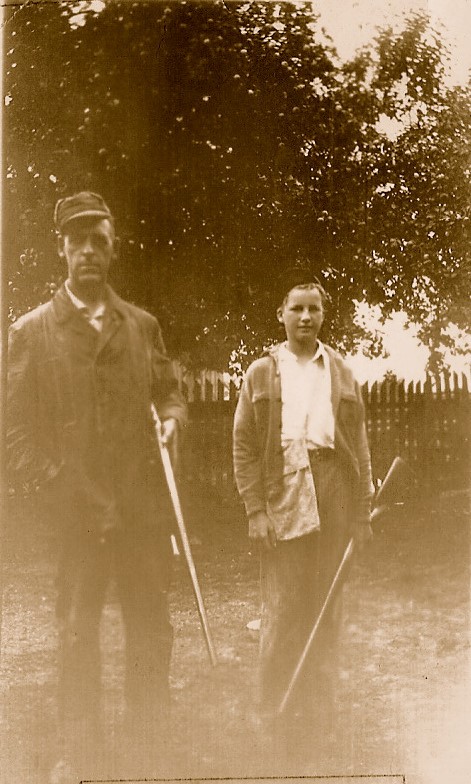 Here’s what I told Kali about my Dad:
I’ve still got my Dad’s Model 12 Winchester. Here he is, on the right, with the gun about 1929 or 1930. Birds are completely safe around me, but it was a privilege to watch that man handle a shotgun. His reflexes were so good that he’d fire the followup shot close enough to mine to make me think there was a slight chance it was me, not him, that’d brought down the pheasant or chukar. He was also a terrific athlete–he came to California on a baseball scholarship that, in the strict legal sense of the word, was not legal at all. But it got him out of Depression-era Missouri and to (yuk!) Taft, where oil meant there were still jobs to be had.
Since my wife’s Dad played for the 49ers, and her older brother started at middle linebacker on three USC Rose Bowl teams, the Gregory contribution to my boys’ athletic talents gets overshadowed pretty easily.
But Dad played a lot of sports, and played them well. The photo of the 1935-36 Houston basketball team includes both Dad (#4) and his nephew, Frank (#3); my grandfather had two batches of kids–his first wife, Doriska Trail, died and he remarried, to my grandmother, so Dad was technically an uncle before he was born. My aunt remembered years after the radio broadcast of that last game, the loss, when the announcer cheerfully observed that “Uncle Bob is passing off to Nephew Frank.” 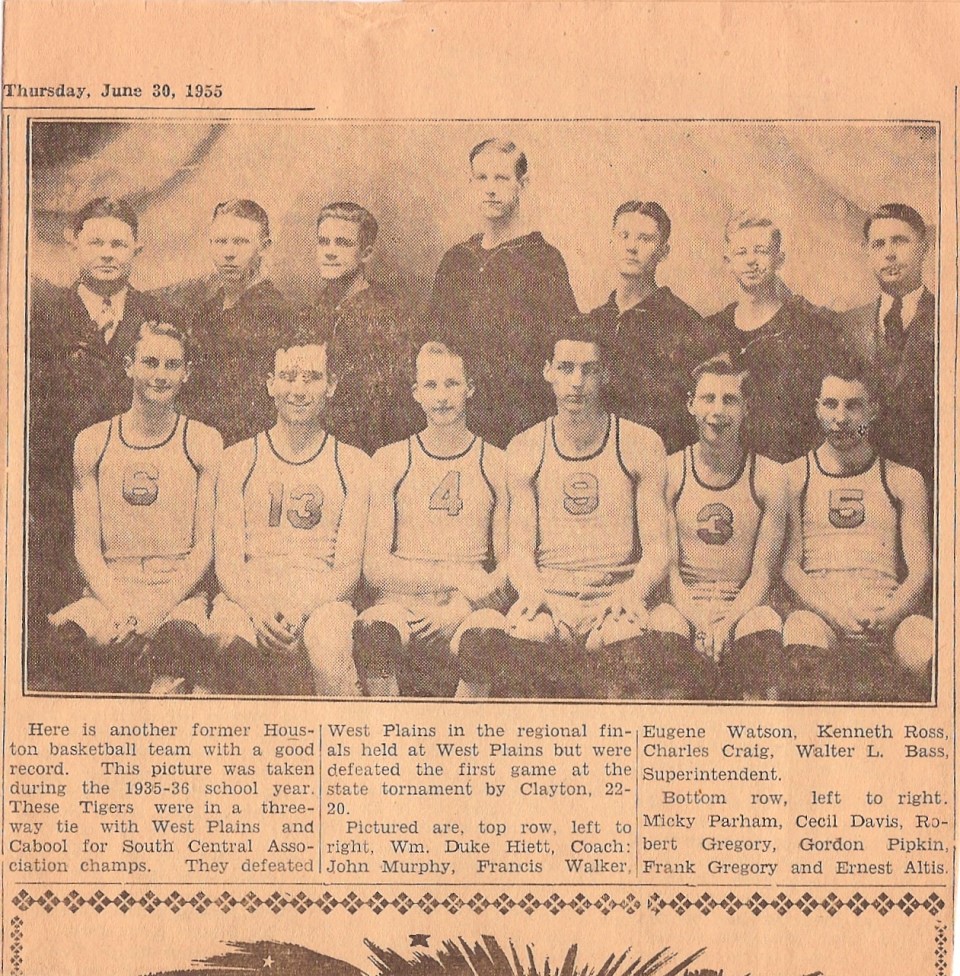
The illegal scholarship secured Dad a second-base spot at Taft Junior College and, a short time later, that in turn led to a meeting with the Irish girl behind the counter at a Taft soda shop. She made him a banana split, I think. She also did a lot to make me the kind of man I am today: that was my Mom, one of the most remarkable people I’ve ever known.
Dad also was a superb golfer, with a fluid swing. He’d learned in Taft, where nothing much grows other than tumbleweeds, and both the teeboxes and “greens” at the local course were sand. You made your tee out of sand, too, with a little pail of water set out to help you build it. One of his Saturday foursome was Harry Clinch, later the first bishop of of the Diocese of Monterey, a Godly and warm man, unless it came to slow play. He was not above aiming a three-wood at the foursome ahead to encourage them to brisk it up a wee bit.
What I remember most about Dad came years later, the time we were playing Black Lake together, and he drove the green on the short Par 4 second hole–about 330 yards–and four-putted. I have never seen a human face turn so many shades of red, ranging into the deep purple that frequently suggests an impending coronary.
My brother reminded of another story. Dad bought my big sister, Roberta, a quarter horse, a mare, Belle, boarded and pastured at Frank Mello’s ranch south of San Luis, and one day she threw my sister, badly. Dad was raised riding horses–his grandfather, Taylor, would whack him in the small of the back with a quirt when Dad slouched in the saddle–”Sit up! You’re hurtin’ the horse!” –but he hadn’t ridden in thirty years.
When Belle threw Bob Gregory’s little girl, he got the same murderous look his eye that he would get later, when he four-putted. He mounted that mare and rode her until she was exhausted and thickly lathered. We watched with our mouths flopped open. She never threw Roberta after, and was as gentle a horse as any girl could wish for. We never saw my father ride again.
* * *
 A Work in Progress
Reblogged this on A Work in Progress.
LikeLike