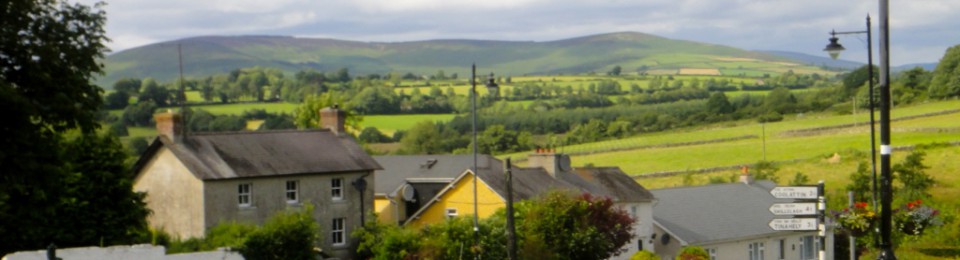
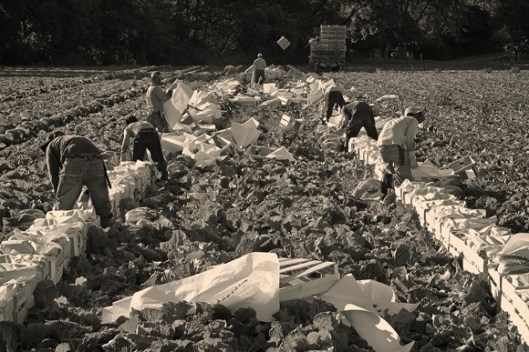
Cabbage harvest, Upper Arroyo Grande Valley. New Times
It’s a story I’ve told a million times, but it speaks volumes about why I love my Mom and why, 43 years after her death, I still miss her. She was pruning her roses and a farmworker–they called them braceros–came into our yard from the field next door and pantomimed filling a gallon jug with water. She nodded, filled it and handed it to me–I was about five: “Help him carry it back.”
That was the day I first fell in love with Mexicans. Not with Brussels sprouts, which is what they were harvesting that day, talking easily with me, as they snapped the sprouts off their stalks with their thumbs, in a language I didn’t think I understood.
“…fell in love with Mexicans.” It amazes me how that might shock some folks (Oh. Doesn’t he mean “Latinos?” or “Hispanics?” We’ve turned an entire people into a pejorative, the butt of ignorant, heartless jokes.) When our family went with the St. Pat’s youth group to Tijuana to help build a home, the mission director asked why we’d come, and there were many moving religious answers. When my turn came:
“I just like Mexicans.”
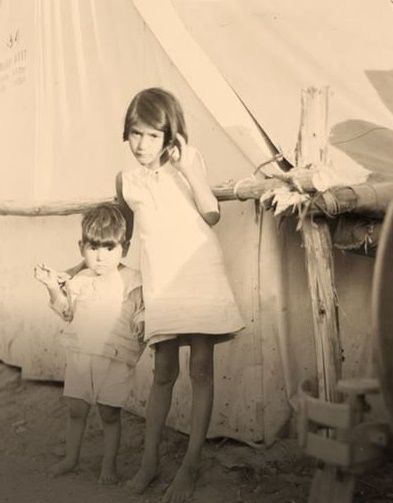
Migrant children, Nipomo, 1936, by Dorothea Lange. The little girl’s knock-knees are symptomatic of rickets, a nutritional disease.
My brother and I once spent an hour in one of George Shannon’s bunkhouses with some of his field workers (George Shannon deserves his own novel. One of the hardest-working and kindest human beings I’ve ever known, an unpretentious man who married into the Hall family, which, around these parts, is like some guy named Lincoln marrying into the Todds.) and they spread out religious medals and family snapshots and pocketknives, toys and firecrackers and belt buckles and, I think, one stuffed baby armadillo, and we chattered away the whole time, each side understanding about every eleventh word, until George came in, smiling, and told us it was time for us to go home for dinner. It was one of the happiest hours of my life and I think it was for them, too, because somehow my brother and I reminded them of family and home and they missed both.
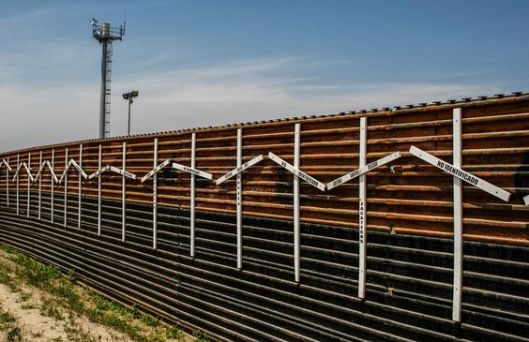
Border fence, Tijuana. The crosses represent migrants lost in the desert.
They missed both. This Mexican was drunk but he was not incoherent. The mission directors were showing us the border fence, with clusters of white crosses at intervals, memorializing the deaths of those–one, a 17-year-old girl–whose coyotes had abandoned them in the desert, and a 13-year-old had started a trash fire at another point as a diversion so a small group of friends might have time enough to vault the fence to what was NOT the promised land, which was the drunk guy’s point.
You think I want to live in your country? he demanded of us, wide-eyed teenagers (and adults). He was drunk but also very angry, which made him clearer than a sober man. You people think we’re invaders? I don’t want to be in your country! I don’t want to be an American. I LOVE MY COUNTRY. I LOVE BEING A MEXICAN! I love my family and that is why I cross over and get arrested by La Migra and then cross over again. I hate it! But I am a man with a man’s responsibilities and if washing dishes in Chula Vista or working melon field in Indio is what it takes for me to be a man, I will do it. I love my country. Not yours. Not yours.
He wandered off and continued the talk with himself alone in that little park where the border fence meets a fetid stretch of Pacific Beach. We were stunned.
We met deportees at a la migra detention center, too. They were flesh and blood, just as the Woody Guthrie song had always suggested, made so evocative by the version covered by Arlo Guthrie and Emmylou Harris.
“Deportees” (Plane Wreck at Los Gatos)
The crops are all in and the peaches are rott’ning,
The oranges piled in their creosote dumps;
They’re flying ’em back to the Mexican border
To pay all their money to wade back again
Goodbye to my Juan, goodbye, Rosalita,
Adios mis amigos, Jesus y Maria;
You won’t have your names when you ride the big airplane,
All they will call you will be “deportees”
My father’s own father, he waded that river,
They took all the money he made in his life;
My brothers and sisters come working the fruit trees,
And they rode the truck till they took down and died.
Some of us are illegal, and some are not wanted,
Our work contract’s out and we have to move on;
Six hundred miles to that Mexican border,
They chase us like outlaws, like rustlers, like thieves.
We died in your hills, we died in your deserts,
We died in your valleys and died on your plains.
We died ‘neath your trees and we died in your bushes,
Both sides of the river, we died just the same.
The sky plane caught fire over Los Gatos Canyon,
A fireball of lightning, and shook all our hills,
Who are all these friends, all scattered like dry leaves?
The radio says, “They are just deportees”
Is this the best way we can grow our big orchards?
Is this the best way we can grow our good fruit?
To fall like dry leaves to rot on my topsoil
And be called by no name except “deportees?”

Here is that song, performed by Woody Guthrie’s son, Arlo, and Emmylou Harris:
https://www.dailymotion.com/video/x13sel
Years before, the most miserable years of my life were when we left A.G., almost as soon as I’d graduated from high school, and moved to Bakersfield.
Do you have any idea how heart-breaking it is to move to Bakersfield, having grown up trout-fishing in the creek alongside your house, hiking and bird-hunting in the foothills of the Upper Valley, sometimes shocking blue with lupine in the springtime, waking up to the regular ring of bean stakes being driven into the ground in the fields next. door. or to the most beautiful whistling in the world of farmworkers walking singe-file down to those fields to work, of occasionally stopping stock-still at the sight of a doe and her faun and, or, one time, at a mountain lion–she rippled when she moved–and then at 18 I had to leave the place where I had grown up and the place I still love more than anywhere on earth.
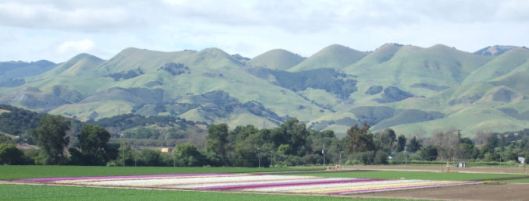
Flower fields, Upper Arroyo Grande Valley.
Chorizo and egg burritos saved me. I had a set of guys I worked with most–especially Alvino and Beto and Jorge–and after awhile of working together, they began bringing extra chorizo and egg burritos. See, I was the boss’s kid, which was my only qualification for the job, and the shock of realizing that I was not an asshole (like any person, I am certainly capable of it), and the fact that I would work just as hard as they would in that delightful Bakersfield heat, and that when we went on furniture or appliance deliveries—for these families, buying their first color television set, it was like we were delivering the American Dream–the truck bouncing along hot filthy back roads bounded by irrigation ditches, their water listless and somehow sinister, and since I spoke the best Spanish I could with the families whose tiny but singularly dignified homes we visited–Sacred Heart of Jesus, Our Lady of Guadalupe, the Kennedy Brothers always on the walls–that meant that my co-workers’ wives began to pack extra burritos.

Robert Kennedy and Cesar Chavez. Mural by Judy Baca.
I loved Jorge most of all—he was an Army vet, a Texan, with a tiny Cantinflas mustache; we’d go golfing together, a sport he’d picked up in the service, and he was wicked good. He was so good he was the only guy who could correct my alarming duck hook, whose trajectory reminds you of grainy WWII footage of a kamikaze banking into the flight deck of an American aircraft carrier. Sometimes I’d have dinner with his family and I loved the easy way he had with his children, the way they teased each other, and I loved Marta, his wife, and the food she put to table.
That is what kept me from going crazy in Bakersfield.
A couple of years later, when I went back to school (“Best Seven Years of My Life”) at the University of Missouri, I was washing my hands in the men’s room when my Spanish professor, on his way out, turned and said “You know, you have a very pronounced Mexican accent.”
As Mark Twain said, I could dine for a week on a good compliment, and that one was a chorizo and egg burrito.
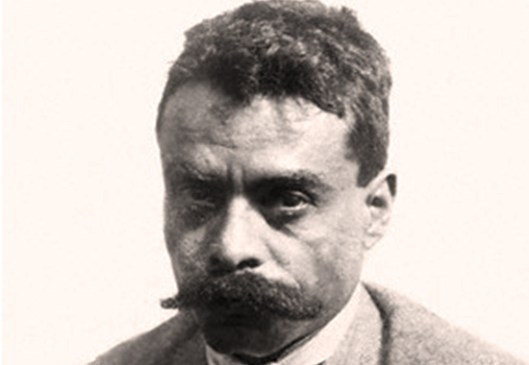
Emiliano Zapata, the hero I discovered in college, is only twenty-nine years old in this photograph. The care he felt for his people, in Morelos, has worn him down.
So when the Journalism professors at Mizzou began to reveal that they knew a lot about journalism but not one damned thing about teaching, I changed majors. This was largely because of Prof. Winfield J. Burggraaff, whose name is longer than he is tall, a Venezuelan specialist whose course on Latin American dictatorships, and, later, the History of Mexico and the History of Cuba, enthralled me. He was smart but he was also funny, and although he affected a blasé New York attitude toward all things political—he was born on Staten Island—he couldn’t quite hide how passionate he was about the history he taught. Once we were invited to his house for Christmas—having undergrads over to a prof’s house at Christmas is akin to having a bagful of abandoned kittens opened up and freed on the dinner table at Thanksgiving—and we felt very Adult and Cool. Also, his wife was lovely and all the guys spent most of the night—when not eating, which was the main order of business—trying to pretend that they weren’t staring at her which, or course, they were. Me too.
At the end of the Mexican History course—he gave little prizes at the end of each class he taught—I got the Sor Juana Ines de la Cruz Award (a pen and pencil set, I think—she was Mexican nun, scholar and poet) for being the outstanding student in the class. I am still flustered by that. It was a big deal to me and I stomped around the grey lifeless frozen campus at Columbia the rest of the day with a warm glow in my heart.
Todo el amor que me has dado, mis amigos, me ha hecho un hombre mejor.

Honduran child and la migra, 2018.
 A Work in Progress