
Not far away from us is the grave of Marine Sgt. Pete Segundo, killed in action in Vietnam in 1969. Pete was once President of the Arroyo Grande High Letterman’s Club, and his yearbook photo is typical: his broken arm is in a sling, and a bright, contagious smile crosses his face. To know Pete was to love him.
Twelve feet from Pete’s grave are two people I love. My parents are buried here. My father was a captain in the U.S. Army. I am writing a book about Arroyo Grande in World War II—my father’s war–and because it is the 70th anniversary of that war’s end, I am thinking of another grave in a cemetery 5,500 miles from here.
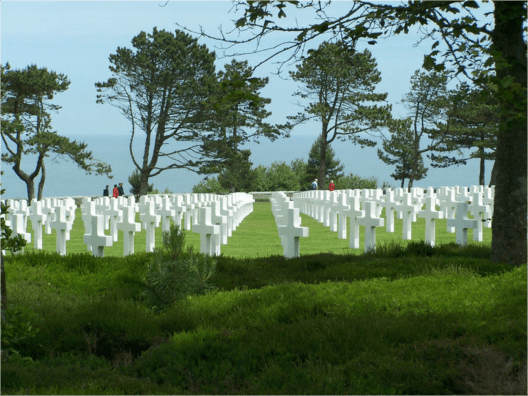
It is the American Cemetery at Colleville-sur-Mer, above Omaha Beach in Normandy.
That beach is the exclusive property of the men and women of my parents’ generation. We honor the fallen of all American wars today, but I would like to direct my remarks to the World War II generation and, by extension, to their families.
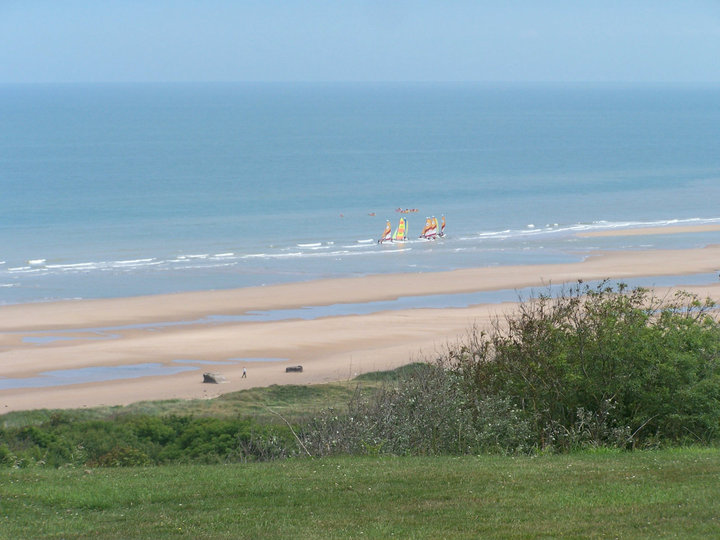
Omaha Beach today.
9,000 young men who will always be young men are buried at that impossibly beautiful cemetery in Normandy. Three came from our county.
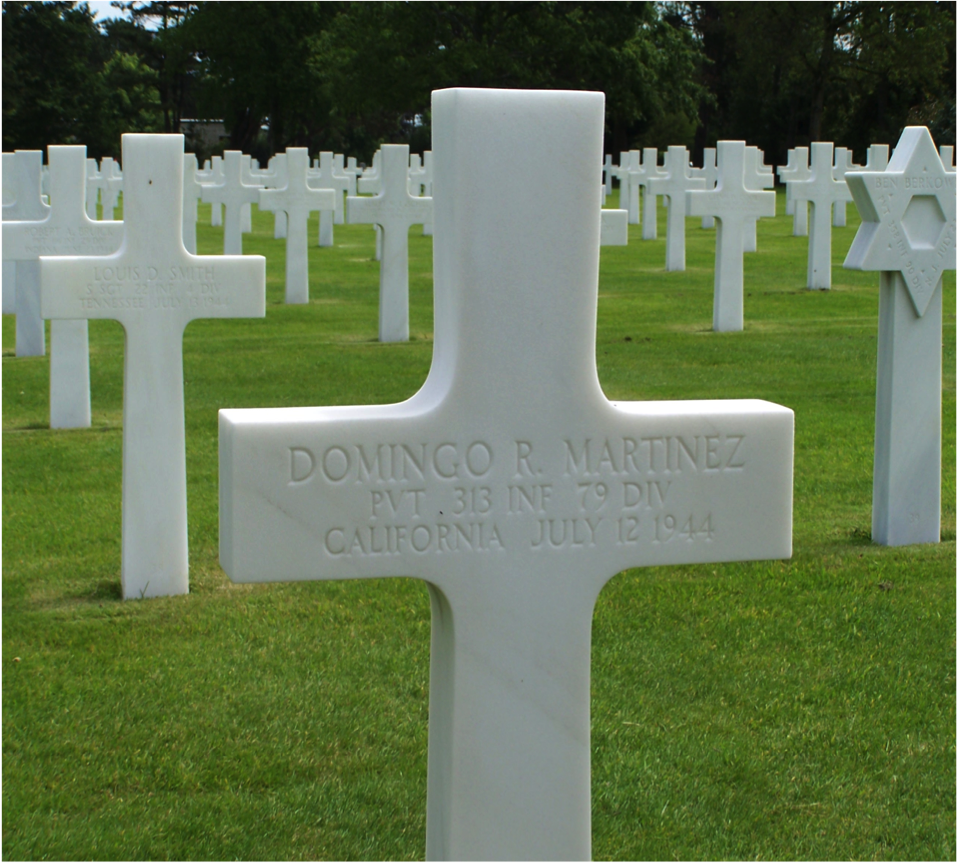
One of them was Pvt. Domingo Martinez. He is buried at Colleville-sur-Mer in Plot C, Row 13, Grave 38. Martinez knew the hard work of driving bean-stakes into the soil and he knew the smell of sweet peas of the prewar Arroyo Grande Valley. He was a farmworker, a refugee from Dust Bowl New Mexico.
But in late June 1944, Martinez was a rifleman, fighting in the streets of Cherbourg with the 79th Infantry Division.
Cherbourg was vital to securing the Allied supply line after D-Day.
It was also difficult to take. Its bristling anti-aircraft defenses would kill a San Luis Obispo fighter pilot named Jack Langston. Massive coastal batteries kept naval support for the Americans at bay, and the city’s defenders, although garrison troops, were securely dug in.

79th Infantry Division GIs, Cherbourg.
They had nowhere to go, for they were backed into a corner of France, and so isolated that the only alternative to fighting was to leap into the sea.
Once they’d entered Cherbourg, 79th Division G.I.’s learned to hate street fighting almost instantly. Death came instantly from illusory shadows that a fallen soldier’s comrades never saw, and from gunfire they sometimes never heard.
In peacetime, a French city block can be noisy with the cheers of a cafe crowd during the World Cup or the comical horns of tiny cars or the singing of children at play.
In combat, that same block, seemingly empty, can muffle the report of a sniper’s rifle or generate echoes that make soldiers look anxiously in every direction at once.
So the 79th fought house by house and street by street and eventually they captured the fortress that dominated the city, on June 26. Military historian John C .McManus notes that the men of the 79th that day were filthy, exhausted, and bearded, “like burlesque tramps,’ as one G.I. said.
They got little rest. The division quickly shifted from urban combat to a drive through the farms and villages of the Cotentin Peninsula.
American soldiers in Normandy now faced a new, even more difficult challenge. By the third week after D-Day, they were falling far short of the objectives set for them by Allied staff officers in crisp uniforms working over crisp maps that lacked one crucial detail.
The offensive in the Cotentin stalled because the Germans had the advantage of fighting defensively, in the bocage, the Norman hedgerows, and they winnowed units like the 79th Division down.
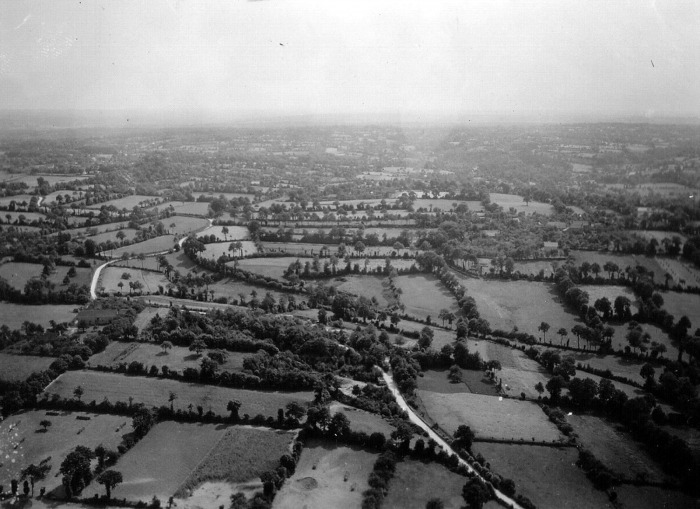
The bocage, Normandy.
The hedgerows the maps never showed enclosed fields plowed since Agincourt, or pasturage for fat Norman cows, and were a hopscotch of natural fortresses.
This meant that the G.I.’s had to assault them, one by one, to try to extract defenders who gave ground and their own lives stubbornly.
When G.I.’s broke through a hedge and entered a field, the superb German machine gun, the MG42, hidden in the next hedge beyond, or positioned on the Americans’ flanks, annihilated entire rifle squads. It fired so rapidly that a burst sounded like canvas ripping.
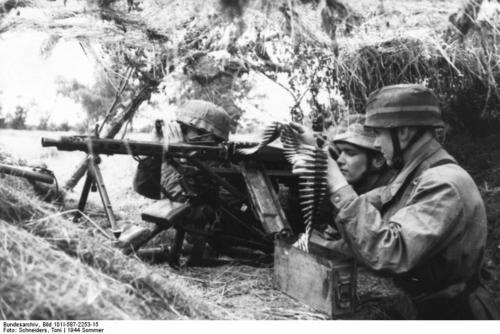
The MG 42 machine gun.
So the Americans could hear, but never see, in the tangle of the hedges, who was killing them so efficiently. The bocage quickly transformed G.I.s, with supreme indifference, into either hardened veterans or into casualties.
American soldiers, adaptive and imaginative, eventually would develop the tactics to overcome the kind of war the Germans fought in the bocage.
But for Martinez’s 79th Division, what lay beyond the hedgerows in early July may have been worse, because the Germans would not wait for them this time: this time they would attack.
The 79th, fighting in echelon with the 82nd Airborne and the 90th Infantry Divisions, seized a ridge and several hills around a key crossroads at a village called Le Haye du Puits.
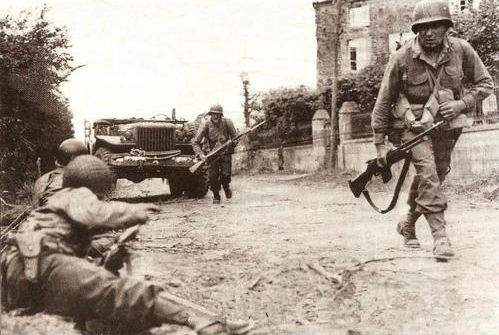
79th Division GIs taking fire, Le Haye du Puits. The GI at the right carries a Browning Automatic Rifle.
This should have compelled the enemy to abandon the town. They didn’t. They attacked instead, on July 7, intent on destroying the 79th in their positions on the ridge above the town.
The German soldiers, including SS-Panzer units, attacked with great ferocity and with great courage. These were not garrison troops, but hardened and determined professionals. They attacked in surges all day and only at nightfall did it become clear that the 79th had stopped them.
This was the turning point. On the next day, in another day of street fighting, the Americans would capture Le Haye du Puits.
Afterward, Signal Corps photographers attached to the 79th captured the images of some soldiers, their faces as blank as those of sleepwalkers. They are utterly worn out, used up, by a month of ceaseless combat.
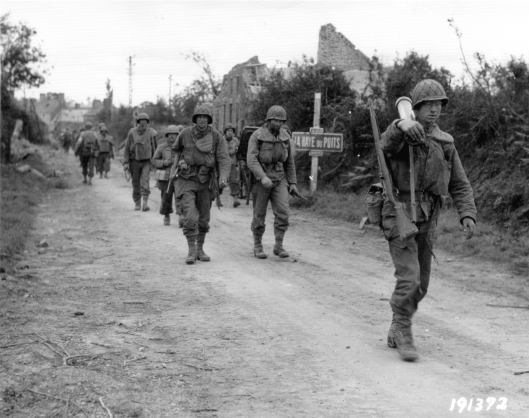
By the time Le Haye de Puits was secured, Domingo Martinez was gone. He was killed during a furious series of assaults on a little village called Le Bot, just to the south, and so would not experience the energy and the jubilation of the breakout from Normandy, which came soon after.
For the next three weeks, the Americans would roll up the Germans, then uncover Paris and liberate the city, standing aside to let Free French units enter first.
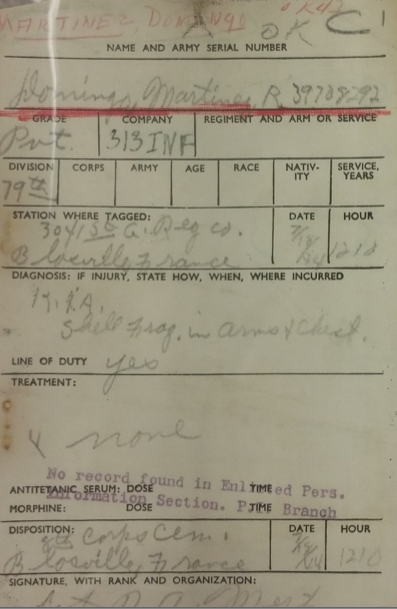
The Graves Registration record of Martinez’s death. He was most likely killed by German artillery–his regiment came under intense fire from 88mm guns.
You cannot help but wish that Pvt. Martinez had been granted enough time enough to follow the French into Paris, and maybe, even better, a week’s furlough for a farmworker, now a soldier, to explore the incredible city.
Domingo would decide to visit Notre Dame. Once he had entered the great church, he would remove his garrison cap, dip his fingers in the holy water font, then cross himself.
He would turn, blinking a little, to take in the vastness of the place, and then he would walk up the nave—the silence pressing on his ears–slowly past the clutter of pews. There, at the transept crossing, he would stop suddenly to stand, smiling with delight, as he was bathed in brilliant, colored sunlight.
This is the gift of the Rose Window to men and women of good faith.
It is your good faith, and your faith in your country, that has marked the World War II generation. Your faith sustained America during the war, and it made my life as a free American possible afterward.
I can’t thank you adequately enough today. But five years ago, I found your brother, Domingo Martinez, in the American Cemetery at Normandy. I gently touched the cold marble of his soldier’s cross and so did eight of my Arroyo Grande High School students. We spoke to him without the encumbrance of words.
That was one way of saying thanks. Now this young soldier belongs to a new generation of Americans.
 A Work in Progress