
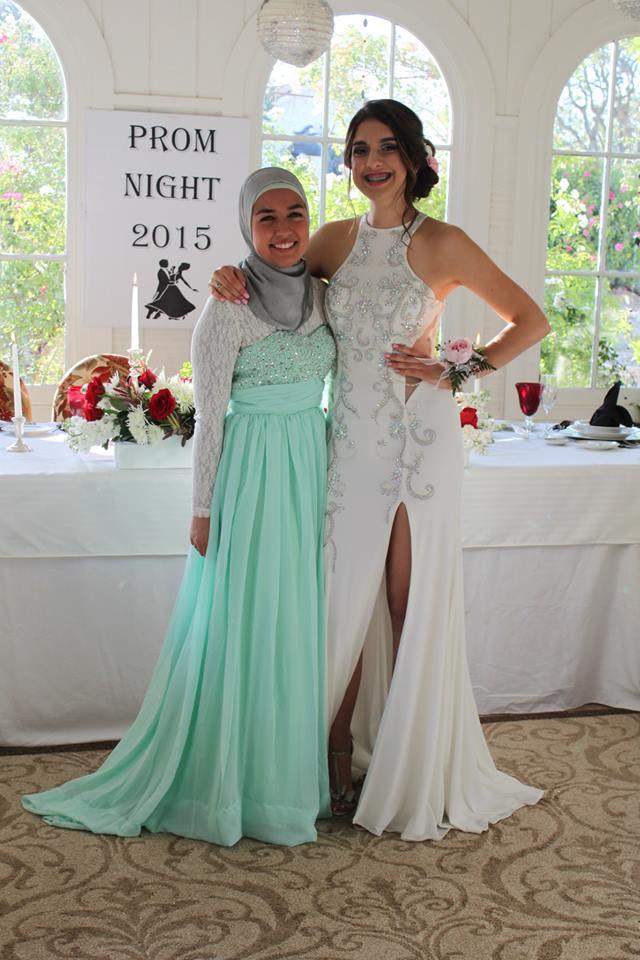
Leila and Claire at the Prom.
Leila will graduate next week and I will retire, so our ways really are parting. In the past, kids always knew where to find me when they came home on break from Cal or Davis or from the Army. Room 306 will belong to someone else next year, so the future of the Class of 2015 with me is less certain.
Each class leaves its mark–when last year’s Seniors broke into a mass flash dance at graduation, it was so unexpected and so delightful that I will never forget them.
Leila is one reason why I have a special fondness for this year’s graduates. The smile you see on her face is a constant: she radiates the kind of warmth and openness that captures others, but there is nothing calculated in the capturing. Leila’s smile comes from Leila’s heart. Today, at the Senior Assembly, she gifted me with a bouquet and fought her tears and seeing her struggle to master her feelings was an even greater gift. It’s good to know the love you’ve spent means something to someone so important.
I have rarely read a college letter that brought me to tears, but Leila’s did. One part told of her family’s trip to Egypt, to visit her grandmother. I saw photos of the woman and she has a kind of Leila-ness about herself, as well. You want to volunteer to be her grandson.
Her health has not been good. She had to have a mastectomy, and the passage I remember is when Leila volunteered to change the dressing on her wound. Her grandmother apologized for its appearance, but Leila did not hesitate and did not flinch, and I don’t think anything so clinical has been done with such gentleness and compassion.
The experience only reinforced Leila’s dream to become a doctor. We have common heroes–Doctors without Borders, a group I donate to even when I can’t really afford to. I could easily see Leila do their work. I immediately thought of her while listening to an NPR story about a doctor who lost 19 of the first 20 patients he’d treated for Ebola in West Africa. That had to be daunting, but this doctor was a man of spiritual depth. “Curing disease isn’t the most important thing a doctor does,” he said. “The most important thing a doctor can do is to enter into another’s pain.” Leila has that kind of empathy and she has the spiritual strength to sustain it.
I will come to the obvious part. Leila is an observant Muslim, and as captivating and welcoming as her smile is, there are those–some have been in the news lately–who are blind to the kindness of others because it’s so threatening to the comfort they find in hating. Leila can take care of herself–she gets those reservoirs of strength from the deep wells her family has made for her–but she also is the kind of student who can provoke every paternal instinct a male teacher has. You want to protect her from the blind and the bigoted who also have the unpleasant tendency to be loud.
The comfort is knowing that those people do not matter and have no enduring impact, unless you count, of course, the agonizing depth of the pain God feels when they broadcast their hatred.
I gained a lot of wisdom by talking to Haruo Hayashi this weekend. The Hayashis are a lot like the Assals–I saw three generations of a family whose bedrock is hard work, relaxing on a Sunday, watching television, reading, raiding the refrigerator, and all of them were present, were living in the moment, and the love you sensed among them was unforced and unpretentious, which only made it more powerful.
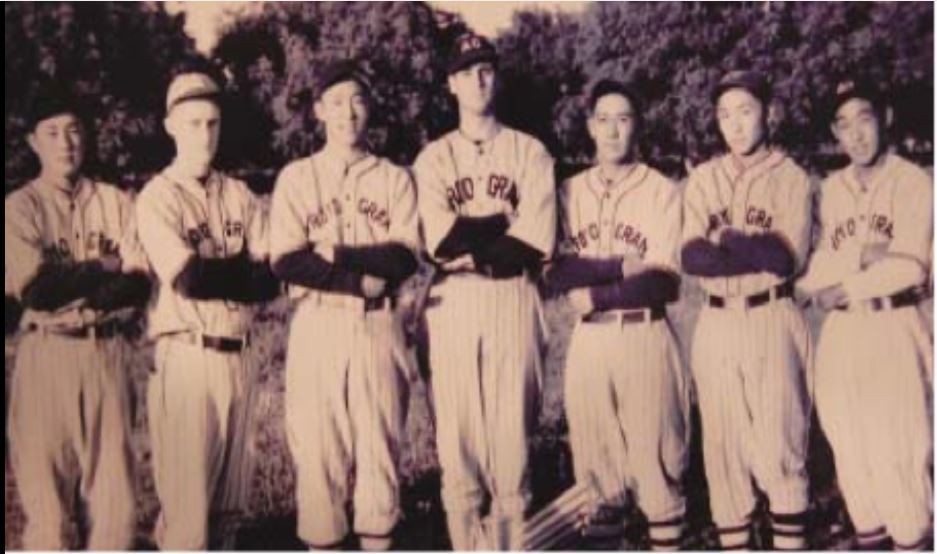
Haruo went through, after Pearl Harbor, the kind of bigotry that I fear so much. But, while the bigots were loud and threatening, they did not matter to him, 75 years later. They were small people whose names he’d lost. He hasn’t lost the names of Don Gullickson or Gordon Bennett or John Loomis, who were constant friends whose constancy lasted four lifetimes. He smiled when he spoke another name, of a tough Italian-American kid, Milton Guggia, who said to him in the week after Pearl Harbor: “Haruo, if any kid calls you a ‘Jap,’ I will personally beat the shit out of him.”
Milton Guggia is a name worth remembering, because there, I think, is a real American.
As is this American girl, who goes to Proms, who serves on the ASB, who plays Powderpuff Football, who participates every year in Mock Trial, who plays in the school band. So did Haruo. You can see him with the 1941 AGUHS Lettermen’s Club–his bad eyesight ruled out sports, but he managed for every team and earned his spot, with all the jocks, right next to Coach Max Belko, the kind of big, boisterous and indestructible coach whom every kid idolizes. The Japanese would destroy Max Belko–a round to the gut–soon after the Marine landing on Guam.
So there, in the old yearbook, are Max and Haruo, shoulder to shoulder: two more real Americans. The faith of the Assal family, their fidelity to each other, their quiet insistence on hard work and service to others, and the openness of their daughter’s heart–all of these have been blessings in my life. They are, I think, the kind of Americans we would all wish to be.































 A Work in Progress