
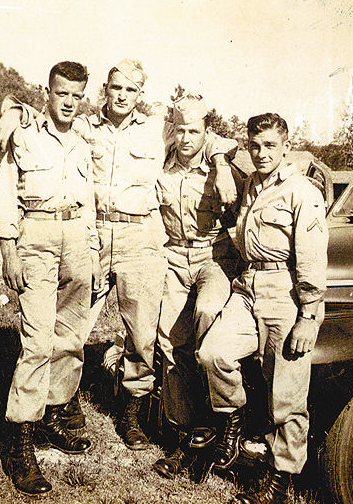
Arthur Youman, second from left, in training with the 101st Airborne.
…Frank’s brother, Manuel, and his 965th Field Artillery Battalion began a desperate fight around St. Vith, Belgium, in support of elements of the Seventh Armored Division. The Americans would lose the town to the Germans, but the 965th’s heavy guns—155 mm cannon—would be one of the factors that would make them pay dearly for it, wrecking the enemy’s timetable: the Seventh Armored abandoned the town four days after the German target date for its seizure: December 17, 1944.
That was the day that the 101st Airborne Division arrived to take up defensive positions in and around Bastogne. Their stubborn resistance in holding this town, in the rear of the German advance, was another decisive factor that prevented the Bulge from becoming the breakthrough that Hitler so desperately wanted: the German drive to the west lost momentum as thousands of Wehrmacht soldiers were thrown into the attack on Bastogne. There, among the tough and battle-wise Americans—some of their foxholes are faintly visible today– was a young sergeant from Arroyo Grande, Arthur C. Youman. He arrived in Bastogne on his twenty-third birthday.
Youman was Kentucky-born and was raised in Kern County, but he’d been living in Arroyo Grande when he enlisted in 1943. He and his comrades were told that the 101st faced, at most, three days in the line. It didn’t work out that way. For nine days they were surrounded, relying on scattered airdrops of food and ammunition to keep going. George Patton’s Third Army launched a furious attack on the southern shoulder of the Bulge and finally broke through: the first of Patton’s tankers to make contact with the 101st, on December 26, was Creighton Abrams, the future commander of American forces in Vietnam. But German resistance continued, with Youman and the paratroopers fighting into February, when they were finally pulled off the line. They had meantime endured not just the last great German offensive of the war, but also the coldest winter in Europe in thirty years.
Youman was a good soldier in one of the best combat units in American military history. He’d dropped into Normandy on D-Day, helped to capture the key Norman town, Carentan, and then joined the 101st in the ill-conceived Operation Market Garden, Field Marshal Montgomery’s attempt, in Holland, to seize the Rhine River bridges and deliver a thrust into Germany. Market Garden was a fiasco: it would claim another Arroyo Grande paratrooper, Lt. Francis Eberding, a member of the 82nd Airborne Division.
The 101st fought in Holland from September until the end of October: one high point came when Youman’s company rescued 100 British soldiers stranded in Arnhem, the centerpiece for Cornelius Ryan’s A Bridge too Far. It was during Market Garden that Youman would be promoted to sergeant; he’d impressed his boss.
The young officer who promoted Youman was Lt. Richard Winters, the commander of Easy Company, 506th Parachute Infantry Regiment, 101st Airborne Division. Youman was one of historian Stephen Ambrose’s “Band of Brothers.”

 A Work in Progress