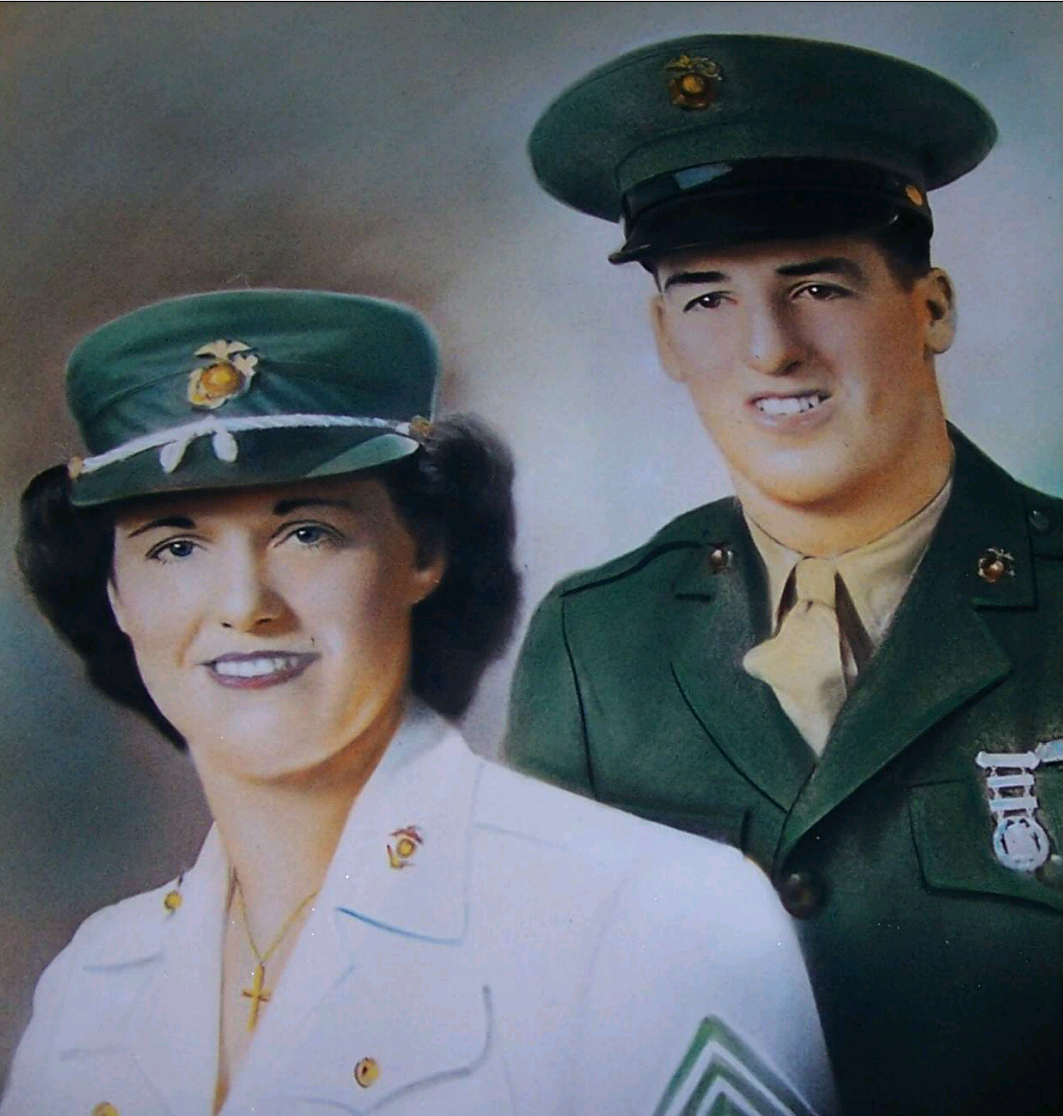
Thelma and George Murray, in a composite made for their mother.
If Guadalcanal was a turning point, Tarawa was one of the most terrible teaching moments of the American war, and it led to two close encounters with history for a brother and sister from the Lower Arroyo Grande Valley, from the little town of Oceano. This is where the farm fields end at steep seaside sand dunes, and here are the packing sheds and the loading docks alongside railroad tracks that carry Valley produce to distant markets.
The brother was a Marine private, George Murray, who was killed in action in the in the Battle of Tarawa in the Gilbert Islands in November 1943. It was a horrific battle—one of the best accounts of it comes in an aptly-titled book, One Square Mile of Hell–in which many mistakes were made. Murray didn’t die in vain, for the mistakes made at Tarawa, the first objective in Adm. Chester Nimitz’s Central Pacific island-hopping campaign, would save the lives of later Marines and of the dogfaces who landed on the coast of Normandy seven months later.
One of the mistakes in this pioneering amphibious assault was in was in the miscalculation of the tides at Betio Island, the key objective in the Tarawa Atoll, which shifted capriciously and so left many of the Marines unable to land on D-Day, on November 20. Their landing craft, the Higgins boat, was unable to surmount the coral reef that guarded the approach to Betio’s landing beaches.
George Murray was among them. While earlier units took such intense fire that 2200 of the 5000 Marines in the initial wave were killed or wounded, his unit, the 1st Battalion, 2nd Marine Regiment, spent most of D-Day, November 20, circling, hour after hour, outside the reef, impotent. It must have been maddening for them, and they were hungry, wet, seasick, and terrified.
It was close to 10 p.m. when Murray’s company was finally ordered to land in support of the first waves, desperately clinging to a sliver of beach below a sea wall and flanking a pier on Betio. The Marines had to transfer from their landing craft—the Higgins boat was essential to the war effort but this day was impeded by the reef—to LVT’s, the smaller amphibious tractors that also were facing their first test under fire. Murray’s company would hit the beach at about 11:30.
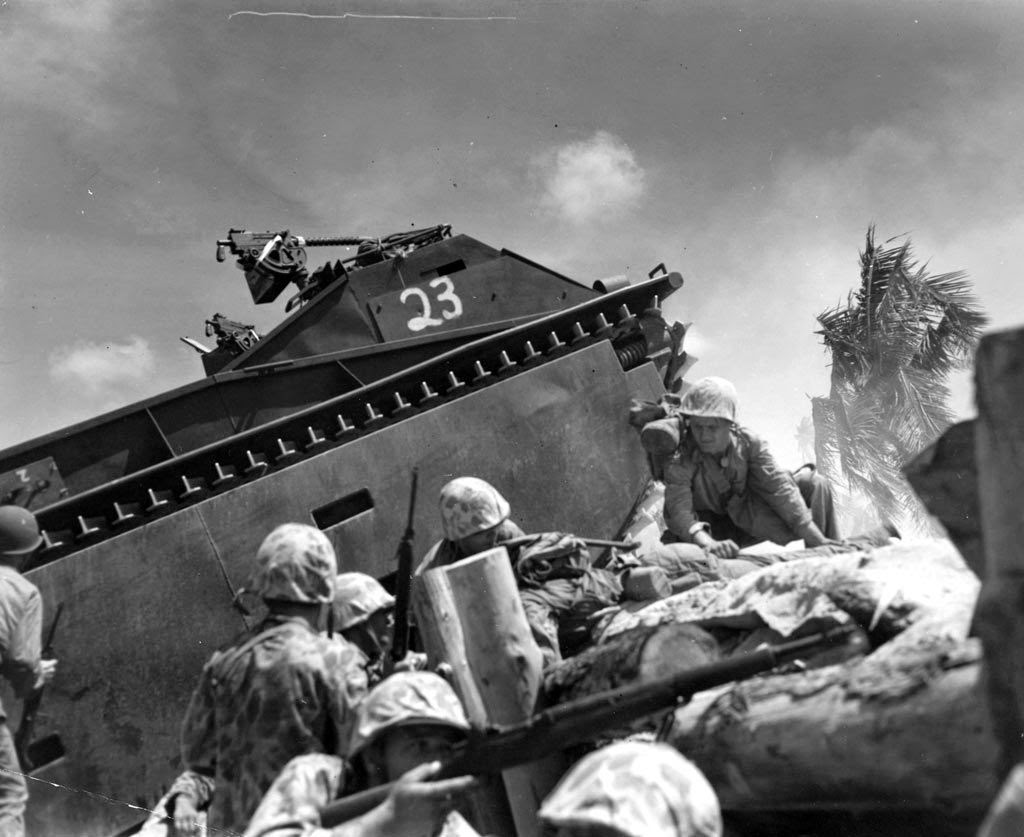
Marines use an amphibious tractor for cover on the beach at Betio Island, Tarawa.
A Department of Defense summary prepared for Murray’s descendants is both colorless and oddly moving in its description of what happened at that moment:
Three tractors of Company B landed on the left side of Red Beach Two. When the men tried to disembark from the first two tractors, only nine of the twenty-four men actually reached the beach…Private First Class Murray’s Casualty Card indicates that he died of gunshot wounds to the head and chest on 20 November 1943. Private First Class Murray was reported buried in East Division Cemetery…Row A, Grave 6. Based on PFC Murray’s recorded circumstances of death and the indication that he was initially buried at this location, it seems likely that PFC Murray did make it to the beach before being killed.
PFC Murray didn’t make it home. His remains have since been lost. Local historian and museum curator Linda Austin has joined Murray’s nephew and namesake, George Winslett, in a long and emotionally-charged search, lobbying the Defense Department and winning the support of JPAC—the Joint POW/MIA Accounting Command—in the search for Murray. In a tragedy of errors, Navy SEABEE teams reorganized and reconfigured East Division Cemetery after the battle; after the war, Army Graves Registration teams, guided by information from Marine Corps chaplains present for the original burials, could not find the cemetery. After digging several cross trenches, the team finally began to find graves—but only 129 of the more than 400 they’d expected. Several sets of remains were transferred to Hawaii for identification, but Murray was not found, either on Betio or in the forensic labs on Oahu. For his mother, Edith, it was like losing her only son twice: she now had no formal way to honor him. She was heartbroken.
So was Murray’s sister, Thelma. She wasn’t willing to wait to honor her younger brother—they were two years apart–so she, too, joined the Marines. She became a driver–and a good one—stationed at Camp Lejeune, North Carolina. Thelma eventually would marry another good driver, a truck driver, Elmer Thomas Anderson, with whom she’d hitched a ride from home in Oceano to a new duty post in San Francisco; Anderson drove for what would become Certified Freight Lines, located where the Bank of America now stands on Branch Street. An honorably discharged Army Air Force staff sergeant, Elmer would sometimes debate good-naturedly with his bride of more than forty years on who, precisely, outranked whom.
One of Thelma’s assignments as a driver at had come when a dignitary visited Camp Lejeune on December 18, 1944, and he had to have the best Marine possible to transport him. Marine Lt. Gen. Herbert Lloyd Wilkerson, a Guadalcanal veteran, was an officer trainee that day. He remembered, in a 1999 interview:
The black cabriolet, with its top down, pulled up close to our commanding officer, LTCOL Piper, who presented us to the Commander-In-Chief. I was in the front rank within 20 feet from the auto and could hear their voices. The auto was driven so close to the commanding officer that he hardly needed to move to reach the side of the vehicle.
The driver needed to be exact, because the dignitary couldn’t get out of the cabriolet and so reveal his paralysis to the fit young Marines.
Thelma’s passenger that day, of course, was President Roosevelt.
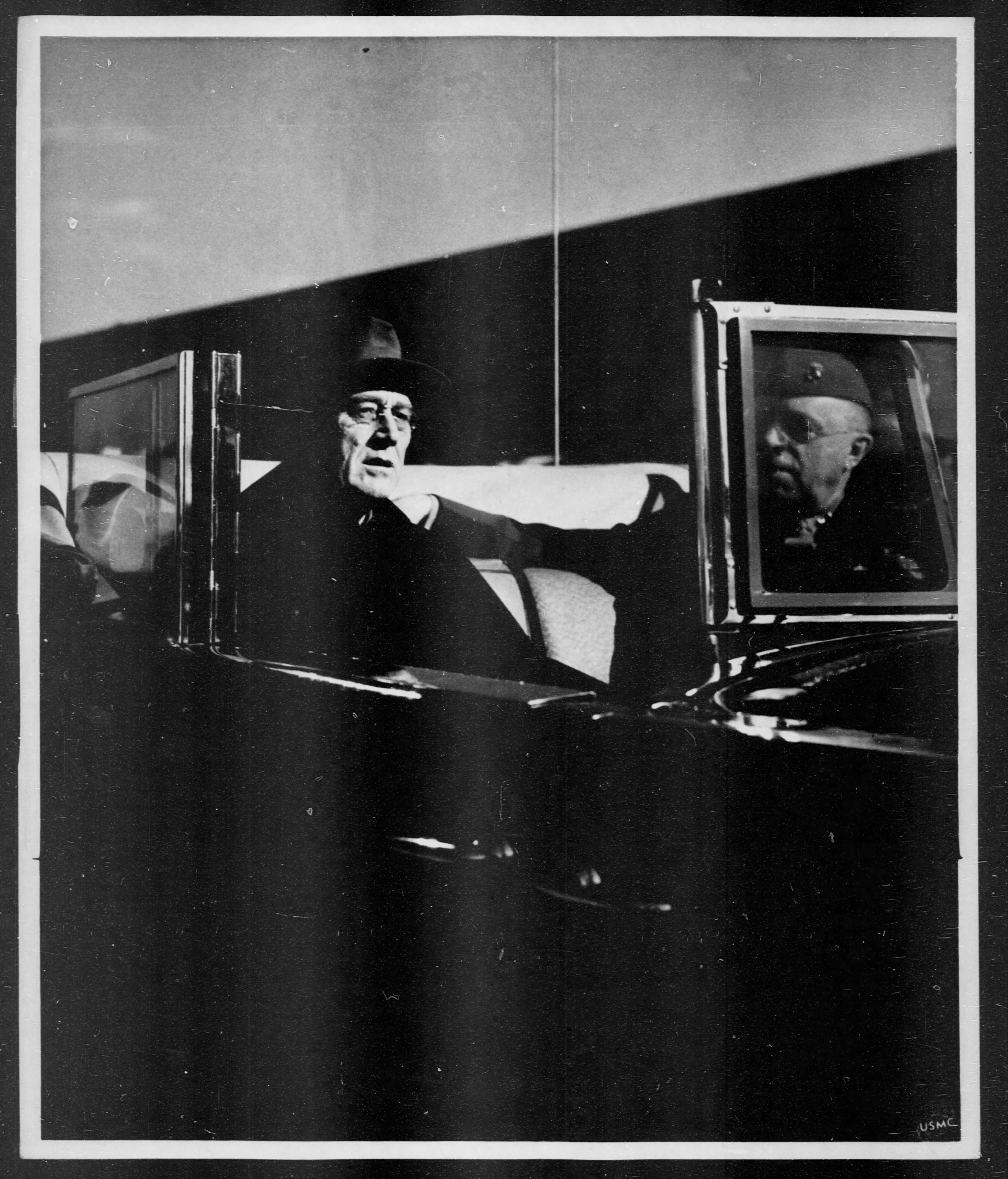
FDR with the Camp Lejeune commanding officer, December 18, 1944.
 A Work in Progress