• About
  • The Germans

A Work in Progress

A Work in Progress

Monthly Archives: August 2015

For Tom and Barb

22 Saturday Aug 2015

Posted by ag1970 in American History, California history, World War II

≈ Leave a comment

It is difficult to imagine Normandy in 1944; it is a beautiful place today, as are its people: a bonjour from an American tourist has more traction here than it does in Paris, and the little villages are lovely, separated by pastures and farm fields, each village with its distinctive little parish church. During the Middle Ages, as the skilled writer and Francophile Graham Robb notes, few villagers ever went beyond the sound of their parish church’s bells. The world beyond was like the ends of the earth.

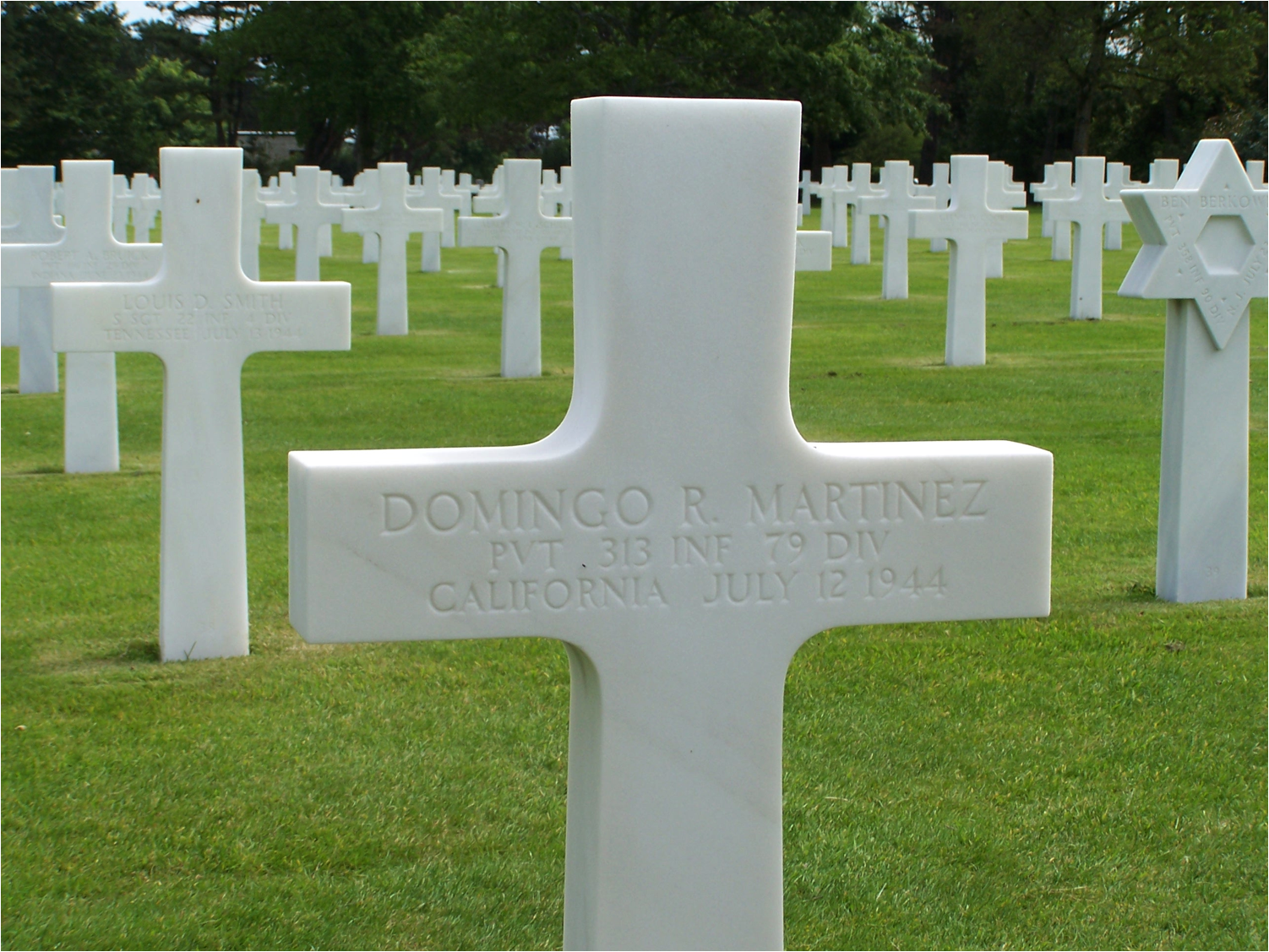
It is not the ends of the earth, but the D-Day beaches are 5,500 miles away from the Arroyo Grande Valley. Three local men, killed in the campaign to capture and then and break free from Normandy, are buried at the American Cemetery at Colleville-sur-Mer, an almost impossibly beautiful place above Omaha Beach.

Below the cemetery, just offshore, a visitor today can see young men as they should be—exuberant and free– as they race tiny sailboats, their sails bright oranges and reds, just beyond the surf line, where on June 6, 1944, young men floated like dead leaves on the water’s surface. The invasion of Hitler’s Europe nearly failed here. It didn’t, but only because of an American generation that includes those who still hold the high ground at Colleville-sur-Mer.

image

Up there, on the immaculate cemetery grounds, and not far from a famous American—the ebullient and popular Gen. Theodore Roosevelt Jr., felled by a massive heart attack soon after the invasion– lies a soldier as far removed from the Roosevelts’ patrician (if rambunctious) Oyster Bay home as a human being can be.

He was a farmworker, then an Army private, named Domingo Martinez. He is buried in Plot C, Row 13, Grave 38. Martinez is a soldier who more than likely knew the bean-stakes and the smell of sweet peas of prewar Arroyo Grande. The best that can be said is “more than likely:” the Arroyo Grande Valley is where a farm worker, as he’s listed in his 1943 Army enlistment records, would have found a job, or a series of jobs, following different harvests, and migrant farmworkers are elusive for both historians and for census-takers. My students, though, found his grave on a trip to Normandy in 2010, and spent some time with Domingo, who’d become “their” GI.

Two more soldiers, city boys compared to Martinez, are memorialized at the American Cemetery, both from the county seat, San Luis Obispo, just to the north. An artillery officer, 2nd Lt. Claude Newlin, is buried here. Ironically, Newlin’s battalion, attached to the 35th Infantry Division, had spent part of its training at Camp San Luis Obispo, just north of his home. Newlin survived some of the costliest fighting of the campaign, near St. Lo, only to die hours before the 35th broke out of Normandy to join George Patton’s breath-taking race across France to Metz and the German frontier.

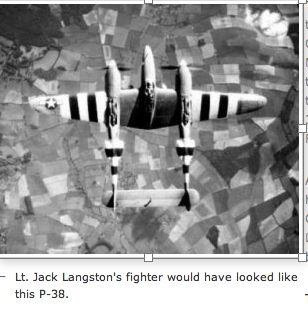
For another San Luis Obispo soldier, an airman, there is a memorial, but no grave. On June 22, 2nd Lt. Jack Langston was flying his P-38 in a low-level bombing and strafing attack on Cherbourg with his 367th Fighter Squadron when that city’s flak guns demonstrated the folly of ordering low-level attacks. Langston died that day with four other 367th pilots. His body was never recovered.
image

The farmworker, Pvt. Martinez, 26 years old, was in the southern suburbs of Cherbourg with the 313th Regiment of the 79th division and would have been grateful for the contributions of Langston and his fellow pilots: a furious eight-minute bombardment to soften the city Martinez and his comrades were ordered to take.

The 79th was sent into action soon after landing on Utah Beach. The division moved west and then turned north to push up the Cherbourg peninsula. The city, at the peninsula’s tip, needed to be taken because the Allies faced an enormous supply problem. They needed a port to help feed, arm, and fuel the growing numbers of Allied soldiers in France—the artificial “Mulberry” harbor that allowed the offloading of ships off Omaha Beach would be destroyed in a capricious Channel storm. For the Allied command, SHAEF, Cherbourg was critical.

It was also difficult to take. Its bristling anti-aircraft defenses would claim Jack Langston. Massive coastal batteries could keep naval support for the Americans at bay, and the city’s Wehrmacht defenders, though not elite troops (20% of them were non-German conscripts) were securely dug in and they had nowhere to go, for they were backed into a corner of France, and so isolated that the only alternative to fighting was to leap into the sea.

That would have been a blessing for Martinez and the 313th Infantry Regiment, because their march north, to the suburbs of Cherbourg, on the right flank of the 79th Division, taught them a bitter lesson in German military engineering.  A network of concrete pillboxes guarded the southern approaches to the city. They contained machine guns pre-sited for interlocking fields of fire, for maximum effect on the American dogfaces.

These pillboxes were impervious to frontal attack—57 mm artillery shells bounced of the steel-and-concrete walls—so two battalions of the 313th engaged the enemy while a third looped to the left and came in on the rear of the fortifications, where they were more vulnerable. The 313th leap-frogged closer to the city, only to discover that the Germans they thought they’d subdued had been hiding deep in underground galleries and had reoccupied some of their fortifications—for a short time, they would cut all of the regiment’s contact with divisional headquarters. So the 313th would have to do what field officers hated—fight over the same ground twice. It must have been a hard lesson for these soldiers, new to combat, to learn.

Once they’d gotten inside Cherbourg, 79th Division GIs learned to hate street fighting almost instantly. Death came instantly from illusory shadows that a fallen soldier’s comrades never saw, and from gunfire they sometimes never heard. In peacetime, a French city block can be cacophonous with the sounds of cafe music, or cheers inside during the World Cup, with the comic honking of little cars or the squeals of children at play. In combat, the same block, seemingly empty, can muffle the report of a sniper’s rifle or generate echoes that make soldiers look anxiously in all directions at once.

image

79th GIs, Cherbourg.

Continue reading →

What do you say to a bunch of Rotarians? Mr. Gregory Speechifies.

20 Thursday Aug 2015

Posted by ag1970 in American History, California history, Teaching, World War II

≈ Leave a comment

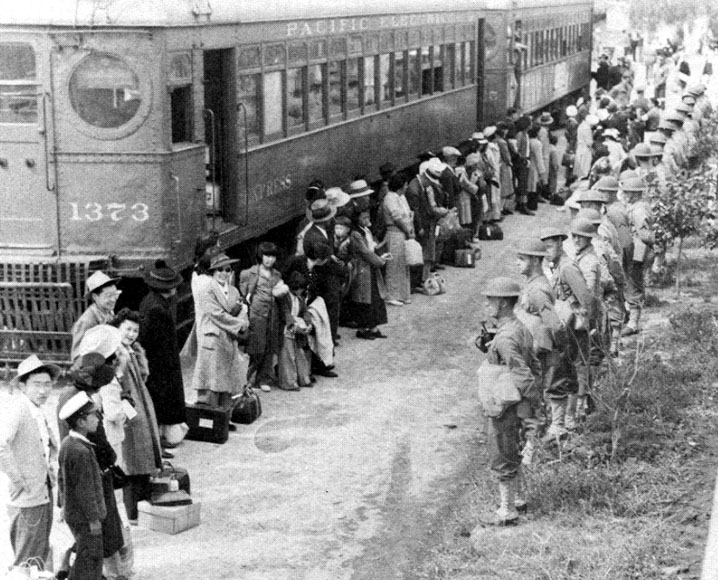
Santa Anita internees, bound for Gila River.

Santa Anita internees, bound for Gila River.

I would like to thank you because I have retired and I need you badly. Today is the first day of school, so this is the first day in thirty-one years that I have not been there.

I have not quite made it to the happy retiree place yet. I am suffering withdrawals: I get weepy when I go into Office Max because I am now irrelevant to back-to-school sales.

After thirty-one years, I can honestly say that I still loved teenagers and loved teaching them. Some people would suggest that I am mentally ill. That is a possibility.

Since that is a possibility, I am going to pretend that you are my designated sophomores. Welcome to Mr. Gregory’s history class!

As a student, my first class came just before Alaska became a state, and, although I cannot say the same about Alaska, I have never regretted that class. I went to the two-room Branch School. Actually, three rooms. One room held grades one through four. The second held grades five through eight. There was a hall in the middle where you hung your coat and where our two teachers motivated us with yardsticks.

I loved growing up here, despite the contusions, and so I had the idea to write a book about my hometown’s experience in World War II, and it found a publisher. It should go to press in November.

I had no idea how many stories a town of 1,090 in the 1940 census would yield. I don’t have time to tell them all, even though I am a history teacher and would certainly like to take that time.

I would like, with your permission, to briefly address three aspects of the war.

–First, I need to talk about what happened immediately after Pearl Harbor because those events impacted the lives of some of my best friends and some of your best Rotarians.

–Second, I’d like to give you a sense of what Camp San Luis Obispo was like during the war. At least eight different divisions—about 15,000 men each– trained here during the war, and they fought in the Aleutians, the Philippines, New Guinea, Normandy, Holland and Germany.

–Finally, I want to introduce you to a young Marine from Corbett Canyon who fought on a desolate place called Iwo Jima.

Before I tell my stories, one more point.

You are not required to like my presentation. The world is populated in part by sad people.

If by chance, you do, then the teaching I’m going to attempt today like is the teaching your children and grandchildren get every day in Lucia Mar schools.

There are Doctors of Education—a degree open to anyone who can write obscure English and collect sufficient Froot Loops boxtops—who are trying every day to confine teaching to a narrow belt on a silent assembly line. This is what we call standardized monotony.

Despite that, most Lucia Mar teachers are much like me. We are passionate about what we do. It’s not a job. It’s our calling. And our thirty-five seats are not filled by abstract manipulatives. Those are our kids. Even if we teach them for only a year, they are, and always will be, our kids, too.

* * *

On December 8, the students of Arroyo Grande Union High School gathered in their new gymnasium—a New Deal WPA work project that is today’s Paulding Middle School gym—to listen to Franklin Roosevelt’s brief but dramatic address asking Congress for a declaration of war.

Haruo Hayashi, a sopohomore, was recovering from an appendectomy when that message was broadcast. He dreaded his return to school a week later. He had no idea how he’d be received.

But nothing had changed his best friends: John Loomis, Gordon Bennett and Don Gullickson. Two of them would later fight the Japanese, but they also would write Haruo letters posted to his desert internment camp. The classmates who called Haruo a “Jap” are so unimportant now that he has forgotten their names.

But two weeks after Pearl Harbor, the war arrived offshore. Verna Nagy, a young Shell Beach resident, was looking out her picture window for a picture-postcard view of the Pacific, when the shaft of a submarine’s periscope appeared. She might have preferred the spout of a migrating gray whale instead.

 A local cattlewoman, on volunteer shore patrol between Port San Luis and Estero Bay, said she saw the sub surface. She let fly with her 30-30 carbine. The range was too great, she said later, but she had the satisfaction of seeing the crew scamper below and the captain dive the boat.

They’re plausible stories. On December 22, A Japanese submarine, I-21 had, fired a torpedo that missed its target, an oil tanker, off Lompoc. The sub headed north, along our county’s coast, in search of targets of opportunity.

I-21 found one in the little tanker Montebello off Cambria, but this time, the result was more satisfying: at 5:45 a.m. on December 23, the sub fired two torpedoes and this time one hit; I-21 surfaced and opened fire with her gun. Its report could be heard inland by residents of Atascadero, 26 miles away. The crew escaped, but Montebello went under 45 minutes after the attack began.

Within weeks, I-21 was patrolling the coast of Australia, would later shell Sydney Harbor, and would be lost with all hands near Tarawa in 1943.

So the surreal shock of Pearl Harbor, followed by the submarine attacks just off the coast, generated fear that outweighed reason. In 1942, Japanese I-boats sank four ships off the West Coast.

At the same time, German U-boats sank 70 ships off North Carolina’s Outer Banks alone. Americans from Coney Island to Miami Beach could watch as doomed American merchantmen and their crews burned offshore.

Nevertheless, it was time, some began to say, to get the Japanese out. The President of the United States, despite the strenuous objections of his own attorney general, agreed.

So, in April 1942, South County Japanese met waiting buses at the high school parking lot on Crown Hill. There was a poignant moment when the Women’s Club brought box lunches for their neighbors to take with them.

The loaded buses then would’ve crept down Crown Hill in low gear, on their way to the two-lane 101 on the western edge of town. Their passengers were crammed inside with their luggage crammed in the bellies of the buses and lashed to the roof racks.

They had to run a gauntlet, along Branch Street, of familiar places: E.C. Loomis and Sons, the Commercial Company market, F.E. Bennett’s grocery, Mr. Wilkinson’s butcher shop, Buzz’s Barber and Beauty, the Grande Theater, the Bank of America and finally, the twin churches, Methodist and Catholic.

The Nisei children and teenagers who grew up here, who had never known any other place, did not know whether they would ever see these places again. Many of them wouldn’t.

As to teenagers, there were 58 seniors in the high school Class of 1942. Twenty-five of them were of Japanese descent, so their carefully-posed senior photos bear no autographs. The yearbook came out in June. Those seniors were gone.

Just past the churches, the drivers, with their silent passengers, turned north to make the connection for the long, colorless journey into the San Joaquin Valley. They would sleep that night at the Tulare County Fairgrounds, in animal stalls that smelled of manure.

Tulare was temporary: an “assembly center.” Gila River, officially known as the Rivers Camp, would house most Arroyo Grande Japanese for the duration in the desert south of Phoenix.

Haruo Hayashi remembered the heat, which hit like a hammer-blow. Families would order swamp coolers from the Sears catalogue, which did little to help.

What Kaz Ikeda remembered was the dust. The desert winds generated terrific dust storms that hid the sun and the dust, sharp and gritty, permeated everything: bedding, nostrils and ears, the floors of the barracks, which required endless cycles of sweeping, and even the internees’ food. The dust would begin to kill older people, as well, who were susceptible to valley fever, whose spores came with the hot desert winds.

When Kaz tried to form a baseball team, it was the wind that destroyed his best efforts. Most of his players were Buddhist, and, as their parents began to die, many from lung disease, the sons observed the traditional 49 days of mourning and prayer. As a result, Kaz lost his first-string pitcher and then a catcher. Kaz’s father, Juzo, paralyzed by a farm accident, told his son that when he died, Kaz could go ahead and play the following week.

When Juzo did die, in 1943, Kaz left to top sugar beets in Utah and began to put aside a little money. Ben Dohi went to college in Missouri. Haruo Hayashi joined the 442nd Regimental Combat Team and discovered, when he tried to use the colored men’s latrine at Camp Shelby, Mississippi, that he was a white man.

By the time the camp closed in fall of 1945, only old people and children remained.

The young people who had left may have saved themselves in ways they couldn’t have foreseen. Kaz would live to be 94. Haruo, who lost Rose, his remarkable, generous-hearted wife, this summer, still lives on the Hayashi farm. Ben Dohi lives on land now farmed by his two sons.

Getting out may have been key to their long lives, because many internees would lose their health as well as their freedom. A 1997 study revealed that internees had a rate of a cardiovascular disease twice that of the Japanese-Americans who lived in the interior and so escaped internment. Many of them experienced the symptoms of post-traumatic stress syndrome, including flashbacks.

The impact of the camps would extend into the third generation, or Sansei: whose parents commonly refused to discuss the camps with their children, and this contributed to a family dynamic fraught with tension and with shame. The Sansei felt intense pressure to assimilate, which in turn generated a sense of emptiness, a loss of cultural identity, and an even more intense pressure to succeed in school and beyond—which most of them did.

Juzo Ikeda’s life had been a successful one, too, marked by hard work. But his workplace had been beautiful—green hillsides, fields of black earth and, in the distance, above the ears of his team of horses, he could see shimmering white sand dunes. He could smell the sea. In coming to America, he had set himself and his sons free.

But when death came for him, Juzo was in a makeshift hospital in a barren desert camp. He died not long after asking his son to remain loyal to the nation that had made them prisoners.

Honoring the Greatest Generation: The debt we owe our elders

11 Tuesday Aug 2015

Posted by ag1970 in Uncategorized

≈ Leave a comment

Martinez

Some good Arroyo Grande folks– which is the reason I’m writing a book–have set aside this Saturday as a day to honor our elders in the Heritage Square Park in Old Arroyo.

I was supposed to have written several books by now, according to my Arroyo Grande High School classmates, from forever ago, but Life intervened, and I am easily distracted, with a short attention span. That intensified the shock I felt when my book proposal, about Arroyo Grande’s role in World War II, was accepted by an actual, real live publishing company. Now I am nearly finished.

I spent a rewarding career as a high school history teacher, mostly at AGHS, because I was taught so well: my father, a World War II veteran, was a masterful storyteller. My Dad is one reason for the book.  My love for my home town, Arroyo Grande, is another.

What has struck me, over and over again, in researching my father’s generation, is how capricious and perverse war can be in taking the lives of young men whose first steps, or first words, first school play or first home run brought such joy to their parents.

The war would not spare Arroyo Grande this cruelty.

–There is the little boy who learned to play piano here, when the grammar school stood where Mullahey Ford is today; he would eventually pick up the trombone and the accordion and, when his family later moved to Long Beach, he would start his own dance band.  He opted for the Navy specifically to stay out of the Army and he was about to join a detail from his ship’s band in the National Anthem when a bomb straddled Arizona’s stern and blew him, dead, into Pearl Harbor. Moments later, his bandmates would be vaporized at their action stations in the No. 2 turret, just inboard from where the fatal bomb struck. The trombonist was named Jack Scruggs.

–The 1938 Arroyo Grande Union High School valedictorian was so brilliant that after his graduation from Cal, the Army Air Force selected him for a special program: He would be among the lead pilots, called “Pathfinders,” in over the target, equipped with the new radar, and his bomb group would drop their payload on his signal, when he let his bombs go. Three weeks before his first mission, he was hitching a ride on another B-17 whose inexperienced pilot flew the bomber into the side of Mt. Skiddaw in northern England. The wreckage is still there today.  His name is Clarence Ballagh.

–The farmworker first fought with the 79th Infantry Division to capture Cherbourg. Afterward, the division fought through Normandy’s hedgerows, in the death-traps the Germans had set in the bocage, but seemed to score a coup in seizing the heights above a key crossroads at Le Haye de Puits. The enemy was unwilling to let the town go. SS-Panzer units–some of the most hardened and highly-motivated soldiers in the German Army– launched a counterattack on his regiment’s position and it failed. The 79th Division eventually took Le Haye de Puits in house-to-house fighting, but Private Domingo Martinez was gone by then. He’d been killed during a furious series of assaults on Le Bot, a village just to the south.

–The Filipino-American mess attendant, the only rating to which a man like him could aspire to in the racist wartime Navy, wrote the funniest, most endearing letter a serviceman could write home. It was published in the Arroyo Grande Herald-Recorder, and it was the kind of letter that made you wish you had known him. Three weeks after he wrote it, near Guadalcanal, a Japanese Long Lance torpedo blew the bow off his destroyer, Walke.  He died along with a third of her crew, including the captain, and many of them died in the water. They survived the torpedo hit but were killed by the concussion of Walke’s depth charges as they tumbled to the bottom of Ironbottom Sound.  His name is Felix Estibal.

-–Before the war, he had worked at the E.C. Loomis feed store, and since he worked for the Loomises, he would have known virtually everybody in Arroyo Grande–population 1,090–and they would have known him. He served in a tank destroyer company in France–big tanks with 90 mm cannon, a counter to the German 88. On Nov. 27, 1944, his company, vastly outnumbered, blunted an enemy infantry attack that would earn the lieutenant in command a Silver Star. The next day was perverse: his platoon advanced toward a village called Merten when the lead tank destroyer ran into a ditch. A German round knocked the tread off a second, and the whole column, stalled, was destroyed. In the melee, a sniper killed Sgt. Frank Gularte. Frank Gularte Jr. was born five days later; the joy of his arrival would be muted by the War Department telegram that followed.

–His father farmed land in Corbett Canyon. In March, 1945, on Iwo Jima, he died as a replacement–in the World War II Marine Corps, the lowest form of life imaginable–a short-termer in the famed 28th Regimental Combat Team. It had been a squad from the 28th, immortalized by AP photographer Joe Rosenthal, that had raised the flag on Mt. Suribachi early in the battle. He might have seen the distant flag, but he was just a stevedore then, offloading supplies and waiting his turn to be assigned to the strangers with whom he would die. That death would come during an assault on Hill 362A, honeycombed with caves and machine gun nests. His total combat experience in the Second World War was, at most, 48 hours, and he was killed 48 hours before he turned twenty-one. Louis had been born when his parents were in their forties: his death had to leave a space, for Antonio and Anna Brown, that never could be filled.

It strikes me that what kills men most often in warfare is not glorious bayonet charges but mistakes, in inferior equipment, in misguided orders, in inexperience, and, most of all, because of mistakes on which nothing can be blamed.  They are fate.

Maybe it’s a different kind of fate that led me to write this book.

When you research men like these something powerful happens.  They are of my father’s generation, but the more I get to know them, the more they become my sons. I miss men I have never met.

Their deaths may seem to have been impersonal and illogical, but they have great meaning. Here is why.

I am amazed at the way the young men and women who survived the war came home and put themselves back to work.

They built schools, started Babe Ruth leagues and Boy Scout troops, ran for office, started hardware stores, incorporated a hometown bank, and poured everything they had into my generation to make sure our lives were safe, to make sure our stomachs were full, to inculcate in us the need to get a good education and the desire to make something of our lives.

It is no coincidence that I grew up loving Arroyo Grande. When my family moved here in 1955, the veterans of World War II had already prepared a home for me.

They worked so hard, I think, because they knew that’s what Jack Scruggs, Clarence Ballagh, Domingo Martinez, Felix Estibal, Frank Gularte, and Louis Brown would have done, too. The generation, raised in depression and in war, to whom we owe so much, would not allow themselves to rest until they had paid their debt to the men who would never see the Arroyo Grande Valley again.

The last barbecue

01 Saturday Aug 2015

Posted by ag1970 in Arroyo Grande, Uncategorized

≈ Leave a comment

Joe, Tony, Manuel, Frank, Mom (Clara), Mary, Edwina, Clara, Rose, Annie, and Barbara

Joe, Tony, Manuel, Frank, Mom (Clara), Mary, Edwina, Clara, Rose, Annie, and Barbara

Eighty-eight photographs with captions and credits, check. I would like to thank Mrs. Clara Gularte for lining up her six daughters in age order–I think I’ve got them right– in this 1944 photograph, at a family barbecue on the ranch at the entrance to Corbett Canyon. It was taken just before her two soldier-sons went overseas. She made it easy, lining up those girls, on us History Types. This is a beautiful photo of a beautiful family, and many thanks to Annie and John Silva.

The tragedy of the photo is that Frank, kneeling, wouldn’t make it home. He would be killed in France on November 29, 1944; his little boy would be born five days later. Shortly after the joy of Frank Jr.’s birth, his wife, Sally, and the family got the worst telegram, from the War Department, that a family could possibly get.

On December 13, a memorial mass was said for Frank at St. Patrick’s. Four days after that, his brother, Manuel, standing in this photo, went into action with his artillery battery at St. Vith to cover the American retreat in the Battle of the Bulge. That was the day that Arthur Youman entered Bastogne with his outfit, the 101st Airborne Division.

It was Youman’s twenty-third birthday.

I’ve been living with this war for a year now. It’s getting a little overwhelming.

Subscribe

  • Entries (RSS)
  • Comments (RSS)

Archives

  • January 2026
  • December 2025
  • November 2025
  • October 2025
  • September 2025
  • August 2025
  • July 2025
  • June 2025
  • May 2025
  • April 2025
  • March 2025
  • February 2025
  • January 2025
  • December 2024
  • November 2024
  • October 2024
  • September 2024
  • August 2024
  • July 2024
  • June 2024
  • May 2024
  • April 2024
  • March 2024
  • February 2024
  • January 2024
  • December 2023
  • November 2023
  • October 2023
  • September 2023
  • August 2023
  • July 2023
  • June 2023
  • May 2023
  • April 2023
  • March 2023
  • February 2023
  • January 2023
  • December 2022
  • November 2022
  • October 2022
  • September 2022
  • August 2022
  • May 2022
  • April 2022
  • March 2022
  • February 2022
  • January 2022
  • December 2021
  • November 2021
  • October 2021
  • September 2021
  • August 2021
  • July 2021
  • June 2021
  • April 2021
  • March 2021
  • February 2021
  • January 2021
  • December 2020
  • November 2020
  • August 2020
  • July 2020
  • June 2020
  • May 2020
  • April 2020
  • January 2020
  • December 2019
  • November 2019
  • October 2019
  • September 2019
  • August 2019
  • May 2019
  • April 2019
  • March 2019
  • February 2019
  • January 2019
  • December 2018
  • November 2018
  • October 2018
  • September 2018
  • July 2018
  • June 2018
  • May 2018
  • April 2018
  • March 2018
  • February 2018
  • January 2018
  • December 2017
  • November 2017
  • October 2017
  • April 2017
  • March 2017
  • December 2016
  • November 2016
  • October 2016
  • September 2016
  • August 2016
  • July 2016
  • June 2016
  • April 2016
  • March 2016
  • February 2016
  • January 2016
  • December 2015
  • November 2015
  • October 2015
  • September 2015
  • August 2015
  • July 2015
  • June 2015
  • May 2015
  • April 2015
  • March 2015
  • February 2015
  • January 2015
  • December 2014
  • November 2014
  • September 2014
  • August 2014
  • July 2014

Categories

  • American History
  • Arroyo Grande
  • California history
  • Family history
  • Film and Popular Culture
  • History
  • News
  • Personal memoirs
  • Teaching
  • The Great Depression
  • trump
  • Uncategorized
  • World War II
  • Writing

Meta

  • Create account
  • Log in

Blog at WordPress.com.

  • Subscribe Subscribed
    • A Work in Progress
    • Join 68 other subscribers
    • Already have a WordPress.com account? Log in now.
    • A Work in Progress
    • Subscribe Subscribed
    • Sign up
    • Log in
    • Report this content
    • View site in Reader
    • Manage subscriptions
    • Collapse this bar
 

Loading Comments...