
Some good Arroyo Grande folks– which is the reason I’m writing a book–have set aside this Saturday as a day to honor our elders in the Heritage Square Park in Old Arroyo.
I was supposed to have written several books by now, according to my Arroyo Grande High School classmates, from forever ago, but Life intervened, and I am easily distracted, with a short attention span. That intensified the shock I felt when my book proposal, about Arroyo Grande’s role in World War II, was accepted by an actual, real live publishing company. Now I am nearly finished.
I spent a rewarding career as a high school history teacher, mostly at AGHS, because I was taught so well: my father, a World War II veteran, was a masterful storyteller. My Dad is one reason for the book. My love for my home town, Arroyo Grande, is another.
What has struck me, over and over again, in researching my father’s generation, is how capricious and perverse war can be in taking the lives of young men whose first steps, or first words, first school play or first home run brought such joy to their parents.
The war would not spare Arroyo Grande this cruelty.
–There is the little boy who learned to play piano here, when the grammar school stood where Mullahey Ford is today; he would eventually pick up the trombone and the accordion and, when his family later moved to Long Beach, he would start his own dance band. He opted for the Navy specifically to stay out of the Army and he was about to join a detail from his ship’s band in the National Anthem when a bomb straddled Arizona’s stern and blew him, dead, into Pearl Harbor. Moments later, his bandmates would be vaporized at their action stations in the No. 2 turret, just inboard from where the fatal bomb struck. The trombonist was named Jack Scruggs.
–The 1938 Arroyo Grande Union High School valedictorian was so brilliant that after his graduation from Cal, the Army Air Force selected him for a special program: He would be among the lead pilots, called “Pathfinders,” in over the target, equipped with the new radar, and his bomb group would drop their payload on his signal, when he let his bombs go. Three weeks before his first mission, he was hitching a ride on another B-17 whose inexperienced pilot flew the bomber into the side of Mt. Skiddaw in northern England. The wreckage is still there today. His name is Clarence Ballagh.
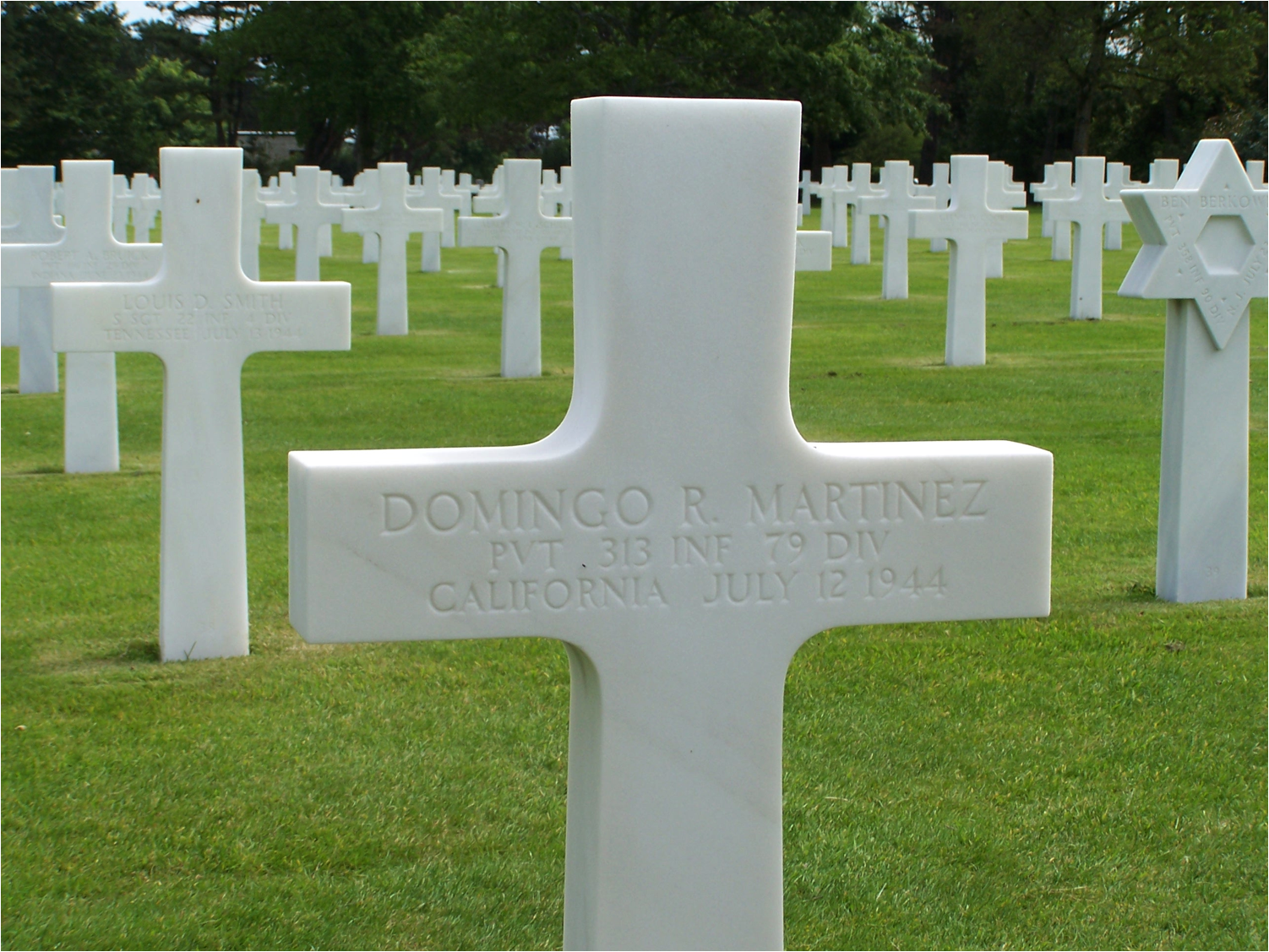
–The farmworker first fought with the 79th Infantry Division to capture Cherbourg. Afterward, the division fought through Normandy’s hedgerows, in the death-traps the Germans had set in the bocage, but seemed to score a coup in seizing the heights above a key crossroads at Le Haye de Puits. The enemy was unwilling to let the town go. SS-Panzer units–some of the most hardened and highly-motivated soldiers in the German Army– launched a counterattack on his regiment’s position and it failed. The 79th Division eventually took Le Haye de Puits in house-to-house fighting, but Private Domingo Martinez was gone by then. He’d been killed during a furious series of assaults on Le Bot, a village just to the south.
–The Filipino-American mess attendant, the only rating to which a man like him could aspire to in the racist wartime Navy, wrote the funniest, most endearing letter a serviceman could write home. It was published in the Arroyo Grande Herald-Recorder, and it was the kind of letter that made you wish you had known him. Three weeks after he wrote it, near Guadalcanal, a Japanese Long Lance torpedo blew the bow off his destroyer, Walke. He died along with a third of her crew, including the captain, and many of them died in the water. They survived the torpedo hit but were killed by the concussion of Walke’s depth charges as they tumbled to the bottom of Ironbottom Sound. His name is Felix Estibal.
-–Before the war, he had worked at the E.C. Loomis feed store, and since he worked for the Loomises, he would have known virtually everybody in Arroyo Grande–population 1,090–and they would have known him. He served in a tank destroyer company in France–big tanks with 90 mm cannon, a counter to the German 88. On Nov. 27, 1944, his company, vastly outnumbered, blunted an enemy infantry attack that would earn the lieutenant in command a Silver Star. The next day was perverse: his platoon advanced toward a village called Merten when the lead tank destroyer ran into a ditch. A German round knocked the tread off a second, and the whole column, stalled, was destroyed. In the melee, a sniper killed Sgt. Frank Gularte. Frank Gularte Jr. was born five days later; the joy of his arrival would be muted by the War Department telegram that followed.
–His father farmed land in Corbett Canyon. In March, 1945, on Iwo Jima, he died as a replacement–in the World War II Marine Corps, the lowest form of life imaginable–a short-termer in the famed 28th Regimental Combat Team. It had been a squad from the 28th, immortalized by AP photographer Joe Rosenthal, that had raised the flag on Mt. Suribachi early in the battle. He might have seen the distant flag, but he was just a stevedore then, offloading supplies and waiting his turn to be assigned to the strangers with whom he would die. That death would come during an assault on Hill 362A, honeycombed with caves and machine gun nests. His total combat experience in the Second World War was, at most, 48 hours, and he was killed 48 hours before he turned twenty-one. Louis had been born when his parents were in their forties: his death had to leave a space, for Antonio and Anna Brown, that never could be filled.
It strikes me that what kills men most often in warfare is not glorious bayonet charges but mistakes, in inferior equipment, in misguided orders, in inexperience, and, most of all, because of mistakes on which nothing can be blamed. They are fate.
Maybe it’s a different kind of fate that led me to write this book.
When you research men like these something powerful happens. They are of my father’s generation, but the more I get to know them, the more they become my sons. I miss men I have never met.
Their deaths may seem to have been impersonal and illogical, but they have great meaning. Here is why.
I am amazed at the way the young men and women who survived the war came home and put themselves back to work.
They built schools, started Babe Ruth leagues and Boy Scout troops, ran for office, started hardware stores, incorporated a hometown bank, and poured everything they had into my generation to make sure our lives were safe, to make sure our stomachs were full, to inculcate in us the need to get a good education and the desire to make something of our lives.
It is no coincidence that I grew up loving Arroyo Grande. When my family moved here in 1955, the veterans of World War II had already prepared a home for me.
They worked so hard, I think, because they knew that’s what Jack Scruggs, Clarence Ballagh, Domingo Martinez, Felix Estibal, Frank Gularte, and Louis Brown would have done, too. The generation, raised in depression and in war, to whom we owe so much, would not allow themselves to rest until they had paid their debt to the men who would never see the Arroyo Grande Valley again.
 A Work in Progress