
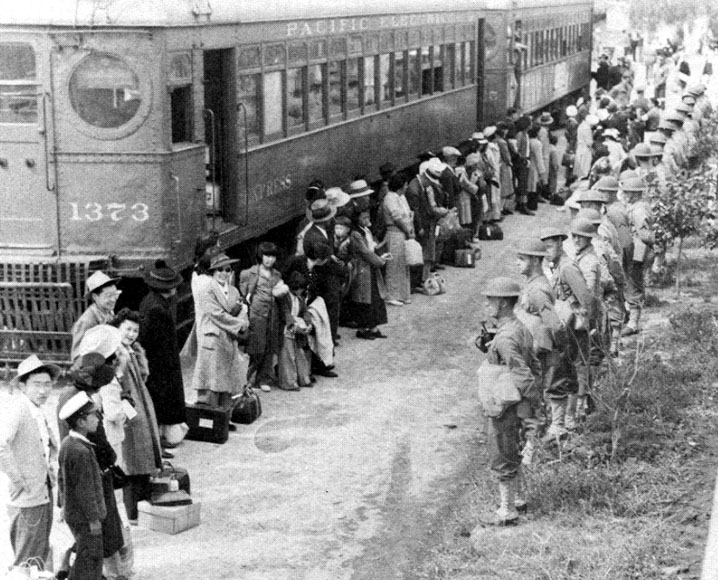
Santa Anita internees, bound for Gila River.
I would like to thank you because I have retired and I need you badly. Today is the first day of school, so this is the first day in thirty-one years that I have not been there.
I have not quite made it to the happy retiree place yet. I am suffering withdrawals: I get weepy when I go into Office Max because I am now irrelevant to back-to-school sales.
After thirty-one years, I can honestly say that I still loved teenagers and loved teaching them. Some people would suggest that I am mentally ill. That is a possibility.
Since that is a possibility, I am going to pretend that you are my designated sophomores. Welcome to Mr. Gregory’s history class!
As a student, my first class came just before Alaska became a state, and, although I cannot say the same about Alaska, I have never regretted that class. I went to the two-room Branch School. Actually, three rooms. One room held grades one through four. The second held grades five through eight. There was a hall in the middle where you hung your coat and where our two teachers motivated us with yardsticks.
I loved growing up here, despite the contusions, and so I had the idea to write a book about my hometown’s experience in World War II, and it found a publisher. It should go to press in November.
I had no idea how many stories a town of 1,090 in the 1940 census would yield. I don’t have time to tell them all, even though I am a history teacher and would certainly like to take that time.
I would like, with your permission, to briefly address three aspects of the war.
–First, I need to talk about what happened immediately after Pearl Harbor because those events impacted the lives of some of my best friends and some of your best Rotarians.
–Second, I’d like to give you a sense of what Camp San Luis Obispo was like during the war. At least eight different divisions—about 15,000 men each– trained here during the war, and they fought in the Aleutians, the Philippines, New Guinea, Normandy, Holland and Germany.
–Finally, I want to introduce you to a young Marine from Corbett Canyon who fought on a desolate place called Iwo Jima.
Before I tell my stories, one more point.
You are not required to like my presentation. The world is populated in part by sad people.
If by chance, you do, then the teaching I’m going to attempt today like is the teaching your children and grandchildren get every day in Lucia Mar schools.
There are Doctors of Education—a degree open to anyone who can write obscure English and collect sufficient Froot Loops boxtops—who are trying every day to confine teaching to a narrow belt on a silent assembly line. This is what we call standardized monotony.
Despite that, most Lucia Mar teachers are much like me. We are passionate about what we do. It’s not a job. It’s our calling. And our thirty-five seats are not filled by abstract manipulatives. Those are our kids. Even if we teach them for only a year, they are, and always will be, our kids, too.
* * *
On December 8, the students of Arroyo Grande Union High School gathered in their new gymnasium—a New Deal WPA work project that is today’s Paulding Middle School gym—to listen to Franklin Roosevelt’s brief but dramatic address asking Congress for a declaration of war.
Haruo Hayashi, a sopohomore, was recovering from an appendectomy when that message was broadcast. He dreaded his return to school a week later. He had no idea how he’d be received.
But nothing had changed his best friends: John Loomis, Gordon Bennett and Don Gullickson. Two of them would later fight the Japanese, but they also would write Haruo letters posted to his desert internment camp. The classmates who called Haruo a “Jap” are so unimportant now that he has forgotten their names.
But two weeks after Pearl Harbor, the war arrived offshore. Verna Nagy, a young Shell Beach resident, was looking out her picture window for a picture-postcard view of the Pacific, when the shaft of a submarine’s periscope appeared. She might have preferred the spout of a migrating gray whale instead.
A local cattlewoman, on volunteer shore patrol between Port San Luis and Estero Bay, said she saw the sub surface. She let fly with her 30-30 carbine. The range was too great, she said later, but she had the satisfaction of seeing the crew scamper below and the captain dive the boat.
They’re plausible stories. On December 22, A Japanese submarine, I-21 had, fired a torpedo that missed its target, an oil tanker, off Lompoc. The sub headed north, along our county’s coast, in search of targets of opportunity.
I-21 found one in the little tanker Montebello off Cambria, but this time, the result was more satisfying: at 5:45 a.m. on December 23, the sub fired two torpedoes and this time one hit; I-21 surfaced and opened fire with her gun. Its report could be heard inland by residents of Atascadero, 26 miles away. The crew escaped, but Montebello went under 45 minutes after the attack began.
Within weeks, I-21 was patrolling the coast of Australia, would later shell Sydney Harbor, and would be lost with all hands near Tarawa in 1943.
So the surreal shock of Pearl Harbor, followed by the submarine attacks just off the coast, generated fear that outweighed reason. In 1942, Japanese I-boats sank four ships off the West Coast.
At the same time, German U-boats sank 70 ships off North Carolina’s Outer Banks alone. Americans from Coney Island to Miami Beach could watch as doomed American merchantmen and their crews burned offshore.
Nevertheless, it was time, some began to say, to get the Japanese out. The President of the United States, despite the strenuous objections of his own attorney general, agreed.
So, in April 1942, South County Japanese met waiting buses at the high school parking lot on Crown Hill. There was a poignant moment when the Women’s Club brought box lunches for their neighbors to take with them.
The loaded buses then would’ve crept down Crown Hill in low gear, on their way to the two-lane 101 on the western edge of town. Their passengers were crammed inside with their luggage crammed in the bellies of the buses and lashed to the roof racks.
They had to run a gauntlet, along Branch Street, of familiar places: E.C. Loomis and Sons, the Commercial Company market, F.E. Bennett’s grocery, Mr. Wilkinson’s butcher shop, Buzz’s Barber and Beauty, the Grande Theater, the Bank of America and finally, the twin churches, Methodist and Catholic.
The Nisei children and teenagers who grew up here, who had never known any other place, did not know whether they would ever see these places again. Many of them wouldn’t.
As to teenagers, there were 58 seniors in the high school Class of 1942. Twenty-five of them were of Japanese descent, so their carefully-posed senior photos bear no autographs. The yearbook came out in June. Those seniors were gone.
Just past the churches, the drivers, with their silent passengers, turned north to make the connection for the long, colorless journey into the San Joaquin Valley. They would sleep that night at the Tulare County Fairgrounds, in animal stalls that smelled of manure.
Tulare was temporary: an “assembly center.” Gila River, officially known as the Rivers Camp, would house most Arroyo Grande Japanese for the duration in the desert south of Phoenix.
Haruo Hayashi remembered the heat, which hit like a hammer-blow. Families would order swamp coolers from the Sears catalogue, which did little to help.
What Kaz Ikeda remembered was the dust. The desert winds generated terrific dust storms that hid the sun and the dust, sharp and gritty, permeated everything: bedding, nostrils and ears, the floors of the barracks, which required endless cycles of sweeping, and even the internees’ food. The dust would begin to kill older people, as well, who were susceptible to valley fever, whose spores came with the hot desert winds.
When Kaz tried to form a baseball team, it was the wind that destroyed his best efforts. Most of his players were Buddhist, and, as their parents began to die, many from lung disease, the sons observed the traditional 49 days of mourning and prayer. As a result, Kaz lost his first-string pitcher and then a catcher. Kaz’s father, Juzo, paralyzed by a farm accident, told his son that when he died, Kaz could go ahead and play the following week.
When Juzo did die, in 1943, Kaz left to top sugar beets in Utah and began to put aside a little money. Ben Dohi went to college in Missouri. Haruo Hayashi joined the 442nd Regimental Combat Team and discovered, when he tried to use the colored men’s latrine at Camp Shelby, Mississippi, that he was a white man.
By the time the camp closed in fall of 1945, only old people and children remained.
The young people who had left may have saved themselves in ways they couldn’t have foreseen. Kaz would live to be 94. Haruo, who lost Rose, his remarkable, generous-hearted wife, this summer, still lives on the Hayashi farm. Ben Dohi lives on land now farmed by his two sons.
Getting out may have been key to their long lives, because many internees would lose their health as well as their freedom. A 1997 study revealed that internees had a rate of a cardiovascular disease twice that of the Japanese-Americans who lived in the interior and so escaped internment. Many of them experienced the symptoms of post-traumatic stress syndrome, including flashbacks.
The impact of the camps would extend into the third generation, or Sansei: whose parents commonly refused to discuss the camps with their children, and this contributed to a family dynamic fraught with tension and with shame. The Sansei felt intense pressure to assimilate, which in turn generated a sense of emptiness, a loss of cultural identity, and an even more intense pressure to succeed in school and beyond—which most of them did.
Juzo Ikeda’s life had been a successful one, too, marked by hard work. But his workplace had been beautiful—green hillsides, fields of black earth and, in the distance, above the ears of his team of horses, he could see shimmering white sand dunes. He could smell the sea. In coming to America, he had set himself and his sons free.
But when death came for him, Juzo was in a makeshift hospital in a barren desert camp. He died not long after asking his son to remain loyal to the nation that had made them prisoners.
 A Work in Progress