
It is difficult to imagine Normandy in 1944; it is a beautiful place today, as are its people: a bonjour from an American tourist has more traction here than it does in Paris, and the little villages are lovely, separated by pastures and farm fields, each village with its distinctive little parish church. During the Middle Ages, as the skilled writer and Francophile Graham Robb notes, few villagers ever went beyond the sound of their parish church’s bells. The world beyond was like the ends of the earth.
It is not the ends of the earth, but the D-Day beaches are 5,500 miles away from the Arroyo Grande Valley. Three local men, killed in the campaign to capture and then and break free from Normandy, are buried at the American Cemetery at Colleville-sur-Mer, an almost impossibly beautiful place above Omaha Beach.
Below the cemetery, just offshore, a visitor today can see young men as they should be—exuberant and free– as they race tiny sailboats, their sails bright oranges and reds, just beyond the surf line, where on June 6, 1944, young men floated like dead leaves on the water’s surface. The invasion of Hitler’s Europe nearly failed here. It didn’t, but only because of an American generation that includes those who still hold the high ground at Colleville-sur-Mer.
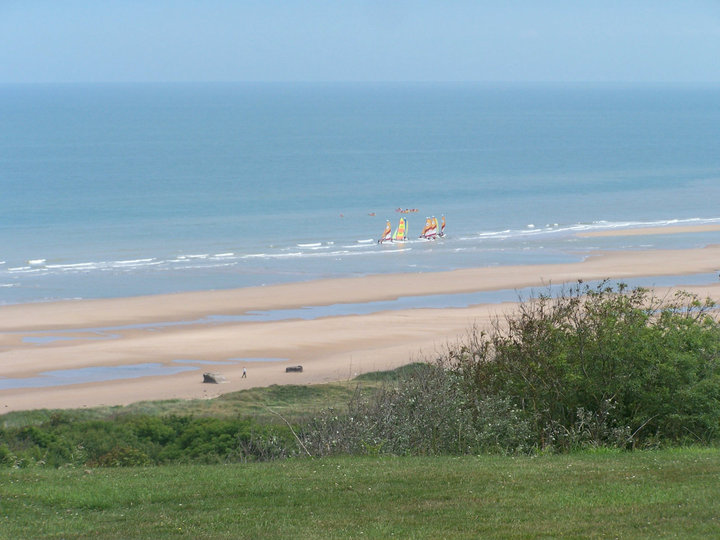
Up there, on the immaculate cemetery grounds, and not far from a famous American—the ebullient and popular Gen. Theodore Roosevelt Jr., felled by a massive heart attack soon after the invasion– lies a soldier as far removed from the Roosevelts’ patrician (if rambunctious) Oyster Bay home as a human being can be.
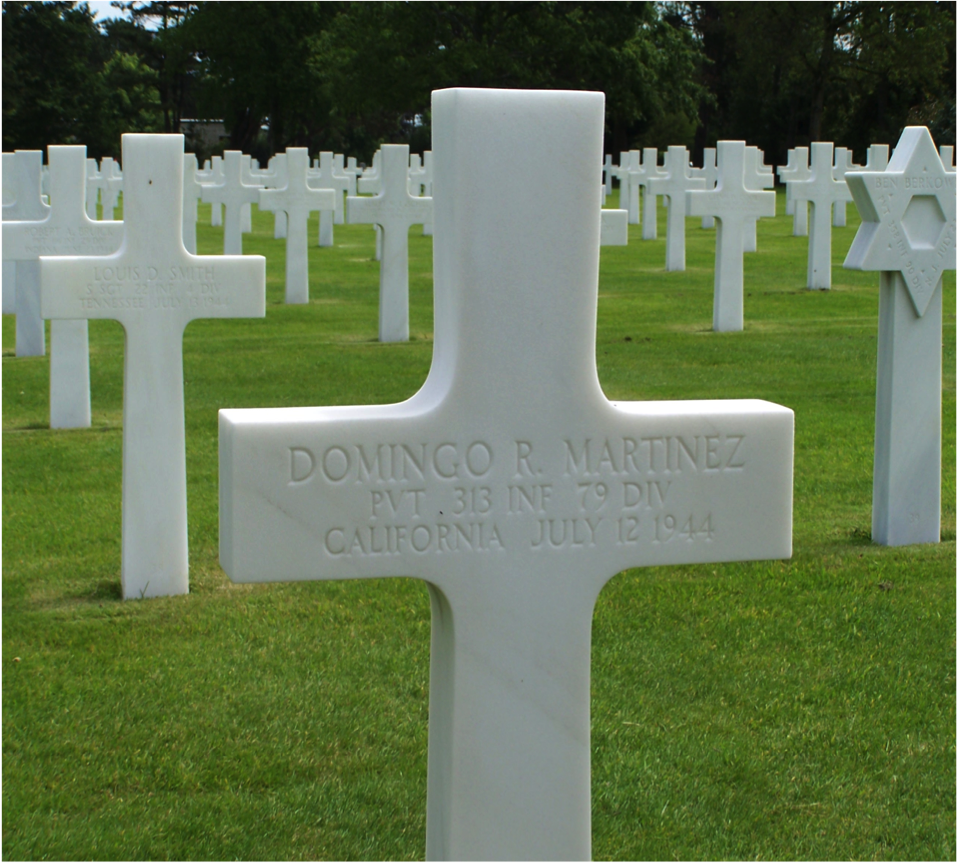
He was a farmworker, then an Army private, named Domingo Martinez. He is buried in Plot C, Row 13, Grave 38. Martinez is a soldier who more than likely knew the bean-stakes and the smell of sweet peas of prewar Arroyo Grande. The best that can be said is “more than likely:” the Arroyo Grande Valley is where a farm worker, as he’s listed in his 1943 Army enlistment records, would have found a job, or a series of jobs, following different harvests, and migrant farmworkers are elusive for both historians and for census-takers. My students, though, found his grave on a trip to Normandy in 2010, and spent some time with Domingo, who’d become “their” GI.
Two more soldiers, city boys compared to Martinez, are memorialized at the American Cemetery, both from the county seat, San Luis Obispo, just to the north. An artillery officer, 2nd Lt. Claude Newlin, is buried here. Ironically, Newlin’s battalion, attached to the 35th Infantry Division, had spent part of its training at Camp San Luis Obispo, just north of his home. Newlin survived some of the costliest fighting of the campaign, near St. Lo, only to die hours before the 35th broke out of Normandy to join George Patton’s breath-taking race across France to Metz and the German frontier.
For another San Luis Obispo soldier, an airman, there is a memorial, but no grave. On June 22, 2nd Lt. Jack Langston was flying his P-38 in a low-level bombing and strafing attack on Cherbourg with his 367th Fighter Squadron when that city’s flak guns demonstrated the folly of ordering low-level attacks. Langston died that day with four other 367th pilots. His body was never recovered.
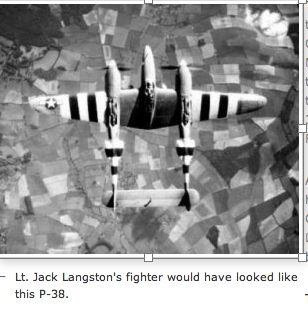
The farmworker, Pvt. Martinez, 26 years old, was in the southern suburbs of Cherbourg with the 313th Regiment of the 79th division and would have been grateful for the contributions of Langston and his fellow pilots: a furious eight-minute bombardment to soften the city Martinez and his comrades were ordered to take.
The 79th was sent into action soon after landing on Utah Beach. The division moved west and then turned north to push up the Cherbourg peninsula. The city, at the peninsula’s tip, needed to be taken because the Allies faced an enormous supply problem. They needed a port to help feed, arm, and fuel the growing numbers of Allied soldiers in France—the artificial “Mulberry” harbor that allowed the offloading of ships off Omaha Beach would be destroyed in a capricious Channel storm. For the Allied command, SHAEF, Cherbourg was critical.
It was also difficult to take. Its bristling anti-aircraft defenses would claim Jack Langston. Massive coastal batteries could keep naval support for the Americans at bay, and the city’s Wehrmacht defenders, though not elite troops (20% of them were non-German conscripts) were securely dug in and they had nowhere to go, for they were backed into a corner of France, and so isolated that the only alternative to fighting was to leap into the sea.
That would have been a blessing for Martinez and the 313th Infantry Regiment, because their march north, to the suburbs of Cherbourg, on the right flank of the 79th Division, taught them a bitter lesson in German military engineering. A network of concrete pillboxes guarded the southern approaches to the city. They contained machine guns pre-sited for interlocking fields of fire, for maximum effect on the American dogfaces.
These pillboxes were impervious to frontal attack—57 mm artillery shells bounced of the steel-and-concrete walls—so two battalions of the 313th engaged the enemy while a third looped to the left and came in on the rear of the fortifications, where they were more vulnerable. The 313th leap-frogged closer to the city, only to discover that the Germans they thought they’d subdued had been hiding deep in underground galleries and had reoccupied some of their fortifications—for a short time, they would cut all of the regiment’s contact with divisional headquarters. So the 313th would have to do what field officers hated—fight over the same ground twice. It must have been a hard lesson for these soldiers, new to combat, to learn.
Once they’d gotten inside Cherbourg, 79th Division GIs learned to hate street fighting almost instantly. Death came instantly from illusory shadows that a fallen soldier’s comrades never saw, and from gunfire they sometimes never heard. In peacetime, a French city block can be cacophonous with the sounds of cafe music, or cheers inside during the World Cup, with the comic honking of little cars or the squeals of children at play. In combat, the same block, seemingly empty, can muffle the report of a sniper’s rifle or generate echoes that make soldiers look anxiously in all directions at once.

79th GIs, Cherbourg.
But Martinez’s regiment fought well; they would drive to the water’s edge on June 26, and then turn their artillery loose on Fort du Roule, which dominated the city. Its commander surrendered later in the day. The men of the 79th, by the time they had finally finished their approach to the city, were filthy, exhausted, and bearded, “like burlesque tramps,” as one newspaper reporter said.
After a short rest, the division made the transition from urban combat to a new offensive, a drive through the farmland of the Cotentin Peninsula. This assignment was interrupted briefly on July 4 for a visit from the Brass: Ike and Gen. Omar Bradley, the American ground commander, were with the 79th when, on their orders, every American artillery piece in Normandy fired, into German lines, a simultaneous single-shell barrage to celebrate Independence Day.
There seemed to be little else to celebrate. By the third week after D-Day, the Americans were falling short of the objectives set for them by Allied planners and the staff officers working furiously over maps in Omar Bradley’s custom command trailer. The offensive in the Cotentin stalled in great part because the Germans had the advantage of fighting defensively, in the bocage, the Norman hedgerows, and they winnowed units like the 79th down.
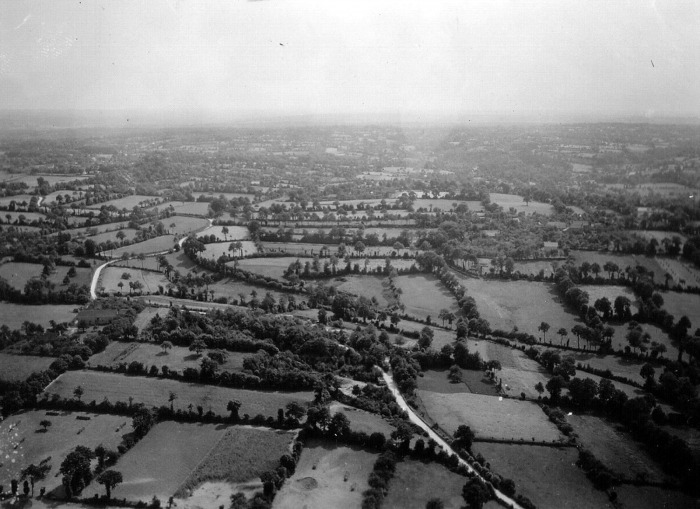
The bocage.
The hedgerows enclosed fields plowed since Agincourt, or pasturage for fat Norman cows, and were a hopscotch of natural fortresses—roots and compacted earth had formed defensible walls. The GIs had to assault them, one by one, to try to root the defenders out. When they broke through a hedge and entered a field, the superb German machine gun, the MG42, hidden in the next hedge beyond, or positioned on the Americans’ flanks, annihilated entire rifle squads. It fired so rapidly that a burst sounded like canvas ripping. Army films had incorporated the sound to try to desensitize trainees.
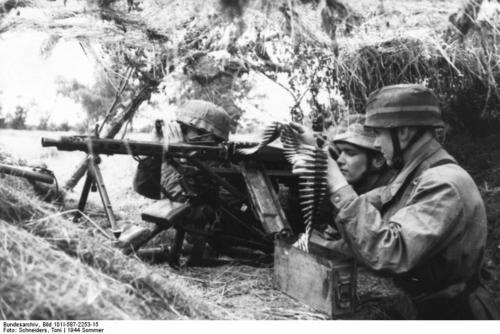
So the Americans could hear, but never see, in the tangle of the hedges, who was killing them so efficiently. The bocage quickly transformed GIs, with supreme indifference, into either hardened veterans or into statistics. American soldiers, adaptive and imaginative, eventually would develop the tactics to overcome the kind of war the Germans fought in the bocage, but the price was high. Domingo Martinez’s 313th Infantry Regiment would face more hedgerow fighting to the south of a key crossroads town, La Haye du Puits.
There, Martinez and his comrades faced first-class combat troops, not garrison soldiers, many of them veterans of the Russian front. As the 313th fought to envelop the town, the regiment’s combat chronicle is almost monotonous with passages that have the Americans falling back to their jump-off point after repeated, and failed, attacks through fields, then across a creek, where every time they would be driven back by concentrated German artillery fire. The Germans had the finest machine gun of the war, and also the finest artillery piece, the versatile and lethal 88-mm gun.
Other elements of the 79th Division would take La Haye du Puits, but the 313th Regiment continued its sledgehammer attacks to the south. Martinez died during three furious 313th assaults near a little town called Le Bot on July 12. It was, after all, an 88 shell that killed Martinez: shrapnel to the head and chest ended his life quickly, but his death wasn’t recorded for three days, an indicator of the intensity of the stress the 313th endured.
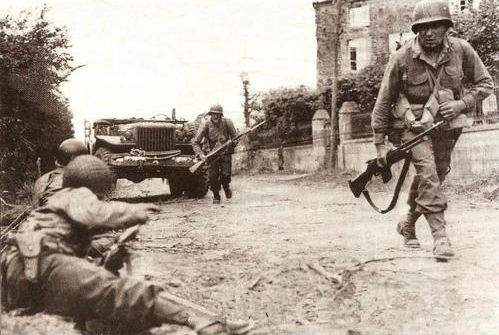
Le Haye de Puits. The soldier at right carries a Browning Automatic Rifle.
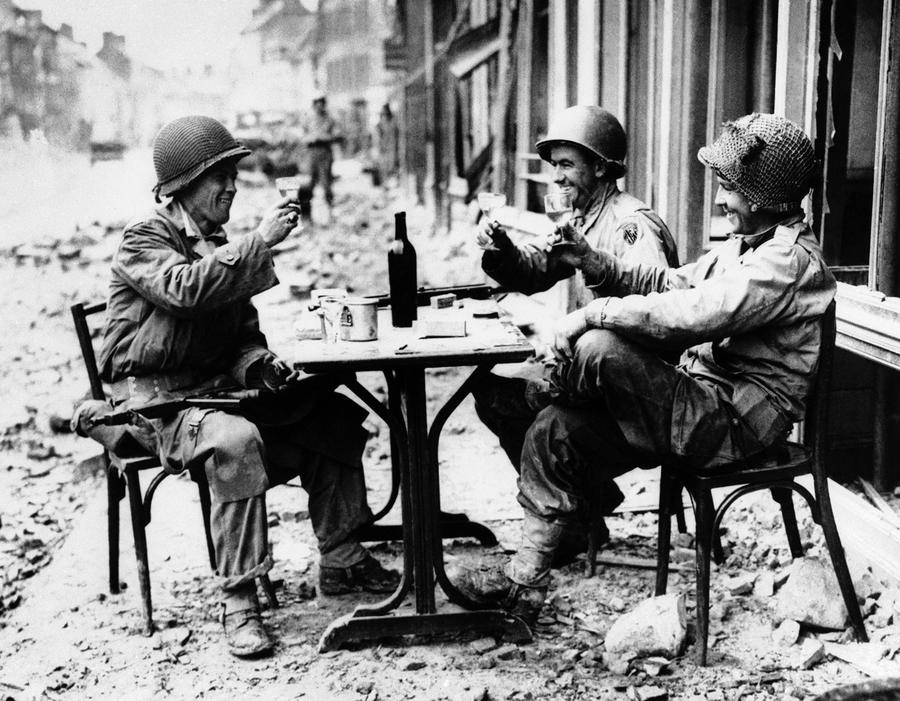
They were victorious, but both the regiment and the division were depleted and their dogfaces, real veterans now, were used up. Signal Corps photographers show some 79th soldiers play-acting outside a wine shop along a street in La Haye du Puits—they sit at a small table amid the rubble, enjoying a fine red wine as if they had dinner reservations and were awaiting the first course. But other photos of other soldiers show men who resemble sleepwalkers: their faces are blank and few of them seem celebratory.
With rest and replacements, the hardened veterans of three weeks’ combat would soon join in the breakout from Normandy. Two weeks after Martinez’s death, the Allies would launch Operation Cobra, a coordinated drive to the east. They would uncover Paris and liberate the city in August, standing aside to let Free French units and their prickly commander, Gen. Leclerc, enter first. Leclerc would have been furious to learn that Ernest Hemingway and some of his camp followers had preceded him and they were, with great offensive spirit, but also with deteriorating unit cohesion, busy liberating the bar at the Ritz Hotel.
It’s not hard to wish that Pvt. Martinez had been granted more time—maybe, for this migrant farmworker and Dust Bowl refugee, time enough for a few days’ leave to explore Paris. Perhaps he would decide to visit Notre Dame, where it’s not hard to see him, in your mind’s eye. He would enter the great church, remove his garrison cap, and cross himself at a holy water font. Then he would walk up the nave, the silence pressing on his ears, to stand for a moment at the transept crossing, where he would stop to smile with delight as he was bathed in brilliant, colored sunlight. This is the gift of the Rose Window to men and women of good faith.
 A Work in Progress