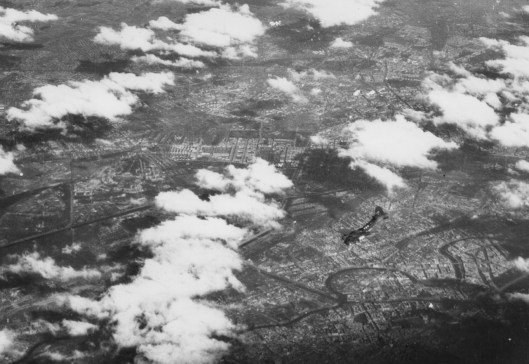
A crippled B-17 begins its plunge to earth over Berlin.
[Dear Editor Lady]:
It was good to talk to you today! You did mention the book title in passing. Arroyo Grande in World War II, to me, has the kind of appeal that would sell twelve—maybe fifteen—books. I am thinking and consulting Lincoln, Shakespeare, Exodus, Wilfred Owen and Ernest Hemingway. Nothing yet. Then there are several passages in the book that come from soldiers’ or sailors’ letters home. I was re-reading Elliot Whitlock’s—he would win the Silver Star for his conduct in bringing his crippled B-17 back to base in England—and a particular sentence arrested me:
…At that time Jim’s parachute caught fire as did an extra one we carried. Mine was burnt but not seriously. With his chute gone, Jim couldn’t jump. I decided to stay with the ship while Jim put out the fire. He succeeded in getting it under control, but his hands were so badly burnt that he couldn’t do anything the rest of the trip.
He held the ship level while I finished putting the fire out…Somebody handed a fire extinguisher through a hole the fire had burnt, and so I looked back and everybody was there (in the tail) for which I thanked God. Nobody…had bailed out. They had not heard the order.
…I had dived the ship immediately after the fire so that nobody would pass out it the oxygen was cut off. Suddenly we started to get an awful lot of flak (anti-aircraft fire from the ground) so I had to hurry back to the cockpit to do some evasive action which worked okay, incidentally. I had one of the boys get the maps…and had the radio operator get fixes so I plotted a course for home with as little flak as possible. The radio operator did a fine job so we came out on course and landed OK. All this was above the clouds, so I think I can qualify for navigator now as well as pilot…
…Your prayers are standing by me. I was praying up there and all the rest of the men were praying, too…
Lots of love,
Elliott
So, this came to mind:
Your Prayers Are Standing by Me
A California Town in World War II
One of the major reasons I wrote this book was to connect an obscure and seemingly unimportant little town with events both famous and world-changing. These events happened so far away, so the theme of distance—spatial, temporal, emotional–is one that comes up over and over in the book. The book shifts between those distant events and the home front. Elliot’s poetic sentence represents, to me, a bridge between the distant and Home, between a plane in trouble over Berlin and a father and mother running a little grocery on Branch Street—in their prayers, almost willing the plane safely home. The book, likewise, is intended to be a bridge between Arroyo Grande and the war, and even more, between living generations and one that has almost disappeared. Frankly, I like it also because it’s organic: it comes from a kid who was in the AGUHS Drama Club and the Diction Club and not from Thucydides, whose high-school yearbook I can’t find. The fact that this is a religious sentence is, to me, irrelevant: it’s a bridge.
Here are just a few examples of that idea of “distance” and of “connectedness:”
>…its characters will enter the Arroyo Grande Valley, many after long and dangerous journeys; World War II will call their descendants—part of “The Greatest Generation”– away on journeys more dangerous still…
>…there were deep hurts that would need time to heal, hurts inflicted all the way from the hedgerows of Normandy to the desolate, shell-blasted landscape of Iwo Jima and, finally, to now-empty baseball fields in internment camps like Gila River.
>…the war, for Americans at home, was both distant and, for grieving families, painfully intimate…
>…Winds had carried the copper-red soil as far east as the mid-Atlantic to drop it, like gritty rain from a place that had none, onto ships still sailing freely between continents…
>…The U-boats would someday kill that young field worker, if indirectly, as part of a inexorable chain of events that would lead him to Normandy, so far away from the fields that border Arroyo Grande Creek, and to pastures bound by hedges and grazed by fat dairy cows…
>… The first gunshot heard in the Arroyo Grande Valley came a few weeks before Victoria ascended the English throne. It was probably fired from an 1825 Hawken rifle…
>… By the early part of the new century, some of the workers in those fields, their wide-brimmed straw hats like mushroom caps as they bent to their work, would figure prominently in the American history that Clara loved. They were first immigrants to arrive from Japan, most of them from the southern island, Kyushu, but a few of them from farther north, in the prefecture that surrounded the city of Hiroshima.
>…The next day, he and his classmates at Arroyo Grande Union High School gathered in their new gymnasium—a New Deal WPA work project that still serves as the Paulding Middle School gym today—to listen to Franklin Roosevelt’s dramatic eight-minute address…
>… Many years later, [a local cattlewoman] would tell Port San Luis Harbor Commissioner Donald Ross that she’d seen a sub—during I-21’s combat patrol– surface offshore during her shift on a volunteer shore patrol, somewhere along the beach in what is today Montana de Oro State Park. She let fly with her 30-30 carbine. The range was too great, she told Ross, but she had the satisfaction of seeing the crew scamper below and the captain dive the boat…Within weeks, I-21 would be sinking shipping off the coast of Australia, would shell Sydney Harbor, and would be lost with all hands near Tarawa in 1943.
>–I just saw one of the swellest sights. You will never believe it when I tell you. It was fresh green peas in a field…if you had been where we were and as long as we were, you would know why we thought so much of seeing a field of vegetables. We saw many wonderful sights….We saw country that reminded my of the Cuyama, some places reminded me of the scenery between San Simeon and Monterey. For the past few months we have seen nothing but country like that at Devils’ Den, except there is more wind and sand here.
–A letter home from North Africa
>That was Frank Gularte’s last full day of life. On the 28th, the 607th was ordered to take another town, Merten. Everything that could go wrong did… Somewhere in the melee, a German sniper took the life of the young man who would never see his son.…Five days later, Sally Gularte gave birth to Frank Jr. Only a few days after that–after she’d first held her son close in her arms–she received the War Department telegram that took her husband away from her.
>Juzo Ikeda’s life had been a successful one, too, marked by hard work. But his workplace had been beautiful—green hillsides, fields of black earth and, in the distance, above the ears of his team of horses, he could see shimmering white sand dunes. He could smell the sea…Japan had destroyed his family’s fortunes and so had trapped those who stayed behind; in coming to America, Juzo had set himself and his sons free.
But when death came for him in 1943, Juzo was in a makeshift hospital in a barren desert camp. He died not long after asking his son to remain loyal to the nation that had made them prisoners.
–On the other hand, I could be full of beans.
Jim



 A Work in Progress