
When you meet someone like Johnny Silva, you say to yourself, “this has to be the best and kindest man I have ever met. Nobody can be like that.” But then you meet Johnny’s wife, Annie Gularte Silva, and you find that somebody can. And when you remember what their kids were like when you were growing up with them, you realize that these things are not coincidences: your life has been blessed.
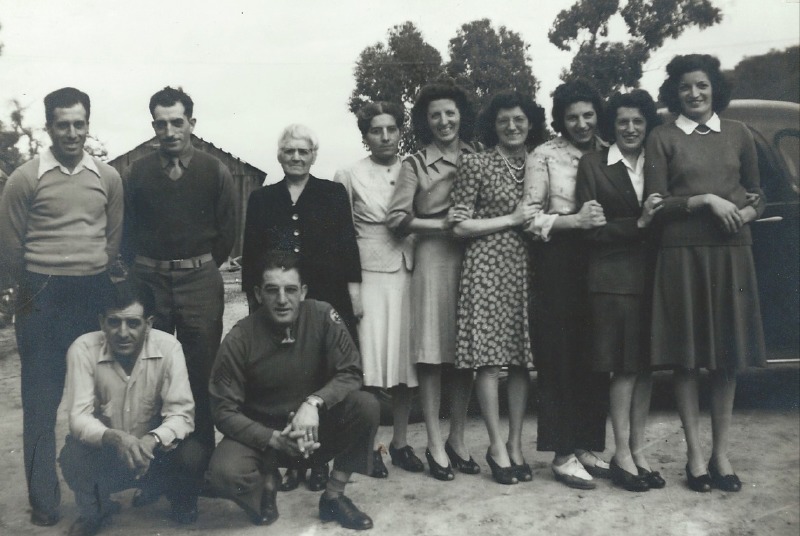
The last time the Gularte children were together, 1944. Frank, in uniform, in front of his mother, would be killed in action in November 1944. Just above him is Manuel, who would serve as an artilleryman and survive the war. Joe and Tony, at left, would run the family farm during the war; Mrs. Clara Gularte is flanked by her six daughters: Mary, Edwina, Clara, Rose, Annie, and Barbara. Photo courtesy Annie Gularte Silva.
…The Americans’ breakout from Normandy, after claustrophobic weeks in the death traps of the hedgerows, must have been a jubilant one, but the 607th would encounter another death trap whose brutality sobered them. The Americans, under Omar Bradley, and the British and Canadians, under Bernard Law Montgomery, had the chance to encircle the entire German Army in Normandy. They would fail, and thousands of Germans would escape, battle-weary, some of them now barefoot, running for their lives along narrow roads and cattle trails through what became known as the Falaise Gap. American artillery units found them there–artillery spotters were nearly incoherent because there were so many targets to call in on their field radios–and the slaughter they inflicted was horrific. Seventy years later, one of the 607th’s soldiers, Frank Kunz, remembered the results in an interview with his hometown newspaper: “ Christ help me. There were 6 to 8 inches of bodies and horses ground up on the road. There was nothing you could do. You had to drive through it.” People, Kunz added, don’t understand what war is.
Patton’s chase would end in September on the Moselle River at the old Roman garrison town of Metz. It would take him two months to break down German resistance and Gularte’s 607th, now attached to the 95th Infantry Division, fought in several actions around the city. In one of them, a company of the unit was credited with firing the first Third Army shells into Germany, aimed at a church steeple in the town of Perl.
By November 23, the battalion was fighting along the river, six miles south of Metz. The Moselle, beautiful, calm, and, in summer, a soft blue, might have made Gularte homesick if he’d had the opportunity to see it then, and in peace. The river’s surface is punctuated by ringlets as trout nose up to feed, and on summer nights, with their long twilight hours, little French boys do what little boys in the Arroyo Grande Valley do—they go fishing.
But with winter descending in 1944, it’s along the Moselle where the unit saw one of its finest hours: Company C, unsupported by infantry, was charged with holding a little town, Falck. By now, the 607th had made the important transition from a towed to a self-propelled unit. Their main anti tank weapon was a robust 90mm gun—with its armor-piercing shell, it was a match for the German 88—mounted on a tank chassis. This was the M36. C Company, commanded by 1st Lt. George King, came under mortar and artillery fire, then repeated infantry assaults from the woods, still dense around the town today. The enemy wanted Falck back, but they would not get it. Smith’s tank destroyers and their crews alone would turn them back in their repeated assaults, and the young officer would earn a Silver Star for his leadership that day: November 27, 1944.
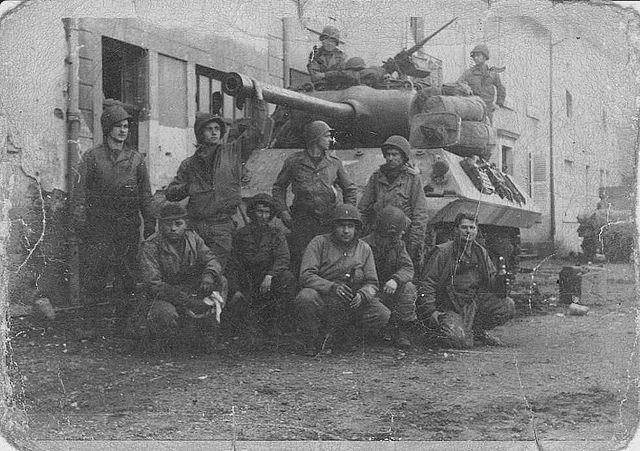
“Old Faithful,” a tank destroyer, with members of Frank Gularte’s 607th TD Battalion.
That was Frank Gularte’s last full day of life. On the 28th, the 607th was ordered to take another town, Merten. Everything that could go wrong did. The infantry that was to support the big M36s never materialized. The 3rd Platoon of Company C took on Merten by itself: the first M36 to advance down the road was fired on, returned fire but then, in moving around a tank barrier, got mired in the mud and so was easily destroyed by a German anti-tank crew. The next destroyer turned back, the third tumbled into a ditch and enemy fire set it ablaze, and the fourth had its gun jam. When it turned to return to Falck, this last destroyer, too, became bogged down in the mud. Somewhere in the melee, a German sniper took the life of the young man who would never see his son. Frank Jr. was born five days after the sniper fired the shot that killed his father. Frank’s wife, Sally, would have gotten the terrible War Department telegram a few days after that.
The squad leader/writer, Sgt. Gantter, wrote in his memoirs of a young man in his company who carried, from his arrival in France to the German frontier, a box of cigars to share once he had word of the birth of his first child. Gantter liked the young man: he was earnest, friendly, and desperate for word from home. But mail was slow—Gantter would be sharing Christmas cookies with his fellow dogfaces in March—so the young soldier eventually gave up the waiting and gave out his cigars when the due date had safely come and gone. Gularte must have been waiting anxiously for word from home, as well—receiving it would be a joyful distraction from the filth, the cold, the constant, dull exhaustion—and it would be a sign, too, that there was a new reason to survive the war, a new reason to get himself home.
Many at home, and in the front lines in Europe, as well, according to Gantter, hoped the war would be over by Christmas. The chase across France had given both false hopes. It would instead be a hard Christmas, hard in the Ardennes, with the onslaught of Nordwind, the great German offensive; hard, too for the Gularte family: on Wednesday, December 13, Father Thomas Morahan celebrated a Mass at St. Patrick’s Church in Frank’s memory.
Even then, the war would not leave the family alone: four days later, Frank’s brother, Manuel, and his 965th Field Artillery Battalion began a desperate fight around St. Vith, Belgium, in support of the Seventh Armored Division, charged with holding the town in the face of the massive German offensive that would become known as the Battle of the Bulge. The Americans would lose the town to the Germans, but the 965th’s heavy guns—155 mm cannons—would be one of the factors that would make them pay dearly for it, wrecking, in the process, the enemy’s timetable. The Seventh Armored abandoned St. Vith, but only after holding on for a full four days past the German target date, December 17, for its seizure.
That was the day that the 101st Airborne Division arrived to take up defensive positions in and around Bastogne. Their stubborn resistance in holding this town, in the rear of the German advance, was another decisive factor that prevented the Bulge from becoming the breakthrough that Hitler so desperately wanted: the German drive to the west lost momentum as thousands of Wehrmacht soldiers were thrown into the attack on Bastogne. There, among the tough and battle-wise Americans—some of their foxholes are faintly visible today– was a young sergeant from Arroyo Grande, Arthur C. Youman. December 17 was his twenty-third birthday.
 A Work in Progress