• About
  • The Germans

A Work in Progress

A Work in Progress

Monthly Archives: October 2015

Why We Write

21 Wednesday Oct 2015

Posted by ag1970 in Uncategorized

≈ 1 Comment

Screen Shot 2015-10-21 at 2.45.13 PMJust got the page proofs. Serious proofreading comes next. Kind of numb, but also happy. These are stories that deserved to be set down and, hopefully, they will be remembered.

I think now, looking back on a little book that’s almost done, that they have an unintended educational value, too. There’s so much petulance and selfishness adulterating our national character today–our polity, especially.

Much of this book is a mirror-reversal of that: it’s instead about civic duty, about sacrifice, about generosity–“the better angels of our nature,” as Lincoln put it so vividly. World War II was, after all, just as the Civil War had been, a war where the survival of democracy was at stake.

I think that’s why I need to write another book. Had it not been for a bureaucracy as prosaic as the Soil Conservation Service, Corbett Canyon would today be a desert. One of the fundamental values of the Second New Deal was the belief that we had an obligation to generations not yet born. Those generations are today walking to school on sidewalks that are stamped “WPA 1940” below hillsides that support grazing cattle only because CCC kids built check dams there in 1937.

Democracy works. It takes courage to nurture it, though, and compromise to sustain it, and we need those qualities now every bit as much as we need rain.

Arroyo Grande’s Japanese-Americans and World War II

09 Friday Oct 2015

Posted by ag1970 in American History, California history, History, World War II

≈ Leave a comment

https://drive.google.com/file/d/0B05dFICUx2kGWTZnenpVTTdQR2c/view?usp=sharing

Dad and Gen. Patton

04 Sunday Oct 2015

Posted by ag1970 in Uncategorized

≈ Leave a comment

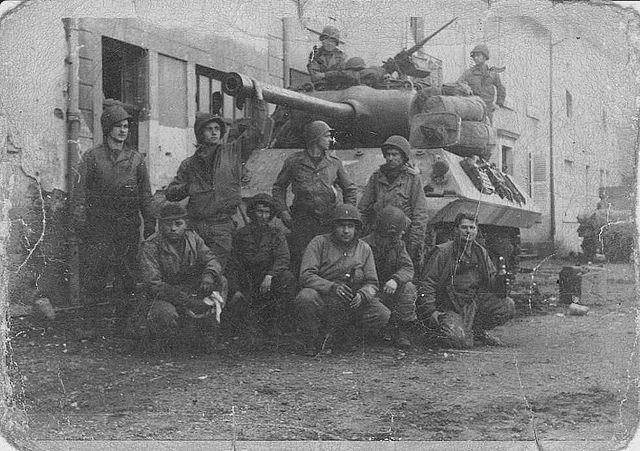
“Old Faithful,” a tank destroyer, with members of Frank Gularte’s 607th TD Battalion.

For the summer and fall, the 607th—its main armament at this point was a three-inch gun, towed by a half-track or ¾ ton truck–sprinted across France under the command of perhaps the most famous American combat general: they were a part of George Patton’s Third Army, and so undoubtedly infused with Patton’s fighting spirit. Patton wanted his tanks and trucks infused, not just his men, and in his drive during the breakout from Normandy—the grand chase across France that Domingo Martinez would not live to see—the general wasn’t hesitant about sending details back to Omaha Beach to steal entire gasoline supply companies. My father, a Quartermaster officer in London, was responsible for sending those units to the beachhead.

Their absence one day led to what had to be the most extravagantly profane cross-Channel phone call ever placed. An irate divisional commander, his division immobilized on Omaha with his men lying on their backs looking for clouds shaped like Rita Hayworth, bellowed that Lt. Gregory would be Pvt. Gregory within 24 hours, and added that there wasn’t a foxhole in northern France deep enough to protect him from the enemy artillery bombardment that the general would be happy to arrange. My father got off the hook when the gasoline’s disappearance was traced to Third Army.

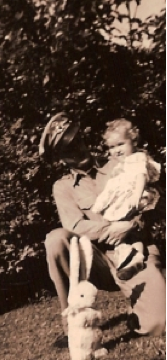
2nd Lt. Robert W. Gregory and his daughter, Roberta, 1944.

2nd Lt. Robert W. Gregory and his daughter, Roberta, 1944.

Thinking about Umpqua

03 Saturday Oct 2015

Posted by ag1970 in Teaching

≈ Leave a comment

Tags

education, school shootings, teachers

10462813_10204064704081643_4755616275869953070_n

This is very difficult for me to share–and probably it’s just me. I need to share it in case it’s not.

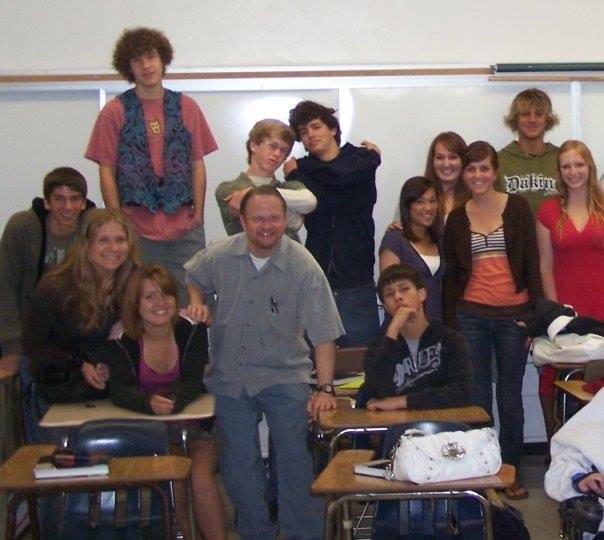
All teachers, myself included, have confrontations with students. [We don’t sleep that night. At all.] When that happens, you wonder, somewhere in the back of your mind–fleetingly, because mostly you think about how badly you screwed up and how you could have handled the situation so much more effectively–if you’ve turned yourself and your kids into the next victims.

You don’t think about it every waking moment, but you certainly do when you lock the doors, close the curtains, and get them quiet for yet another lockdown drill.

And it’s not so much dying that you think about: it’s dying in such an apparently meaningless way.

I can’t imagine that my teachers ever had thoughts like mine. I also can’t imagine, with this added to the absurdity and the weight of all the expectations placed on teachers today, why any young person would want to become a teacher.

In the last few years, in the mandated anarchy of No Child Left Behind, which involved teaching to the test, and then The Common Core, which involves a curriculum of great enrichment (Not for students. For the textbook publishers who designed it),  it was the kids who saved me and my career. They kept me going.

But the shock–and, paradoxically, the monotony– of school shootings is a reality that teachers have to think about every day, and it’s poisoning our nation at its most important juncture: in the classroom, where adults and young people are supposed to be in partnership, where they are to work together to ensure that the nation has a future.

I always worked, very purposefully, to make my classroom safe for the students I loved to teach. I think I taught with high expectations, but I also wanted them to have a place–a place that belonged to them–where they would find humor, kindness, and acceptance. But neither my classroom, nor any classroom today, is a sanctuary. Not anymore.

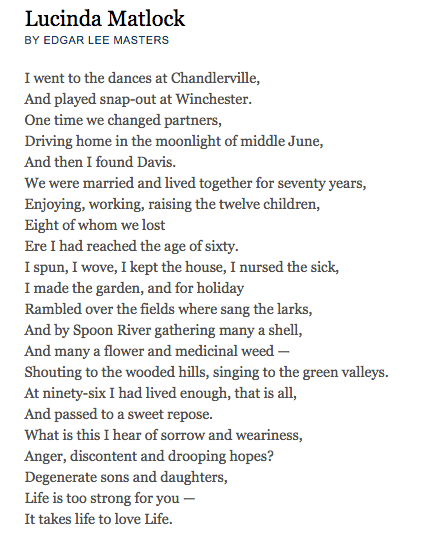
“It takes life to love life.”

02 Friday Oct 2015

Posted by ag1970 in American History, California history

≈ Leave a comment


The more I learn about Mr. Branch, the more respect I have for him. The 1862-63 drought wiped out his cattle–cost him $8 million in today’s money—but he’d already started to make the shift to dairy farming, and that millstone brought in some nice income, too. At the same time–1862– he lost three daughters to smallpox. Despite these setbacks and a lawsuit that dogged him in his later years, he was fighting his way back to the very day of his death in May 1874.

“Setbacks” is an inadequate word.  He was in San Francisco when his daughters became ill, traveled hard, at sixty, to get home, but when he arrived, two were already gone. The third died soon after. He saw to it that when he was buried, his three little girls would be close alongside. He missed them–one of the girls was named for his wife–and you wonder if he didn’t blame himself for not being there to protect them, even, as fathers want so badly to do, to protect them from events beyond a father’s control.

He doesn’t look it here, but he was said to be a good-humored man–his actions speak to a someone with a positive outlook–and he was small, spare, wiry. Tough as nails. The energy, too, that he had to have must have been electric. It had to be, to drive an ambition that was much like Lincoln’s: “a little engine that knew no rest,” one of Lincoln’s law partners said.

(Lincoln had lost his mother when he was nine, and, although his stepmother was immensely sympathetic, he was estranged from his father–he would refuse to attend Thomas Lincoln’s funeral–and so he struck out early. Branch, as a toddler, lost his father; his impoverished mother had to divide her children among relatives, so he, too, got out and on his own as soon as he could.)

Now I’m reading a biography of the Lakota chief Red Cloud, and even that bears on Francis Branch. He was a mountain man, but gave up fur-trapping to become a Santa Barbara grocer, marrying Manuela, about 1835. He’d start running his first cattle on the Santa Manuela Rancho two years later.

The book suggests that this is about the time the bottom fell out of the market for beaver pelts: cheap English silk now became the main component for gentlemen’s hats. No demand for beaver pelts meant, simply, that by 1837, mountain men were obsolete.

But Branch, by then, was a rancher. He’d had the foresight to re-invent himself, at 35, for about the fourth career change of his young life.

His outlook on life reminds me a little of a favorite character of mine, Lucinda Matlock, from Edgar Lee Masters’ Spoon River Anthology, a collection of poems about the residents of a little Illinois town who tell the stories of their own lives with their tombstones’ epitaphs:
Screen shot 2015-10-02 at 11.21.29 AM

Subscribe

  • Entries (RSS)
  • Comments (RSS)

Archives

  • January 2026
  • December 2025
  • November 2025
  • October 2025
  • September 2025
  • August 2025
  • July 2025
  • June 2025
  • May 2025
  • April 2025
  • March 2025
  • February 2025
  • January 2025
  • December 2024
  • November 2024
  • October 2024
  • September 2024
  • August 2024
  • July 2024
  • June 2024
  • May 2024
  • April 2024
  • March 2024
  • February 2024
  • January 2024
  • December 2023
  • November 2023
  • October 2023
  • September 2023
  • August 2023
  • July 2023
  • June 2023
  • May 2023
  • April 2023
  • March 2023
  • February 2023
  • January 2023
  • December 2022
  • November 2022
  • October 2022
  • September 2022
  • August 2022
  • May 2022
  • April 2022
  • March 2022
  • February 2022
  • January 2022
  • December 2021
  • November 2021
  • October 2021
  • September 2021
  • August 2021
  • July 2021
  • June 2021
  • April 2021
  • March 2021
  • February 2021
  • January 2021
  • December 2020
  • November 2020
  • August 2020
  • July 2020
  • June 2020
  • May 2020
  • April 2020
  • January 2020
  • December 2019
  • November 2019
  • October 2019
  • September 2019
  • August 2019
  • May 2019
  • April 2019
  • March 2019
  • February 2019
  • January 2019
  • December 2018
  • November 2018
  • October 2018
  • September 2018
  • July 2018
  • June 2018
  • May 2018
  • April 2018
  • March 2018
  • February 2018
  • January 2018
  • December 2017
  • November 2017
  • October 2017
  • April 2017
  • March 2017
  • December 2016
  • November 2016
  • October 2016
  • September 2016
  • August 2016
  • July 2016
  • June 2016
  • April 2016
  • March 2016
  • February 2016
  • January 2016
  • December 2015
  • November 2015
  • October 2015
  • September 2015
  • August 2015
  • July 2015
  • June 2015
  • May 2015
  • April 2015
  • March 2015
  • February 2015
  • January 2015
  • December 2014
  • November 2014
  • September 2014
  • August 2014
  • July 2014

Categories

  • American History
  • Arroyo Grande
  • California history
  • Family history
  • Film and Popular Culture
  • History
  • News
  • Personal memoirs
  • Teaching
  • The Great Depression
  • trump
  • Uncategorized
  • World War II
  • Writing

Meta

  • Create account
  • Log in

Blog at WordPress.com.

  • Subscribe Subscribed
    • A Work in Progress
    • Join 68 other subscribers
    • Already have a WordPress.com account? Log in now.
    • A Work in Progress
    • Subscribe Subscribed
    • Sign up
    • Log in
    • Report this content
    • View site in Reader
    • Manage subscriptions
    • Collapse this bar
 

Loading Comments...