
The more I learn about Mr. Branch, the more respect I have for him. The 1862-63 drought wiped out his cattle–cost him $8 million in today’s money—but he’d already started to make the shift to dairy farming, and that millstone brought in some nice income, too. At the same time–1862– he lost three daughters to smallpox. Despite these setbacks and a lawsuit that dogged him in his later years, he was fighting his way back to the very day of his death in May 1874.
“Setbacks” is an inadequate word. He was in San Francisco when his daughters became ill, traveled hard, at sixty, to get home, but when he arrived, two were already gone. The third died soon after. He saw to it that when he was buried, his three little girls would be close alongside. He missed them–one of the girls was named for his wife–and you wonder if he didn’t blame himself for not being there to protect them, even, as fathers want so badly to do, to protect them from events beyond a father’s control.
He doesn’t look it here, but he was said to be a good-humored man–his actions speak to a someone with a positive outlook–and he was small, spare, wiry. Tough as nails. The energy, too, that he had to have must have been electric. It had to be, to drive an ambition that was much like Lincoln’s: “a little engine that knew no rest,” one of Lincoln’s law partners said.
(Lincoln had lost his mother when he was nine, and, although his stepmother was immensely sympathetic, he was estranged from his father–he would refuse to attend Thomas Lincoln’s funeral–and so he struck out early. Branch, as a toddler, lost his father; his impoverished mother had to divide her children among relatives, so he, too, got out and on his own as soon as he could.)
Now I’m reading a biography of the Lakota chief Red Cloud, and even that bears on Francis Branch. He was a mountain man, but gave up fur-trapping to become a Santa Barbara grocer, marrying Manuela, about 1835. He’d start running his first cattle on the Santa Manuela Rancho two years later.
The book suggests that this is about the time the bottom fell out of the market for beaver pelts: cheap English silk now became the main component for gentlemen’s hats. No demand for beaver pelts meant, simply, that by 1837, mountain men were obsolete.
But Branch, by then, was a rancher. He’d had the foresight to re-invent himself, at 35, for about the fourth career change of his young life.
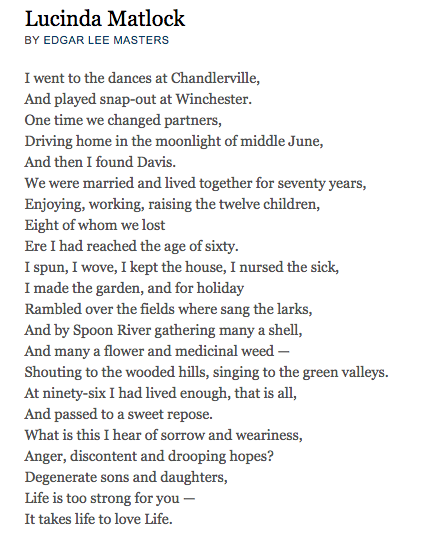
His outlook on life reminds me a little of a favorite character of mine, Lucinda Matlock, from Edgar Lee Masters’ Spoon River Anthology, a collection of poems about the residents of a little Illinois town who tell the stories of their own lives with their tombstones’ epitaphs:
 A Work in Progress