

Filipino field workers thinning lettuce with el cortito, the short hoe, Salinas Valley. The tool would be outlawed in 1974. Photograph by Dorothea Lange.
I thought it would be a good idea to write about the Depression and New Deal, and I still think it is. What I wasn’t prepared for was the topic’s massiveness, the inchoate nature of local scholarship on the period, and the kind of conflict that, in some ways, is more hurtful than writing about the war.
I’m using Kenneth Starr’s series—if California has a Historian Laureate, it’s Starr, and he’s pretty even-handed—as a guide. But once you get into Starr’s depiction of the period 1934-37, the wheels start to come off your Comfort Train.
California was unique in so many ways in the Great Depression. The downturn didn’t have the wallop here that it did in the industrial Midwest, where at one point unemployment in Toledo was 80%, because California, in these prewar years, was still largely agricultural. It also, in large part thanks to a reactionary governor, Frank Merriam, resisted the New Deal–failing to stop FDR’s programs, but retarding their introduction into the state until long after they’d taken hold elsewhere. Around here, for example, the New Deal didn’t seem to have had real impact, except for the CCC, and, of course, except for AAA farm subsidies, until 1938 or 1939.
What California did have–and in spades–was a political right wing that veered, intermittently and locally, into a tight and militarized alliance between business and government: that’s a serviceable definition of corporativism–or Fascism.
This alliance had its beginning in the postwar years, with the Palmer Raids, Sacco-Vanzetti and, more locally, with the IWW and with San Francisco dockworkers’ agitation. By the mid-1930s, the right’s fear intensified, because there were communists among farm labor organizers–made manifestly clear by Steinbeck’s In Dubious Battle. In reality, the struggles of California workers at the time had little or nothing to do with ideology and everything to do with organizing for a living wage, for sanitary living conditions, and for a safer workplace.
That, according to the powerful elements in the state–the umbrella organization for big growers, Associated Farmers, Inc., the Union Pacific Railroad, Pacific Gas & Electric, and the City of Los Angeles, with the most aggressive “Red Squad” in the nation being the LAPD’s–that kind of agitation was communism, pure and simple.
The right had its roots in LA, although most of the earlier labor strife had come farther north. By the 1930s, the Imperial, San Joaquin and Salinas Valleys, and the Arroyo Grande and Nipomo Valleys, to a smaller extent, had become the front lines for fighting incipient Communism.
When Socialist Upton Sinclair ran for governor in 1934, it was the LA District Attorney who notified thousands of potential working-class voters, potential Sinclair voters, that they would have to appear and present legal proof of their residence. It was the LAPD who, in 1936, sent nearly 200 officers to entry points around the state’s borders with the extraconstitutional mandate to turn away travelers with “no visible means of support”–they waved through, for example, a gentleman in a brand-new Packard but detained, rousted, and turned away a poor family crammed into a 1921 modified Ford pickup. At night, they gathered hundreds of unemployed men–mostly very young men–handed them peanut-butter and baloney sandwiches, and put them on freight trains bound for the Arizona border.
In Salinas–there are rumbles about the 1936 strike in the old Arroyo Grande Herald-Recorders–lettuce workers were locked off the job while hundreds of scabs were brought in. The strikers threw rocks at the trucks bringing in the strikebreakers, which brought the Monterey County Sheriff, the California Highway Patrol, and hundreds of deputized citizens, armed with axe handles, onto the side of the growers. They beat strikers, men and women, senseless, used tear gas and nausea gas, set up machine gun nests, and when deputies mistakenly unloaded their shotguns on three carloads of strikebreakers, it took them all night and most of the next day to coax them out of the fields where they were hiding, terrified.
In an Imperial Valley strike, growers beat the attorney, on the courthouse steps, who was representing labor organizers indicted for criminal syndicalism. The sheriff and his deputies watched, waited, and then intervened, arresting the semiconscious attorney’s wife when she went to their car and retrieved a revolver. Another labor attorney–a Jesuit-educated Irishman, God love him–took over the case, and tore the prosecution to shreds: they had to drop four of the six charges against the organizers. The D.A. prosecuting the case had his term lapse, but was allowed to continue when the state attorney general named him a special prosecutor. The defense attorneys presented six hours of tightly-reasoned legal arguments (How can you send a man to prison, for example, for being a member of the Communist Party when the Communist Party was recognized by the state of California and regularly ran candidates?) while in his summation, the prosecutor–literally–clutched the courtroom flag to his breast and preached Americanism.
The jury deliberated sixty-six hours, brought back a handful of guilty verdicts, and recommended that the convicted be placed on probation. The judge ignored the jury and sentenced the defendants: one to eight years in prison. The women got the lesser sentences; the men went to San Quentin.
There were bitter strikes here, as well, in 1934 and again in 1937, when the CHP were imported to Nipomo, as they had been in Salinas, to protect strikebreakers and to intimidate strikers. The San Luis Obispo District Attorney, with a near-Dickensian name, van Wormer, and Sheriff Haskins felt confident enough to issue the strikers an ultimatum: Go back to work or go to jail, charged as vagrants.
99% of the workers, the Arroyo Grande Herald-Recorder proclaimed, with equal confidence, were eager and willing to go back to the pea fields, but they were intimidated by outside agitators.
The implacable 1%–doubtless, they were Communists–wanted forty-five cents a hamper to bring in the pea crop. The Herald-Recorder soberly reported that one worker maintained that twenty-five cents a hamper was more than enough to allow a family to support itself.
The final offer was presented, not by the growers, but by Sheriff Haskins: Thirty cents. Take it or leave it.
This research is going to lead me into dark places–and shining daylight there, even eighty years later, is going to make me enemies.
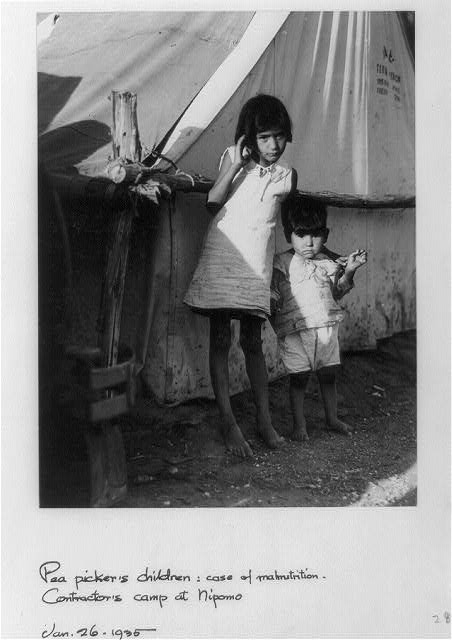
Pea pickers’ children, Nipomo, 1935. The little girl’s knocked knees are indicative of rickets, caused by a Vitamin D deficiency. Dorothea Lange photo.
 A Work in Progress