
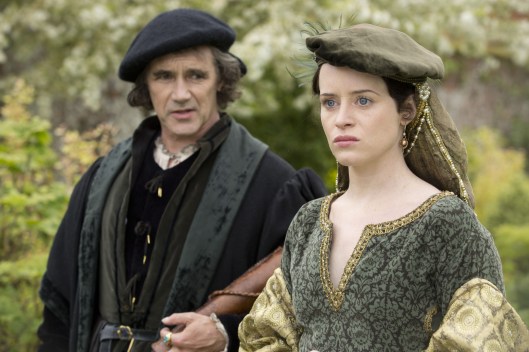
Mark Rylance, as Thomas Cromwell; Claire Foy as Anne.
It took Anne Boleyn to help me to understand why I cringe when Donald Trump asserts that he “cherishes” women. Henry VIII cherished Anne, and that diminishment is what made killing her so much easier for him.
I thought about Anne recently while watching PBS’s Wolf Hall, based on the wonderful Hilary Mantel novels, whose protagonist is Henry’s minister, Thomas Cromwell.
One of my favorite lines–Cromwell’s, and typically, it stings–involves Anne’s alleged lack of cleavage. There’s an exchange between him and Jane Boleyn, when Cromwell asks Jane, who has little love for her brittle sister, if Anne and Henry’s love has been consummated.
Not yet, Jane tells him. But Anne allows Henry to kiss her breasts.
A pause. Just a slight one.
“Good man if he can find them,” Cromwell replies, and exits.
* * *
Henry wrote about them in his love letters. He refers to Anne’s breasts as “pritty Duckys” in 1533, three years before he has her executed.
There was, by the way, bad weather in the Channel that day. Anne had prepared herself to die, only to be told the superb French executioner, her husband’s parting gift, was delayed. She had to do it all over again the next day, when he arrived and she departed.
She did so with immense courage.
Her grave is beneath the altar of St. Peter ad Vincula—I’ve taken students there–within the Tower of London, only a short walk for her ladies-in-waiting, who brought her coffin down from the scaffold, once they’d carefully wrapped Anne’s head and body in damask and reunited them inside. In reality, it wasn’t a coffin. It was a chest for storing bow staves, originally bound for Ireland to kill humbler subjects there.
It’s hard to hate Anne, with her being there the way she is. It’s such a tiny grave. So was her neck, she remarked with a laugh before the execution. Her alleged lovers, including her brother, were buried at the other end of the little chapel, and their bones now are intermingled there, as if they finally were co-conspirators, after all. But the Boleyn family was evidently a piece of work: arrogant, ambitious, tone-deaf–-much like the Greys, who beat Lady Jane all through her growing up–-they boxed her ears, punched her, flailed at her legs with a birch rod, and then they got her beheaded, still a child, in the name of their own ambition.
I would not have chosen a life as a noblewoman, I remember telling my students. The lives lived by the wives of peasants or tradesmen, I think, were in many ways more substantive: the executions, disinheritances, serial affairs, and the emotional and physical abuse so prevalent in Henry’s circle set noblewomen apart from most English women, who could count on the smallness of their rural villages for protection.
One example. No pregnant girl was left bereft. There are virtually no illegitimate births in rural England in the sixteenth century. There are plenty of marriages recorded in parish registers that produce issue in the christening books four months later. [Anne herself was heavy with Elizabeth when she finally married Henry in a midnight ceremony.] Young men, anonymous to us, were held accountable for their actions; we can’t even hold a famous man, Trump, accountable for his words.
No woman’s life was easy. But the lives of women like the Boleyn sisters or Jane Grey had such cruel edges. Their personal power was cleaved as decisively as if they’d all gone to the block.
Meanwhile, Henry’s love letters are in the Vatican Library, which seems a waste. So does his life: all the statecraft, the parsimony and the ruthlessness of his father, Henry Tudor, was wasted by Henry VIII, a soft, self-indulgent man, in the single-minded pursuit of a son of his own.
Neither Trump nor Henry, so often true of soft, self-indulgent men, show evidence of a sense of humor, so the irony would have eluded them: within Henry’s court, in her little petticoats, there was Anne’s red-haired toddler daughter, who would become twice the king her father ever hoped to be. Donald, just as oblivious as Henry was to an obviously gifted daughter, has opined, creepily, that he would date his if their lives had been different.
There’s a scene in one segment of Wolf Hall where Henry holds Elizabeth in his arms. He is enchanted, but only momentarily. Mistress Seymour catches his eye, so Henry abruptly hands the little girl off to her governess. Damian Lewis, who plays Henry, is such a good actor that you can see the king forgets his daughter in the instant he loses physical contact with her. Meanwhile, Jane might burst into flames, so intense is his focus.
I think that’s why Cromwell is so appealing in Wolf Hall. Henry’s self-absorption, like Trump’s, is suffocating, so Cromwell’s competence, which is so unlike Trump, is like a candle that won’t go out. Not yet.
Jane Seymour finally gave Henry the son he wanted, only to die after the little boy’s birth. She was another female sacrificed for her king. Henry was heartbroken. Of his six wives, Jane was the one he cherished most.
Of course, little Elizabeth would grow up to decide that she would never marry. There’s no mystery in that at all. She’d grown up in a world dominated by vain and powerful men like her father. There was nothing they had that she wanted.

Anne-Marie Duff as Elizabeth, Tom Hardy as Leicester, as she approaches Tilbury to speak to her troops, assembled for the Armada invasion. Duff’s delivery of the speech is, I think, pitch-perfect.
 A Work in Progress