
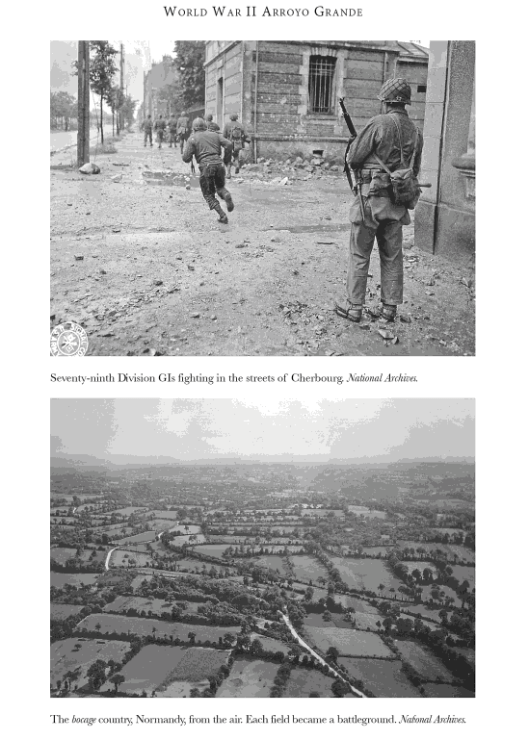
- It is not perfect. I made mistakes—word choice here, a caption there (one cites walnut trees that aren’t there because they switched photos; I won’t cop to that one), and there will be factual errors that, for someone trained as newspaper reporter, are sins that send a writer to hell, postage paid. There were about 35 revisions to the book, and sometimes things I corrected were counter-corrected in a manner that wouldn’t have happened with good old typewriter drafts. Other mistakes I made because sometimes I am stupid. Also, the young woman who edited the book and I have a deeply philosophical disagreement over comma usage. And there were gaps in her knowledge: she didn’t appear to know all that much about World War II; she turned all ships from “shes” into “its,” and she was not clear on what school the word “Cal” denoted. She also did some wonderful and necessary corrections that made my draft better.
- Two of the chapters are not about World War II. My audience was my friends from Arroyo Grande, but I also wanted to introduce strangers to my home town, so Chapter 2, “Pioneers,” goes back to 1837 and Branch, and Chapter 3, “Immigrants,” focuses on the waves of immigration from the Azores, Japan and the Philippines, which became necessary because the children of those people would play such a prominent part in the book, in fighting and enduring the war.
- There are not enough Mexicans in the book, and this from someone whose college major’s focus was Latin American, and particularly Mexican, history. Part of this is because we deported so many early in the Depression—many of them, by the way, American citizens. Part of it’s because my publisher didn’t understand the “South County” concept, the Five Cities familiar to you and me, and while there were many Mexican-American veterans from Oceano, she wanted the book’s focus on A.G. Most of the servicemen I discuss have a common thread, and that’s their attendance at the Arroyo Grande Union High School. Because of the Great Depression, there were many World War II servicemen who’d achieved only an eighth-grade education because they lived in the kind of poverty that made high school a luxury. They went to work. At the time of the War, the dominant immigrant groups here, and represented in the yearbooks, were of Portuguese or Japanese descent. 43% of the Class of 1942 was Nisei.
- There are not enough women in the book. Had we more industry here, that would have been a different story. There’s some detail about a woman Marine; nine phone calls to learn more about an Army nurse proved fruitless and I am sad about that. But women—like Clara and Ruth Paulding, Gladys Loomis,Eileen Taylor, Kimi Kobara, Evelyn Betita—who appear only briefly in the book still have important roles to play, and some of them are staggeringly heroic.
- For a book about Arroyo Grande, we sure spend a lot of time in places like Normandy and the South Pacific. That’s one of the major reasons for me writing the book. I think our kids—my students—feel sometimes that history is something that happens somewhere else, to someone else. That’s not true, because Arroyo Grande has unique links to wartime London, to Bastogne, to Iwo Jima, and even to Hiroshima. I wanted to make that connection because even a little farm town of 1,092 people was—and is—important to all history, and so to all Americans.
- The worst part was the photographs. I am heartbroken because photos of new and dear friends like Will Tarwater, or the fathers of friends—Pvt. Francis Fink—or heroes who need their faces to be seen, like Jack Leo Scruggs, killed on Arizona, did not have images that fit the peculiar digital requirements of modern publishing. The photographs I mention here were submitted and re-submitted; I made alternate versions or hunted down alternate versions on my own, and submitted those, but they didn’t make the cut. This turned, for me, out to be the most hurtful aspect of writing the book and the one area where I feel like a failure.
- This is not academic history. This is this is a very personal book. I use the pronoun “I” in several places, something I will not tolerate in my students’ essays, because this is a book that is deeply rooted in my life experience, and that life experience includes events, like the death of a Marine on Hill 362A on Iwo Jima, that happened a long time before I was born. When I found that Marine’s grave in the Arroyo Grande cemetery, he, like so many soldiers and sailors I wrote about, became part of my family. These young men are from my father’s generation; in writing about them, they became my sons.
- I know that there are many, many stories that I missed. I regret those almost as much as I do the photographs, but I had a word count limit–it’s just a little book– and I had a deadline. They made me stop. Good thing. If I’d been the editor for Gone with the Wind, the movie would still be on the cutting-room floor.
 A Work in Progress