
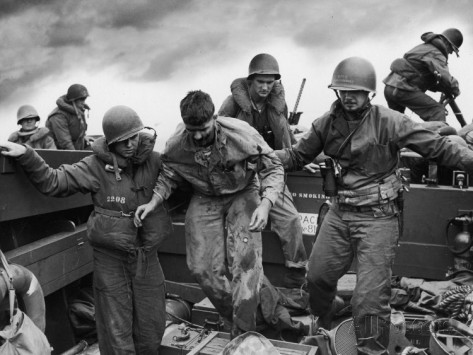
Coast Guardsmen and a wounded Iwo Jima Marine.
I got wounded today–nothing at all like what this young Marine is going through. I left something out of the book, and I got reamed for it. I’d let a reader down who deserved to be in the book. A lot of it went back to the maddening business about the photographs. I submitted 104; they used 70, of the 70, I had to re-submit about thirty.
It has to do with megapixels and dpm’s, which are beyond my understanding. What it meant was that a story and image–this man’s story and his family’s story– that deserved to be shared didn’t make it into the book. There were other images that didn’t get in, each with its own story, that included:
–My friend Will Tarwater
–Vard Loomis and the Arroyo Grande Growers baseball team–Vard’s first name was “Joseph,” as in Joe, one of the best friends of a lifetime.
–The Dohi family; it took me weeks to get permission to use this photo. Didn’t make it.
–Jess Milo McChensney and his B-24 crew
–A photo of Clara Paulding, just dismounted from her bicycle, in front of 1898 Branch Elementary School–the same schoolhouse where my education would begin sixty years later.
–Pvt. Francis Fink, a relative of an Arroyo Grande family that means a lot to me.
–A photo I thought essential, of two Filipino men in the garden of their Allen Street home, inundated with ten-year-old boys who were their pals.
–A photo donated by my friend Gerrie Quaresma, of a Portuguese wedding of an ancestor of hers at old St. Patrick’s.
–The senior portrait of Elliott Whitlock, who won the Silver Star for bringing his B-17 and her crew home to their base in Norfolk.
Not getting those in and not having the chance to tell the story the way you want to is heart-breaking.
I was so disgusted with their photo policy that I decided, at one point, to give up the book entirely. I had put too much work into it and changed my mind.
But one part of the reaming that grated was the insinuation that I hadn’t worked hard enough in my research, that I didn’t do enough homework.
Getting called on the carpet for an accusation like that is bullshit.
The “Notes” section only lists those works I actually cited in the manuscript. If I’d had a bibliography, here are the sources I consulted to learn about one Marine’s family, his service, and his death (I got his whole personnel file, including his fitness reports, his last will and testament, the last effects recovered from his body, the pitifully small list of his personal belongings kept back home, at Pendleton, and some things that were none of my damned business. I used it and then trashed it. It seemed an invasion of the young man’s privacy, and he’d led a good and hard-working life.):
I don’t have all of them, but here are the at least most of the sources I consulted to learn about Marine Pvt. Louis Brown, about one man:
- “Azoreans and Madeirans,” Minority Rights Group International—Workingto Secure the Rights of Minorities and Indigenous Peoples, http://www.minorityrights.org/1820/portugal/azorea.
- Yesterday, Today, and Tomorrow, vol. 5 (Arroyo Grande, CA: South County HistoricalSociety, 1981–89).
- Antone [sic] Brown, “Headstone Applications for Military Veterans,” Ancestry.com.2009.
- “Certificate of Death,” Private Louis Brown, Bureau of Medicine and Surgery, Navy Department, Washington, D.C., June 1945.
- Antone [sic] and Anna Brown, “Family Tree,” Ancestry.com
- 1920 Census
- 1930 Census
- 1940 CensusComplete personnel file, Pvt. Louis Brown, Records of the United States Marine Corps, Department of the Navy, National Archives (that cost $100)
- Arroyo Grande Valley Herald-Recorder, 6 April 1945
- World War II Navy, Marine Corps, and Coast Guard Casualties, 1941-1945. (where I discovered Louis’ name had been spelled “Louise.”)
- The First Battalion of the 28th Marines on Iwo Jima: A Day-by-Day History from Personal Accounts and Official Reports, with Complete Muster Rolls, by Robert E. Allen.
- MUSTER ROLL OF OFFICERS AND ENLISTED MEN OF THE U.S. MARINE CORPS FIRST BATTALION, TWENTY-EIGHTH MARINES, FIFTH MARINE DIVISION, FLEET MARINE FORCE, C/O Fleet Post Office, San Francisco California.
- The United States Marines on Iwo Jima: The Battle and the Flag Raisings. By Bernard C. Nalty and Danny J. Crawford
- Fifth Marine Division Daily Summaries, Iwo Jima. 19 Feb. 1945-24 March 1945.
- The Ghosts of Iwo Jima. Robert Burrell, 2006.
- Action Report on Iwo Jima, Part 1, Vol I: Schmidt, K.E. Rockey, 7 February 1945-24 May 1945.
- “Closing In: Marines in the Seizure of Iwo Jima,” by Colonel Joseph H. Alexander,U.S. Marine Corps (Ret.)
- “Team Find Two Possible Sites in Search for Remains of Marine From Iwo Jima Flag-Raising,” (Bill Genaust) AP, June 27, 2007
- Map: “ Iwo Jima: Nishi Village and Hill 362-A.” jacklummus.com
- Records of War: Casualties of Iwo Jima. http://www.recordsofwar.com/iwo/dead/dead.htm
- “Iwo Jima Retrospective,” by Cyril J. O’Brien. http://www.military.com/NewContent/0,13190,NI_Iwo_Jima2,00.html
- From Leatherneck: Iwo Jima: “Hell With The Fire Out” – See more at: https://www.mca-marines.org/gazette/leatherneck-iwo-jima-hell-fire-out#sthash.G6FJ7IHq.dpuf
- Sergeant Christopher Zahn, “Echoes of Iwo Jima Heard by Present-day Marines,”Quantico Sentry Online, http://www.quanticosentryonline.com.
The sum total of that research was a 640-word passage in a small (35,000-word) book. And for every $21.99 book The History Press sells, I get less than $1–this is for work that lasted over eighteen months. I will break even for that work. Maybe.
It may sound like it, but this isn’t meant to be sour grapes. I’m a happy historian. I deserved the knock—and besides, it was just the corrective I needed—but I’m still proud of the work I did. I knew from the beginning that I would miss some stories that needed to be told–one that comes to mind is of an Army nurse who would’ve pulled duty during the Bulge in 1944-45– but that story didn’t happen after eight phone calls that were never returned. Sometimes, though, I just wish folks would wait a minute before they let fly. I can be accused of many, many things. Laziness isn’t one of them. It wasn’t true of me as a teacher, it’s not true of me as a writer, and, like my critic, I’ve gotten my hopes up as a writer and had stories, story ideas, and essays rejected by more editors than I can count. It was crushing.
What I did, though, was pick myself, up and keep writing–until I wrote a book that is imperfect, but writing the book filled a hole in my town’s heritage that no one realized was there at all.
Oh, and the other criticism, that there were too many Japanese in the book? 25 of the 58 members of the Class of ’42 were Japanese-American. I just emphasized the “American” part.
 A Work in Progress