There was one sin no Union soldier forgave in his commander, and that was if he called a halt during a march but didn’t give him enough time to brew coffee. Gen. Phil Sheridan must have known that in rallying his men during the 1864 Battle of Cedar Creek, and among Sheridan’s soldiers were eight young men who would someday settle in Arroyo Grande
In the fall of 1864, the rich farmland of the Shenandoah Valley was razed by Union troops under the command of their fiery, pint-sized commander, Phil Sheridan, in a replication of Sherman’s tactics in Georgia and the Carolinas. The Valley had long provided food and forage for Confederate armies in the East and a conduit for repeated threats to Washington; perhaps a more modern comparison might be the Ho Chi Minh Trail in the Vietnam War.
But on October 19, at the suggestion of one of my favorite Civil War generals, John B. Gordon (shot five times at Antietam, thank you very much), Confederate forces under Jubal Early fell on Sheridan’s men at their encampment on Cedar Creek and generated a rout that looked to be as complete as the one Albert Sidney Johnston inflicted on Grant’s troops the first day of Shiloh.
Unfortunately for Early, this battle turned out with the same result: a Confederate defeat. And it was because of Sheridan and one of the most inspirational moments of the war.
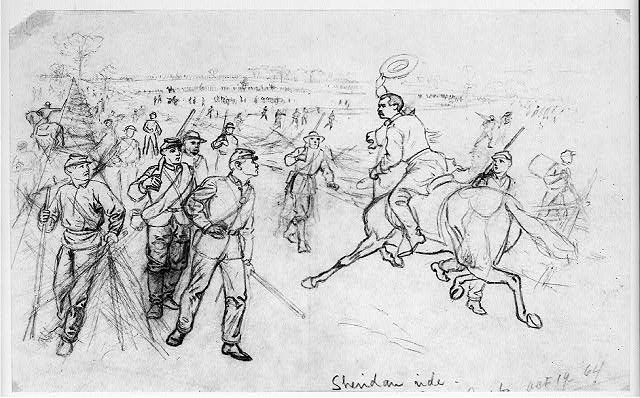
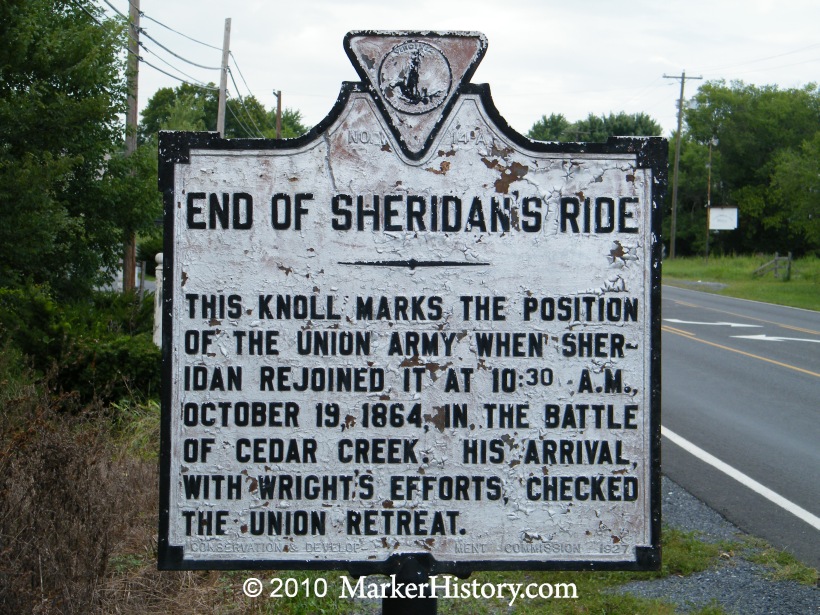
Sheridan was some ten miles away, in Winchester, when, at 9 a.m. he heard the sound of cannon fire (in the massive cannonade on Gettysburg’s last day, residents of Washington, Baltimore and Philadelphia heard what sounded like a distant thunderstorm). He swung into the saddle of his mount, Rienzi, a spirited black Morgan named for a town in Mississippi, and started to ride toward the sound. And then he began to gallop, with frantic staff officers, including young William McKinley, trying to keep up. As Rienzi and Sheridan closed on the battlefield, the little general began to holler–“God damn it, boys, we’ll be making coffee out of Cedar Creek tonight!”–and wave his porkpie hat, rallying his men, who were lining the roads in retreat.
It worked.
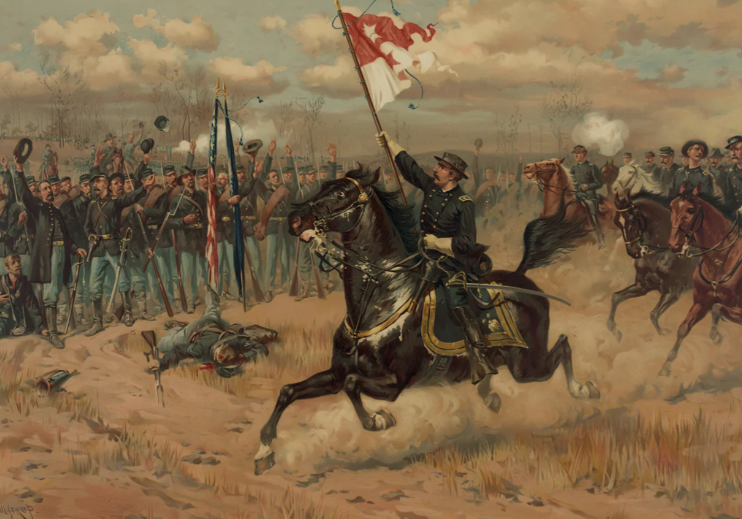
Early and his Confederates made the mistake of pausing to rest–the rations in the Union camp were too much for the perpetually hungry rebels to resist–when Sheridan and his dynamic VI Corps commander, Horatio Wright, slammed into them in mid-snack. Meanwhile, George Custer’s cavalry looped around the Confederates, got into their rear, threatening to block their escape route across the creek, and generated a panic that was complete. Jubal Early’s army disintegrated and was never an effective fighting force again.
Here are the Arroyo Grande veterans who fought at Cedar Creek:
- Alexis Adams 12th Maine
- Herbert D. Adams Co. K 12 Maine
- William Lane 1st Lt Co. Co. C 24th Iowa
- Samuel McBane Co. F 123rd Ohio
- Samuel B. Miller Co. G 24th Iowa
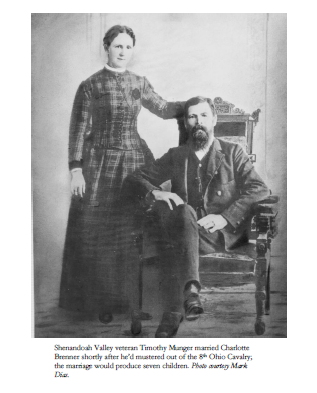
- Timothy Munger, Co. C 8th Ohio Cavalry (Arroyo Grande’s first City Recorder, 1911)
- George Henry Purdy Capt. Co. A 11th WV
- William Haze Stobridge 1st Michigan Cavalry (part of Custer’s command)
 A Work in Progress