
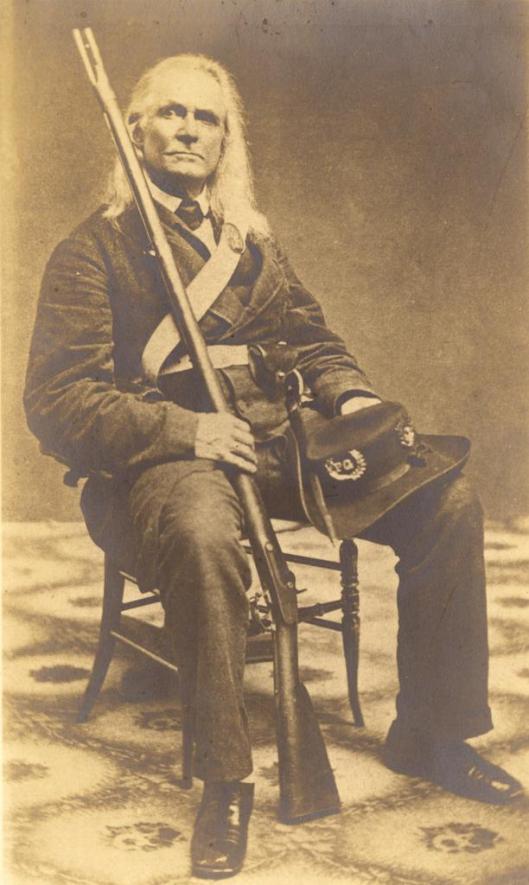
Edmund Ruffin
I thought today about my old friend Edmund Ruffin.
Edmund hated the hated the Bank of the United States, hated the federal government, hated abolitionists, hated Abraham Lincoln, and most of all, like many Southerners, he hated change—southern planters, like Ruffin, were beginning to sense that their traditional dominance of the federal government (four of our first five presidents were Virginians) even if increasingly it lay only in their power to block legislation, was eroding, and they were starting to realize, too, that the future lay with the North and with the Free Soil states entering the Union in the West. It is a great irony that as profitable as Southern agriculture was–60% of the value of 1860 American exports was in cotton–no one did more to bring on the Industrial Revolution in America than the Southerners who fired on Fort Sumter: it was Yankee steel that put so many young Southern men into the ground of Virginia or Mississippi.
And so we are changing, too. White Americans will soon be a minority; the economy faces a postindustrial future that is neither clear nor reassuring; it appears as if it was my generation, the postwar “Boomers,” will be the last to enjoy the assurance (tempered as it was by nuclear annihilation) of an America ever progressing to a brighter, more powerful, more affluent future. Things look grim. They must have looked that way in 1861.
The crowning insult, of course, for 21st Century Ruffins is the presence of a black man in the White House–this one more a child of the Pacific Rim and not, to be accurate, an “African American” in the sense that we understand that term, because it is Mrs. Obama, and not her husband, whose ancestors were enslaved: she is of West African descent. Obama’s ancestors, on his father’s side, were from Kenya, a place far away from the Dutch and Spanish and English and Portuguese slavers who dropped anchor off Ghana or Mali and introduced the firearms that led to such rapid West African political destabilization; this was the factor that would lead to the trade in human beings on a scale never before seen.
Over eight years ago, I distinctly remember a New Yorker profile of Obama, this son of a Kenyan, still in the thick of the primaries, that reminded of Lincoln. (This is not a judgment on the current presidency and I am not talking about “greatness” in this paragraph. I don’t know that history will judge the Obama presidency that sympathetically.) Here is the narrower similarity: the writer depicted a young man in the Illinois State House and then the Senate who was dispassionate, rational (John Kennedy traits, at least in politics), and one who was invariably open to hearing the other side in a debate, almost at pain to understand that side’s viewpoint, and willing to look for an eddy where compromise might be reached when the current necessitated it. He was, in that way, much like Lincoln. That’s what I was hoping for–the Lincoln in Doris Kearns Goodwin’s Team of Rivals. But I tried not to get my hopes up: he was also, I thought uneasily, a little too Clintonesque, like Bill the Triangulator–the political equivalent of a man who smiles at you with such charm as he slips his hand into your pocket to remove your wallet–always ready to trim his sails to suit Republican winds. This, after all, was “Bubba,” the nation’s “first black president,” who perhaps did more than any modern president to incarcerate young black males by the tens of thousands.
For whatever reason, and maybe that reason is and always has been obvious–Obama’s intellect is as subversive in its way as Emmitt Till was in his–the conciliator that the magazine piece portrayed was pinned to the wall from the moment of his swearing-in. A cabal of conservative congressmen, with Newt Gingrich in a special guest appearance, had already met the night before and decided on a scorched-earth policy for the duration of the new administration. They would fight every Obama initiative, block every Obama appointee, frustrate every Obama reform. This included the one reform most inspired by a Republican, Mitt Romney, in the Affordable Care Act, which came down in a ludicrous public debate to death panels and a “Government Takeover of Our Health Care System.” In reality the act was timid to the point of pipsqueakery when compared to the health care programs long ago adopted by nearly every Western democracy.
Of course, in FDR’s day, Social Security faced the same kind of wild-eyed hysteria–still does–even though it took the United States 70 years to adopt such a law once that noted socialist, Otto von Bismarck, had put Germany’s into effect. The other side is today, as it was in 1935 on the eve of the Social Security Act, immune to conciliation, to compromise, and most of all to reason–“reason can deceive a man,” another German statesman once wrote in the 1930s. I spent an hour today researching and explaining the origins of and the reasons for the presence of so many undocumented Mexican workers in the United States to someone from the other side, and he thanked me for the pains I took and then dismissed Obama, without citing a single reason for his judgment, as a man who has irreparably and deliberately harmed the United States.
So it was with Lincoln.
Lincoln did not make a single speech and issued very few political statements, the exceptions being a few private letters, during the campaign of 1860, because he knew that whatever he said would be twisted by Southern opinion-makers–many of them planters, and so men of immense economic power a who had a stranglehold on every little rural courthouse in the South–into a malevolent scheme to irreparably and deliberately harm Southern rights.
In modern politics, this kind of distortion is mostly seen in the advocacy practiced by the National Rifle Association. Lincoln wanted to limit the spread of slavery, not abolish it. Reasonable Americans want to abolish large-capacity ammunition drums, not the guns themselves. In both cases, men and women of reason are painted as dangerous interlopers, as demagogues who want to destroy American rights.
The foremost Southern right, of course, in 1860, was the right to own human beings. Everything else, for the sake of accuracy, is irrelevant. Everything the South Carolina fire-eaters said in the month between Lincoln’s election and the secession crisis that began in December was in a code–these were politicians who could weave, in hyperbole, a lurid tapestry whose centerpieces were Denmark Vesey, Nat Turner and John Brown. What they said and wrote in 1860 was so powerful that the technique worked to perfection a century and more later with Nixon’s Southern Strategy, with Reagan’s Welfare Queen, with George H.W.Bush’s Willie Horton.
In 1860, every Southern white man woke up to the realization that somehow his rights were being violated, his freedom that was being threatened, and so it was his duty to go to war to fight tyranny. But the real tyrants weren’t the godless polyglot money-changers so far away in boardrooms and exchanges in Manhattan and Boston and Chicago, they were, in truth, the down-home speechifiers, the nullifiers, the secessionists. These were the opportunists who would push the South into war. In the months before that war came, Edmund Ruffin and his cohort saw no contradiction in calling Lincoln an extremist long before that man had written the opening sentence to his first Inaugural, a speech that was extremist if sentiments like conciliation, compromise, patriotism and brotherhood can be called “extreme.”
Ruffin must have laughed at the transcript of that speech, if he ever read it, and snorted derisively, in the same way that those who know better on the other side insist that when Obama’s tears are manufactured, as if there would be need for that in a town whose first-graders have just been slaughtered by a madman with an assault rifle. So, not believing a word that came our of Lincoln’s mouth or recorded by his pen, the last principle that Edmund Ruffin supported was war.
He got to pull the lanyard on one of the artillery pieces that opened fire on Fort Sumter at 4 a.m. on April 9, 1861. Edmund Ruffin and his friends, in the pretzel logic they’d come to master, called the event that they had started “The War of Northern Aggression.”
Ill health prevented him from killing the bushels of Yankees he wanted so badly to kill–his war had come and gone, in 1812–but a few weeks after Lee’s surrender, Edmund Ruffin had the good grace to put the muzzle of a gun to his head and pull the trigger.
What made me think about Edmund was a king-sized “DON’T TREAD ON ME!” flag I saw today, flying in the back of a pickup, and, of course, the shootout in the snow that ended the “siege” in Oregon, which I’d hoped would end when the ostensibly besieged ranchers issued a desperate call for, among other things, Cheetohs. Not even Edmund Ruffin was that funny.
Those things made me think some more: we haven’t learned a damned thing from the 620,000 boys and men we lost 150 years ago.
Our polarization and our refusal to compromise is as grievous today as it was on the eve of war in 1861. In Oregon, men very similar to Edmund Ruffin painted themselves into a corner inside an office on national parkland because they’d created a mindset as paranoid and unyielding as was Ruffin’s. They were hemmed in–long before their takeover– by the enemies their imaginations had created.The killing of Robert LaVoy Finicum a couple of days ago was the dead man’s moment of triumph: it was, after all, the way he wanted to go out. He didn’t have the time to think that the way his life was coming to its end was both tragic and the darkest of comedies. What Finicum’s partners in revolution left behind, in their little fortress on national parkland, was an immense debris field of garbage that they’d failed to clean up. Like Edmund Ruffin, their cause was passionate but empty of accountability.

Robert LaVoy Finicum
 A Work in Progress