
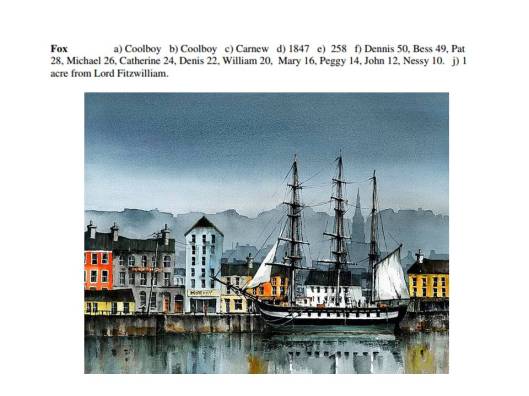
This is New Ross, Ireland, and the folks in the list are distant ancestors, fleeing the Famine and bound for Canada. When the Fox family got settled in Ontario, Denis’s son, Pat, fathered a little girl named Margaret. Margaret was my mother’s grandmother.
So Mom’s name–her other great-grandfather was Patrick Keefe, another Coolboy tenant– was Patricia Margaret.
This is a replica of the ship that might have brought them, the Dunbrody, and it’s the same ship that brought a third Patrick to Boston–John F. Kennedy’s great-grandfather, from County Wexford. My ancestors were close by, in Wicklow, near the Wexford border.
It must have been terrifying. It would have been a two-day walk from Coolboy to New Ross and few Irish–this was true for most medieval Europeans, and in Ireland, the Middle Ages persisted well into Victoria’s reign–ever traveled beyond the sound of their parish church’s bells.
The voyage took two weeks, and the ships carrying Famine refugees became known as “Coffin Ships” because sometimes half the passengers died. Dunbrody, thank goodness, was an exception: the owners seemed to actually care for their human cargo, and she made dozens of passages between New Ross and the New World (New York, Boston and Quebec) with a very low death rate.
But, if I have the sailing date right, June 1849, the time the Fox family finally, after a long wait, left New Ross (Denis and two children had been sick when they were first scheduled by their landlord, Lord Fitzwilliam, to leave his estate), two of these Famine ships foundered on icebergs: one was lost with all souls and the other lost sixty passengers.
There’s a wonderful book about the Famine and migration called Paddy’s Lament, and emigrants bound for America were feted, with what folks could get together, with a grand farewell party. But these were celebrations shot through with sadness and they inevitably ended with tears.
The Irish called them “American wakes.”
 A Work in Progress