
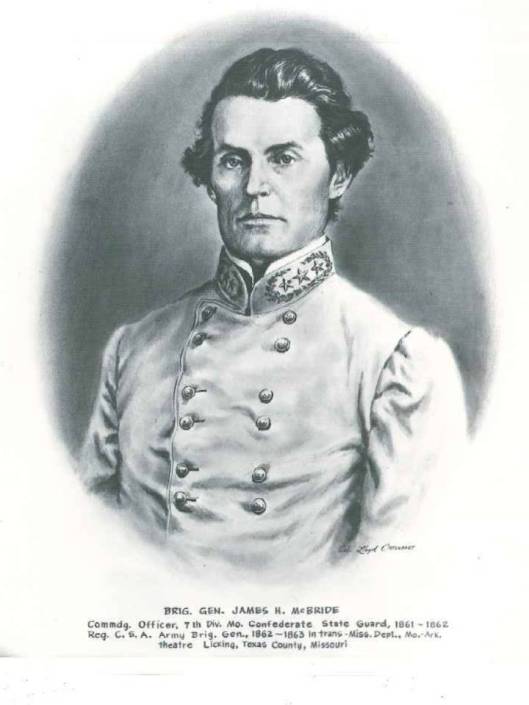
Okay, let’s assume you want to write a book about the Civil War. You want photographs, which is fine, because most Civil War photographs are in the public domain—with credit and attribution, they’re free.
This is my great-great grandfather, a Confederate brigadier general. I was named after him. This was taken from a photograph that’s about 156 years old—the uniform was superimposed by an artist. The subject died in 1863—153 years ago. So clearly, this is in the public domain, right?
Wrong.
I had to pay for it, which I don’t mind at all. If I hadn’t paid for it, family or not, I could’ve been sued. But here’s where it gets complicated.
Say I want to use a photo from your family: a great-great-great grandpa, for example, who fought with Sherman at the Battle of Atlanta. You (graciously) give me permission to use the photo, and I (naturally) credit you for it in the caption of the book I publish.
Then we both get sued.
Just because it’s your photo, and in your possession, doesn’t mean you’re the owner. The guy who took the photo is the owner. Rightfully so. But let’s assume, being reasonable people, that the guy who took a photo in 1860 is dead. Pssst! He is!
Then you’re home free, right?
Wrong.
Is someone PUBLISHED the photo—for example, posted it on their ancestry.com family tree, then you are doomed.
A photo taken before Jan. 1, 1923, is in the public domain. Freebie.
But a photo taken before Jan. 1, 1923 and published, say, in 2002, is under copyright until 2047—the life of the creator plus 70 years, or 2047, whichever is greater.
So, let’s say the photo you want was published on ancestry.com in 2002. You can’t use it, because you can’t establish the identity of the “creator,” nor can you assume that the person who posted that photo is the creator and entitled to the copyright. It gets even dicier if the person who published that ancestry.com photo hasn’t been active on that website since 2003, which means you can assume that he or she is dead, dead, dead.
That means that the photograph you want of a private citizen who was once a soldier serving under Sherman during the Atlanta Campaign during one of the most significant events in American history AND who farmed thirty acres in the Upper Arroyo Grande Valley, voted every election day, served on the Branch School board, left behind a brace of little Yankees, that means that the photograph of that person…
…is unattainable.
Which is bad for you, a writer. But, in another way, it cheats the subject of the photograph, doesn’t it? A man who would otherwise be an anonymous tombstone who MIGHT get a second look from a passerby who knows a little history (“Oh, look! That guy was in the Civil War!”)—and that’s chancy—has lost the chance to be remembered in a way that’s meaningful to him, to his family, and to our history.
And that’s a tragedy.
How long does copyright last?
Due to complicated and ever-changing copyright laws, the duration depends on when the work was created and whether it was published. Here are simplified guidelines (though exceptions apply):
Works published before Jan. 1, 1923, are in the public domain (meaning anyone can use, adapt or copy them freely).
Works published between 1923 and 1963 were protected for 28 years—but the copyright could be renewed for 47 years, then extended for another 20. If the copyright wasn’t renewed, the work is in the public domain. About 85 percent of works published during this period aren’t protected anymore.
If a work was published between 1964 and 1977, the copyright lasts a total of 95 years.
Any published or unpublished work created on or after Jan. 1, 1978, is protected for the life of the creator plus 70 years.
A work created before Jan. 1, 1978, and published between that date and Dec. 31, 2002, is protected for the life of the author plus 70 years or until Dec. 31, 2047—whichever is greater.
Confused? You can assume that anything published within the past 75 years is protected. Once the copyright expires, a work moves into the public domain.
 A Work in Progress