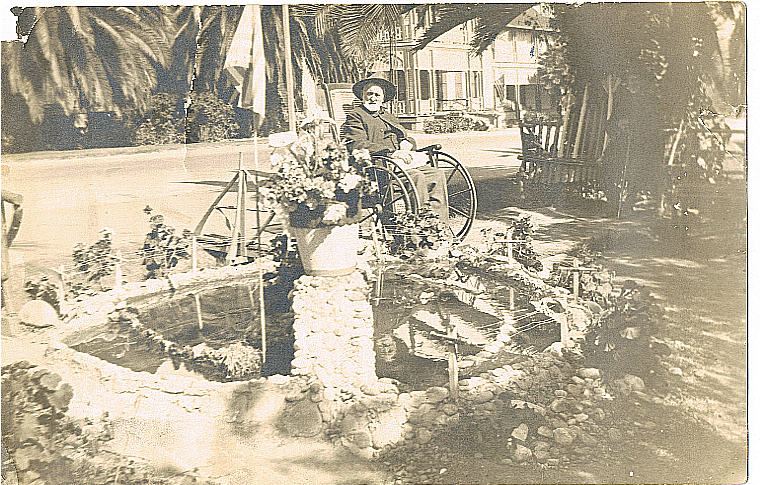
Otis W. Smith at the Sawtelle Home for Disabled Veterans, Los Angeles.
Early that morning, long and twisting columns of butternut gray moved slowly up the three pikes that cut their way toward Franklin, Tennessee. They were miles away but closing fast. Bright metal flashed from within each column, like the glistening of a snake’s scales. The locals later remembered that the thump of boots and bare feet upon the macadam rattled the windows of their houses. These were the Confederates, come to smash the Federals.
–From the novel The Widow of the South,
By Robert Hicks
This is what happened instead: the Confederates smashed themselves upon the Federals, who had gotten to Franklin first and had gone to work with picks and shovels. They’d thrown up earthworks beyond a two-mile stretch of bare field that was punctuated only by islets of scrub brush not big enough to hide a dog, let alone a man. When they marched into Franklin, the Confederates had been ordered to cross that field and carry the federals’ entrenchments. This was in part because their commander’s audacity had won him promotion after promotion in fighting the war which had whittled him half away. John Bell Hood’s reputation for bravery grew even as he’d lost a leg and the use of an arm in battles farther north; at Antietam, in 1862, he’d lost even more when he sent his Texans shrieking like Comanches into the cornfield beyond the Dunker Church. They’d gone into the cornstalks and disappeared. Hood was asked later where his division was. “Dead on the field,“ he’d replied.
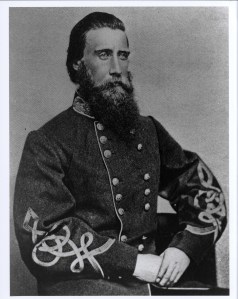
Gen. Hood
Now Hood, who had to be strapped into his saddle, had been sent south to replace a general, Joe Johnston, with too much finesse and not enough deference for the taste of the Confederate commander-in-chief, President Jefferson Davis. Hood was a smasher. In truth, he had been promoted this time beyond his capabilities. But now, in the late fall and early winter of 1864, even the smasher was playing—strategically, at least—with finesse. If he could raise enough hell in Tennessee–enough, maybe, to get in between the two Union armies there and then replicate Napoleon at Austerlitz, or Hood’s breathing hero, Lee, at Chancellorsville—he could take on one army, bloody it, and then turn and knock aside the second on a fighting march north, into Kentucky.
And that feat, if Hood could accomplish it, would force Sherman to double back on the path he’d burned into Georgia. Sherman would have no choice but to come to the rescue of the wreckage John Bell Hood left for him in Tennessee.
Hood wasn’t impressed with the material he’d been given to accomplish the coup he’d designed so artfully. He was convinced his army was made up of diggers—like the Yankees two miles away, they fought only behind earthworks or stout stone walls. They didn’t have the drive or the killer instinct of the Texans Hood once commanded, and, a few days before, at Spring Hill, they had allowed one of the armies that Hood had wanted to maul a free march, screened by trees, past their encampment, so close that a few Yankees had come up to the Confederate campfires to light their pipes, where they were taken prisoner instead. That was a few Yankees. The rest of the army—the Army of the Ohio, led by Union Gen. John Schofield—had slipped away in the night as noiseless as Lee’s had at Antietam, and in the morning an enraged Hood discovered that they were gone.
Now, on November 30, he’d found Schofield’s army again, behind their entrenchments and two miles away across ground bare enough for Hood to put his entire Army of Tennessee on parade, in a grand review. And this, essentially, was what Hood intended to do. This would be an assault to remember; Hood would teach his 26,000 Confederates a lesson. They would take entrenchments, not hide behind them. He was going to put some salt into the Army of Tennessee.
What happened next was, of course, murder.
* * *
Prunes again. Otis W. Smith weighed only a little more now than he had when his Ohio regiment had arrived at Franklin in 1864, over fifty years ago. It was the diet—or the lack of a diet—at the Sawtelle National Home for Disabled Veterans in Los Angeles, California, which allowed Smith, even while confined to a wheelchair with wire wheels big enough to drive a motorcar, to remain as lean as a whippet.
He didn’t want to eat now and he didn’t want to eat then. Smith had seen dead men before—he’d enlisted in 1862, at 17—but never on the scale John Bell Hood had arranged. Smith’s regiment came up the day after Hood’s assault, so he had seen the Confederate dead strewn in driblets across the field and packed in dense clumps against the face of the Union earthworks. They were shapeless, some, torn by artillery shells, gelatinous and shiny—not men, but sacks of men. He may have helped burial details dig the long, shallow trenches into which the shapeless bodies, or fragments of bodies, were rolled by the dozen. Forty Confederates buried here, a penciled epitaph might read on a tombstone no more substantial than the lid from a crate of hardtack.
The Confederates, being dead, couldn’t complain about their lot, but neither could the living graybeards who were Smith’s friends at Sawtelle. If the “inmates,” as the papers called them, complained about the food or an attendant’s cruelty, they’d be “shown the gate.” One Sawtelle veteran taught them an object lesson about what life was like beyond the gate: he’d been burned alive in his little apartment in Santa Monica. Another had wandered off the grounds once, tumbled into a ditch and hadn’t been found for hours—he was lucky enough to go to a hospital, where the food might be marginally better and the staff’s attitude marginally softer.
Sawtelle had been investigated twice, and exonerated twice, in 1897 and in 1912, for allegations of mistreating veterans like Smith. But, in truth, there weren’t that many veterans like Smith. While, like many of those tottering around or being wheeled around the grounds of the National Home—grounds shaded by palm trees, and Smith liked a dappled spot next to a little Spanish-style fountain–he had built himself a new life in California, as a rancher in the Huasna Valley, east of Arroyo Grande. But none of the “inmates,” none of his friends in Arroyo Grande, and not even Smith’s family, knew the secret he’d hidden about the war.
In combat against John Bell Hood’s Army of Tennessee, Otis Smith had won the Medal of Honor. Here is how that happened.
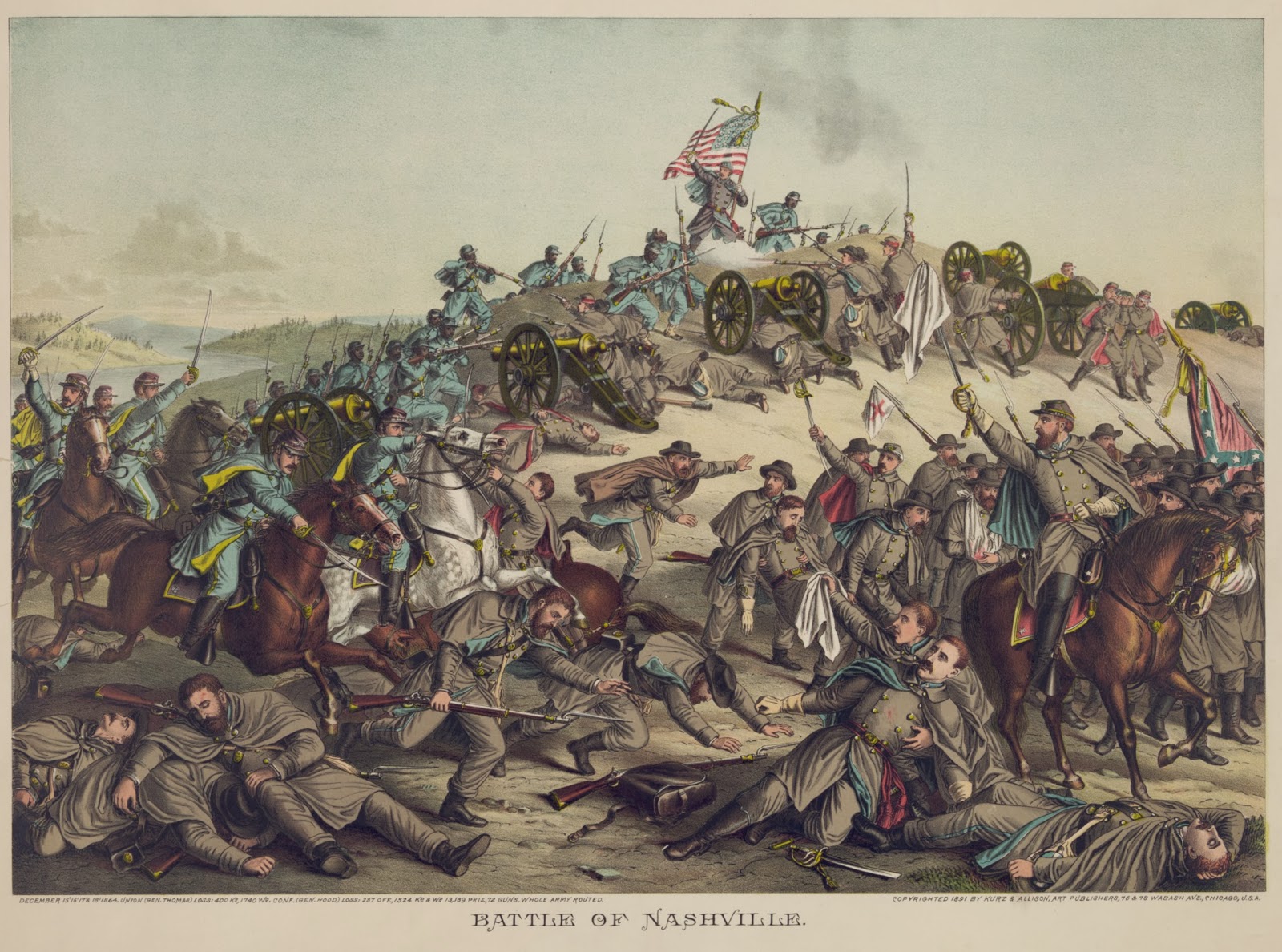
…A month after the Battle of Franklin, outside Nashville, Gen. John Schofield was stalling. Perhaps it was the memory of what he and Otis Smith had seen at Franklin in the tangled mounds of Confederate dead. Now, in December, Schofield was in the same place [Confederate Gen. John B.] Hood had been at Franklin. The Union general was about to lead an assault on an enemy that was well dug in. There was one difference between Schofield’s situation and Hood’s. He was a subordinate officer, not in command. Maj. Gen. George Thomas was Schofield’s superior, and Thomas was ordering him, in the second day of fighting at Nashville, to attack a hillside held by entrenched Confederates. So it would be Hood’s men who would be waiting for Schofield’s this time, not the other way around, and they would be eager to return the favor of Franklin. Earlier that afternoon, December 16, three regiments of U.S. Colored Troops had attacked the Confederate right and were repulsed with forty percent of them dead or wounded—the Confederate officer commanding thetroops that had inflicted this destruction noted the African Americans’ bravery in his official report.
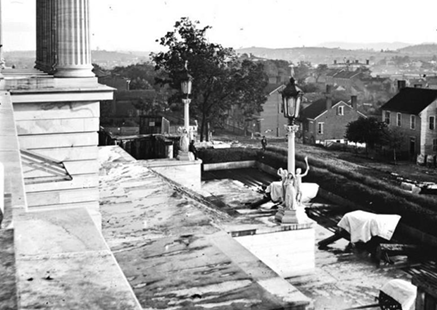
The state capitol steps at Nashville, protected by an artillery battery, 1864. Library of Congress.
Now, on the Confederate left, Schofield was to duplicate that costly effort and send his men up the steep slopes of Shy’s Hill. So he hesitated. He asked General Thomas for reinforcements. Thomas studied the hill for a moment and the decision was suddenly made for him: there were Union troops already attacking the entrenchments there. They were Brig. Gen. John MacArthur’s men. MacArthur, an aggressive and, on December 16, an insubordinate Scot, born in a town on the River Clyde, had grown tired of waiting. Thomas ordered Schofield to follow MacArthur’s lead and send in the rest of his men.2
Otis Smith’s 95th Ohio Infantry was on the right of the impetuous Scot’s attack when MacArthur let it go at 3:30 p.m. The 95th advanced silently, with fixed bayonets, and began to clamber up the hill, ironically, up hillsides so steep that they protected Smith and his comrades from the enemy entrenched unwisely on the summit, rather than below it, where they would have enjoyed a shallower and so more punishing field of fire. The men atop Shy’s Hill included a depleted Florida brigade; in fact, they could manage to field only enough troops that day to make up a regiment. Their position had been further weakened by Hood, who’d transferred troops from the hill to other points in his line. The Floridians had worked all night digging trenches, had been soaked all day by a cold rain, and so they were exhausted. Suddenly, the 95th Ohio, after advancing without a cheer and without firing a shot, were in the Floridians’ entrenchments, Otis Smith among them, killing the Southerners with their bayonets.
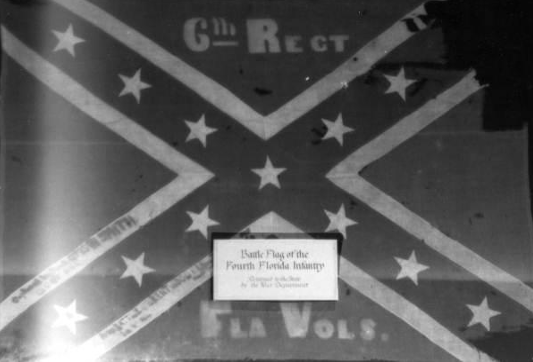
The Confederate position collapsed and Hood watched, dismayed, as his army’s left dissolved. Those left behind were now surrounded by the Union brigade that included Smith. One Floridian started to tear his regimental flag into pieces to keep the victors from having it. For the 6th Florida, it was too late: during the assault, Otis Smith had seized their regimental colors. After the capture of Shy’s Hill, the rest of Hood’s men followed their comrades who were retreating on the left. Hood later wrote that he had never seen a Confederate army retreat in such confusion.3 His army was finished. Less than a month after their rout at Nashville, Hood resigned his command, and Otis Smith would be awarded the Medal of Honor that he never talked about, perhaps because it was tarnished.
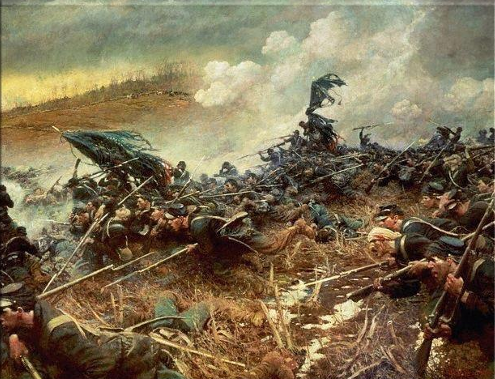
Artist Howard Pyle’s depiction of a Minnesota regiment’s assault on Shy’s hill, part of the attack in which Otis Smith played a role.
This is why. The officer commanding the Floridians on Shy’s Hill, Gen. Thomas Benton Smith, was being conducted to the rear when he was confronted by Otis Smith’s regimental commander, a peacetime physician, Lt. Col. William Linn McMillen. Words were exchanged. McMillen may have been drunk. He suddenly drew his saber and began striking the disarmed Gen. Smith on the head; one blow was so deep that Smith’s brain was exposed.4 McMillen’s own men intervened to disarm their enraged commander. No charges were ever brought against him. He was later promoted, grew cotton in Louisiana after the war, was a state senator, and won patronage jobs from two presidents as postmaster and then port inspector for New Orleans.
In 1886, his victim at Nashville, Thomas Benton Smith, was admitted to an insane asylum where he would spend most of the rest of his life, crippled by the depression that doctors said was a result of his injuries that day below Shy’s Hill. He was temporarily released in 1910 to attend a veterans’ reunion. Out of kindness, he was allowed to conduct close-order drill with some of his old soldiers, and the moment transformed him. An observer wrote that the old general was “as full of the animation of the old days as could be imagined” as he put his little command through its paces.5 Gen. Smith died on May 21, 1923, ten weeks after Medal of Honor winner Smith died at the Sawtelle Home in Los Angeles.
 A Work in Progress