
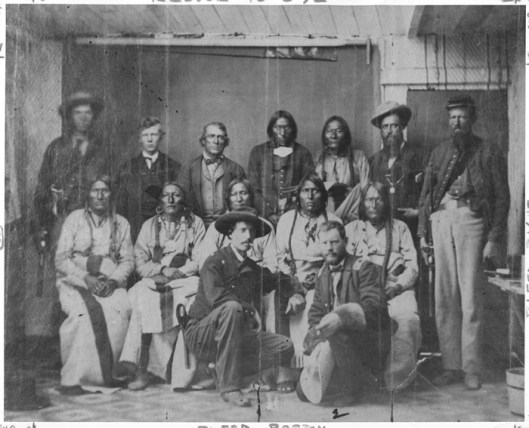
The Camp Weld Conference, Sept. 1868. The soldiers kneeling are (l) Edward Wynkoop and Silas Soule, Directly behind Wynkoop is Black Kettle; the man to Black Kettle’s immediate left is One-Eye.
John Rice would leave Minnesota and farm for a decade in Iowa before coming to Arroyo Grande. He and his brother, Daniel, who transformed local cattle and Indian trails into serviceable roads, would make a mark on the community that would sustain it, after the rancho days of Francis Branch had ended, during its incarnation as a center for California truck gardening.
Much less is known about another veteran with an impressive name. Harrison Marion Bussell was born in Tennessee in 1835 and died in Arroyo Grande, but in 1864 he was living in Colorado, and the notation on his gravestone:– “1st Colorado Cavalry”—refers to one of the units responsible for perhaps the greatest atrocity of the Civil War years, an attack on a Cheyenne village that would become known as the Sand Creek Massacre. Bussell’s role at Sand Creek is not completely clear, but it’s significant that his gravestone identifies him as a member of the First Colorado’s Company G.
It was Cheyenne Chief Black Kettle who said that he would find it hard to believe white men anymore, and, in 1863-64, deteriorating communications between Colorado military and civil authorities and the Cheyenne would be a key cause of what would happen in November 1864 at Sand Creek. Colorado Governor John Evans began to hear rumors of a meeting among several Plains tribes—Cheyenne, Arapaho, Sioux and Kiowa—planning a coordinated war on white settlers and soldiers. It was doubtless the Minnesota Sioux uprising the year before—with troops, including John Rice’s Tenth Minnesota, still in the field on Gen. Sibley’s punitive expedition—that would have given Evans reason to believe those rumors.
Isolated but violent raids seemed to confirm the threat of war: a band of Arapaho launched a raid on Isaac van Wormer’s ranch southwest of Denver and stole some of his cattle; a year later, another party of Indians—assumed to be Cheyenne—returned to the van Wormer ranch and killed a young couple and their two small children. The mutilated bodies of the Hungate family were disinterred and put on display in Denver. Meanwhile, raids persisted from various tribes, including Utes, Lakota Sioux and a Cheyenne warrior society, the Dog Soldiers, whose power seemed to be growing during 1863 and 1864 when leaders like Black Kettle were counseling peace with the whites.
The aggressive Dog Soldiers would get a counterpart on the other side. His name was John Chivington. A Methodist pastor who secured an officer’s commission from the Governor of Colorado, Chivington had made his reputation with Harrison Bussell’s First Colorado Cavalry in the Battle of Glorietta Pass in New Mexico, where a Confederate force was defeated in part because of the First’s daring attack—rappelling on ropes down a mountainside—on their supply train. Now, in the fall of 1864, Chivington was among the increasing chorus of Coloradans—led by newspaper editors and both military and civil leaders—calling for, as one Denver newspaper called it, “the extermination of the red devils.”
That prospect was complicated by Black Kettle and other Cheyenne leaders when they came into Camp Weld, near Denver, in September to ask for peace. They were accompanied by Maj.Edward Wynkoop, the commander of nearby Fort Lyon, whose opinion of the Indians he was to police had been steadily evolving: as he got to know Cheyenne like Black Kettle and another leader, One-Eye, he wrote that “I felt myself in the presence of superior beings, and these were the representatives of a race I had heretofore looked upon without exception as being cruel, treacherous, and bloodthirsty…” Neither Governor Evans nor Colonel Chivington was pleased with Wynkoop’s peace efforts: Evans had just raised a regiment of 100-day volunteers, the Third Colorado Cavalry, whose sole purpose was to exterminate hostiles, and Wynkoop threatened to make the Third redundant. So the Camp Weld conference ended inconclusively, without a peace agreement. Black Kettle and his people were told to come in to Fort Lyon and surrender to Wynkoop when they were ready to make peace—that is, to give up their traditional lives to become farmers. But Chivington’s opinion of Wynkoop became apparent when the young officer was relieved of his command and replaced, six weeks after the Camp Weld conference, by Maj. Scott J. Anthony.
Black Kettle, anxious about the new commander of Fort Lyon, came to the fort to meet him; the Cheyenne had heard he was not friendly toward Indians. His reception belied that: Maj. Anthony assured the Cheyenne that they were under his protection and would be safe at their winter encampment on Sand Creek. He even sent a trader, accompanied by a trooper from Harrison Bussell’s First Colorado Cavalry, out to the encampment to do some business with Black Kettle’s people. At the same time, Anthony telegraphed his superiors, informing them of the encampment at Sand Creek. The telegraph read in part: “I shall try to keep the Indians quiet until such time as I receive reinforcements.”
Anthony got his implied wish quickly: Governor Evans’s 100-day volunteers, the Third Colorado Cavalry, about 300 troopers, arrived at Fort Lyon on November 28, commanded by John Chivington. Chivington was just as quick: once he’d arrived at the fort, he informed the officers of the First Cavalry stationed there that he intended to take both regiments out to Sand Creek and attack Black Kettle. Several of the First Colorado’s officers—men who had served under Wynkoop—immediately protested, insistent on the good intentions of leaders like Black Kettle and One-Eye. Chivington overrode the protest, but one of the officers he’d failed to convince was Lt. Silas Soule; after the meeting, Soule made his position clear to his brother officers: “[I] told them,” he wrote in a later letter to Major Wynkoop, “that any man who would take part in the murders, knowing the circumstances as we did, was a low lived cowardly son of a bitch.” Despite his protests, Soule would ride out with his Company D, First Colorado Cavalry, as part of Chivington’s attack force—believing, perhaps, as Chivington had implied, that the expedition was going after hostile Dog Soldiers and not peaceful Indians. Harrison Marion Bussell was a private in Company G, commanded by Lt. Horace Baldwin, whose troopers also had responsibility for two of the four small mountain howitzers that Chivington’s command, now about 700 soldiers, would bring along with them.
To the northeast, Black Kettle’s encampment of some 650 Cheyenne and Arapaho would be awakened by barking dogs. Women beginning to prepare breakfast could feel and hear the pounding of hooves, which they at first assumed, hopefully, was a nearby herd of buffalo, but the vibration was followed almost immediately, as dawn broke, by heavy small-arms fire and the terrifying shriek of artillery shells from the mountain howitzers. What happened next will never be known definitively; apologists for Chivington argue that a substantial number of warriors was present at the encampment and quickly returned fire. The historical record, which includes testimony from two Congressional investigations, indicates something much more sinister happened on November 29, 1864. Twenty-four of Chivington’s men were killed in combat that lasted from early morning until nearly sunset—about 3 p.m., in winter—but perhaps as many as 200 Cheyenne and Arapaho died. Many of them were women and children.
Lt. Silas Soule and his Company D refused to participate; D Company held its fire. Later, Soule recorded, in his letter to Wynkoop, horrific scenes:
I tell you Ned [Wynkoop] it was hard to see little children on their knees have their brains beat out by men professing to be civilized. One squaw was wounded and a fellow took a hatchet to finish her, she held her arms up to defend her, and he cut one arm off, and held the other with one hand and dashed the hatchet through her brain. One squaw with her two children, were on their knees begging for their lives of a dozen soldiers, within ten feet of them all, firing – when one succeeded in hitting the squaw in the thigh, when she took a knife and cut the throats of both children, and then killed herself. One old squaw hung herself in the lodge – there was not enough room for her to hang and she held up her knees and choked herself to death. Some tried to escape on the Prairie, but most of them were run down by horsemen. I saw two Indians hold one of another’s hands, chased until they were exhausted, when they kneeled down, and clasped each other around the neck and were both shot together.
What about Arroyo Grande’s Harrison Bussell and his Company G? While men from both the regulars of the First Cavalry and the 100-day volunteers of the Third Cavalry participated in the killing—and in the sexual mutilation of bodies afterward—a September 2013 acquisition by Colorado College’s Special Collections at least suggests the possibility of exoneration for the man who would make Arroyo Grande his home.
The acquisition is a typescript of an account by a Company G trooper, Pvt. Isaac Clarke, which suggests that Bussell and G Company acted that day much as Silas Soule’s men had. Clarke, like Major Wynkoop, had become acquainted with One-Eye and respected the Cheyenne leader immensely; according to him, One-Eye came walking toward Chivington’s soldiers carrying a white flag. The soldiers began to shoot at their target, obligingly coming toward them. Just as a G Company trooper rode out to try to save One-Eye, a bullet finally found its mark and the Cheyenne leader fell dead; moments later, the soldiers’ comrades killed him, too, as he trotted back toward the firing line. Isaac Clarke blamed the short-term volunteers of the Third Cavalry; it would take every effort, Clarke reported, of Company G’s officers “to keep us from turning our artillery loose on every hundred day man in the bunch.”
So it’s entirely possible that Harrison Bussell did not share, or did not care to share, in the accolades Denver showered on Chivington and his men once their mission had been completed. The Rocky Mountain News proclaimed, without proof, that the murderers of the Hungate family had themselves been killed and so had Cheyenne Chief Black Kettle. He had not: Black Kettle had survived, dragging his wounded wife to safety, away from their lodge, over which the chief had flown a large American flag, hoping for its protection.
Black Kettle would live only a few years longer. In a remarkable duplication of history, George Custer’s Seventh Cavalry troopers would kill him, along with hundreds of others, in a surprise attack on a winter camp along the Washita River in 1868. Silas Soule, after testifying against Chivington in the investigations that followed, was shot dead on a Denver street, five months after Sand Creek. Chivington loyalists were suspected but no man ever stood trial for the murder. Soule had been walking with his wife of five weeks when he was gunned down. Harrison Marion Bussell would marry an Ohio girl, Mattie Imus, and move to Arroyo Grande, where Mattie died in 1896 and Harrison ten years later.
Censured by Congress, John M. Chivington would resign from the service and move away from Colorado. He returned in 1887 to visit the town named in his honor. One of the citizens of Chivington, Colorado, remembered him in a 1940 memoir:
Colonel Chivington impressed us with his frankness and sincerity. We believe he really had consideration and even affection for the Red Man. But he did his duty as a soldier. After all he forever put a stop to the Indian massacres on the plains of eastern Colorado…
We doubt if any other man has ever been the target of unjust criticism and calumny that has fallen upon the head of Col. Chivington. He denied the accusation that when asked by his troops, what do with the “woman and papooses,” that he replied “Nits make lice, kill them.”…
We believe that Col. Chivington has been much maligned and misrepresented in that he was a kindly, but dignified and courageous officer.
For the last two decades, on the anniversary of Sand Creek, runners from the Cheyenne and Arapaho people have participated in a three-day race that ends at the Colorado State Capitol. It is as much a spiritual event, dedicated to healing, as an athletic contest. After the 2015 run, the presentations were made at Riverside, Denver’s oldest cemetery. The runners, their families and friends, and tribal elders wanted to be close to the grave, and so the spirit, of a man buried there: Lt. Silas Soule, First Colorado Cavalry.
 A Work in Progress