• About
  • The Germans

A Work in Progress

A Work in Progress

Monthly Archives: March 2016

Champion Hill, Mississippi, May 1863

30 Wednesday Mar 2016

Posted by ag1970 in Uncategorized

≈ Leave a comment


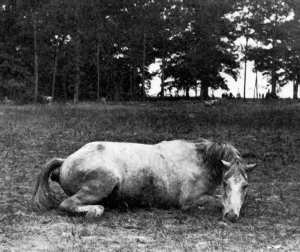
antietamhorse

A casualty at the Battle of Antietam, 1862.

William Lane, who would someday raise cattle and a herd of Lane children in the Huasna Valley, was a lieutenant in the 24th Iowa’s Company C when the regiment, on May 16, 1863, confronted a large Confederate force, part of John C. Pemberton’s command. They were digging in on plantation property atop Champion Hill, whose slopes were covered with tangled scrub and cut by deep gullies. It would be difficult to take, but at 10:30, Grant arrived and ordered the division that included the 24th up the hill. Typically, the regiment shook out skirmishers—a thin line of advance troops whose assignment it was to probe the enemy’s positions—and the skirmishers were followed by dense lines of attackers, and it was the job of lieutenants, perhaps even more expendable than privates, to order the maneuvers that would transform a company from a marching column into an attack formation. It was also a lieutenant’s job one to lead from the front, to keep his men closed up, and wave his sword in an attempt to project ferocity. It might be understandable if, given his duties that day, twenty-eight-year-old William Lane was feeling as if every Confederate atop Champion Hill was aiming at him.

The men he was leading were confident, if the account left by a corporal in Company H, James Oxley, is any indication. Oxley succinctly and in his own spelling recounted what happened next:

a short hault was ordered and we was informed that in a fiew hundred yards wer the Rebs. Strongly posted they had a battery which was for us to charge and capture it…The enemy was fast massing his forces more left when the [24th] Iowa was ordered to charge a six gun battery which was only a fiew hundred yards in our front.

No sooner had the gallent sons of Iowa received the orders to charge till they went not willing that the fare fame of Iowa soldiers deminished rushed like wild and enraged tigers upon the men & batteries. Giving at the same time one of those furious yells which startled fear…dinging the Rebs and they wer driven like chaf before the wind.

The 24th was triumphant in its capture of the guns and a successful episode of Reb-dinging—they’d shot or bayoneted most of the artillery crews—when they were confronted by a counterattack; after a fifteen-minute firefight, they were driven back down the hill, the Confederates re-took their guns, and Major Edward Wright of the 24th, badly wounded, still managed to capture a burly Confederate who carried the wounded officer downhill and out of harm’s way. The tide of the battle seemed to be turning when a brigade that included Francis X. Belot and the Fourth Minnesota fell on the Confederates’ flank. The Fourth galloped up to, into, and over the other side of a ravine and captured 118 prisoners. They then confronted a sight so vividly described by Alonzo Brown, a corporal in Company B, that it must have haunted many in the regiment for the rest of their lives

When the fighting ceased we walked along the wooded, hill and examined the artillery captured from the enemy, and, unless mistaken, counted twenty-eight pieces which had been captured and which the enemy bad abandoned in the road after taking away the horses. We saw one battery upon the brow of the hill. Some of the horses had been killed, and upon one of them sat its rider, – dead. The animal lay on the side of a sharp little slope so that the right leg of the rider was under its body while the other was extended naturally, with the foot in the stirrup. He held the bridle rein in his right hand and with eyes wide open, as if looking to the front, sat upright in the saddle as naturally as if still alive. His features looked like marble, and he was apparently not over seventeen years of age.

By 4:00 p.m., Pemberton’s fight was ending, and the general was both disheartened and furious at a recalcitrant division commander who had failed to move up in time to support the defenders on Champion Hill. He ordered a general retreat toward Vicksburg. Grant now had Pemberton where he wanted him, trapped in the town on the Mississippi bluffs. Grant attempted to attack Pemberton’s fortifications there—the 4th lost twelve killed and 42 wounded in one assault a week after Champion Hill —but then decided to besiege the city and starve it into surrender. The surrender came, appropriately, on the Fourth of July, the bookend in the West to the great victory of the day before in the East, at Gettysburg. The first regiment to enter the conquered city was Francis X. Belot’s 4th Minnesota.
Dear English Majors

20 Sunday Mar 2016

Posted by ag1970 in Uncategorized

≈ Leave a comment


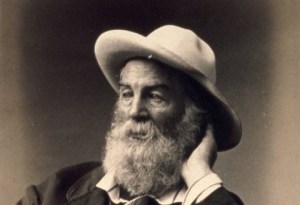
walt-whitmanI have been thinking all day about Walt Whitman’s “Crossing Brooklyn Ferry.” And I am not a Whitman guy. I am a Dickinson guy–“a narrow fellow in the grass;” “the nerves sit ceremonious, like tombs;” “…rowing in Eden…” I have always liked her economy, and there is nothing I’ve ever written that wasn’t better when written with fewer words. Whitman’s appetite for words was vast and he savored every one of them, but he was always hungry for more.
Whitman will come over to your house, drink your imported beer, eat the meatiest ribs off the barbecue, hold the center of attention at the dinner table for four hours, this Niagara of verbiage, then leave singing sea chanties with the wicker basket full of tollhouse cookies that Emily had baked clamped firmly under one arm.

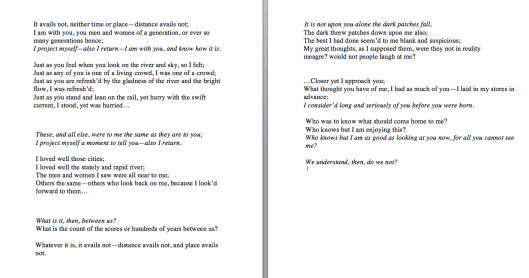
But I always loved teaching this poem–excerpts attached–and I was especially fond of the italicized parts.

Sooner or later, you realize, as you you navigate your way through his hallooing and disgusting jubilance, his ecstatic self-regard, you realize…

…He’s reading his poem with you, right over your shoulder. It is the damnedest thing. He’s smiling, too, the old coot, under those cotton-candy whiskers. It is a miraculous and timeless poem, and he knows it. He sees you, too, and the smile grows broader when he sees you looking backward to try to see him.

SouthFerry


I think that’s why I loved teaching. Good teaching has a chance at timelessness, too. The results of what you teach you see in patches, but they flicker and disappear. The consequences of how you teach may come years later, may even come beyond your own lifetime. They may appear, as a small causative, in someone you’ve taught who decides to do something courageous and decent–it might even be something immensely unpopular because it’s courageous and decent.

I was thinking today, too, of Eileen Taylor’s defense of our Japanese-American neighbors when they returned to our home, to our valley, justifiably fearful (Iso Kobara heard gunshots in the night) in 1945. A grocer told Iso’s mother, Kimi, never to come in his store again.

Eileen heard about this incident. She was the president of the Arroyo Grande Women’s Club. She decided, I think, to read the membership the riot act at the next meeting–we’ll never really know, because, like Lincoln’s Cooper Union speech in 1860, nobody was taking notes. She must have spoken about their obligation, as women, as mothers, as neighbors, to open their arms and their hearts to people who needed, and who had earned, their compassion.

Kimi Kobara remembered in an interview many years later that the atmosphere improved immediately after that Women’s Club meeting. And what  Eileen Taylor did meant, many years later, that I had the great pleasure of teaching both Eileen’s great-grandchildren and Kimi Kobara’s.

So an event that happened before I was born–time avails not–became an important part of my life. The lives of Eileen and Kimi, two women I never met,  became entwined with my life.

And my teaching–how I taught my Taylors and Kobaras– was a product of people they had never met, either.  My teaching was shaped by the  good teachers I’d had, and there were many, and it was shaped by my mother and father. If you were a student of mine, and knew me, then you also know Arroyo Grande High School speech teacher Sara Steigerwalt, Cal Poly journalism teacher Jim Hayes, University of Missouri history professor Richard Bienvenu.

Most of all, you know my Mom and Dad.

That’s why I so enjoy this poem. It’s life-affirming, and lives lived 150 years ago are just as important today as they were then.

Even better, they are just as much alive. They are right beside us, like Whitman standing at the rail of the Brooklyn Ferry, these old lives that give life.


Screen Shot 2016-03-19 at 8.16.11 PM

How NOT to fight Indians

04 Friday Mar 2016

Posted by ag1970 in Uncategorized

≈ Leave a comment


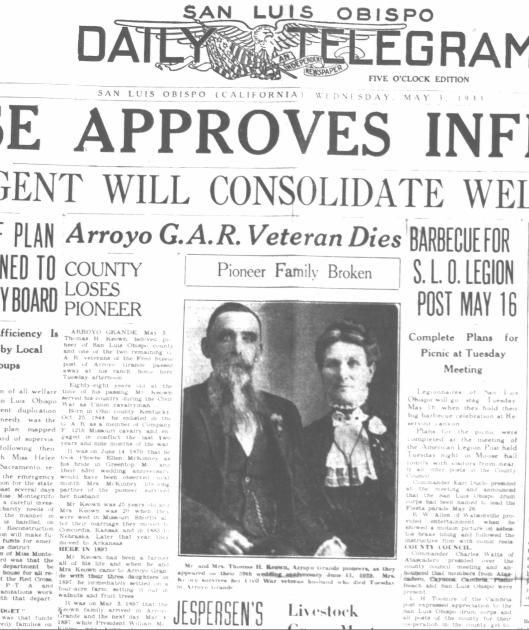
Thomas Keown

Cavalry veteran Thomas Keown’s obituary, 1933.


Infantry soldiers were noted for the sardonic saying that there was no sight rarer on a battlefield than that of  a dead cavalryman. Luckily for historians, if not for cavalrymen, there were such things and, thanks to forensic science, horse soldiers been given a voice that suggests their lives were no easier than those of foot soldiers.

In fact, for Civil War cavalrymen, the most poignant evidence for the difficulty of the lives they led comes from slightly younger contemporaries—the remains of the troopers who died with George Custer at the Little Bighorn in 1876. Recent forensic studies there indicate that spinal problems—arthritis of the neck, degeneration of the disks of the mid- to lower spine, hypereflexibility of hip and ankle joints, and even muscle markings at their attachments to the jaw, suggesting a regular clenching of teeth while on the move—had given men in their mid-twenties the aches and pains of men in their seventies; in fact, the only part of their bodies that may have hurt worse than their backs would have been their teeth, which showed poor dental care and extensive tobacco use. Arroyo Grande veteran James A. Dowell, 16th Kansas, was plagued by another ailment common to cavalrymen—hemorrhoids.

Despite letting Lee down at Gettysburg, for most of the Civil War, J.E.B. Stuart and his Confederate contemporaries, Fitzhugh Lee, Joseph Wheeler and Nathan Bedford Forrest, had the reputation for fielding cavalry who were far better—in both mounts and in troopers—than mounted northerners. This was a gap that would begin to close in the war’s last year—Custer was noted for the kind of boldness that Stuart embodied, a trait that would get both men killed—but a similar gap would never be overcome for cavalrymen like Harrison Bussell, James Dowell and another Arroyo Grande veteran, Thomas Keown, 12th Missouri Cavalry, who were primarily Indian fighters during the Civil War.

A fictional Confederate veteran, Charles Portis’s Rooster Cogburn, unwittingly points out a disadvantage that would plague these men when, in the novel True Grit, he disparages the officious Texas Ranger LaBoeuf’s little mustang by posing the question “How long have you boys been riding sheep down there?” But it was the compact Indian pony, the descendants of Andalusian horses the Spanish had brought with them to the New World, that made tribes like the Cheyenne, the Lakota Sioux and the Comanche the finest light cavalry in the world. In their best-selling biography of Sioux leader Red Cloud, historians Bob Drury and Tom Clavin make an unfavorable comparison between the cavalryman’s mount, descended from “the hulking, grain-fed steeds” of Northern Europe and the Indian pony, “easy to break and able to travel great distances without water.”

So the mobility of Plains Indians made them elusive for aggressive Union officers like Gen. Patrick Connor, who led three columns of cavalry into the Powder River Country of Montana in the summer of 1865 on an expedition that included James Dowell and Thomas Keown. Connor, whose standing order was to kill every Native American male over twelve years old, wouldn’t find all that many to kill. They would find Connor with ease—and if they’d only been as armed as well as the soldiers, they would have killed the men in Connor’s command, Dowell and Keown included.

* * *

The Powder River Country includes vast areas of the Dakotas, Wyoming and Montana, and had been among the traditional hunting grounds, confirmed by an 1851 Treaty, of tribes like the Lakota. It was the discovery of another resource—gold—in Montana in 1863 that suddenly made the area potentially valuable to whites, as well. A trail to the gold fields established by John Bozeman and John Jacobs would lead to an alarming rise in the number of whites penetrating Indian territory. In 1864-65, attacks on miners increased, so the attacks were to be ended, and the Bozeman Trail secured, by Patrick Connor and his cavalry.

Connor’s expedition moved out in July 1865, and two future neighbors, Dowell and Keown, fought together in one of Connor’s columns, under the command of Col. Nelson Cole. One of the first things the commanders did, and they did it rapidly, was to get lost. Connor sent out scouts to find Cole’s column and Cole did the same. They failed. Cole, meanwhile, had uknowingly marched his men into the midpoint between two large encampments, between two of the most inspirational leaders the Lakota would ever produce: Sitting Bull and Red Cloud. Sitting Bull’s men found Cole’s with ease, and would jump “like angry badgers” on Dowell and Keown and their comrades. At the moment of their attack, the weather—as capricious on the Great Plains as the English Channel’s weather was in the final hours before D-day—took a turn for the worse.

On September 1, 1865, the temperature dropped seventy degrees and, although the Indians disappeared, a freak blizzard attacked Cole’s detachment instead, killing many of their ill-fed and exhausted horses. Cole’s men, some of them now and by necessity infantry, continued their march up the Powder River, fighting the whole time and harassed the whole time by detachments of Sioux and Cheyenne who picked off isolated troopers and made off with even more Union Army horses. A week later, Cole’s column found themselves, accidentally and uncomfortably, near a camp whose leader was yet another man famed to the Plains Indians: Roman Nose.

On September 8, Roman Nose organized an attack on Cole’s men, who had formed their wagons into a protective square. It was then that Dowell and Keown saw what modern American historians of the West would willingly die to have seen—perhaps the most famous of all the Lakota: on a “dare ride”—both to prove his own courage, already well-established, and more to the point, to draw out the soldiers—a warrior, nearly nude except for moccasins and breechclout, with his light, slightly curly hair tied back, with a small stone behind his ear fixed in place by a leather strap, rode up and down the little stockade of wagons.

His name was Crazy Horse.

The soldiers refused to take the bait—not even when Roman Nose, imitative of Crazy Horse but more finely equipped, with an eagle-feather war bonnet, rode up to them on his white horse, which was later shot out from under him. They remained behind their barricade and responded to three attacks with breech-loading carbines and artillery canister. The weather again intervened: this time, a thunderstorm turned the area into a virtual swamp, making more Lakota attacks impractical and making the lives of troopers like Dowell and Keown miserable. Once again—after burning extraneous equipment and the corpses of dead troopers—Col. Cole continued his march. By now, many of his men were sick from scurvy, were eating their mounts, and were virtually in rags. It was at this point when they finally made contact with their commanding officer, Patrick Connor, and his column, who had been no more successful in killing any Indians, twelve years old or otherwise. Connor led his dispirited command back to Fort Laramie in October 1865.

The grandiose-sounding “Powder River Expedition” was a disaster.

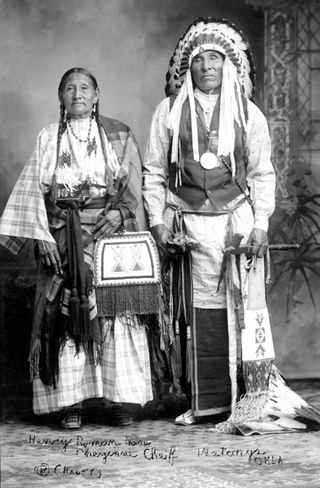
Roman_Nose_and_wife (1)

Roman Nose, in old age, with his wife.


Subscribe

  • Entries (RSS)
  • Comments (RSS)

Archives

  • January 2026
  • December 2025
  • November 2025
  • October 2025
  • September 2025
  • August 2025
  • July 2025
  • June 2025
  • May 2025
  • April 2025
  • March 2025
  • February 2025
  • January 2025
  • December 2024
  • November 2024
  • October 2024
  • September 2024
  • August 2024
  • July 2024
  • June 2024
  • May 2024
  • April 2024
  • March 2024
  • February 2024
  • January 2024
  • December 2023
  • November 2023
  • October 2023
  • September 2023
  • August 2023
  • July 2023
  • June 2023
  • May 2023
  • April 2023
  • March 2023
  • February 2023
  • January 2023
  • December 2022
  • November 2022
  • October 2022
  • September 2022
  • August 2022
  • May 2022
  • April 2022
  • March 2022
  • February 2022
  • January 2022
  • December 2021
  • November 2021
  • October 2021
  • September 2021
  • August 2021
  • July 2021
  • June 2021
  • April 2021
  • March 2021
  • February 2021
  • January 2021
  • December 2020
  • November 2020
  • August 2020
  • July 2020
  • June 2020
  • May 2020
  • April 2020
  • January 2020
  • December 2019
  • November 2019
  • October 2019
  • September 2019
  • August 2019
  • May 2019
  • April 2019
  • March 2019
  • February 2019
  • January 2019
  • December 2018
  • November 2018
  • October 2018
  • September 2018
  • July 2018
  • June 2018
  • May 2018
  • April 2018
  • March 2018
  • February 2018
  • January 2018
  • December 2017
  • November 2017
  • October 2017
  • April 2017
  • March 2017
  • December 2016
  • November 2016
  • October 2016
  • September 2016
  • August 2016
  • July 2016
  • June 2016
  • April 2016
  • March 2016
  • February 2016
  • January 2016
  • December 2015
  • November 2015
  • October 2015
  • September 2015
  • August 2015
  • July 2015
  • June 2015
  • May 2015
  • April 2015
  • March 2015
  • February 2015
  • January 2015
  • December 2014
  • November 2014
  • September 2014
  • August 2014
  • July 2014

Categories

  • American History
  • Arroyo Grande
  • California history
  • Family history
  • Film and Popular Culture
  • History
  • News
  • Personal memoirs
  • Teaching
  • The Great Depression
  • trump
  • Uncategorized
  • World War II
  • Writing

Meta

  • Create account
  • Log in

Blog at WordPress.com.

  • Subscribe Subscribed
    • A Work in Progress
    • Join 68 other subscribers
    • Already have a WordPress.com account? Log in now.
    • A Work in Progress
    • Subscribe Subscribed
    • Sign up
    • Log in
    • Report this content
    • View site in Reader
    • Manage subscriptions
    • Collapse this bar
 

Loading Comments...