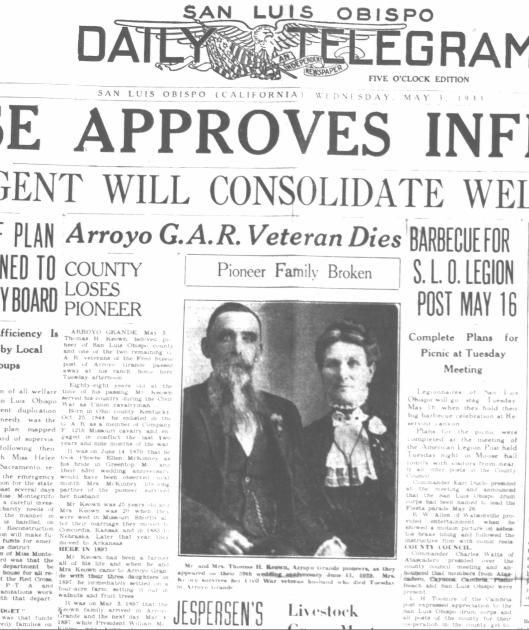
Cavalry veteran Thomas Keown’s obituary, 1933.
Infantry soldiers were noted for the sardonic saying that there was no sight rarer on a battlefield than that of a dead cavalryman. Luckily for historians, if not for cavalrymen, there were such things and, thanks to forensic science, horse soldiers been given a voice that suggests their lives were no easier than those of foot soldiers.
In fact, for Civil War cavalrymen, the most poignant evidence for the difficulty of the lives they led comes from slightly younger contemporaries—the remains of the troopers who died with George Custer at the Little Bighorn in 1876. Recent forensic studies there indicate that spinal problems—arthritis of the neck, degeneration of the disks of the mid- to lower spine, hypereflexibility of hip and ankle joints, and even muscle markings at their attachments to the jaw, suggesting a regular clenching of teeth while on the move—had given men in their mid-twenties the aches and pains of men in their seventies; in fact, the only part of their bodies that may have hurt worse than their backs would have been their teeth, which showed poor dental care and extensive tobacco use. Arroyo Grande veteran James A. Dowell, 16th Kansas, was plagued by another ailment common to cavalrymen—hemorrhoids.
Despite letting Lee down at Gettysburg, for most of the Civil War, J.E.B. Stuart and his Confederate contemporaries, Fitzhugh Lee, Joseph Wheeler and Nathan Bedford Forrest, had the reputation for fielding cavalry who were far better—in both mounts and in troopers—than mounted northerners. This was a gap that would begin to close in the war’s last year—Custer was noted for the kind of boldness that Stuart embodied, a trait that would get both men killed—but a similar gap would never be overcome for cavalrymen like Harrison Bussell, James Dowell and another Arroyo Grande veteran, Thomas Keown, 12th Missouri Cavalry, who were primarily Indian fighters during the Civil War.
A fictional Confederate veteran, Charles Portis’s Rooster Cogburn, unwittingly points out a disadvantage that would plague these men when, in the novel True Grit, he disparages the officious Texas Ranger LaBoeuf’s little mustang by posing the question “How long have you boys been riding sheep down there?” But it was the compact Indian pony, the descendants of Andalusian horses the Spanish had brought with them to the New World, that made tribes like the Cheyenne, the Lakota Sioux and the Comanche the finest light cavalry in the world. In their best-selling biography of Sioux leader Red Cloud, historians Bob Drury and Tom Clavin make an unfavorable comparison between the cavalryman’s mount, descended from “the hulking, grain-fed steeds” of Northern Europe and the Indian pony, “easy to break and able to travel great distances without water.”
So the mobility of Plains Indians made them elusive for aggressive Union officers like Gen. Patrick Connor, who led three columns of cavalry into the Powder River Country of Montana in the summer of 1865 on an expedition that included James Dowell and Thomas Keown. Connor, whose standing order was to kill every Native American male over twelve years old, wouldn’t find all that many to kill. They would find Connor with ease—and if they’d only been as armed as well as the soldiers, they would have killed the men in Connor’s command, Dowell and Keown included.
* * *
The Powder River Country includes vast areas of the Dakotas, Wyoming and Montana, and had been among the traditional hunting grounds, confirmed by an 1851 Treaty, of tribes like the Lakota. It was the discovery of another resource—gold—in Montana in 1863 that suddenly made the area potentially valuable to whites, as well. A trail to the gold fields established by John Bozeman and John Jacobs would lead to an alarming rise in the number of whites penetrating Indian territory. In 1864-65, attacks on miners increased, so the attacks were to be ended, and the Bozeman Trail secured, by Patrick Connor and his cavalry.
Connor’s expedition moved out in July 1865, and two future neighbors, Dowell and Keown, fought together in one of Connor’s columns, under the command of Col. Nelson Cole. One of the first things the commanders did, and they did it rapidly, was to get lost. Connor sent out scouts to find Cole’s column and Cole did the same. They failed. Cole, meanwhile, had uknowingly marched his men into the midpoint between two large encampments, between two of the most inspirational leaders the Lakota would ever produce: Sitting Bull and Red Cloud. Sitting Bull’s men found Cole’s with ease, and would jump “like angry badgers” on Dowell and Keown and their comrades. At the moment of their attack, the weather—as capricious on the Great Plains as the English Channel’s weather was in the final hours before D-day—took a turn for the worse.
On September 1, 1865, the temperature dropped seventy degrees and, although the Indians disappeared, a freak blizzard attacked Cole’s detachment instead, killing many of their ill-fed and exhausted horses. Cole’s men, some of them now and by necessity infantry, continued their march up the Powder River, fighting the whole time and harassed the whole time by detachments of Sioux and Cheyenne who picked off isolated troopers and made off with even more Union Army horses. A week later, Cole’s column found themselves, accidentally and uncomfortably, near a camp whose leader was yet another man famed to the Plains Indians: Roman Nose.
On September 8, Roman Nose organized an attack on Cole’s men, who had formed their wagons into a protective square. It was then that Dowell and Keown saw what modern American historians of the West would willingly die to have seen—perhaps the most famous of all the Lakota: on a “dare ride”—both to prove his own courage, already well-established, and more to the point, to draw out the soldiers—a warrior, nearly nude except for moccasins and breechclout, with his light, slightly curly hair tied back, with a small stone behind his ear fixed in place by a leather strap, rode up and down the little stockade of wagons.
His name was Crazy Horse.
The soldiers refused to take the bait—not even when Roman Nose, imitative of Crazy Horse but more finely equipped, with an eagle-feather war bonnet, rode up to them on his white horse, which was later shot out from under him. They remained behind their barricade and responded to three attacks with breech-loading carbines and artillery canister. The weather again intervened: this time, a thunderstorm turned the area into a virtual swamp, making more Lakota attacks impractical and making the lives of troopers like Dowell and Keown miserable. Once again—after burning extraneous equipment and the corpses of dead troopers—Col. Cole continued his march. By now, many of his men were sick from scurvy, were eating their mounts, and were virtually in rags. It was at this point when they finally made contact with their commanding officer, Patrick Connor, and his column, who had been no more successful in killing any Indians, twelve years old or otherwise. Connor led his dispirited command back to Fort Laramie in October 1865.
The grandiose-sounding “Powder River Expedition” was a disaster.
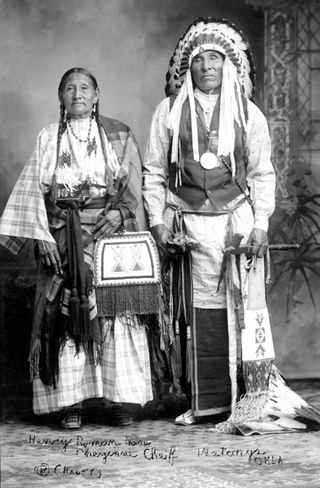
Roman Nose, in old age, with his wife.
 A Work in Progress