
 I have been thinking all day about Walt Whitman’s “Crossing Brooklyn Ferry.” And I am not a Whitman guy. I am a Dickinson guy–“a narrow fellow in the grass;” “the nerves sit ceremonious, like tombs;” “…rowing in Eden…” I have always liked her economy, and there is nothing I’ve ever written that wasn’t better when written with fewer words. Whitman’s appetite for words was vast and he savored every one of them, but he was always hungry for more.
Whitman will come over to your house, drink your imported beer, eat the meatiest ribs off the barbecue, hold the center of attention at the dinner table for four hours, this Niagara of verbiage, then leave singing sea chanties with the wicker basket full of tollhouse cookies that Emily had baked clamped firmly under one arm.
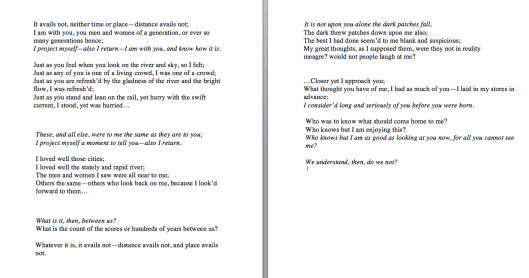
But I always loved teaching this poem–excerpts attached–and I was especially fond of the italicized parts.
Sooner or later, you realize, as you you navigate your way through his hallooing and disgusting jubilance, his ecstatic self-regard, you realize…
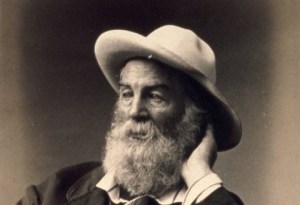
…He’s reading his poem with you, right over your shoulder. It is the damnedest thing. He’s smiling, too, the old coot, under those cotton-candy whiskers. It is a miraculous and timeless poem, and he knows it. He sees you, too, and the smile grows broader when he sees you looking backward to try to see him.

I think that’s why I loved teaching. Good teaching has a chance at timelessness, too. The results of what you teach you see in patches, but they flicker and disappear. The consequences of how you teach may come years later, may even come beyond your own lifetime. They may appear, as a small causative, in someone you’ve taught who decides to do something courageous and decent–it might even be something immensely unpopular because it’s courageous and decent.
I was thinking today, too, of Eileen Taylor’s defense of our Japanese-American neighbors when they returned to our home, to our valley, justifiably fearful (Iso Kobara heard gunshots in the night) in 1945. A grocer told Iso’s mother, Kimi, never to come in his store again.
Eileen heard about this incident. She was the president of the Arroyo Grande Women’s Club. She decided, I think, to read the membership the riot act at the next meeting–we’ll never really know, because, like Lincoln’s Cooper Union speech in 1860, nobody was taking notes. She must have spoken about their obligation, as women, as mothers, as neighbors, to open their arms and their hearts to people who needed, and who had earned, their compassion.
Kimi Kobara remembered in an interview many years later that the atmosphere improved immediately after that Women’s Club meeting. And what Eileen Taylor did meant, many years later, that I had the great pleasure of teaching both Eileen’s great-grandchildren and Kimi Kobara’s.
So an event that happened before I was born–time avails not–became an important part of my life. The lives of Eileen and Kimi, two women I never met, became entwined with my life.
And my teaching–how I taught my Taylors and Kobaras– was a product of people they had never met, either. My teaching was shaped by the good teachers I’d had, and there were many, and it was shaped by my mother and father. If you were a student of mine, and knew me, then you also know Arroyo Grande High School speech teacher Sara Steigerwalt, Cal Poly journalism teacher Jim Hayes, University of Missouri history professor Richard Bienvenu.
Most of all, you know my Mom and Dad.
That’s why I so enjoy this poem. It’s life-affirming, and lives lived 150 years ago are just as important today as they were then.
Even better, they are just as much alive. They are right beside us, like Whitman standing at the rail of the Brooklyn Ferry, these old lives that give life.
 A Work in Progress