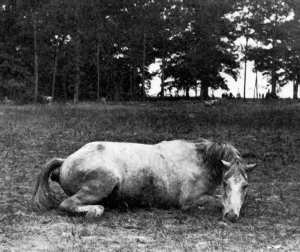
A casualty at the Battle of Antietam, 1862.
William Lane, who would someday raise cattle and a herd of Lane children in the Huasna Valley, was a lieutenant in the 24th Iowa’s Company C when the regiment, on May 16, 1863, confronted a large Confederate force, part of John C. Pemberton’s command. They were digging in on plantation property atop Champion Hill, whose slopes were covered with tangled scrub and cut by deep gullies. It would be difficult to take, but at 10:30, Grant arrived and ordered the division that included the 24th up the hill. Typically, the regiment shook out skirmishers—a thin line of advance troops whose assignment it was to probe the enemy’s positions—and the skirmishers were followed by dense lines of attackers, and it was the job of lieutenants, perhaps even more expendable than privates, to order the maneuvers that would transform a company from a marching column into an attack formation. It was also a lieutenant’s job one to lead from the front, to keep his men closed up, and wave his sword in an attempt to project ferocity. It might be understandable if, given his duties that day, twenty-eight-year-old William Lane was feeling as if every Confederate atop Champion Hill was aiming at him.
The men he was leading were confident, if the account left by a corporal in Company H, James Oxley, is any indication. Oxley succinctly and in his own spelling recounted what happened next:
a short hault was ordered and we was informed that in a fiew hundred yards wer the Rebs. Strongly posted they had a battery which was for us to charge and capture it…The enemy was fast massing his forces more left when the [24th] Iowa was ordered to charge a six gun battery which was only a fiew hundred yards in our front.
No sooner had the gallent sons of Iowa received the orders to charge till they went not willing that the fare fame of Iowa soldiers deminished rushed like wild and enraged tigers upon the men & batteries. Giving at the same time one of those furious yells which startled fear…dinging the Rebs and they wer driven like chaf before the wind.
The 24th was triumphant in its capture of the guns and a successful episode of Reb-dinging—they’d shot or bayoneted most of the artillery crews—when they were confronted by a counterattack; after a fifteen-minute firefight, they were driven back down the hill, the Confederates re-took their guns, and Major Edward Wright of the 24th, badly wounded, still managed to capture a burly Confederate who carried the wounded officer downhill and out of harm’s way. The tide of the battle seemed to be turning when a brigade that included Francis X. Belot and the Fourth Minnesota fell on the Confederates’ flank. The Fourth galloped up to, into, and over the other side of a ravine and captured 118 prisoners. They then confronted a sight so vividly described by Alonzo Brown, a corporal in Company B, that it must have haunted many in the regiment for the rest of their lives
When the fighting ceased we walked along the wooded, hill and examined the artillery captured from the enemy, and, unless mistaken, counted twenty-eight pieces which had been captured and which the enemy bad abandoned in the road after taking away the horses. We saw one battery upon the brow of the hill. Some of the horses had been killed, and upon one of them sat its rider, – dead. The animal lay on the side of a sharp little slope so that the right leg of the rider was under its body while the other was extended naturally, with the foot in the stirrup. He held the bridle rein in his right hand and with eyes wide open, as if looking to the front, sat upright in the saddle as naturally as if still alive. His features looked like marble, and he was apparently not over seventeen years of age.
By 4:00 p.m., Pemberton’s fight was ending, and the general was both disheartened and furious at a recalcitrant division commander who had failed to move up in time to support the defenders on Champion Hill. He ordered a general retreat toward Vicksburg. Grant now had Pemberton where he wanted him, trapped in the town on the Mississippi bluffs. Grant attempted to attack Pemberton’s fortifications there—the 4th lost twelve killed and 42 wounded in one assault a week after Champion Hill —but then decided to besiege the city and starve it into surrender. The surrender came, appropriately, on the Fourth of July, the bookend in the West to the great victory of the day before in the East, at Gettysburg. The first regiment to enter the conquered city was Francis X. Belot’s 4th Minnesota.
 A Work in Progress