
City Point, Virginia, was Grant’s supply base the last year of the war. It would would have astounded the men at Gone with the Wind’s barbecue because of its acres of artillery parks, stacked cannonballs, warehouses full of shoes, Springfield rifles, boxes of hardtack—the army cracker almost durable enough to build a home, and just as indigestible—row after row of tents in a city of soldiers, even its bakery, capable of turning out 100,000 loaves of bread a day. Quartermaster wagons offloaded cargo along a river controlled by navy ironclad gunboats; the wagons traveled in a never-ending stream so busy that it might have reminded the gentlemen from Margaret Mitchell’s Georgia of worker ants, charged with energy and purposeful.
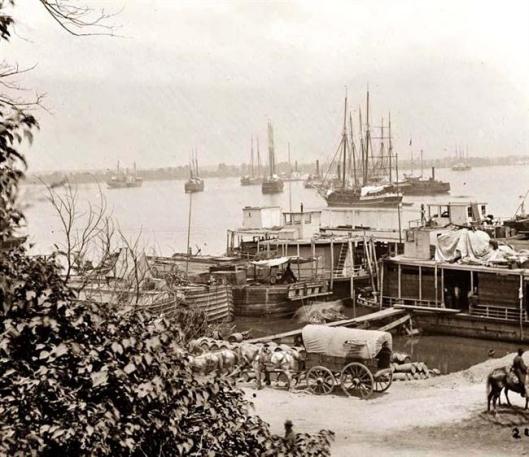
Wharf, City Point, Virginia
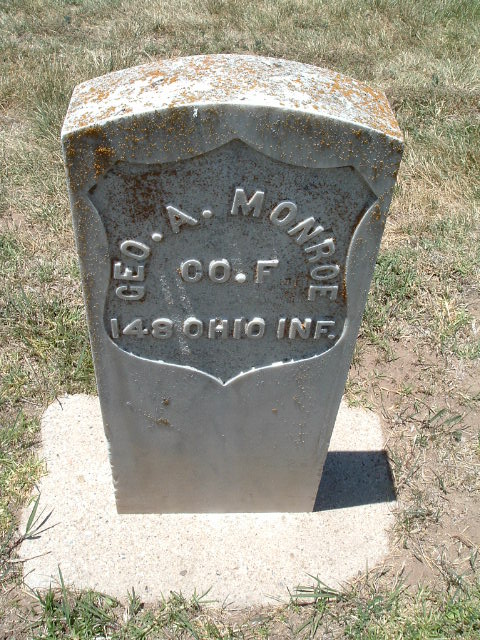
By 1865, even Lincoln’s presidential yacht, the River Queen, was anchored in the river when he visited with Grant and Sherman to sketch out the final acts of the war. Lincoln treasured these trips to see his soldiers, away from the constant assault of favor-seekers who paraded through his office. On another visit earlier in the war, to McClellan’s headquarters, Lincoln had idly picked up an ax on the deck of the Treasury Department yacht Miami, smiled, and lifted it, holding it straight out at arm’s length for several moments. None of Miami’s sailors, when they attempted it, could do the same. On April 14, 1865, John Wilkes Booth’s bullet would traverse Lincoln’s brain; logically, it should have killed him instantly, so it was only Lincoln’s will and physicality that allowed him to live for nine hours after the shot had been fired. George Monroe, another Arroyo Grande settler, would have felt the president’s loss in a very personal way: the 148th Ohio Infantry and Pvt. Monroe had been the recipients of a thank-you, a short Lincoln speech, in August 1864.
Even though Monroe and his comrades were short-termers—100-day men, usually relegated to guard duty on railroads, at strategic bases like City Point, or as support troops—the 148th, came close, thanks to the spectacular attempt at sabotage, to never seeing Lincoln at all. On August 9, 1864, two Confederate secret agents penetrated the picket line that surrounded the wharves simply by crawling through it on their hands and knees. The letdown in security might at in part be traced to the heat that day. City Point’s pickets may have found themselves dulled by the kind of torpor ninety-eight-degree temperatures can induce. Even the stoic Grant found it hard to deal with the heat; he emerged from his tent and was doing his paperwork in his shirtsleeves.
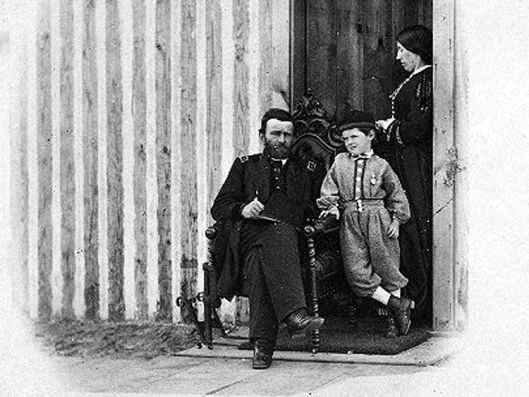
Grant, his son Fred and his wife Julia at City Point.
While Grant was at his labors, the lead Confederate agent, John Maxwell, left his companion behind and approached a barge, the J.E. Kendrick. From Maxwell’s report.
I approached cautiously the wharf, with my machine and powder covered by a small box. Finding the captain had come ashore from a barge then at the wharf, I seized the occasion to hurry forward with my box. Being halted by one of the wharf sentinels I succeeded in passing him by representing that the captain had ordered me to convey the box on board. Hailing a man from the barge I put the machine in motion and gave it in his charge. He carried it aboard.
The hapless man from the barge did not know that he’d just been handed–Maxwell’s “machine”—was a time bomb, packed with about twelve pounds of explosives. Maxwell and his accomplice did not know, since they were attempting both nonchalance and rapid flight at the same moment, that the box they’d delivered was now aboard an ammunition barge.
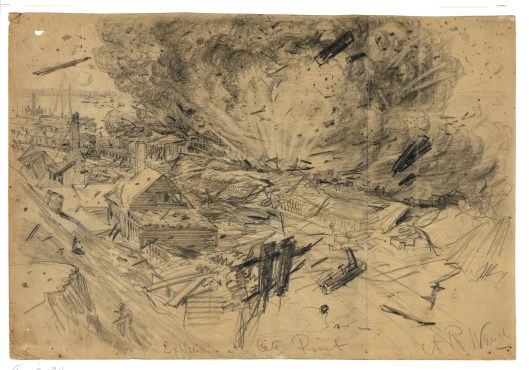
Artist’s conception of the August explosion.
What a Union soldier heard, ten miles away, in the trenches outside Petersburg, Virginia, was like a thunderclap. What a group of officers near Grant’s headquarters heard in the middle of their poker game was a cannonball ripping through the canvas of their tent, from one side to the other, after the explosion had sent it flying. What a soldier felt was immense pain at the sight of a white horse, on which a woman had been seated at the moment of the explosion. The woman was gone, and a Whitworth bolt—a shell from an artillery rifle—had gone through her horse, now standing, shivering in shock. The soldier held the muzzle of his rifle next to the animal’s head and fired. What a woman on a riverboat nearby felt was a dull thud on the deck beside her. She noticed it was a human head. She picked it up by its hair and placed it carefully in a fire bucket full of water. The only other person as nonplussed as she was Grant, who looked with concern after some slightly wounded staff officers, gave a few orders, and returned to his paperwork.
The barge Kendrick was gone, as was much of the City Point wharf. So were unknown numbers of contrabands, former slaves who were working for pay as stevedores. Three members of Monroe’s 148th Ohio were killed, along with forty other soldiers, clerks and civilians, and over a hundred were wounded. The disaster was deemed an accident—not until after the war would it be revealed that it had been the act of John Maxwell, who escaped.
Nine days later, the wharf at City Point had been rebuilt and was as busy as it had been in the moments before Maxwell’s bomb had detonated. What happened at City Point was a tragedy, but it did nothing to stop the industrial machine that would continue to grind the Confederacy down. George Monroe and the 148th Ohio would soon be headed home; Adam Bair, the soldier who would settle in the Huasna Valley, and his 60th Ohio were three-year men, not 100-day men, and so they were headed for wherever Robert E. Lee was headed.
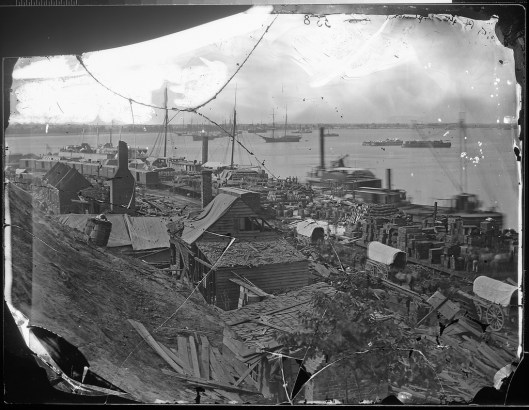
City Point after the explosion; damage can still be seen in the foreground.
 A Work in Progress