
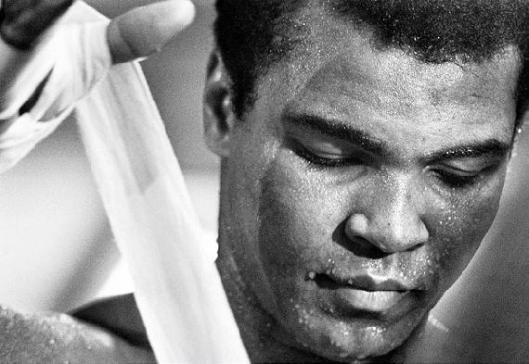
Muhammad Ali’s nemesis, Joe Frazier, was a counterpuncher—I used to teach Frazier to my high school students to help them learn how to write argumentative essays—but that label belies his savagery. Opponents said that Frazier hit so hard that they thought they were going to die. Frazier hit so hard that the disbelief on Ali’s face when the Philadelphia fighter knocked him down is indelible. Frazier hit him just as hard in the rematch, the “Thrilla in Manila”—he said afterward that he’d hit so hard that he landed punches that would’ve knocked down the wall of a house—but Ali took them, kept talking to him, kept making delicate little circular gestures to Frazier with one glove, goading him to come in closer.
Ali’s left jab was his most famous and most electric weapon, but what finally put Frazier away was a staccato series of rights, the last one quick as a cobra strike; it traveled only a little more than eighteen inches and it left Frazier on the canvas in the fetal position. Death would travel more slowly than Ali’s right, but this was the night that both men began to die.
* * *
From The Telegraph (UK), from an interview with Ali’s business manager, Gene Kilroy:
I remember a lady came by our camp in Zaire and said her son was sick.
“Ali said: ‘We’ll go visit him.’ She took us to a leper colony. The staff would put the food down and walk away. Ali was soon lying down with the lepers, hugging them. I took about 10 showers when we got back. Ali just said: ‘Don’t worry about it, God’s looking out for us.’”
* * *
At a press conference at the Waldorf-Astoria before leaving for the 1974 Zaire fight against George Foreman, the “Rumble in the Jungle,”, Muhammad talked about his training:
“I’ve wrestled with alligators,
I’ve tussled with a whale.
I done handcuffed lightning
And throw thunder in jail.
You know I’m bad.
just last week, I murdered a rock,
Injured a stone, Hospitalized a brick.
I’m so mean, I make medicine sick.”
* * *
The novelist Norman Mailer, going into that fight, said that Muhammad was afraid. Foreman had destroyed Frazier, destroyed Ken Norton—two fighters who had beaten Ali—in two bouts that had lasted two rounds each. Mailer implied that the volume of Muhammad’s poetry was in direct proportion to the intensity of his fear.
But Ali had watched films of the fights, and when Foreman had knocked those men down, he’d meekly and quickly retired to his corner, breathing heavily. He didn’t have the stamina it would take to escape the trap Ali was laying for him—a fight intended to be a marathon. As Foreman pounded a crumpled Ali, gloves up, forearms locked at the elbows, in merciless showers of blows that would have hospitalized most men, Ali whispered to him, from the ropes, after one particularly jarring punch, “That the best you got, George?”
In the end, Mailer probably was right. Ali, the victor, was afraid of George Foreman. That is why he was so remarkable. George Foreman grew to love Muhammad Ali. That is why he is the greatest.
* * *
My late brother-in-law, Tim O’Hara, then living in Los Osos, took my nephew Ryan, then a little boy, to meet Ali at a Los Angeles-area sports-card show and signing. Ali signed a pair of boxing gloves, and took a moment to look at Ryan and remark on something I’m not sure Ryan had ever much liked. “I love your curly hair,” the Champ said softly.
* * *
In Famine Ireland, an English clergyman and his companion climbed into their carriage to leave a stricken town. A thirteen-year-old girl, expressionless, her clothing in tatters and so exposing ribs like an accordion’s bellows, her clavicle and shoulder joint with their contours visible just below her skin, began to run after the carriage. When the horses picked up speed, so did she. The clergyman, distressed, kept looking out the window and the girl and her long, bony legs were keeping pace with them. She did so for two miles. The clergyman could finally take no more, ordered the driver to stop, and gave the girl money. She took the money, expressionless and silent, and turned her back on them to walk home.
In the film When We Were Kings, African children, in the same way, ran after Ali’s car. They weren’t expressionless. Their faces were radiant with joy. They weren’t silent. They sang for Ali when his car stopped for them, a call-and-response song so beautiful that it makes you shiver to hear it. What the clergyman gave the little girl would have kept her alive, but only for a short time. What Ali gave these children would feed them all their lives.
 A Work in Progress