

I just found my Mom’s maternal great-grandfather, Patrick Fox, from the 1880 Pennsylvania Census. He was a coal miner. Mom’s paternal great-grandfather was also named Patrick, and his last name was Keefe.
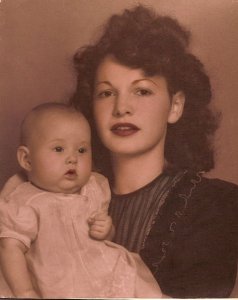
My mother, Patricia Margaret Keefe Gregory, with my big sister Roberta, 1943.
The two Patricks were Famine immigrants from the same village, Coolboy, in County Wicklow, tenants to the same landlord, Lord Fitzwilliam. Fitzwilliam paid their passage to the New World because his tenants were so unfaithful to him. They kept starving to death, or more likely, dying of the typhus or pneumonia that hunger invites. The last thing the Famine Irish lost, according to contemporary chroniclers, who wrote of them in amazement, was their sense of humor. Once they’d stopped laughing, death was close at hand.
Long before that, they’d stopped knuckling their foreheads in deference to their betters who waited impatiently for them to die. Some of them had the audacity to refuse the sustenance offered them by Presbyterians in missionary kitchens that required only their conversion as the price for soup. (Before the great Famine exodus, every Irish family kept a hog, which had run of the place, cottage included. They sold it to market to pay their tithes to the Protestant Church of Ireland, to which none of them belonged. It was the law, you see.)
Fitzwilliam replaced his Irish families with sheep, generally easier to get along with than the natives and slightly cheaper to feed, although the variety of potato the Irish ate was so inferior that any self-respecting sheep would have turned it down. The vast majority of the Irish, in the 19th century, lived their entire lives without ever once eating meat, and this is a true thing that I am not inventing. They were the poorest people in Europe before the blight hit, when they were then transmuted from poor people into statistics.

A replica of the coffin ship Dunbrody in New Ross, Wexford. This is the port from which both the Kennedys and my family sailed for the New World.
But by 1849, my two ancestral families had come to North America, to Canada, at first. They survived Quebec, where, on Belle Isle, thousands died in quarantine once they’d been deposited there by the Coffin Ships.
Patrick Fox’s daughter, Margaret, married Patrick Keefe’s son, Thomas, so Mom’s name was Patricia Margaret Keefe. Margaret and Thomas went from a farm in Ontario to a Minnesota homestead to California orange groves, leaving a trail of children and grandchildren in their wake before they decided to divorce when they were in their seventies. My great-grandfather died in San Jose, my great-grandmother in Los Angeles. He was a Republican, she a Democrat. So it goes.
As to their children, most were named after ancestors, which simplified naming them at all. I guess a couple’s imagination for names runs thin by the time when they dry newborn #11 and wrap her in warm blankets, so the old standards serve best, and the families the size of either the Foxes or the Keefes would’ve easily filled almost a whole 19th-century row house in Boston or New York, with some of the kids spilling over into the flats of families named Berkowitz or Guggia and maybe absently getting adopted. It would’ve looked just like the “Every Sperm is Sacred” number from Monty Python’s Meaning of Life.
One of the Foxes, Sister Loreto, bucked the naming trend, but that’s because she became a nun. Her order wore the same headpiece as Sally Field’s order did, but Sister Loreto did not fly much. Nor does she look perky, like Sally Field. In the one photo we have of her. She looks Determined. She makes the late Mother Angelica look like a Mousketeer. Sister Loreto was a nurse in homes for unwed mothers in the Midwest. I do not want to think too much about that.
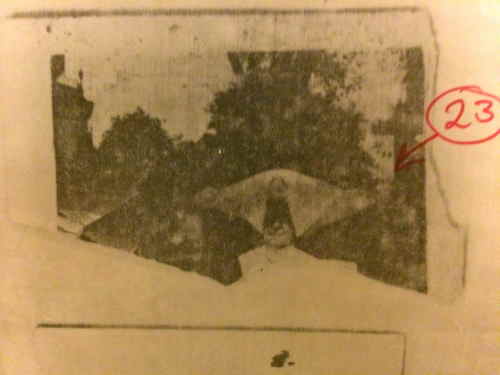
Sister Loreto, from a photo possibly taken in St. Louis.
By the way, Patrick Keefe never would have stooped to working in a Pennsylvania coal mine like Patrick Fox, Loreto’s father, did. Keefe preferred the Pennsylvania oil fields, preferred labor in forested derrick landscapes where the explosions at least had the decency to kill workingmen in the open air above ground and not bury them anonymously in collapsed tunnels below.
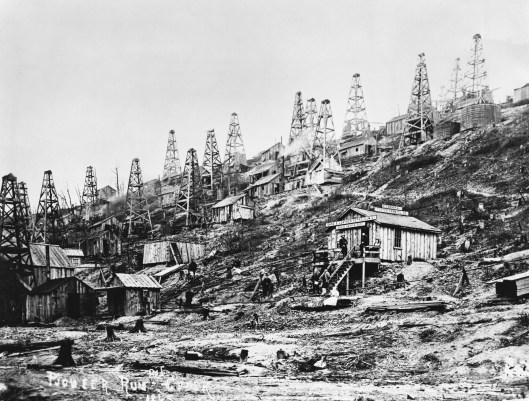
So did my Dad’s side of the family. The middle two of those roughnecks in the photo below are from his side, my great-uncles, at a field in Taft or Bakersfield. One of them became enraged at a rude and incompetent camp cook and shoved him into a boiler. We’re not sure whether it was lit.

My Grandfather, Edmund Keefe, was an oilfield worker, too–a “battice man,” which I’ve never successfully defined, before he disappeared in the 1920s, probably with a whore who’d ridden a motorcycle from Texas to take up trade in California. In the wake of his desertion, he wrote plaintive letters to my grandmother in Taft–we have one, post-marked in Long Beach–and even wrote a one-act play about her. She would not take him back.
She instead married another Irishman named Kelly, a sergeant of police, who became my real grandfather. Yet it was my biological grandfather, Ed Keefe, who remained the real love of my grandmother’s life, which was a long one. I suspect that his wasn’t. He died, in my imagination, in a PEMEX oilfield somewhere deep in post-revolutionary Mexico, a time when gringos were about as welcome as archbishops. Maybe he was shoved into a boiler, too. If so, he likely deserved it.
I’m reasonably sure this is true of every family: our ancestors were hard people, somehow capable of both love and great cruelty, and occasionally both at the same time. We inherited that contradiction, too, I guess, but we would’ve inherited nothing from them at all had they not been so determined to survive.
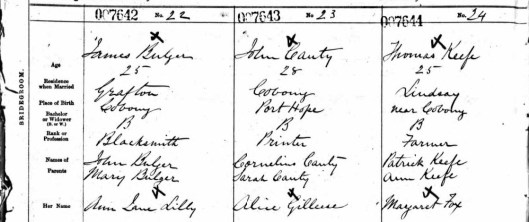
Marriage 007644, October 3, 1876, Northumberland and Durham, Ontario: My great-grandparents.
 A Work in Progress