• About
  • The Germans

A Work in Progress

A Work in Progress

Monthly Archives: July 2016

Four marriages

30 Saturday Jul 2016

Posted by ag1970 in Arroyo Grande, Uncategorized

≈ 1 Comment

o-OLD-COUPLE-HOLDING-HANDS-facebook

The Pioneers

The first gunshot fired in the Arroyo Grande Valley came a few weeks before Victoria ascended the throne. It was probably fired from an 1825 Hawken rifle, and its target, dropped, might either have been a meal—mule deer creep down at dusk from the hills to water– or an animal that wanted to make the rifleman a meal. In 1837, the principal occupants of the Arroyo Grande Valley were grizzly bears—hundreds of them—who dominated, unchallenged, what was then monte, the Spanish word for a vast wasteland of marsh dense with cottonwoods. Another newcomer at the time, attempting to settle the remote Huasna Valley, claimed 45 bears in 1837 alone, and, before he gave up the idea of ranching altogether, estimated that he’d killed close to 200. The man who finally settled the Huasna, Isaac Sparks, outlasted the grizzly bears but not before one had cost him an eye.

The man who fired the Hawken rifle that day, Francis Branch, would not give up the idea of ranching and instead would begin to build a home that would someday be the center of a vast rancho, named for his wife, the Santa Manuela, of some 37,000 acres. He’d add to that adjunct lands of another several thousand to nearly double his holdings. He’d been a mountain man before he decided to take up ranching, so he did not miss his shot, and thirty years later, he would become the founder of Arroyo Grande.

He’d brought his wife, thirteen years his junior, with him to this wilderness. Her name was Manuela Carlon, and she would bear him a small army of eleven children, and many of them, as in any army, would be lost. Heavily pregnant, she rode the 90 miles back to her parents’ Santa Barbara home to deliver one child rather than bring it into a world of grizzly bears. She would have the pleasure of seeing what her husband had started grow: the little town of Arroyo Grande may have been her twelfth child and her most important, and it was bustling with commerce, progress and boosterism when she died at 94, in 1909.

But their time together was a time when men were as savage, if not more so, than the rapidly-dwindling grizzly bears. In the County Historical Museum in San Luis Obispo, 19th-century coroner’s reports are kept in what resembles an old-time library card catalogue, and every desk-drawer reveals an adventure when it’s opened. On delicate blue parchment, in the elegant cursive of Victorian America, a researcher can find reports, like the one on a cowboy’s body found on the Cuesta Grade north of San Luis Obispo, that read, with great precision and economy: “Cause of death: Pistol ball through heart.”

When a merciless gang of ship-jumpers and goldfield refugees murdered an innkeeper his family at Mission San Miguel in 1848, it was another former mountain man, like Branch, who found the bodies. “Medicine Jim” Beckwourth rode 62 miles south to William Dana’s Ranch Nipomo to deliver the news; later, Branch and John Price—an alcade, or justice of the peace—who had themselves been visiting the gold fields, inspected the grisly murder scene and Price turned out a posse of enraged citizens to pursue the killers.

It was a second posse of Santa Barbarans who finally caught up to the men south of Santa Barbara, near what is now the little town of Summerland. They were not particularly willing to surrender; there was a running gun battle before they were captured, and one was shot, another, according to some versions, drowned, but may have been helped, and the remaining three were executed by firing squad after an economic trial, shot by soldiers commanded by a future Civil War general, then-Lieutenant Edward O.C. Ord.

So it was an incomplete civilization: a tragedy central to Branch’s life can still be seen in the family’s little burying ground: a poignant story is symbolized by three small tombstones that flank Branch’s. Since his adobe ranch house was, as was customary among the rancheros, a stopping place for travelers, so the smallpox brought there by a stranger killed three of his daughters within a month in the summer of 1862.

Branch, away on business in San Francisco, was summoned home. By the time he arrived, his five-year-old and 16-year-old were already dead; 14-year-old Manuela, his wife’s namesake, would die shortly after. Edward Jenner had introduced smallpox vaccination in 1796, but in mid-century Arroyo Grande, the only available medical care came from the same Mission priest who probably performed the last rites for Branch’s children.

1862 was a turning point for the rancheros and the end of their dominance of the area. They had eradicated grizzlies and killers, but they had no weapons to use against the drought that came then and returns in cycles that 21st-century Americans can see every fall, when the hills of Central and Southern California, yellow and brittle, catch fire and send smoke plumes, into the skies.

When the cattle died, so did Branch’s fortune. The 1860s drought cost him $400,000—roughly $8 million today—and what would have broken another man’s spirit seemed only to energize Branch. Small, spare, said to love a good joke, even if he was the butt of it, Branch was also a sophisticated businessman, and had generated income in a variety of ways—including using the Arroyo Grande Creek to turn a millstone that ground the valley’s grain into flour—and began to make the shift to dairy farming. He was fighting his way back when he died in 1874.

Twelve years later, in 1886, a lynch mob broke into the town jail and hanged a father and his fifteen-year-old son accused of murder from the railway bridge over the Arroyo Grande Creek, along what is today Pacific Coast Railway Place.

While a local minister praised the lynching from his pulpit the Sunday after, Manuela Branch’s reaction was far more memorable. The lynch mob’s victims had been immigrants from Switzerland, newcomers, just as she and her husband had once been. In a gesture of consummate grace, at Manuela Branch’s insistence, they are buried today near Mr. and Mrs. Branch, near the three little girls they had lost to smallpox.

By the time she died, seventy-two years after she’d ridden as a 22-year-old down into a valley infested with grizzly bears, Manuela had become Dona Manuela, a kind of surrogate mother for the little town her husband had started. The Branches were in effect Arroyo Grande’s parents, and no community could hope for better role models, for people who exemplified courage, toughness, compassion, and character.

The Doctor, the Doctor’s Wife, the Doctor’s Daughter

Miss Ruth Paulding had retired by the time I knew her. She had taught language for so many years at Arroyo Grande Union High School, just across the street on Crown Hill from the house where she’d been born, that she became an institution. So had her mother, Clara, a lifelong teacher who decided to teach one more year, in Oceano, when she was seventy-one, so that she could splurge a little on herself. Her teacher’s salary that last year bought her a porcelain kitchen sink. And dentures.

I got to see that sink, among a houseful of minor but precious treasures, during a tour of the Paulding home.

I knew Ruth, or Miss Paulding, when I was a little boy. We were both parishioners at St. Barnabas Episcopal Church. She was by then in a wheelchair but had a kind of elegance about her that was captivating. If you got a little smile from Miss Paulding on returning to your pew from the communion rail, it carried the same freight as a priest’s blessing.

Ruth was born in that house and she would die there in the aftermath of the 1960s, when the nation seemed to be coming apart at the seams, because that was exactly what it was doing. Her mother, Clara, was a great student of history as well as a great teacher–she’d taught at Branch, Huasna, was the principal of the Arroyo Grande Grammar School and one of the founders of the high school–and she might have been able to give us all some perspective then, perspective we need today, about the durability of America and of Americans.

Clara was durable. She and Ed buried a little boy in the front yard, under a white rosebush, who should have been Ruth’s older brother. He died a few hours after a birth that nearly killed Clara, as well. But this was a woman who had commuted to Cholame to teach, spent the night at Creston to come home down the Grade in her trap and pony where there were no turnouts and the road edged sheer drops of hundreds of feet. She later taught at Branch, and by herself, sixty children at eleven different grade levels and not only did she juggle them artfully, but she loved them, too.

And that is the emotion that suffuses the Paulding House when you walk inside. It is a loving, unpretentious kind of homeliness and you are honored to be its guest. It is also a little insistent, as Clara was (she was descended from Jonathan Edwards, the terrifying Puritan divine) that you wipe your feet. That’s why the bathtub, one of Clara’s more prized possessions, adjoins an exterior door that overlooks the gardens where Ed loved to putter. Ed was a doctor by profession but was by nature a putterer. Clara was by nature a pragmatist, so Ed was not allowed back into the house after his gardening until he’d cleaned himself up in the bathroom first. And the bathtub was no trivial thing: people would drive out to the Coffee Rice home in the 1890s just to stare at the bathtub. It was the equivalent of a Disneyland ride. People just didn’t have them, and the Pauldings had Arroyo Grande’s second. It is a long one and looks like it was made for leisurely baths accompanied by books or magazines and maybe a hot chocolate.

Ed also loved woodcarving. Doctoring, not so much, although a glass hutch contains virtually every instrument he’d carried in his black bag, even his original Gray’s Anatomy. He resented it a little when folks got sick or fell off rooftops, as he did once, because it took him away from his flowers and his woodcarving. But there was nobody in San Luis Obispo County better equipped to deal with roof plunges than Ed: he was a natural-born orthopedist, and a bone set by Doc Paulding, it was said, healed as good as new and sometimes better. (Clara would need Ed when a speeding handcar smashed into her buggy at the foot of Crown Hill and broke her arm in three places. It healed completely. And the Pauldings got $1500 from the Pacific Coast Railway, which they needed. Ed was as inept with money as he was skilled at setting broken bones.)

So the mantle and smaller pieces–down to a little rocking chair for Ruth–were all made by Ed, and they’re cut with delicate and graceful motifs, usually floral, inspired by the models he’d just brought in from the garden where he loved to get dirty. Clara later bought a little farm, just outside of town, and it was there where Ed, in his older years, was happiest. When he got sick one day in what would turn out to be his last illness, he’d forgotten to take his morning medicine. Clara, 79, walked–or rather, marched–the five miles out to the farm and watched critically as Ed swallowed his required tablespoon.

There are curios, under glass, everywhere: a rhinoceros-hide warrior’s shield that Ed’s missionary parents had acquired in Syria, where he was born, a Chumash water-carrier, like a canteen, caulked with Pismo tar; the contents of Ed’s pockets, including his pocket-watch and chain, money clip, a tiny folding knife. Aside from Gray’s Anatomy, there are books everywhere: a collected Dickens, A Thousand and One Knights, a multi-volume history of the United States, collections of English Romantic poets, especially Tennyson, Clara’s favorite. And there is the bedframe, dark mahogany, with a lion’s head relief at the headboard, and that lion was Ruth’s lion. It protected her every night she went to sleep as a little girl; it was as solid and as real and as constant as were her parents.

And everywhere there are tea services. Ruth’s little-girl doll’s cups and saucers are painted with delicate, tiny flower buds. There is a sterling-silver coffee service at one end of the dining room table, and on a shelf above, there is the best of all. It’s the set Ruth reserved especially for her high school students when she welcomed them into the home of her own girlhood, and that service was reserved for hot chocolate so rich that teenagers would remember it the rest of their lives.

The Immigrants

There was only one humane opening in the anti-Japanese laws. They allowed those men already in American to settle here with their wives, to send home for them or to send, as if they came from the Sears Catalogue, for “picture brides.”

This is how Shigechika Kobara, one of the early immigrants to the valley, and his wife, Kimi, began their lives together. Their fathers were neighbors in Kagoshima, and after a short negotiation and a longer courtship, by letter, the match was made. Shigechika took a train north and was waiting on a Seattle dock, looking for his bride among the passengers on her ship as it began to berth. She was looking back.

“I remembered his brother, a naval officer,” Kimi recalled, “and I found a man who resembled him. I thought that this was the man I was about to marry. From the deck, I fixed my eyes on him, even though I had never met him. That is why it is called a ‘picture bride.’”

Life in Arroyo Grande dismayed the middle-class, somewhat sheltered Mrs. Kobara. While her husband got up every morning at 4:00 a.m. to groom and harness the draft horses for his boss, Mr. Tomooka, Kimi sat alone in the bed and wondered what she’d gotten into. She wondered every morning; she cried every night.

There is an extraordinary photograph in Cal Poly’s Special Collections.

It’s a housewarming party, about 1949, and it’s an important occasion because Pete Guion had broken decades of de facto segregation. He was the first Filipino American to buy a home in South County. A large group photo taken at the housewarming might be the most significant in the series, for it shows not only a proud Guion and his friends from the Filipino community but also Caucasian and Japanese faces. Something important was beginning to happen four years after the Kobara family had faced such a fearful homecoming from the internment camp at Gila River.

For Filipinos, that change came at the cost of many lives. They had
fought for the country of their birth as well as the country that had showed them little good will, and finally, they began to achieve a measure of justice. Filipino veterans were given a path to citizenship—ten thousand would become naturalized citizens, and under the December 1945 War Brides Act, they finally got the chance to marry and start families in America. So what followed the war was another remarkable campaign in the Philippines. This one was led by ardent bachelors, many of them former soldiers, and its objective was conquest of a different sort, in the form of a flurry of marriage proposals. Between 1945 and 1964, over four thousand Filipinas accepted and came to live in America.

Many of the men, because of immigration restrictions and the prewar miscegenation laws, had deferred marriage and so were considerably older than their fiancées, and they were in a hurry to resume their lives in California.

So they sought to win family approval, get a proper church wedding and arrange for the return of their new wives as quickly as possible. One local woman, Josie Bolivar, remembered her marriage as “kind of a shock” because it violated so many Filipino proprieties—parental negotiation, a protracted and tightly chaperoned courtship and the customary time it took to establish a bond between the groom and the bride’s family. Her father, at first, was upset, but Josie’s wedding—she was, after all, going to become an American—turned out to be a huge affair, complete with uninvited guests and feasting that lasted for days.

Perfecto Betita moved with similar speed in courting Evelyn:

“Right away, he said that we didn’t have much time, that they were looking for someone to marry, and it’s gonna be quick, because we have to go back. After about a month’s time, I found out he had already talked to my grandmother and grandfather, and my uncle and aunt. He told me he didn’t have any more time to stay in the Philippines, and he wanted to…well, marry me.”

The marriage was concluded, and Perfecto brought his bride to the States. When they arrived in San Francisco in July, the first thing the new husband had to do was to buy his wife a coat. She was freezing in what passed for a San Francisco summer. They took a Greyhound bus south to Arroyo Grande, where Evelyn had a reaction very similar to that of Kimi Kobara when she had come to the valley with her husband, Shigechika, in 1920:

Oh, we were so shocked when we came here. We thought we would come here and live in a big two-story, three-story house. But they worked at thefarm, and we were shocked! We said, “This is where they live? I thoughtyou lived in some three-story house? It’s all muddy and farmy!”

Both Evelyn Betita and Kimi Kobara had made marriages that would be happy and successful; their children and grandchildren were very bright, were hard workers and were likewise successful. The apple does not far fall from the tree, they say, not even when the tree’s roots are planted so far away, on Kyushu, in Japan or Luzon, in the Philippines.
My afternoon with the Pauldings

25 Monday Jul 2016

Posted by ag1970 in Arroyo Grande, Uncategorized

≈ 5 Comments

12063512_10207842859653171_3208888555396038759_n

Clara, Baby Ruth, Ruth’s cousin, Ormie, and Dr. Edwin Paulding, about 1898.

Miss Ruth Paulding had retired by the time I knew her. She had taught language for so many years at Arroyo Grande Union High School, just across the street on Crown Hill from the house where she’d been born, that she had become an institution. So had her mother, Clara, a lifelong teacher who decided to teach one more year, in Oceano, when she was seventy-one, so that she could splurge a little on herself. Her teacher’s salary that last year bought her a porcelain kitchen sink. And dentures.


Screen Shot 2016-08-03 at 7.39.53 PM

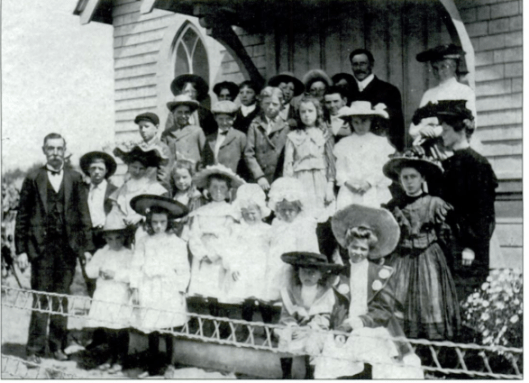
The St. Barnabas Sunday School, 1906. Clara Paulding, at upper right, was the church organist; this church is now Oceano’s St. Francis.

I got to see that sink, among a houseful of minor but precious treasures, during a tour today after rehearsal for the South County Historical Society production, The Mistress of Crown Hill.

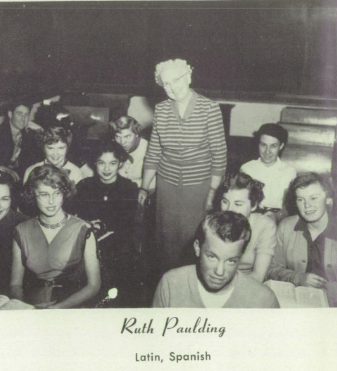
I knew Ruth, or Miss Paulding, when I was a little boy. We were both parishioners at St. Barnabas Episcopal Church, then in a surplus World War II chapel on what was once Barnett Street; the street’s gone and so is the church, replaced by a gas station. Memories have more staying power than mere buildings, especially if they’re of women like Miss Paulding. She was by then in a wheelchair but had a kind of elegance about her, dressed as she was for Grace Cathedral instead of an old army chapel,  and if her body was betraying her, her spine curved cruelly, her spirit was graceful and even youthful. If you got a little smile from Miss Paulding on returning to your pew from the communion rail, it carried the same freight as a priest’s blessing.

Screen Shot 2016-07-28 at 4.33.40 PM

From the 1955 Arroyo Grande Union High School yearbook.

Ruth was born in that house and she would die there in the aftermath of the 1960s, when the nation seemed to be coming apart at the seams, because that was exactly what it was doing. Her mother, Clara, was a great student of history as well as a great teacher–she’d taught at Branch, Huasna, Santa Manuela, Oceano, was the principal of the Arroyo Grande Grammar School and one of the founders of the high school–and she might have been able to give us all some perspective then, perspective we need today, about the durability of America and of Americans.


Branch

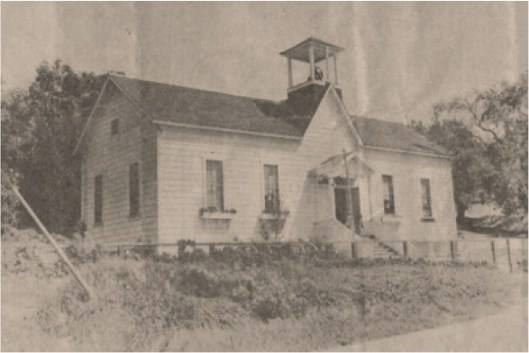
Branch Elementary School

Clara was durable. She and Ed buried a little boy in the front yard, under a white rosebush, who should have been Ruth’s older brother. He died a few hours after a birth that nearly killed Clara, as well. But this was a woman who had commuted to Cholame to teach, spent the night at Creston to come home down the Grade in her trap and pony where there were no turnouts and the road edged sheer drops of hundreds of feet.

image039

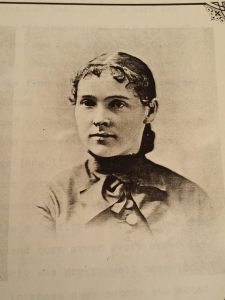
Clara Edwards Paudling, 1881.

I did not know that I had ties to Clara until later, but from what I knew about Ruth’smother, I was an admirer. She returned to college with Ruth, who’d been promised an extra $100 a year, if she took additional coursework, when the Second World War began to revive the economy. The pair decided to take summer courses at Clara’s alma mater, Mills College. Ruth took classes for the extra money; Clara, at ninety-three, took hers for pleasure, a course in “History of the United States to 1865” because, she said, she remembered the rest.

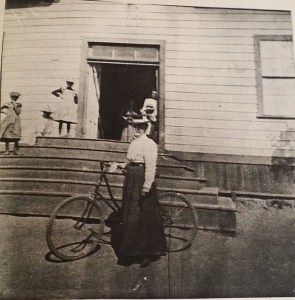
One of Clara’s assignments during nearly fifty years in the classroom had been at the school I attended, Branch Elementary. There is a photo of her in front of the school. Behind Clara and her bicycle in 1898 is the same doorway I would enter on my first day of formal education sixty years later. She taught, by herself, sixty children at eleven different grade levels and not only did she juggle them artfully, but she loved them, too.

10523966_10204259047340103_6944737570254081160_n-1

Clara Paulding, Branch School, 1898

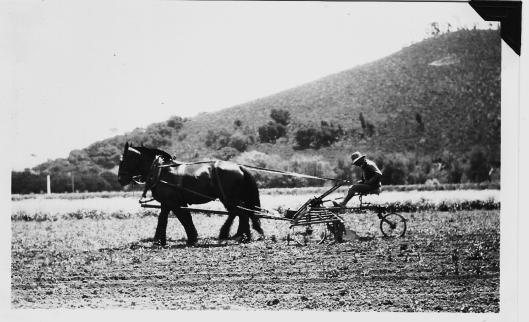
Arroyo Grande’s population, at the time of the photograph, was approaching 1,000. Beyond the town, to the east in the Upper Valley, and to the west, bounded by the sand dunes at the edge of the Pacific, in the Lower Valley, there were patchworks of farms worked by ambitious pragmatists: Arroyo Grande men and their teams of heavily-muscled draft horses, their necks arched in effort, turned some of the richest soil in the world to prepare it for planting. They might have been plowing for sowing pumpkins or carrots, onions or beans, or one of the most important products in the many cycles of agriculture the Valley has seen: flowers, cultivated for their seeds.

What must have delighted Clara Paulding on her two-mile bicycle commute to her sixty students every morning would have been the sight of brilliant fields of flowers and, planted in others, she would have smelled the delicate fragrance of sweet peas.

waller

A Waller Seed Company employee cultivates a field in the Lower Arroyo Grande Valley at about the time of the First World War.

It’s not hard to imagine her, given her personality, waving cheerily to the men working those fields, their faces hidden by broad-brimmed straw hats, or to imagine them waving back, wide smiles creasing their upturned faces. because even as field workers they had never had this much hope, and even in the Upper Valley, hemmed in closely by the oak-studded Santa Lucia foothills, they had never had this much room.

Clara’s spirit was expansive. She may look severe in her photograph, but she adored, without disguising it, young people, and the youngest the most, a feeling they reciprocated. Her wave on school mornings would have touched these men, younger sons from a very crowded place, and not particularly welcome in this new place.

The men in the fields whom she greeted were from Japan, and some of them from a prefecture known as Hiroshima-ken.

Clara’s spirit suffuses the Paulding House when you walk inside. It is a loving, unpretentious kind of homeliness and you are honored to be its guest. It is also a little insistent, as Clara was (she was descended from Jonathan Edwards, the terrifying Puritan divine) that you wipe your feet. That’s why the bathtub, one of Clara’s more prized possessions, adjoins an exterior door that overlooks the gardens where Ed loved to putter. Ed was by nature a putterer. Clara was by nature a pragmatist, and Ed was not allowed back into the house after his gardening until he’d cleaned himself up in the bathroom first. And the bathtub was no trivial thing: people would drive out to the Coffee Rice home in the 1890s  just to stare at a bathtub that was the equivalent of a Disneyland ride. People just didn’t have them, and the Pauldings had Arroyo Grande’s second. It is a long one and looks like it was made for leisurely baths accompanied by books or magazines and maybe a hot chocolate.


Ed

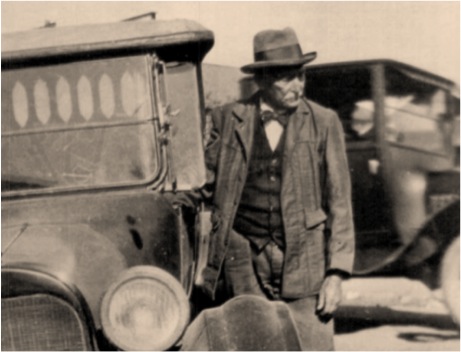
Dr. Edwin Paulding

Ed also loved woodcarving. Doctoring, not so much, although a glass hutch contains virtually every instrument he’d carried in his black bag, even his original Gray’s Anatomy.  He resented it a little when folks got sick or fell off rooftops, as he did once, because it took him away from his flowers and his woodcarving. But there was nobody in San Luis Obispo County better equipped to deal with roof plunges than Ed: he was a natural-born orthopedist, and a bone set by Doc Paulding, it was said, healed as good as new and sometimes better. (Clara would need Ed when a speeding handcar smashed into her buggy at the foot of Crown Hill and broke her arm in three places. It healed completely. And the Pauldings got $1500 from the Pacific Coast Railway, which they needed. Ed was as inept with money as he was skilled at setting broken bones.)

So the mantle and smaller pieces–down to a little rocking chair for Ruth–were all made by Ed, and they’re cut with delicate and graceful motifs, usually floral, inspired by the models he’d just brought in from the garden where he loved to get dirty. Clara later bought a little farm, just outside of town, and it was there where Ed, in his older years, was happiest. When he got sick one day in what would turn out to be his last illness, he’d forgotten to take his morning medicine. Clara, 79, walked–or rather, marched–out to the farm and watched critically as Ed swallowed his required tablespoon.


Ruth, far right

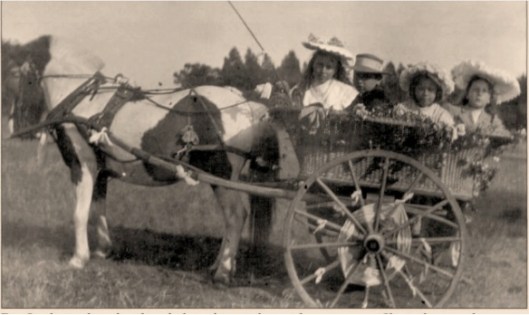
Ruth, far right, as a little girl.

There are curios, under glass, everywhere: a rhinoceros-hide warrior’s shield that Ed’s missionary parents had acquired in Syria, where he was born, a Chumash water-carrier, like a canteen, caulked with Pismo tar; the contents of Ed’s pockets, including his pocket-watch and chain, money clip, a tiny folding knife. Aside from Gray’s Anatomy, there are books everywhere: a collected Dickens, A Thousand and One Knights, a multi-volume history of the United States, collections of English Romantic poets, especially Tennyson, Clara’s favorite. And there is the bedframe, dark walnut, with a lion’s head relief at the headboard, and that lion was Ruth’s lion. It protected her every night she went to sleep as a little girl; it was as solid and as real and as constant as were her parents.

And everywhere there are tea services. Ruth’s  little-girl doll’s cups and saucers are painted with delicate, tiny flower buds. There is a sterling-silver coffee service at one end of the dining room table, and on a shelf above, there is the best of all. It’s the set Ruth reserved especially for her high school students when she welcomed them into the home of her own girlhood, and that service was reserved for hot chocolate so rich that teenagers would remember it the rest of their lives.


Jim Gregory is a retired Arroyo Grande High School history teacher and the author of the books World War II Arroyo Grande and the just-released Patriot Graves: Discovering a California Town’s Civil War Heritage.


Wounded, not damaged

23 Saturday Jul 2016

Posted by ag1970 in Uncategorized

≈ 4 Comments

1689864_10203039972623997_595650753_n

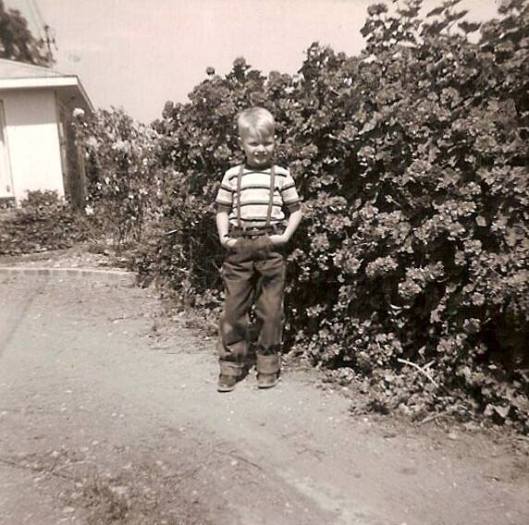
Me, age 6, Huasna Road, Arroyo Grande

This is a second attempt to make sense of horrible crimes. I taught a man who is now in the county jail on $7 million bail on 31 felony and misdemeanor accounts of molesting at least nine little girls. “At least” because these are the little girls that sheriff’s deputies have so far been able to identify. There are more.

The news hit Elizabeth and me exceptionally hard, because she taught him, too. We were close to the alleged molester’s family.  And the news came in a week when a friend and colleague at Arroyo Grande High School whom I respected and admired–and feel so much the same for his wife and for his three children, all students of mine–died unexpectedly. It has been a steep and sobering tailspin.

As to the crimes, I have been dismayed by the comments that have followed the news stories about the accused man because they call for summary and vigilante justice. That solves nothing and helps no one. It only makes us all complicit in a different kind of savagery.

I find it just as difficult to summon any sympathy for the accused, if the accusations are true. I can find none. Child molesters are narcissists; they see other human beings as objects, as manipulatives, in their drive for gratification. They lack any kind of empathy (it is said that the accused man abused animals, as well). There must be something dead inside a person who does these things. Yes, the accused was more than likely physically and sexually abused himself. So was I.

And this is what growing up as a victim–if that’s what you choose to be–of violence and sexual abuse is like: every conscious moment is lived in fear. There is a constant undercurrent of dread, of impending doom, that you can never push aside. People like me have a sense of hypervigilance and a pronounced startle reflex: we jump at a dog’s bark or a Fourth of July firecracker. The anxiety is so pervasive that the most reliable palliatives are alcohol or drugs. Those are the only things that consistently and reliably push the fear aside, that allow a fleeing moment of release and self-acceptance, because abuse victims very often are generous, compassionate people with everyone except for themselves.

That is the kind of life that at least nine little girls, who will of course blame themselves for what happened to them, might live out.

They are not doomed to that. It will take an immense amount of hard work on their part, built, I believe, on a foundation of prayer, on our part, to bring them the healing they deserve.

What was done to these little girls was evil and it was powerful. Evil always presents itself this way, as something that is powerful, insurmountable,irresistible. But this self-infatuation is its weakest point. Evil cannot outlast the good will of all of us who love children. I became a teacher because I love children. One of the kindest compliments paid my teaching wasn’t about brilliant lectures. It was about providing a classroom that was safe and accepting.

And evil cannot outlast the power of God, who loves children most of all. These little girls are wounded. They are not damaged. Nothing and no one can violate the loving intention with which they were made.

Because these little girls are incarnate proof of God’s love for all of us, they have every chance, with our help, to become strong, loving and beloved women someday. They may themselves become the mothers of little girls of unimagined–even wondrous– strength and compassion.

This is how the cycle of abuse is broken. I hope it will be broken, too, in the accused man’s family.

But it takes time–God’s time–and in the meantime, the hurt we feel for little girls we may never know sears us. That is God’s intention, I think, as well. He is reminding us in our own pain, and our anger, that we are alive, that we care, that we love, that we endure.

And the Lord, as my  Book of Common Prayer would remind me, endureth forever.

Why, yes. I do love the French.

15 Friday Jul 2016

Posted by ag1970 in Uncategorized

≈ Leave a comment


10398625_1115626854628_6649335_n

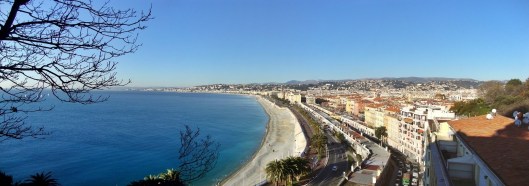
The view from our Nice hotel when we took AGHS students there.

I have never been fond of jokes about the courage of French. They are not funny, they are inaccurate, and they reveal only one thing: the joke-teller is a juvenile.

Go to the Ossuary at Verdun, where there are basement galleries heaped with the bones of young men who will never be known except to God. Or go to Fort Douamont on that battlefield, the fortress taken, and re-taken, that consumed 100,000 soldiers between February and December 1916. Go there to tell jokes about the French.

My students and I visited Verdun in perfect silence.

We visited Nice, too, where there was a cowardly and despicable terrorist attack today. The people of Nice know about such things. We saw there a beautiful neoclassic arcade flanking a square in this town on the Mediterranean coast, a place God intended to be known by the perfect clarity of its colors, where cowardly and despicable men—Nazis—executed 27 young people, members of the Resistance, in 1944.

When the Americans invaded southern France in Operation Dragoon that year, they pulled up infuriatingly short of Nice. The nicois, the Resistance, were appalled but they took it out on the Nazis, not the Americans. Outnumbered seven to one, armed with museum-piece firearms, some plastique, some land mines, but most of all with the Resistance weapon of choice, the Molotov cocktail, the nicois, young women and young men, rose up and drove the enemy out. Enraged, the Werhmacht machine-gunned the public buildings of Nice as they fled while the Gestapo crept like furtive spiders out of the Hotel Negresco, where they might have champagne and oysters in one room to fortify themselves for torture in another.


Nice_France_panorama

It took the nicois only 48 hours to humiliate the Nazis.

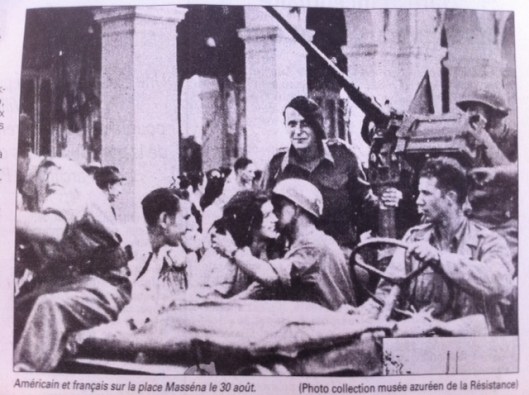
The Americans, expecting a Battle of Nice, arrived and were attacked instead with wine, flowers, and kisses. I doubt that those GI’s thought that jokes about the courage of the French were very funny, not on the day they liberated a beautiful city that had already liberated itself. The real cowards were gone.


WWII-liberation-of-Nice

The Americans arrive in Nice, 1944.


They came back today, and cowards always have days like today, they always shock and sicken, they always brutalize, but they always recede to become footnotes in the yellowing pages of dry history texts. Cowards cannot stand up, no matter how long it might take to defeat them, to men and women of courage—and of culture. France, despite her tendency to infuriate us English-speakers, her prickliness and her pride, is still France. The terrorists struck today in a city whose museums honor Chagall and Matisse. This may seem ludicrous to those who are ignorant by choice, but the cowards who attack a city like that are doomed.

Two wars, two generations

05 Tuesday Jul 2016

Posted by ag1970 in Uncategorized

≈ Leave a comment


http13714849_92c661efa1

In January 1941, Medal of Honor winner Otis W. Smith’s grandson, Johnnie, would enter an army belatedly preparing to fight an even more terrible war, this one against fascism. Hitler declared war near the end of that year, though he had no obligation to do so after the Pearl Harbor attack that had claimed two Arroyo Grande sailors on U.S.S. Arizona. The dictator was jubilant, thinking America decadent and Americans, in his simplistic and misshapen worldview, a “mongrel people.”

 
Prime Minister Winston Churchill was said at the time to have been nearly as pleased as the parochial Austrian dictator was. Unlike Hitler, Churchill knew about Grant and Sheridan, knew what the Iron Brigade had done at Gettysburg, and knew, as well, what Jackson and his “foot cavalry” had done at Chancellorsville. He admired Americans. After all, his mother, Jennie, had been born in Brooklyn.


Three thousand miles from Brooklyn, on the Pacific Coast, the Huasna Valley’s Johnnie Otis Smith was preparing to go to war. He was just one of over three hundred young men and women from southern San Luis Obispo County who would join the military in World War II, including the Gularte brothers, Manuel and Frank, whose parents came from the Azores, and the Fuchiwaki brothers, Hilo and Ben, whose parents came from Japan. All three Robison brothers saw action. In nearby Oceano, when Thelma Murray learned that her younger brother, George, had been killed on Tarawa, she became a Marine, too.


So this, too, was a brothers’ war, but in this war the brothers fought on the same side. Of course, that realization wouldn’t have had time to occur to Americans on December 7. They would realize it later in the war, when a California GI might write home to his family about the rifle squad that was his new family, write about his new friend, his brother in arms, a dogface from South Carolina. World War II, brutal as it was, would force Americans to rediscover themselves as a common people with a common purpose. The war did this even as it scattered young Americans around the world, to battlefields in New Guinea, the Solomons, and the Aleutians; to Cassino, Eindhoven, and St. Vith.


That rediscovery was in the future. On December 7, the first CBS bulletin had come at about 11:30 that morning to the people of Arroyo Grande. On hearing the news of the burning wrecks along Battleship Row, families here would have pushed listlessly at Sunday lunches for which they had no appetite. They would have been shocked and somber and tense, a father snapping at a mother who’d turned off the radio to try to recapture the kind of Sunday afternoon the family would never enjoy again. The war meant that some Arroyo Grande families would never be complete again.

 
A continent and an ocean away, in the depth of an English winter night, Winston Churchill was filled with hope. In an instant of clarity, he understood that now democracy would not—could not—perish from the earth.

Subscribe

  • Entries (RSS)
  • Comments (RSS)

Archives

  • January 2026
  • December 2025
  • November 2025
  • October 2025
  • September 2025
  • August 2025
  • July 2025
  • June 2025
  • May 2025
  • April 2025
  • March 2025
  • February 2025
  • January 2025
  • December 2024
  • November 2024
  • October 2024
  • September 2024
  • August 2024
  • July 2024
  • June 2024
  • May 2024
  • April 2024
  • March 2024
  • February 2024
  • January 2024
  • December 2023
  • November 2023
  • October 2023
  • September 2023
  • August 2023
  • July 2023
  • June 2023
  • May 2023
  • April 2023
  • March 2023
  • February 2023
  • January 2023
  • December 2022
  • November 2022
  • October 2022
  • September 2022
  • August 2022
  • May 2022
  • April 2022
  • March 2022
  • February 2022
  • January 2022
  • December 2021
  • November 2021
  • October 2021
  • September 2021
  • August 2021
  • July 2021
  • June 2021
  • April 2021
  • March 2021
  • February 2021
  • January 2021
  • December 2020
  • November 2020
  • August 2020
  • July 2020
  • June 2020
  • May 2020
  • April 2020
  • January 2020
  • December 2019
  • November 2019
  • October 2019
  • September 2019
  • August 2019
  • May 2019
  • April 2019
  • March 2019
  • February 2019
  • January 2019
  • December 2018
  • November 2018
  • October 2018
  • September 2018
  • July 2018
  • June 2018
  • May 2018
  • April 2018
  • March 2018
  • February 2018
  • January 2018
  • December 2017
  • November 2017
  • October 2017
  • April 2017
  • March 2017
  • December 2016
  • November 2016
  • October 2016
  • September 2016
  • August 2016
  • July 2016
  • June 2016
  • April 2016
  • March 2016
  • February 2016
  • January 2016
  • December 2015
  • November 2015
  • October 2015
  • September 2015
  • August 2015
  • July 2015
  • June 2015
  • May 2015
  • April 2015
  • March 2015
  • February 2015
  • January 2015
  • December 2014
  • November 2014
  • September 2014
  • August 2014
  • July 2014

Categories

  • American History
  • Arroyo Grande
  • California history
  • Family history
  • Film and Popular Culture
  • History
  • News
  • Personal memoirs
  • Teaching
  • The Great Depression
  • trump
  • Uncategorized
  • World War II
  • Writing

Meta

  • Create account
  • Log in

Blog at WordPress.com.

  • Subscribe Subscribed
    • A Work in Progress
    • Join 68 other subscribers
    • Already have a WordPress.com account? Log in now.
    • A Work in Progress
    • Subscribe Subscribed
    • Sign up
    • Log in
    • Report this content
    • View site in Reader
    • Manage subscriptions
    • Collapse this bar
 

Loading Comments...