
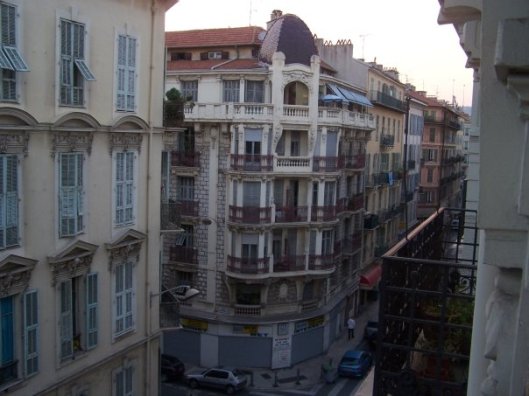
The view from our Nice hotel when we took AGHS students there.
I have never been fond of jokes about the courage of French. They are not funny, they are inaccurate, and they reveal only one thing: the joke-teller is a juvenile.
Go to the Ossuary at Verdun, where there are basement galleries heaped with the bones of young men who will never be known except to God. Or go to Fort Douamont on that battlefield, the fortress taken, and re-taken, that consumed 100,000 soldiers between February and December 1916. Go there to tell jokes about the French.
My students and I visited Verdun in perfect silence.
We visited Nice, too, where there was a cowardly and despicable terrorist attack today. The people of Nice know about such things. We saw there a beautiful neoclassic arcade flanking a square in this town on the Mediterranean coast, a place God intended to be known by the perfect clarity of its colors, where cowardly and despicable men—Nazis—executed 27 young people, members of the Resistance, in 1944.
When the Americans invaded southern France in Operation Dragoon that year, they pulled up infuriatingly short of Nice. The nicois, the Resistance, were appalled but they took it out on the Nazis, not the Americans. Outnumbered seven to one, armed with museum-piece firearms, some plastique, some land mines, but most of all with the Resistance weapon of choice, the Molotov cocktail, the nicois, young women and young men, rose up and drove the enemy out. Enraged, the Werhmacht machine-gunned the public buildings of Nice as they fled while the Gestapo crept like furtive spiders out of the Hotel Negresco, where they might have champagne and oysters in one room to fortify themselves for torture in another.
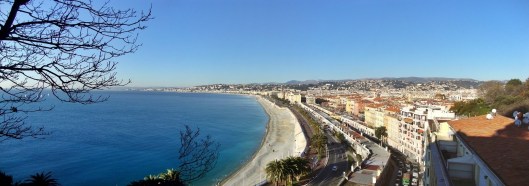
It took the nicois only 48 hours to humiliate the Nazis.
The Americans, expecting a Battle of Nice, arrived and were attacked instead with wine, flowers, and kisses. I doubt that those GI’s thought that jokes about the courage of the French were very funny, not on the day they liberated a beautiful city that had already liberated itself. The real cowards were gone.
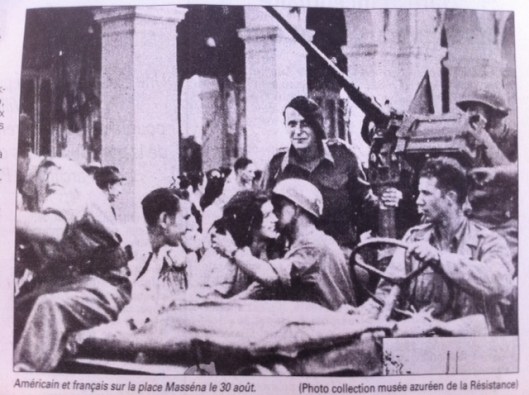
The Americans arrive in Nice, 1944.
They came back today, and cowards always have days like today, they always shock and sicken, they always brutalize, but they always recede to become footnotes in the yellowing pages of dry history texts. Cowards cannot stand up, no matter how long it might take to defeat them, to men and women of courage—and of culture. France, despite her tendency to infuriate us English-speakers, her prickliness and her pride, is still France. The terrorists struck today in a city whose museums honor Chagall and Matisse. This may seem ludicrous to those who are ignorant by choice, but the cowards who attack a city like that are doomed.
 A Work in Progress