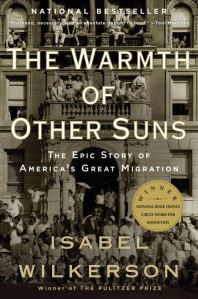
I have been meaning to read this book for three years; it’s about the great African American migration from the South to the North. Eventually, it would reach the Pacific Coast. I am also terrified to even start this book because I am afraid that I will love it, and this is why: this is something I’d love to write about, too.
But I wonder if I can. There is the obvious handicap: I am as white as a new pack of Jockey briefs. Beyond that, I am descended from slaveowners—Virginians, Kentuckians, Missourians—and I am in fact named for two Confederates who, no matter how hard they tried to twist the logic (their battle flag was a white cross on field of blue) were fighting to defend the perpetuation and the expansion of slavery, enormously profitable still in 1861. I grew up in a place rich in Mexican, Asian and Azorean culture, but the Stone family were about the only African Americans that I knew growing up, especially Malcolm, who was one of my older brother’s best friends.
But I’m like the dog in Up!—I keep having these “squirrel” moments. I am easily distracted. The 20s-30s book took a left turn and then went over a cliff into the Civil War, and now I want to tackle a subject about which I have only the briefest acquaintance.
That brief acquaintance came mostly through a year of the History of the American South at the University of Missouri. It hooked me. The Middle Passage, slaves’ impact on the English language and the coded language they spoke only among themselves, the centrality of Moses in their faith, the centrality of their faith in their endurance, the thousand ways they subtly resisted, the vitality of slaves’ family lives, which were always in danger, the incredible tension, on large plantations, that came when the eldest son inherited and suddenly, the woman who had for all intents and purposes been his mother now was his chattel.
After the war, the litany of injustices enraged, I guess, the Irish half of me: the revocation of voting rights after 1877, the rise of the KIan, race rioters bent on extermination, the wave of lynchings, including of women, including of children, the Scottsboro Boys, Emmett Till, three buried voting rights workers in Neshoba County, Mississippi, the murders of Medgar Evers and of Martin.
But.
There are incandescent bursts of dignity and pride, from the Tuskegee Institute to the vitality, up North, of the Harlem Renaissance and of the Negro Leagues. In World War I, black soldiers had fought like tigers, but they fought for the French, who asked to borrow them because they needed them, and the Americans were using them for manual labor. Black American poilus astonished the French with their battlefield discipline and their courage. [And the French fell in love with African Americans, too, with Sidney Bechet, with Josephine Baker, who felt more at home in Paris during the 20s than they had ever felt in the States.]
Despite their performance in the Great War, American policy was much the same in World War II, but then you see the brilliant bursts of pride and character again: the Tuskegee airmen, all-black tank units, the defiance of black sailors after the Port Chicago disaster that killed over three hundred of their comrades, the role black women played in defense plants from Biloxi to Seattle, despite the fact that even shipyard unions in the East Bay followed the color line.

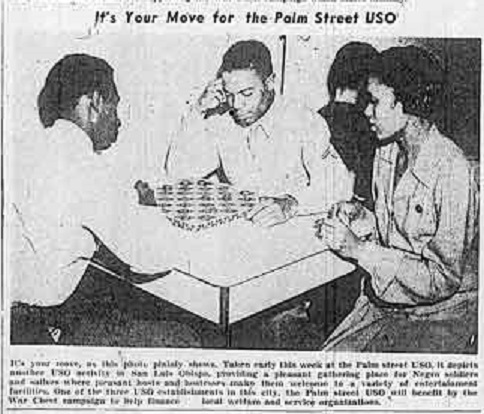
It was the war that brought the first large numbers of African Americans to San Luis Obispo. Jim Crow was observed here, too. This building, which would be unrecognizable to any Camp San Luis Obispo soldier from 75 years ago, near Chinatown, was the black USO. The white USO was the gymnasium that still stands much as it just off Palm Street. The dependents of black GI’s began to settle in the southern part of town, especially in what had been Japantown, along what had been Eto Street because, of course, those people were banished to the desert and even the street name had to be banished, as well.
One of the conversations I had with Haruo Hayashi that endeared him to me the most was about his stint, near the end of the war, with the 442nd Regimental Combat Team. The Four-four-two GI’s trained in the Deep South, in Mississippi, and Haruo’s first encounter with Jim Crow came when his platoon of Nisei recruits had to choose between “white” and “colored” restrooms once they got off the buses for the first time at Camp Shelby. They discovered, after some spectacular and extended profanity and threats of physical violence from both white and black GIs, that “colored” was the incorrect choice. Haruo never got over, never understood, and still doesn’t understand, why at the excellent USO shows that came to that camp, black trainees had to be content with listening to dance bands or torch singers while standing outside the base concert hall. Haruo didn’t like it.
If the war brought African Americans here, where did they come from? How were they treated? What triggered violence between black and white GIs in San Luis Obispo during the war? What role did St.Luke’s Missionary Baptist Church play in generating a sense of community and fellowship among San Luis Obispo’s black residents? Why did some of these wartime families stay in San Luis Obispo after the war, what kinds of jobs did they hold down, how were they treated? [One of them, I know, was a cook at the Madonna Inn, and am ashamed that I cannot remember her name, but I do remember that my father, not necessarily an enlightened man when it came to race relations, loved her.] What was their experience of the civil rights movement? When they have family reunions or church potlucks, what food do they eat and where do the recipes come from? What makes so many of their families, like the Stone family, so successful and so open, especially in a community, like Grover (City), where they were not only a minority, but a tiny minority? Wasn’t it lonely for them?
I have got a thousand more questions that only reveal my own cluelessness. But I’ve found out something about myself, as a writer, that I’ve always known about myself, as a person. I love to learn. And, in writing and teaching, there is no greater joy than in sharing what you’ve learned.
And I want to learn about the experience here of black folks. I am afraid they are stuck with me, a benign little human variation of kudzu. It’s because my Irish mother–there she is again!–so loved and admired what W.E.B. DuBois called “the souls of black folk.” I am, after all, my mother’s son.
 A Work in Progress
I am going to put “The Warmth of Many Suns” next on my reading list. I went to school and attended church with the Stone family, and just spent last weekend with Linda and her husband Tony. We even talked about their experiences growing up here, and how different their lives may have been had her parents chosen to select an offer of a job in LA rather than Grover City. Really a blessing for all of us. Thanks again for this bit of local history,
LikeLike