
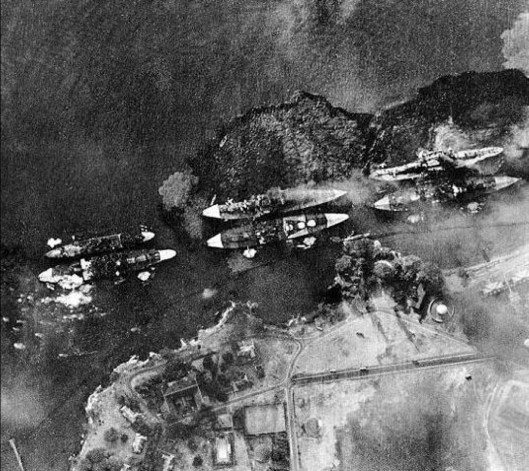
Battleship Row, December 7. Arizona, at left, just inboard of the smaller ship Vestal, has just taken two bomb hits astern. This is the moment when Arroyo Grande sailor Jack Scruggs died.
Just before eight o’clock on December 7, 1941, a bomb’s concussion on battleship Arizona’s stern blew the lifeless body of Navy bandsman Jack Scruggs into Pearl Harbor. A little more than five minutes later, the second, fatal, bomb penetrated the teak deck, killing a second sailor, Wayne Morgan, and nearly 1200 of his shipmates when it detonated the forward powder magazines. Scruggs and Morgan had grown up in Arroyo Grande, a farm town in San Luis Obispo County.
Park Service divers can still see, just behind portholes, December 7 air trapped inside Arizona’s submerged compartments. A clock recovered from the chaplain’s cabin was frozen at just past 8:05 a.m., the moment the ship blew up.
Few moments can be frozen in time. History is remorseless and it demands change. The war changed Arroyo Grande forever. In a way, the little town of just under 1100 people was torn apart just as Arizona had been.
Residents here heard the first bulletin at about 11:30 a.m., as they were preparing for Sunday lunch, the big meal of the day for churchgoers like Juzo Ikeda’s family. Like many of the town’s Japanese-American residents, the Ikedas were Methodists. They were also baseball fans. Juzo’s sons had played for local businessman Vard Loomis’s club team, the Arroyo Grande Growers, and for Cal Poly.
Juzo was technically not “Japanese-American.” He was not permitted citizenship. The Supreme Court maintained that this honor was never intended for nonwhite immigrants.
The court couldn’t deny citizenship to Juzo’s sons, born Americans, or to the sons and daughters of families like the Kobaras, the Hayashis, the Fuchiwakis, the Nakamuras.
These young people played varsity sports at the high school on Crown Hill, or served in student government or on The Hi-Chatter, the school newspaper, or joined the Latin Club or the Stamp Collecting Club, the brainchild of young cousins John Loomis and Gordon Bennett, known for committing occasional acts of anarchy as little boys (John’s mother grew so frustrated that she once tied him to a tree. Gordon freed him.) and known even more for being good and loyal friends.
Two of those friends were Don Gullickson and Haruo Hayashi. Loomis, a Marine, and Bennett and Gullickson, sailors, would fight the Japanese in the Pacific in the last year of the war. They would also continue to write to Haruo at his internment camp at Gila River, Arizona.
Haruo joined the 442nd Regimental Combat Team, but he was very young—only a sophomore when Pearl Harbor was attacked—and the war ended before he could ship out for Europe.
Haruo never understood an incident at the 442nd’s training camp at Camp Shelby, Mississippi. A wonderful USO show arrived and while both the white and Nisei GI’s watched it in the camp auditorium, black GI’s had to content themselves with hearing what they could of the show while standing outside.
It wasn’t right, Haruo thought.
In April 1942, buses had appeared in the high school parking lot atop Crown Hill to take Haruo and his family to the assembly center in Tulare. A line of teenaged girls—twenty-five of the fifty-eight members of the Class of 1942 were Nisei—walked up the hill together to where some would board the buses. They were holding hands. They were sobbing.
Many young men would join the army after they and their families were moved to the desolate Gila River camp. Sgt. George Nakamura won a Bronze Star and a battlefield commission to lieutenant for rescuing a downed flier in China. Pfc. Sadami Fujita won his Bronze Star posthumously. German small-arms fire killed him as he brought up ammunition during the relief of the “Lost Battalion” in France in 1944. Nearly a thousand Nisei GI’s were killed or wounded in freeing the 230 young Texans pinned down in dense woodland splintered by German shellfire.
When Sgt. Hilo Fuchiwaki first came home at war’s end, he went to the movies in Pismo Beach in his uniform. A patron spat on him. When the Kobara family came home from the Gila River camp, they could hear gunshots in the night as they slept, for protection, in an interior hallway of their farmhouse.
As others began to come home, they found that families like the Loomises, the Silveiras and the Taylors had watched over their farmland and farm equipment. Insurance agent and football booster Pete Bachino, killed in the 1960 Cal Poly plane crash, had taken care of their cars.
But more than half of Arroyo Grande’s Japanese-Americans never came home again.
Arizona, twisted grotesquely at her mooring, burned for two days after the Pearl Harbor attack. The scar that this terrible fire left behind, even here, seems invisible only because it is so deep.
 A Work in Progress